

Executive Overview
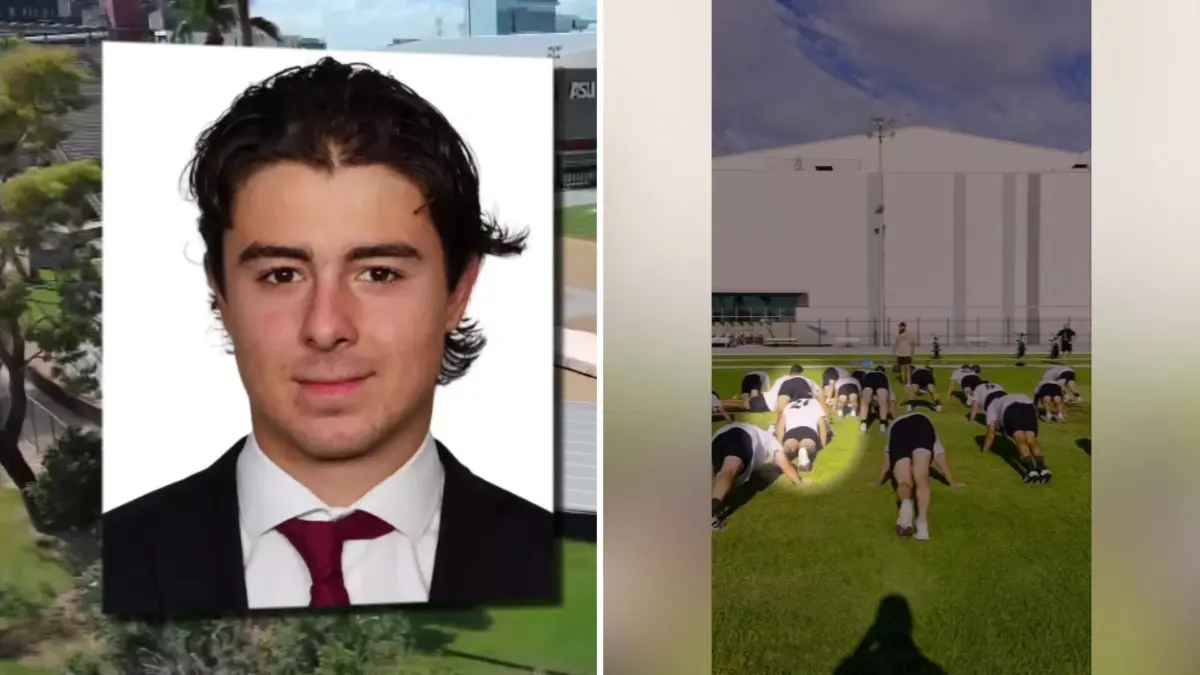
The crisis enveloping the Arizona State University (ASU) NCAA Division I men’s ice hockey program has deepened significantly, evolving from a tragic medical emergency into a full-scale institutional controversy. Matthew Mayich, a 21-year-old sophomore defenseman from Ontario, Canada, remains hospitalized and faces a catastrophic, life-altering prognosis after collapsing during an outdoor conditioning session on August 20 in Tempe, Arizona. According to legal representation for the Mayich family, the young athlete is highly unlikely to make a full recovery.
In the wake of the incident, the tragedy has catalyzed intense scrutiny over university oversight, athletic training protocols, and the accountability of the coaching staff. John and Christina Mayich, the player’s parents, formally broke their silence via a public statement, demanding the immediate removal of the coaches who oversaw the fateful August 20 workout. Their primary concern centers on protecting current players from institutional and interpersonal retaliation while an independent investigation uncovers the unvarnished truth.
This demand follows a contentious letter sent to ASU President Michael Crow by seven anonymous members of the hockey team. The players fiercely challenged the university’s preliminary internal review of the incident, characterizing the session as an unvetted, "military-style conditioning" ordeal rather than a standard team-building exercise. While external legal representation for the outside trainer who led the session has vigorously defended the workout’s intensity and compliance with hydration policies, the broader community—including criminal investigators and the Maricopa County Attorney’s Office—is now tasked with untangling conflicting accounts of what went wrong under the Arizona sun.
Detailed Chronology
August 20: The Fateful Outdoor Workout
The sequence of events leading to Matthew Mayich’s hospitalization unfolded during an outdoor team workout in Tempe, Arizona. Seeking to build team cohesion ahead of the upcoming collegiate hockey season, the coaching staff brought in Timothy Ziesel, a former U.S. Army Green Beret, to direct the session.
According to accounts later provided by anonymous players, the session quickly deviated from standard athletic conditioning into a grueling, high-stress military-style endurance test. The outdoor environment, characterized by extreme heat, compounded the physical demands placed upon the athletes. Players reported that the workout persisted unabated even as multiple participants began exhibiting acute signs of physical distress, including falling to their knees and vomiting.
August 20–Late August: Medical Emergency and Dire Prognosis
During or immediately following the exertion, Matthew Mayich collapsed. Emergency protocols were activated, and the sophomore defenseman was rushed to a local hospital. In the days and weeks that followed, medical evaluations revealed the severity of his condition. By early September, legal representatives for the Mayich family delivered the devastating assessment that a full recovery was highly unlikely, plunging the player’s family, teammates, and the broader collegiate hockey community into grief and disbelief.
September 2–4: Emerging Questions and Policy Scrutiny
As Mayich fought for his life in the hospital, initial media reports and legal statements began raising urgent questions regarding safety protocols at ASU. Focus quickly shifted to the hydration policies enforced during the workout. Anonymous sources within the program alleged that water breaks were severely restricted—amounting to fleeting seconds granted to only a fraction of the roster—and that Mayich was among those denied adequate fluid intake.
September 22–24: Internal Review and Calls for Criminal Investigation
Under mounting public pressure, Arizona State University released its preliminary internal review of the workout on September 22. The report attempted to contextualize the events of August 20, but it failed to quell the rising tide of skepticism from the players and the Mayich family.
Two days later, on September 24, legal counsel representing interests close to the players formally requested that local authorities launch a criminal investigation into the circumstances surrounding the collapse. The ASU Police Department initiated a formal inquiry, announcing that once completed, the investigative findings would be turned over to the Maricopa County Attorney’s Office for potential prosecutorial review.
September 28: Players Challenge University Findings
The internal rift between the university administration and the hockey roster burst into the open on September 28. In a direct challenge to the school’s narrative, seven anonymous hockey players authored and submitted a scathing letter to ASU President Michael Crow.
The letter alleged that Ziesel had been contracted without undergoing proper background checks or possessing relevant collegiate athletic safety certifications. The players reiterated claims regarding restricted hydration and unrelenting physical demands, while joining the chorus demanding that the coaching staff be placed on administrative leave and that the inquiry be handed over entirely to an independent, outside agency.
September 29: The Mayich Family Demands Coaching Removal
The crisis reached a new milestone when John and Christina Mayich released an impassioned public statement through their attorney. Rejecting rumors regarding their intentions, the Mayich parents made it clear that while they desired a successful season for the Sun Devils hockey team, the coaches present at the August 20 workout must be removed immediately. Their primary motivation was safeguarding the remaining players from potential retaliation, ensuring that witnesses and team members could speak freely to investigators without fear of professional or athletic repercussions.
Supporting Context & Metrics
The controversy at ASU highlights the complex intersection of high-stakes collegiate sports, alternative conditioning methodologies, and institutional liability.
- The Athlete: Matthew Mayich, 21, is a sophomore defenseman who traveled far from his hometown of Ontario, Canada, to pursue his athletic and academic ambitions at Arizona State University.
- The Setting: Tempe, Arizona, is known for its punishing ambient temperatures, particularly during late summer months. Outdoor physical exertion in this climate requires strict adherence to heat-acclimatization guidelines and fluid replacement strategies.
- The Trainer: Timothy Ziesel, a former Green Beret, was brought in to lead the session. His involvement has triggered intense debate over the vetting processes utilized by NCAA athletic departments when hiring external contractors for specialized conditioning.
- The Hydration Standard: According to statements from defense counsel, ASU’s formal athletic hydration policy mandates that student-athletes pre-hydrate under supervision at least four hours prior to exercise, supplementing with 8 to 12 fluid ounces roughly 10 to 15 minutes before exertion commences.
- The Investigative Pipeline: The inquiry involves multiple layers: internal university reviews, an active criminal investigation by the ASU Police Department, and eventual evaluation by the Maricopa County Attorney’s Office.
Official Statements
The battle lines in the ASU hockey controversy are sharply defined by the contrasting statements issued by the affected family, the anonymous players, and the legal representation for the outside trainer.
The Mayich Family Statement
In their September 29 statement, John and Christina Mayich sought to clear up misconceptions regarding their stance on the hockey program while firmly asserting the need for administrative disruption:
“We’ve heard some things about what our family wants that aren’t right, so we want to be clear. We want this team to have a great season, and we’ll be cheering for you. But the coaches who ran that workout on August 20 need to be removed while an independent investigation gets to the truth. The players shouldn’t have to worry about retaliation from the people they report to every day. And there are plenty of former college and pro players in the Valley who could step in and help.
Nobody should keep quiet about what they think should happen because they believe that’s what we want. It isn’t. If anyone wants to know what we want, ask us. We want the truth, and we want it done in a way that lets the boys focus on hockey instead of wondering whether their coaches think they talked.
Mostly, we want accountability for what happened to our son, and we want his teammates to be safe.”
The Anonymous Players’ Letter
Highlighting a deep-seated loss of trust within the locker room, the seven anonymous players wrote to President Michael Crow to dispute the university’s account:
- Characterized the session as an unauthorized, "military-style conditioning session" led by an unvetted contractor lacking safety certifications.
- Asserted that water breaks were limited to seconds and restricted to a select few players, excluding Mayich.
- Alleged that the workout continued even as athletes displayed visible signs of physical failure, including vomiting and collapsing to their knees.
Defense Perspective: Trainer Timothy Ziesel’s Counsel
Buddy Rake, attorney for Timothy Ziesel, forcefully pushed back against the players’ narrative during media briefings, defending both the nature of the workout and his client’s adherence to protocol:
“The workout was not punishing unless you consider flutter kicks, pushups, planks, and sprints punishing. Have you ever seen a D1 preseason workout?” Rake stated via email.
Rake maintained that Ziesel lacked the authority to restrict water access, noting that hydration breaks were strictly governed by the coaching staff and ASU’s established hydration policies. Furthermore, Rake claimed that documentation from a member of the coaching staff indicated Mayich did not exhibit distress until after Ziesel had departed the session, adding that six coaches and trainers were present throughout the workout.
“As Tim’s attorney, I continue to be of the opinion that the family and parents of Matthew receive complete transparency. Instead of focusing on a non-existent hard workout, the focus should be on how could this happen during a workout that was not as hard as an average D1 conditioning program… There is not a definition of a military workout.”
Future Outlook
As autumn progresses, the Arizona State University hockey program finds itself navigating an unprecedented operational and moral crisis. The immediate future hinges upon the outcomes of the ongoing investigations being conducted by law enforcement and university officials.
- Law Enforcement Findings: The ASU Police Department’s transition of its investigative file to the Maricopa County Attorney’s Office will be a critical inflection point. Prosecutors will determine whether criminal negligence or other charges are warranted against any participating parties.
- Administrative Action: President Michael Crow and the ASU athletic department face continuous pressure from both the Mayich family and the team’s roster to suspend the coaching staff pending the conclusion of independent reviews. The demand for interim leadership—potentially drawn from the pool of former collegiate and professional hockey players in the Phoenix metropolitan area—highlights the urgency felt within the community to restore trust.
- Institutional Reform: Regardless of the legal outcomes, the incident is certain to prompt a rigorous nationwide re-evaluation of how NCAA athletic programs vet outside fitness contractors, structure preseason training regimens, and enforce safety and hydration compliance.
For the time being, the Sun Devils hockey team prepares to take the ice under a heavy cloud of uncertainty, caught between the desire to honor their hospitalized teammate and the profound demand for institutional accountability that continues to reverberate across the campus and beyond.

0 Comments