
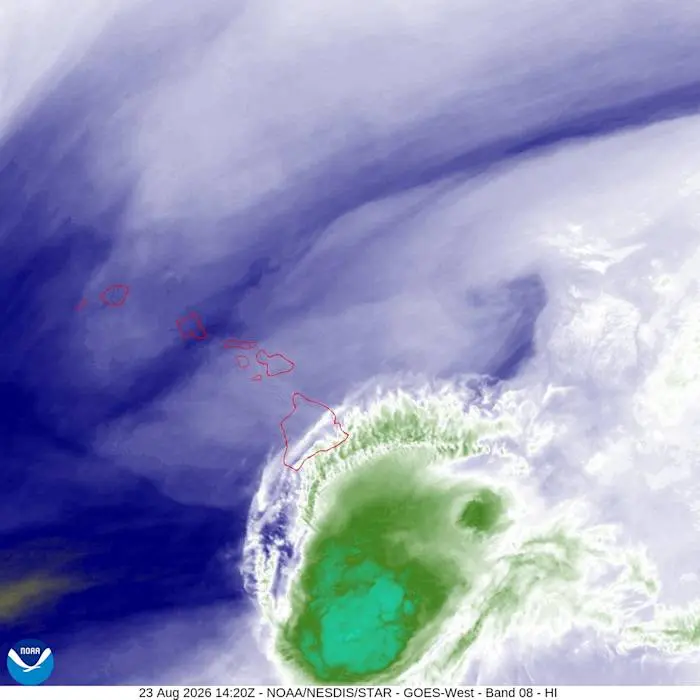

Executive Overview
The Hawaiian Islands are once again reeling from the relentless fury of the Pacific tropical weather systems. Barely had emergency responders and residents begun to clear the debris, restore power lines, and search for the missing in the wake of Hurricane Lala when a second major weather threat materialized on the horizon. On Sunday, August 23, 2026, Tropical Storm Moke swept past the Hawaiian archipelago. Although its center remained safely offshore, its sprawling moisture bands brought torrential downpours directly onto a landscape still deeply scarred, waterlogged, and fragile from Lala’s devastating blow just a week prior.
According to updates from the National Hurricane Center (NHC), the center of Tropical Storm Moke was located approximately 310 miles (500 kilometers) south of Hilo by Sunday morning. Packing maximum sustained winds of roughly 45 mph (75 kph), Moke was never characterized as an extreme wind threat on the scale of a major hurricane. Instead, its primary and most lethal weapon was water. Meteorologists warned that the storm would dump an accumulated rainfall of 10 inches across the Big Island, with isolated pockets receiving a catastrophic 15 inches.
This compounding deluge immediately elevated the risk profile across windward and southeast slopes, triggering renewed flash flood warnings, severe mudslides, and structural instability in areas where soil was already saturated to its maximum capacity. Compounding the misery, more than 6,700 utility customers remained without electricity on Sunday—primarily on the Big Island—following Lala’s destruction of power infrastructure. Governor Josh Green, alongside emergency management teams, convened urgent press briefings, imploring citizens to remain vigilant, secure emergency supplies, and brace for a protracted recovery phase. As local educators and community leaders describe a palpable sense of anxiety across the islands, Hawaii finds itself confronting the stark realities of intensifying tropical climate patterns in the central Pacific basin.
Detailed Chronology: From Hurricane Lala’s Landfall to Moke’s Approach
Mid-August 2026: The Onslaught of Hurricane Lala
The sequence of meteorological disasters began in earnest during the middle of August 2026. Hurricane Lala tracked toward the Hawaiian island chain, bringing hazardous surf, destructive winds, and historic amounts of precipitation. By Monday, August 17, 2026, communities such as Naalehu on the Big Island were completely overwhelmed. Torrents of mud rushed down roadways, cutting off vital transportation arteries, while falling trees and snapped power lines severed communication lines and plunged thousands into darkness.
Data compiled by the National Weather Service later revealed the staggering scale of Lala’s precipitation totals. The northeast coast of the Big Island bore the brunt of the atmospheric river associated with the hurricane, recording a staggering maximum rainfall of 43.54 inches (1.1 meters). Bridges were compromised, localized infrastructure was severely fractured, and rescue operations were launched to extract residents trapped by rising waters. Tragically, the storm was not without human cost; two fatalities were directly attributed to Hurricane Lala, underscoring the lethal potential of tropical systems in isolated island terrain.
The Interlude: A Fragile Recovery
For a brief window between mid-week and Saturday, emergency services, state road crews, and local volunteers scrambled to clear obstructed roads, restore washed-out temporary crossings, and check on vulnerable populations. Utility workers labored around the clock to string new power lines and replace damaged transformers. However, the ground throughout the eastern and southeastern quadrants of the Big Island remained unstable. Hillsides were primed for mass-wasting events, and riverbanks were already swollen well beyond their normal capacities.
Sunday, August 23, 2026: Tropical Storm Moke Arrives
As officials were beginning to tally the infrastructural losses of Lala, satellite imagery from the National Oceanic and Atmospheric Administration (NOAA) captured the ominous swirl of Tropical Storm Moke advancing steadily from the south. By Sunday morning, the storm was churning past the island chain, tracking westward on a path that would keep its center south of the islands but close enough to wrap dense, moisture-laden rainbands across the windward slopes of the Big Island and parts of eastern Maui.
Forecasters immediately recognized the danger of a "double-dip" weather event. While Moke’s 45 mph winds were capable of downing weak trees and further stressing already damaged structures, the rainfall was the defining crisis. The National Hurricane Center issued urgent alerts forecasting up to 10 inches of rain widely across the Big Island, with localized peaks reaching 15 inches. Furthermore, eastern Maui—the next island in the chain—was projected to receive up to 6 inches of rain, while the remaining islands braced for general accumulations of 1 to 2 inches. Although no formal coastal watches or warnings were posted at the exact moment of closest approach, the implicit threat level remained exceptionally high due to the saturated nature of the terrain.
Supporting Context & Metrics
To fully comprehend the gravity of Tropical Storm Moke’s impact, one must examine the baseline data and meteorological metrics defining the late-August 2026 tropical season in Hawaii.
- Storm Center Location: Approximately 310 miles (500 kilometers) south of Hilo, Hawaii (as of Sunday morning, August 23, 2026).
- Maximum Sustained Winds: Near 45 mph (75 kph), classifying Moke as a moderate tropical storm.
- Rainfall Projections (Moke): 10 inches widely across the Big Island; up to 15 inches in isolated, mountainous terrain; up to 6 inches in eastern Maui; 1 to 2 inches across the rest of the Hawaiian chain.
- Rainfall Totals (Lala): A maximum of 43.54 inches (1.1 meters) recorded along the northeast coast of the Big Island during the previous week.
- Power Outages: More than 6,700 customers remained without electricity on Sunday, August 23, according to data tracked by poweroutage.us, with the overwhelming majority concentrated on the Big Island.
- Casualties: Two confirmed deaths linked directly to the passage of Hurricane Lala.
- Geographic Vulnerability: Steep terrain, windward slopes, and southeast-facing communities bore the heaviest concentration of both wind and water impacts.
The compounding nature of these metrics highlights a fundamental challenge in modern disaster management: cumulative environmental stress. When an ecosystem receives over 43 inches of rain in a single week—as occurred during Hurricane Lala—the hydrological carrying capacity of the soil is entirely exhausted. Consequently, when a secondary system like Tropical Storm Moke introduces another 10 to 15 inches, the ground cannot absorb the moisture. Surface runoff immediately transforms into aggressive flash floods and fast-moving mudslides that can sweep away vehicles, undermine foundations, and isolate entire neighborhoods within minutes.
Official Statements and Local Perspectives
State Leadership and Preparedness Urged
Recognizing the extreme vulnerability of the populace, Hawaii Governor Josh Green stepped forward alongside emergency management directors to coordinate a unified response. In a series of briefings leading up to Moke’s arrival, state officials urged residents not to underestimate the secondary storm.
Governor Green emphasized that emergency services were already stretched thin managing Lala’s aftermath. State agencies coordinated closely with county mayors to preposition swift-water rescue teams, heavy machinery for clearing mudslides, and emergency generators for critical infrastructure hubs. Citizens were strongly advised to shelter in place, avoid unnecessary travel, and ensure their emergency kits—stocked with potable water, non-perishable food items, critical prescription medications, and battery-operated communication devices—were fully replenished.
Ground-Level Realities and Psychological Strain
While official metrics and meteorological bulletins provide the scientific framework of the crisis, the human dimension is articulated best by those living through the ordeal. Tiffany Edwards Hunt, a teacher residing in Keaau on the eastern side of the Big Island, captured the emotional climate of the region in remarks to reporters.
“There’s definitely tension in the air,” Edwards Hunt noted, describing the collective dread felt by residents as towering rain clouds gathered over communities still attempting to dredge thick mud out of their living rooms and garages.
The psychological toll of enduring consecutive weather emergencies cannot be overstated. Families who spent days cleaning up debris, discarding ruined drywall, and navigating washed-out roadways were suddenly forced to secure outdoor furniture, stock up on drinking water once more, and prepare for the possibility of prolonged isolation. Local community centers, churches, and mutual aid networks mobilized quickly, offering emotional support alongside physical supplies to neighbors exhausted by the relentless string of storms.
Future Outlook: Recovery, Resilience, and Climate Realities
As Tropical Storm Moke gradually tracks further west into the open waters of the Pacific and begins to dissipate, the immediate emergency phase will transition into a massive, multi-week recovery effort. However, the path forward for the Big Island and the broader Hawaiian chain involves complex systemic challenges.
Infrastructure Repairs and Structural Hardening
The immediate priority for state and county engineers will be the structural assessment and repair of compromised roadways, bridges, and culverts. The massive volumes of water dropped by both Lala and Moke have accelerated erosion along coastal highways and mountain passes. Engineers will need to redesign drainage systems to accommodate higher peak water flows, acknowledging that historical weather baselines are increasingly unreliable.
Power restoration efforts will likewise require intensive labor. Utility crews working to reconnect the remaining 6,700 customers will have to navigate washed-out access roads and unstable terrain to replace downed poles and damaged transformers safely.
Environmental and Ecological Impact
Beyond human infrastructure, the ecosystems of the Big Island and Maui face significant recovery hurdles. Massive sediment runoffs into coastal waters can smother coral reefs, disrupt marine life habitats, and temporarily degrade nearshore water quality. Conservation groups and environmental agencies will need to monitor watershed health closely in the coming months.
Long-Term Climate Considerations
The back-to-back arrival of Hurricane Lala and Tropical Storm Moke serves as a stark reminder of changing climatic dynamics in the Central Pacific. As ocean surface temperatures rise and atmospheric moisture content increases, tropical systems are capable of retaining greater intensity and producing unprecedented rainfall volumes. For Hawaii, a state defined by its geographic isolation and steep topography, these events underscore the urgent need for long-term climate adaptation strategies, resilient housing codes, robust micro-grid energy systems, and enhanced early-warning infrastructure.
For now, however, the immediate focus remains on safety, compassion, and rebuilding. As the skies finally begin to clear over Hilo, Kona, Keaau, and Naalehu, the resilience of the Hawaiian people will once again anchor their recovery from nature’s formidable double strike.

0 Comments