

Executive Overview
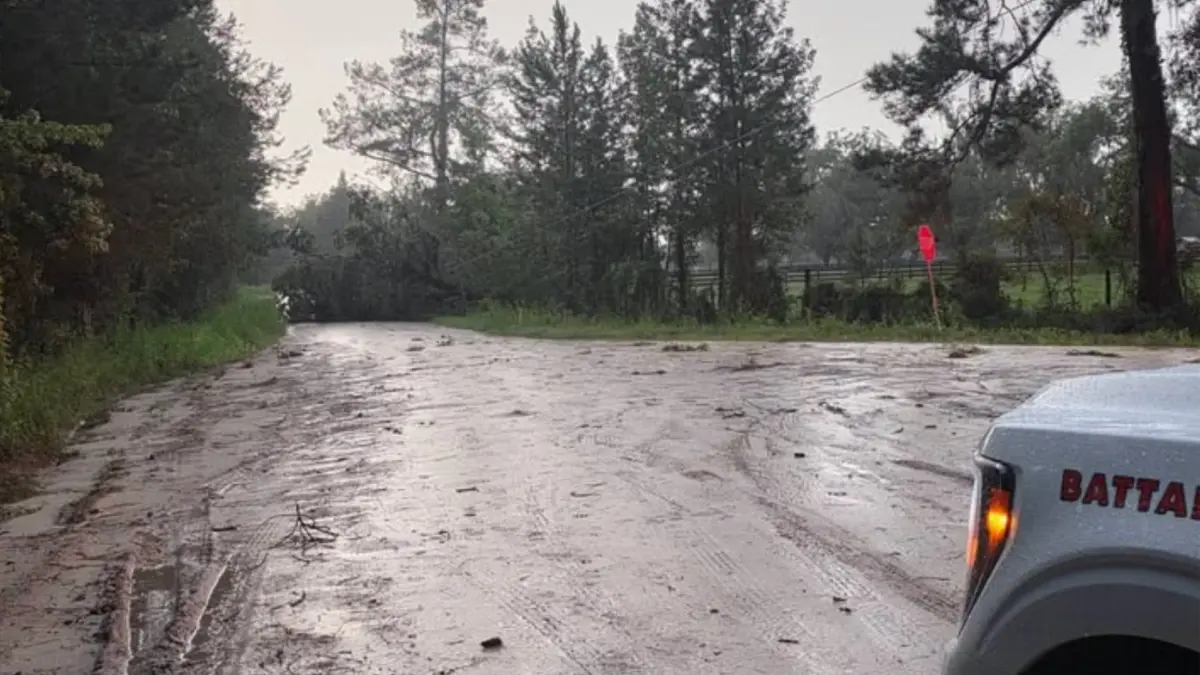
Late Saturday evening, a sudden and localized weather event struck rural Bradford County, Florida, resulting in the structural failure of a mature tree that brought down active electrical distribution lines. The incident occurred at the critical intersection of Northwest 215th Way and 74th Avenue, a semi-rural transit corridor situated between the municipalities of Raiford and Starke.
First responders from Bradford County Fire Rescue (BCFR) arrived on the scene shortly after the collapse, quickly establishing a security perimeter to safeguard motorists from live electrical hazards. The obstruction has effectively severed normal traffic flow along this localized route, prompting urgent public safety warnings from emergency management personnel.
As utility crews from the regional power provider mobilized to address the compromised infrastructure, local authorities strongly urged motorists and pedestrians to bypass the area entirely. This comprehensive incident report outlines the chronology of the event, the broader operational context of rural storm response in North Florida, the socioeconomic and infrastructural impact on Bradford County commuters, and the prospective measures required to mitigate similar hazards in an era of increasingly volatile weather patterns.
Detailed Chronology of Events
The unfolding of Saturday’s emergency follows a textbook trajectory of weather-related infrastructure failure in rural North Central Florida, moving rapidly from environmental trigger to emergency containment.
Phase 1: Environmental Trigger and Initial Impact (Approx. 6:30 PM – 6:50 PM EDT)
While the exact meteorological metrics—such as microburst wind speeds or localized soil saturation levels—are still being compiled by local weather stations, environmental conditions across Bradford County deteriorated quickly late Saturday afternoon. The sustained heat and moisture typical of late August in North Florida frequently give rise to sudden, high-intensity convective cells capable of producing isolated wind gusts.
At approximately 6:45 PM EDT, a mature hardwood tree, compromised either by root rot, soil erosion, or direct wind stress, lost its structural integrity. The tree fell squarely across the roadway at the intersection of Northwest 215th Way and 74th Avenue. In its descent, the massive trunk and heavy canopy dragged down live medium-voltage electrical distribution lines, rendering the thoroughfare impassable and exceptionally dangerous.
Phase 2: First Responder Dispatch and Perimeter Establishment (6:55 PM – 7:15 PM EDT)
Emergency dispatchers in Bradford County received the first 911 calls from passing motorists reporting blocked lanes and sparking wires shortly before 7:00 PM EDT. Bradford County Fire Rescue units were immediately dispatched to the scene, arriving within minutes.
Recognizing the immediate threat to human life posed by downed, energized conductors, the incident commander established a strict safety perimeter. Firefighters positioned apparatus to block oncoming traffic from both directions on Northwest 215th Way and 74th Avenue. Initial assessments confirmed that while no vehicles were struck by the falling tree and no injuries had been reported, the infrastructure damage was severe enough to warrant total road closure until utility specialists could render the scene safe.
Phase 3: Utility Mobilization and Public Advisory (7:15 PM EDT – Onward)
By 7:00 PM EDT, emergency dispatchers had coordinated with the primary regional electricity provider serving the Raiford-Starke corridor. A specialized line crew was immediately routed to the location to de-energize the lines, clear the tangled brush and heavy timber from the roadway, and begin the complex process of repairing the damaged utility poles and wiring.
Simultaneously, local media outlets and emergency broadcast channels began disseminating public service announcements. Bradford County emergency management officially requested that all drivers avoid the Northwest 215th Way and 74th Avenue corridor for the duration of the evening, projecting extended delays as crews worked under artificial illumination to restore both safe passage and electrical service to the immediate vicinity.
Supporting Context & Metrics
To fully understand the gravity of a localized tree-fall incident in Bradford County, one must examine the geographic, infrastructural, and environmental framework of the region.
Geographic and Demographic Profile of Bradford County
Bradford County is geographically one of the smaller counties in Florida, encompassing approximately 300 square miles with a population hovering around 28,000 residents. Characterized by a mix of dense pine flatwoods, hardwood hammocks, and agricultural acreage, the county relies heavily on a network of secondary roads, county-maintained highways, and rural byways.
The corridor connecting Raiford (home to the notorious Florida State Prison system and tight-knit residential communities) and Starke (the county seat) serves as a vital arterial route for local commuters, agricultural transport, and correctional facility staff. Incidents that block these secondary arteries can severely disrupt daily routines, emergency service response times, and regional commerce.
Infrastructure Vulnerabilities: Trees and Power Lines
The coexistence of overhead utility lines and an abundance of mature canopy trees represents one of the most persistent operational challenges for municipal and county governments across the Southeastern United States.
- The Urban-Rural Interface: While urban centers often invest in underground utilities and aggressive municipal arboriculture programs, rural counties frequently maintain hundreds of miles of overhead distribution lines running parallel to heavily wooded rights-of-way.
- Root Systems and Soil Conditions: The sandy soils prevalent throughout North Central Florida, combined with frequent summer saturation from tropical systems and afternoon thunderstorms, can significantly weaken the root plates of large trees. When saturated soils are met with sudden gusts of wind, even healthy-looking trees can experience catastrophic failure.
- The Physics of Downed Conductors: When a tree limb or entire trunk falls across a distribution line, it introduces massive mechanical stress that can snap utility poles, shatter crossarms, and leave bare copper or aluminum lines resting on wet ground. These lines can remain energized unless automated substation reclosers trip or manual intervention occurs, creating an invisible, lethal hazard known as "step potential"—where electricity radiates through the soil surrounding the fallen wire.
Official Statements and Emergency Protocols
In the wake of Saturday evening’s incident, municipal and emergency services officials reiterated standard safety protocols designed to protect the public during weather-related infrastructure failures.
Bradford County Fire Rescue (BCFR) Directives
In statements issued via local emergency networks and media partners, BCFR command staff emphasized the absolute necessity of public compliance during road closures.
"Our primary objective during any structural failure involving electrical infrastructure is twofold: first, to prevent civilian injury or electrocution; and second, to facilitate rapid, unimpeded access for utility repair crews," stated a department spokesperson. "We are asking all drivers in the Raiford and Starke areas to exercise patience, respect the barricades established at Northwest 215th Way and 74th Avenue, and utilize alternate routes until our partners in the private utility sector can clear the hazard."
Standard Operating Procedures for Downed Lines
Emergency management agencies enforce strict operational guidelines when handling incidents involving downed power lines:
- Never Assume a Line is Dead: All downed wires must be treated as live, high-voltage conductors regardless of weather conditions or visual appearance.
- Stay Inside Vehicles: If a vehicle is struck by a falling tree that brings down power lines, occupants are instructed to remain inside the vehicle until professional rescuers or utility workers confirm the power has been cut. Exiting a vehicle while it is in contact with an energized wire can create a fatal path to ground through the human body.
- Establish Safe Stand-Off Distances: First responders maintain a minimum perimeter of at least one full pole span away from downed wires to account for whipping cables or collapsing infrastructure.
- Coordinate De-Energization: Municipal fire services do not attempt to cut or move limbs tangled in power lines until the power company has physically verified and locked out the circuit at the local substation or transformer.
Future Outlook: Mitigation, Resilience, and Infrastructure Modernization
Incidents like the Saturday evening tree-fall along Northwest 215th Way and 74th Avenue highlight ongoing vulnerabilities within rural infrastructure networks. As regional planners and utility providers look toward the future, several key strategies are being evaluated to minimize the frequency and severity of weather-related road blockages.
Enhanced Vegetation Management Programs
Preventative tree trimming and hazard tree removal remain the most effective defenses against line-failing vegetation. Utility companies operating in North Florida face mounting pressure from county commissioners and state regulators to expand their right-of-way clearance zones.
- Proactive Identification: Utilizing LiDAR (Light Detection and Ranging) mapping and aerial drone surveys, utility providers are increasingly able to identify "danger trees"—dead, dying, or structurally compromised trees located outside standard right-of-way boundaries that could still reach power lines if they fell.
- Targeted Pruning: Pruning methods are shifting away from archaic "V-cuts" or indiscriminate shearing toward directional pruning, which preserves tree health while directing new growth away from conductors.
Grid Hardening and Undergrounding Initiatives
While burying distribution lines underground is cost-prohibitive for every rural mile of county roadway, strategic undergrounding is gaining traction in high-traffic corridors and vulnerable flood-prone zones.
- Composite and Steel Poles: Where overhead lines must remain, utilities are gradually replacing aging wooden poles with spun-concrete, galvanized steel, or composite poles capable of withstanding significantly higher wind loads and mechanical impacts.
- Smart Grid Technology: The integration of automated switches and remote sensors allows power companies to isolate damaged sections of a circuit instantly, reducing the duration of outages and pinpointing the exact coordinates of structural failures for repair crews.
Community Preparedness and Communication
As severe weather events become more frequent and unpredictable, local emergency services continue to stress the importance of community resilience. Residents living along rural corridors are encouraged to report leaning trees, dead limbs near service drops, and unusual electrical buzzing sounds immediately to their local utility provider or non-emergency dispatch.
Conclusion
The Saturday evening incident at Northwest 215th Way and 74th Avenue resulted in no reported injuries or property damage beyond the affected tree and utility infrastructure—a testament to the swift response of Bradford County Fire Rescue and the proactive cooperation of local motorists. However, the event serves as a sharp reminder of the delicate balance between natural environments and modern infrastructure in rural Florida. As cleanup operations conclude and power is fully restored, the incident underscores the continuous need for robust municipal preparedness, rigorous vegetation management, and unwavering adherence to public safety protocols across the Raiford and Starke communities.

0 Comments