
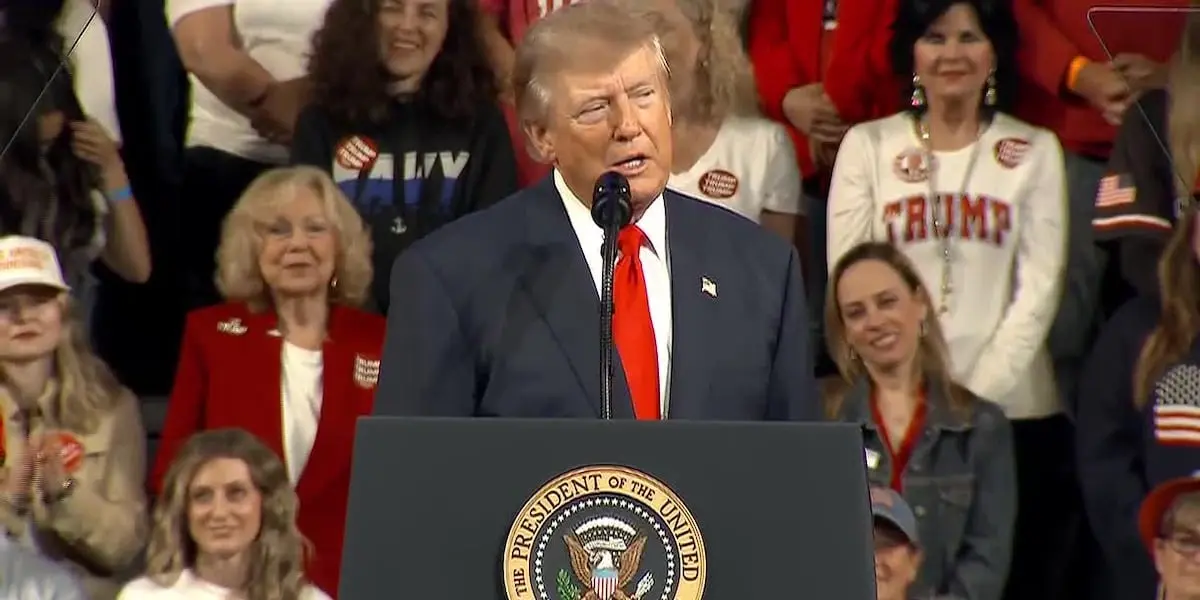

In a political landscape continually shaped by unconventional rhetoric and headline-dominating pronouncements, former U.S. President Donald Trump has once again sparked a national conversation—and a constitutional debate—regarding geographic nomenclature. Speaking before an enthusiastic crowd at a high-energy campaign-style rally in Tennessee, Trump floated a proposal that would dramatically alter global maps: renaming either the Atlantic or the Pacific Ocean.
According to remarks delivered during the weekend address, the former president suggested branding one of the planet’s massive oceanic expanses as either the "Trump Ocean" or the "Ocean of the Americans." This latest proposition builds upon a historical pattern of rhetorical and administrative attempts to rebrand prominent natural landmarks under nationalist banners. In his speech, Trump underscored a sense of urgency regarding the timeline of these potential changes, remarking, "We have to. We should have before I get out."
While critics view these proposals as theatrical branding exercises designed to generate media buzz and rally his base, supporters point out that the executive branch holds significant, albeit legally complex, authority over federal geographic naming conventions through bodies like the U.S. Board on Geographic Names (BGN). Trump’s track record demonstrates that his administration has previously toyed with or enacted localized renaming initiatives, such as his past proclamations regarding the Gulf of Mexico and Lake Ontario. However, expanding this philosophy to global marine environments—the Atlantic and Pacific oceans—represents an unprecedented escalation that would require unprecedented international cooperation, maritime legal adjustments, and domestic bureaucratic navigation.
This investigative report examines the chronology of Trump’s geographic renaming initiatives, analyzes the legal mechanisms governing domestic and international bodies of water, explores the political motivations behind these statements, and projects the far-reaching diplomatic and economic implications of such proposals.
Detailed Chronology of Events
To understand the weight and context of Trump’s recent remarks regarding the Atlantic and Pacific oceans, it is essential to trace the evolution of his geographic renaming strategy over recent years. What began as rhetorical flourishes during campaign rallies has occasionally manifested in tangible policy discussions and executive actions.
The Early Phase: Rhetorical Nationalism and Localized Targets
During his initial term in office and subsequent campaign trails, Trump frequently utilized populist symbolism to claim ownership of American history and geography. His speeches often juxtaposed traditional explorers and colonial figures with contemporary nationalist ideals. However, the concrete pivot toward officially renaming bodies of water gained serious traction in the years following his departure from the White House, serving as a staple of his rallies to evoke themes of national pride and dominance.
The Gulf of Mexico and Lake Ontario Proclamations
The escalation toward major hydrographic renaming became apparent last year when Trump formally suggested renaming the Gulf of Mexico to the "Gulf of America." While the body of water is bordered by multiple sovereign nations—primarily the United States and Mexico—the unilateral declaration served as a powerful domestic talking point, playing heavily into his administration’s broader trade and border security rhetoric.
Following that pronouncement, Trump set his sights northward in August, proposing the renaming of Lake Ontario—one of the five Great Lakes shared with Canada—to "Lake America." While Lake Ontario is shared internationally with the Canadian province of Ontario, the domestic push aimed to rebrand the American shoreline and discourse surrounding the watershed. These actions established a clear precedent: for Trump, natural landmarks were fair game for ideological rebranding.
The Tennessee Rally and the Oceanic Proposal
The most recent chapter in this ongoing saga unfolded in Tennessee, where Trump took the stage before thousands of supporters. Amidst a wide-ranging speech touching on economic policy, immigration, and electoral victories, the former president pivoted to hydrography.
"We could call it Trump Ocean or Ocean of the Americans. Something like that," Trump told the cheering crowd. "We have to. We should have before I get out."
During the same address, Trump was careful to carve out exemptions for specific historical rivers, offering insight into his calculus. He explicitly stated that he would not alter the name of the Hudson River, paying a tongue-in-cheek tribute to the English explorer who mapped it: "He did a good job of setting up that sucker a long time ago." Similarly, Trump assured the audience that the Mississippi River would retain its name, binding his decision not to political heritage, but to electoral loyalty: "Now, I’m not changing the name of the Mississippi. I love Mississippi. We won that state by so much."
Supporting Context & Metrics
To evaluate the feasibility and impact of renaming major geographical features like the Atlantic or Pacific oceans, one must examine the administrative apparatus governing place names, as well as the sheer scale of the geographical entities involved.
The Mechanics of Geographic Renaming: The U.S. Board on Geographic Names
In the United States, the official standardization of geographic names falls under the purview of the U.S. Board on Geographic Names (BGN), a federal body established in 1890 and currently maintained jointly by the Department of the Interior and the U.S. Geological Survey (USGS).
- Jurisdiction: The BGN is tasked with maintaining uniform geographic name usage throughout the federal government. While it primarily deals with domestic features—such as mountains, streams, valleys, and local lakes—its decisions dictate what appears on official federal maps, nautical charts, and government databases.
- Executive Authority: The president possesses broad executive authority and can issue executive orders directing federal agencies to adopt specific nomenclature. However, international bodies of water—such as the high seas, the Atlantic Ocean, and the Pacific Ocean—fall outside the unilateral jurisdiction of any single nation.
Scale and Scope of the Proposed Targets
The sheer physical scale of the oceans Trump suggested renaming highlights the radical nature of the proposal:
- The Atlantic Ocean: Covering approximately 41.1 million square miles (106.4 million square kilometers), the Atlantic accounts for roughly 20% of the Earth’s surface area. It touches the shores of North America, South America, Europe, and Africa. Unilaterally renaming it would create massive discrepancies in international cartography, as European, African, and South American nations would retain the historical designation.
- The Pacific Ocean: As the largest and deepest of Earth’s oceanic divisions, the Pacific spans an astonishing 63.8 million square miles (165.2 million square kilometers)—covering more area than all of Earth’s land mass combined.
- Economic and Cartographic Impact: Global trade, satellite navigation systems (GPS), international maritime law, and meteorological reporting rely on standardized, universally recognized names established by organizations like the International Hydrographic Organization (IHO). Altering these names within U.S. federal mapping systems alone would cause bureaucratic friction, while global adoption would be virtually impossible without international consensus.
Official Statements & Stakeholder Reactions
Reactions to Trump’s proposal to rename the world’s oceans have been swift and varied, reflecting the deep political polarization that defines modern American discourse. Supporters view the idea as quintessential Trump—bold, disruptive, and unapologetically pro-American—while critics, historians, and international relations experts express bewilderment and alarm.
Proponent Perspectives
Within populist political circles, the proposal is framed as an exercise in cultural sovereignty. Proponents argue that the United States, as a dominant global superpower with vast oceanic coastlines, has every right to celebrate its national identity through domestic cartography.
- "President Trump understands that naming is about claiming cultural narrative," noted a prominent conservative strategist following the Tennessee rally. "When we look at our maps, we should see our values and our national greatness reflected back at us. Coastal elites scoff, but everyday Americans love the idea of putting America first—even on the map."
- Supporters also point out that historical naming conventions have always reflected the ambitions and discoveries of dominant powers, arguing that updating these names is simply a modern iteration of historical tradition.
Critic and Historian Rebuttals
Conversely, historians, geographers, and political opponents have sharply criticized the proposal, characterizing it as historically illiterate, diplomatically reckless, and legally untenable.
- "The Atlantic and Pacific oceans belong to the global commons, not to any single administration," said a leading environmental historian specializing in maritime law. "You cannot simply rename a body of water that washes the shores of dozens of sovereign nations. It demonstrates a profound misunderstanding of international law, cartography, and the interconnected nature of our global ecosystem."
- Diplomatic analysts have warned that such rhetoric, even if pitched primarily as campaign theater, alienates international allies. Renaming shared bodies of water without international consultation risks triggering diplomatic disputes with neighboring and transatlantic partners, particularly Canada, Mexico, and European Union member states.
- Environmental and scientific communities have similarly expressed frustration, arguing that political grandstanding over geographic names distracts from critical challenges facing marine ecosystems, such as overfishing, rising sea levels, and plastic pollution.
Future Outlook & Strategic Implications
As the political cycle progresses, the proposition to rename the Atlantic or Pacific oceans forces a broader examination of how political rhetoric translates into governance, cultural identity, and international relations.
The Likelihood of Implementation
From a pragmatic standpoint, the physical renaming of the Atlantic or Pacific oceans is an administrative and diplomatic impossibility. The U.S. government cannot unilaterally decree a name change for international waters recognized by the United Nations and global maritime bodies. Furthermore, even within domestic agencies, any executive order attempting to rename global oceans would face immediate legal challenges regarding statutory authority, administrative procedure, and international treaty obligations.
However, dismissing the proposal merely as an impractical joke misses its strategic function within modern populist politics. The primary goal of such announcements is not necessarily the physical alteration of nautical charts; rather, it is the establishment of a cultural and rhetorical framework that prioritizes nationalist symbolism over institutional norms.
Long-Term Cultural and Political Fallout
The legacy of Trump’s geographic renaming initiatives—ranging from the Gulf of America to potential oceanic redesignations—will likely be analyzed through two distinct lenses:
- As a Masterclass in Political Signaling: To his base, these proposals serve as constant reminders of an administration willing to challenge established conventions, defy globalist frameworks, and center American identity in every facet of public life.
- As a Symptom of Institutional Erosion: To critics, they represent a troubling disregard for established scientific, cartographic, and international standards, substituting objective global metrics with partisan performance art.
Ultimately, whether or not the maps are ever officially redrawn to feature a "Trump Ocean," the debate itself underscores the enduring power of nomenclature in political warfare. As long as geography remains intertwined with national identity, the temptation for political leaders to stake their claim—not just on policy, but on the very earth and water beneath our feet—will remain a potent force in American politics.

0 Comments