
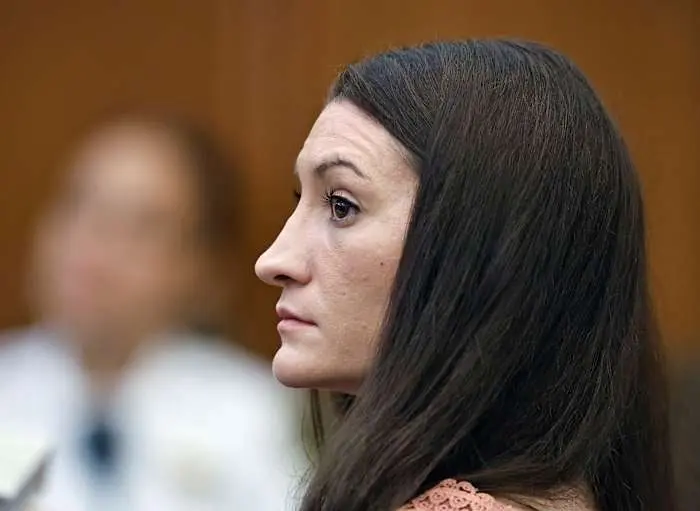

PLYMOUTH, Mass. — Following five weeks of intense, emotionally harrowing courtroom proceedings at Plymouth Superior Court, a Massachusetts jury has begun deliberating the fate of Lindsay Clancy, a former labor and delivery nurse accused of murdering her three young children in January 2023. As of Friday evening, the panel of jurors had not yet reached a verdict, leaving a deeply fractured community and a nation transfixed by the intersections of motherhood, severe mental illness, and criminal accountability waiting on edge.
The core facts of the case are undisputed by either prosecution or defense: Lindsay Clancy strangled her children—5-year-old Cora, 3-year-old Dawson, and 8-month-old Callan—inside their Duxbury, Massachusetts home before attempting to take her own life by jumping from a second-story window. She survived the fall, though it left her paralyzed from the waist down.
However, the legal battle hinges entirely on her state of mind at the time of the killings. The defense asserts that Clancy was suffering from acute, undiagnosed, and inadequately treated postpartum psychosis, rendering her legally insane and incapable of understanding the criminality of her actions. Conversely, the Commonwealth argues that Clancy’s actions were calculated and deliberate, driven by a desire to end her own suffering by eliminating what she perceived as her burdens, thereby possessing full criminal responsibility under the law.
If convicted, Clancy faces a sentence of life imprisonment without the possibility of parole. A verdict of not guilty by reason of insanity, however, would likely result in her indefinite confinement within a secure psychiatric facility. As the jury weighs the extensive medical testimony, harrowing 911 audio, and agonizing family accounts, the case has ignited a national conversation regarding the systemic failures of maternal mental healthcare in the United States.
Detailed Chronology of the Trial
The Prosecution’s Opening Salvo: An Anguished 911 Call and Allegations of Calculation
The trial commenced with the harrowing testimony of Patrick Clancy, the defendant’s former husband. Taking the stand in late July 2026, Patrick provided a devastating account of returning home on the snowy afternoon of January 24, 2023. He described how his wife had sent him out to pick up takeout and specialized medication for their daughter—an errand prosecutors later argued was a calculated maneuver designed to clear the house.
Upon returning, Patrick found the home uncharacteristically quiet. He noticed blood in the primary bedroom and an open window. Jurors then listened in stunned silence to the frantic 911 call Patrick placed after discovering his wife lying injured in the snow outside. In the audio recording, Patrick can be heard trying to communicate with Lindsay before running inside to check on the children. Moments later, the courtroom echoed with his agonizing shrieks and cries. When the bewildered 911 dispatcher repeatedly demanded to know what had happened, Patrick’s voice broke through the static with a devastating realization: "She killed the kids!"
Building upon this emotional foundation, Assistant District Attorney Jennifer Sprague argued during closing statements that Clancy’s downward spiral did not strip her of her cognitive faculties. Instead, the prosecution framed the murders as a planned act born of profound exhaustion and depression. Sprague suggested that Clancy viewed her children as "protective factors" preventing her from committing suicide, and that she believed killing them would pave the way for her own planned death and a subsequent reunion in heaven.
The Defense’s Counter-Narrative: A Systemic Failure of Medical Care
In stark contrast to the state’s portrayal of calculation and malice, defense attorney Kevin Reddington presented a narrative of catastrophic medical failure and psychological disintegration. Over the course of the trial, Reddington paraded a succession of family members, friends, and co-workers to establish that Clancy had undergone a terrifying, rapid personality shift following the birth of her youngest child, Callan.
Susan Clancy, the defendant’s mother-in-law and a fellow labor and delivery nurse, testified that Lindsay had devolved into a state of acute paranoia, crippling anxiety, and severe insomnia. "She felt unwell. She had insomnia. She was losing her appetite. She was very anxious and sad," Susan Clancy told the jury. "She was begging for help."
This sentiment was echoed by Lindsay’s mother, Paula Musgrove, who read aloud increasingly desperate text messages sent by her daughter in the months leading up to the tragedy. In an October 2022 text, Clancy wrote: "Mom, will you please come up and stay with me for a bit? I’m really sick. Something is wrong… I had horrible insomnia all night, and I just don’t know how I am going to get through the day. … It’s just really scary, and I don’t want to be alone."
The defense heavily scrutinized the psychiatric treatment Clancy received as her mental state deteriorated. Clancy had consulted multiple medical professionals and even checked herself into a residential psychiatric facility just weeks before the incident. Reddington aggressively cross-examined Dr. Jennifer Tufts, one of Clancy’s treating psychiatrists, lambasting the use of brief, 25-minute telehealth sessions and what he characterized as a robotic, box-checking approach to severe psychiatric crises. Reddington argued that overmedication and misdiagnosis directly exacerbated Clancy’s postpartum psychosis, transforming a loving mother into a terrified patient caught in the throes of a delusional state.
The Battle of the Experts: Psychosis vs. Cognizance
The legal crux of the insanity defense rested on psychiatric and psychological evaluations conducted before and after the killings.
Clinical and forensic psychologist Paul Zeizel testified for the defense, recounting how he overheard Clancy muttering in the hospital that a disembodied male voice had commanded her that she had no choice but to kill her children and then herself. Zeizel concluded that Clancy was suffering from severe psychosis that completely compromised her ability to conform her conduct to the requirements of the law.
Conversely, the prosecution mounted a robust rebuttal featuring forensic psychologist Kirk Heilbrun and FBI Behavioral Analysis Unit senior psychiatrist Dr. Gregory Saathoff. Heilbrun challenged the hallucination narrative, pointing to statements Clancy allegedly made during the commission of the crimes. According to Heilbrun, Clancy whispered, "Go to God, baby. Go to God," while strangling her children—an indication, the expert argued, of a shared delusional expectation of an afterlife rather than a command hallucination that overrode her cognitive control. Dr. Saathoff further testified that, despite her depressive state, Clancy retained the capacity to know right from wrong at the time of the murders.
Supporting Context & Metrics
The Lindsay Clancy trial has brought unprecedented national attention to the under-discussed realities of maternal mental health disorders. While "postpartum depression" is widely recognized, severe manifestations such as postpartum psychosis remain deeply misunderstood by the public and legal systems alike.
- Prevalence: According to medical literature cited during the proceedings, postpartum psychosis affects approximately 1 to 2 out of every 1,000 deliveries. It is considered a psychiatric emergency characterized by sudden onset hallucinations, delusions, severe insomnia, and extreme confusion.
- Legal Standard for Insanity: In Massachusetts, as in many jurisdictions, a defendant is not criminally responsible if, as a result of a mental disease or defect, they lacked substantial capacity either to appreciate the wrongfulness of their conduct or to conform their conduct to the requirements of the law.
- Trial Duration: The jury began deliberations after five weeks of intense testimony, reviewing dozens of exhibits, extensive medical histories, and hours of expert depositions.
Official Statements and Closing Arguments
The stark divide between the prosecution and defense was crystallized during their final addresses to the jury, each side appealing to vastly different interpretations of human empathy and legal culpability.
Defense Attorney Kevin Reddington:
Displaying two contrasting photographs—one of a vibrant, smiling Clancy family, and a subsequent one of Lindsay Clancy hospitalized and paralyzed—Reddington made a direct emotional appeal to the jurors.
"How does this turn into this? How? Because of the damn medicine and the lousy medical care that she got."
Assistant District Attorney Jennifer Sprague:
Rebutting the defense’s focus on the medical establishment, Sprague urged the jury to remain focused on the defendant’s deliberate choices rather than systemic healthcare shortcomings.
"She was depressed. She was exhausted. She was done. She didn’t want to try anymore. She felt damaged. But those kids, those kids were her protective factor. Those kids were keeping her from ending her misery." Sprague asserted that blaming the medical system was merely "a distraction" from accountability.
Future Outlook
As the Plymouth Superior Court jury continues its deliberations behind closed doors, the legal and social ramifications of the trial loom large over the Commonwealth of Massachusetts and the broader medical community.
Regardless of the verdict, the case has permanently altered public discourse surrounding maternal mental health. It has exposed the perilous gaps in psychiatric care for postpartum mothers, sparking urgent calls for systemic healthcare reform, increased screening protocols for new parents, and greater societal awareness of the razor-thin line separating treatable postpartum distress from catastrophic psychological break.
If the jury accepts the defense’s argument of postpartum psychosis, it will mark a significant legal precedent regarding the recognition of severe hormonal and psychiatric trauma as a complete defense to capital crimes. If they convict, it will reinforce a hardline standard that even unimaginable psychological agony does not absolve an individual of accountability for the lives of others. For now, a community continues to mourn three young lives lost, while a jury weighs the complex boundaries of human suffering and legal justice.

0 Comments