

WASHINGTON — In an extraordinary escalation of tensions between the White House and the nation’s central bank, President Donald Trump issued a sweeping and aggressive ultimatum on Friday, threatening to completely sever trade relations with any nation running a trade surplus with the United States unless the Federal Reserve immediately slashes interest rates.
The ultimatum, delivered via a series of posts on Truth Social, came in the immediate wake of a surprisingly robust August employment report that fundamentally upended conventional macroeconomic expectations. According to data released by the Bureau of Labor Statistics, the U.S. economy added 162,000 jobs during the month—more than doubling the consensus forecasts of most major Wall Street economists and representing a dramatic rebound from the sluggish 21,000 jobs added in July.
While the administration hailed the figures as a crowning vindication of its aggressive tariff and onshoring strategies, financial markets reacted with immediate apprehension. Wall Street traders and institutional investors quickly priced in the likelihood that the unexpectedly strong labor market would compel Federal Reserve Chairman Jerome Powell and the Federal Open Market Committee (FOMC) to hold interest rates steady or even enact a rate hike to combat lingering inflationary pressures.
President Trump’s threat to embargo nations with which the U.S. maintains a trade deficit marks an unprecedented intersection of monetary policy demands and aggressive protectionist trade warfare. Economists, trade experts, and international allies have reacted with alarm, noting that cutting off trade with deficit partners—a list that includes major global economies like China, the European Union, Mexico, and Vietnam—would effectively dismantle the global trading system, choke off vital supply chains, and trigger catastrophic economic contractions worldwide.
This comprehensive report examines the sequence of events leading up to the president’s explosive ultimatum, analyzes the underlying economic data from the August jobs report, explores the philosophical chasm dividing the White House from the independent central bank, and provides a forward-looking assessment of the systemic risks facing the global economy.
Detailed Chronology
Friday Morning: The August Jobs Report Drops
The economic drama began at 8:30 a.m. Eastern Time on Friday, when the U.S. Bureau of Labor Statistics published its monthly Employment Situation Summary for August. The headline figure—162,000 nonfarm jobs added—shattered consensus expectations, which had hovered around conservative estimates of 70,000 to 80,000 jobs.
The jump was powered largely by a massive hiring wave in the leisure and hospitality sector, as bars, restaurants, and entertainment venues aggressively ramped up operations heading into the late-summer and early-autumn transition. The national unemployment rate held steady at 4.1 percent, a historically low figure that underscores the persistent tightness of the American labor market.
The Immediate Market Reaction
Within minutes of the report’s release, futures contracts for the Dow Jones Industrial Average, the S&P 500, and the Nasdaq Composite turned sharply negative. Rather than celebrating the creation of tens of thousands of new jobs, equity markets shuddered under the weight of monetary policy realities.
In the complex calculus of modern finance, robust job growth and low unemployment translate into heightened consumer demand, which in turn fuels inflation. Wall Street immediately deduced that the Federal Reserve—tasked with a dual mandate of achieving maximum employment and price stability—would view the August numbers as a flashing red light signaling that the economy remains too hot to justify monetary easing. Consequently, investors feared that borrowing costs would remain elevated for longer, choking corporate expansion and reducing equity valuations.
The Oval Office Press Interaction
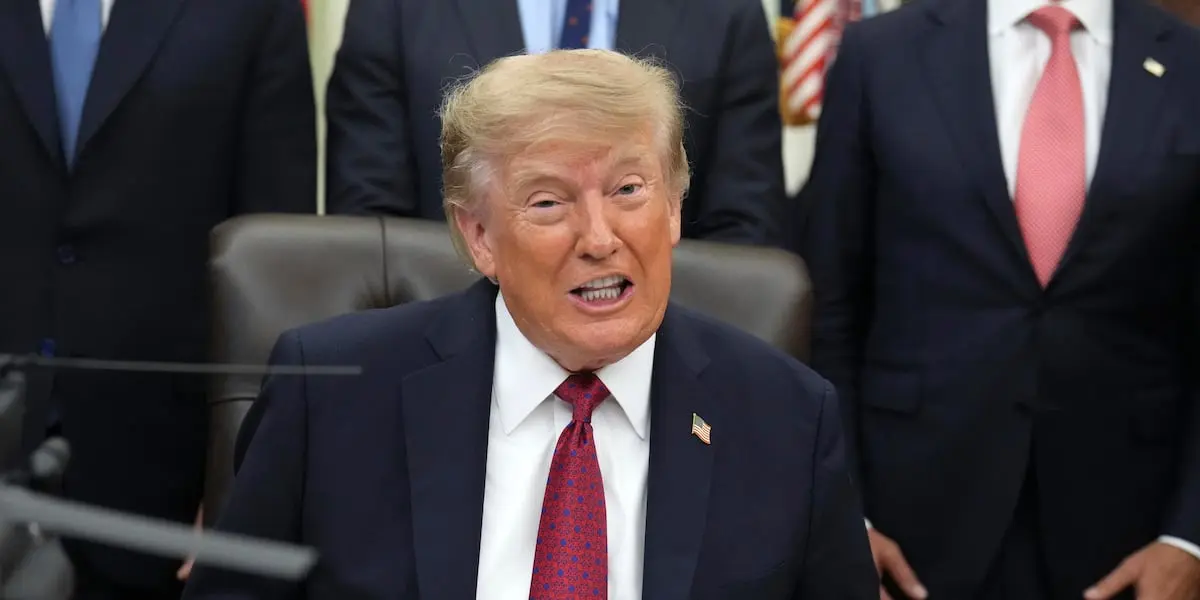
Later on Friday morning, President Trump addressed the jobs report during an extensive and wide-ranging media availability in the Oval Office. Visibly energized by the raw job creation numbers, the president simultaneously expressed deep frustration with the mechanics of the financial markets and the independent central bank.
“It’s been amazing,” President Trump told reporters assembled in the West Wing. “And today, they announced 162,000 jobs, new jobs, which was about five times more than the projection. And sadly, I said, the numbers doing so good, the country is doing so well. Watch the stock market will go down because we have good numbers, because everyone—every time you have good numbers, the stock market goes down.”
The president’s lament captured a profound paradox at the heart of contemporary American economic policy: the direct conflict between a thriving Main Street fueled by protectionist industrial policy and a Wall Street dependent on cheap money and liquidity injections from the Federal Reserve.
The Truth Social Ultimatum
Following the Oval Office press session, the rhetoric escalated dramatically. Taking to Truth Social, President Trump issued a blunt, non-negotiable demand to the nation’s central bankers.
Asserting that the Federal Reserve’s reluctance to lower borrowing costs was deliberately undermining American economic potential and punishing domestic manufacturers, the president declared that he would unilaterally halt all trade with any sovereign nation maintaining a trade surplus with the United States unless the central bank immediately enacted aggressive interest rate cuts.
The declaration transformed a routine disagreement over monetary policy into a geopolitical and economic crisis of the highest order, sending shockwaves through foreign embassies, international trade organizations, and financial trading desks across the globe.
Supporting Context & Metrics
Dissecting the August Employment Landscape
To fully understand the gravity of Friday’s events, it is necessary to examine the granular details of the August jobs report and the structural shifts occurring within the domestic economy.
| Economic Metric | August Data | July Data (Revised) | Historical Context / Analyst Expectations |
|---|---|---|---|
| Nonfarm Payrolls | +162,000 | +21,000 | Consensus expectations were roughly +75,000. Highest mark since March. |
| Unemployment Rate | 4.1% | 4.1% | Remains near historic lows; reflects an exceptionally tight labor market. |
| Leisure & Hospitality | Strong Growth | Stagnant | Led all sectors as bars, restaurants, and tourism venues accelerated hiring. |
| Wage Growth | Lagging Inflation | Lagging Inflation | Real wages continue to erode consumer purchasing power despite job gains. |
| Factory Construction | ~90,000 Workers | Steady | Unprecedented workforce building domestic production facilities due to tariffs. |
As detailed in the table above, the labor market demonstrated remarkable resilience. The addition of 162,000 jobs represents the highest monthly accumulation since March, reversing the alarming deceleration seen in July when payrolls crept up by a meager 21,000.
However, beneath the headline-grabbing top-line figures, lingering structural vulnerabilities persist. Most notably, nominal wage growth failed to keep pace with the cumulative effects of inflation. While Americans are finding work in record numbers, their paychecks possess diminished purchasing power compared to previous years, creating a persistent sense of economic anxiety among working-class families that national policymakers cannot easily dismiss.
The Tariffs and Onshoring Phenomenon
Defending the administration’s performance, National Economic Council Director Kevin Hassett pointed directly to the White House’s signature protectionist trade policies as the primary catalyst for the job growth.
“People, because of the tariffs, are onshoring production,” Hassett stated during a post-report briefing. “We have almost 90,000 people building factories right now, which is an unheard-of number. And so there’s just lots and lots of good news in this report.”
The administration’s strategy relies heavily on the aggressive imposition of tariffs designed to penalize foreign manufacturing and incentivize multinational corporations to relocate their supply chains back to the United States. According to White House economic models, the massive influx of capital expenditure directed toward factory construction has created a localized manufacturing boom, cushioning the broader economy against global headwinds.
The Monetary Policy Dilemma
Yet, it is precisely this manufacturing boom—and the robust economic indicators accompanying it—that places the White House on a direct collision course with the Federal Reserve.
Traditional economic theory holds that when an economy is operating near full employment with robust job creation, central banks must maintain higher interest rates to cool aggregate demand and prevent inflation from spiraling out of control. Federal Reserve Chairman Jerome Powell and his colleagues have repeatedly emphasized their commitment to data-dependent policymaking.
With inflation continuing to hover stubbornly above the Fed’s official 2% target, central bank officials viewed the weak July jobs report (+21,000) as an early sign that their restrictive monetary policy was successfully slowing the economy. The August report (+162,000), however, completely shatters that narrative, signaling that the economy is accelerating rather than decelerating. Consequently, market pricing shifted swiftly on Friday, with fed funds futures indicating a drastically reduced probability of a near-term rate cut, and a non-zero probability of a rate hike.
It is this prospect of sustained high interest rates—or, worse, a monetary tightening cycle—that triggered President Trump’s wrath. From the perspective of the White House, high interest rates counteract the benefits of tariffs and industrial policy by making capital prohibitively expensive for the very domestic factories the administration is trying to build.
Official Statements
The widening chasm between the executive branch and the nation’s monetary authorities prompted a flurry of reactions from high-ranking administration officials, economic advisors, and market analysts.
National Economic Council Director Kevin Hassett
In his defense of the administration’s economic record, Kevin Hassett emphasized the transformative impact of domestic industrial policy:
"People, because of the tariffs, are onshoring production. We have almost 90,000 people building factories right now, which is an unheard-of number. And so there’s just lots and lots of good news in this report. The American worker is winning, and our manufacturing base is being rebuilt from the ground up."
President Donald Trump
During his Oval Office press engagement, the president expressed deep exasperation with the paradoxical relationship between strong economic fundamentals and negative market reactions:
"It’s been amazing. And today, they announced 162,000 jobs, new jobs, which was about five times more than the projection. And sadly, I said, the numbers doing so good. The country is doing so well. Watch the stock market will go down because we have good numbers, because everyone—every time you have good numbers, the stock market goes down."
Following this press interaction, the president’s subsequent Truth Social statement introduced an explosive geopolitical threat:
"If the Federal Reserve does not immediately lower interest rates to support American business and workers, we will cease all trade with every country that maintains a trade deficit with the United States. We will no longer allow foreign nations to take advantage of our markets while our own central bank fights our economic success."
Independent Economic and Market Analysts
Wall Street economists and legal scholars were quick to evaluate the feasibility and potential fallout of the president’s threats. Dr. Elizabeth Vance, senior macroeconomic strategist at Global Horizon Capital, noted the unprecedented nature of the conflict:
"We have entered uncharted territory. For decades, the foundational pillar of American economic stability has been the institutional independence of the Federal Reserve. President Trump is explicitly conditioning international trade policy—a domain historically governed by multilateral treaties and statutory authority—on the internal monetary policy decisions of an independent central bank. If executed, a total ban on trade with deficit nations would reduce global GDP by double digits and instantly trigger a depression."
Future Outlook
As the dust settles on a turbulent week in Washington and Wall Street, the road ahead is fraught with profound uncertainty. The confrontation between the White House and the Federal Reserve is no longer a localized policy dispute; it has evolved into a systemic stress test for the American constitutional and economic framework.
1. The Federal Reserve’s Independence Under Fire
The central question moving forward is whether Chairman Jerome Powell and the Federal Open Market Committee will bow to political pressure or stand their ground. The Federal Reserve was deliberately engineered by Congress to be insulated from short-term political pressures, ensuring that monetary decisions are made based on objective economic data rather than electoral cycles or presidential demands.
If the Fed caves to President Trump’s threats and cuts rates in the face of robust job growth and persistent inflation, the credibility of the central bank as an inflation-fighting institution will be severely compromised. Conversely, if the Fed holds rates steady—or raises them—President Trump may attempt to make good on his threat to restrict trade with deficit nations, plunging the global economy into chaos.
2. The Feasibility of Trade Embargos Based on Deficits
From a practical and legal standpoint, executing a total cessation of trade with every nation that runs a trade deficit with the United States is a logistical impossibility fraught with insurmountable constitutional and statutory hurdles. The U.S. maintains trade deficits with roughly 100 countries, including indispensable trading partners such as China, Germany, Japan, Mexico, and the broader European Union.
Cutting off imports from these nations would instantly create catastrophic shortages of critical consumer goods, raw materials, industrial inputs, and high-technology components, paralyzing American manufacturing and retail sectors within days. Furthermore, such an action would almost certainly violate numerous international trade agreements, including the United States-Mexico-Canada Agreement (USMCA) and World Trade Organization (WTO) rules, leading to immediate retaliatory tariffs and export bans against American agricultural and industrial products.
3. Market Volatility and Investor Sentiment
Financial markets will remain hyper-sensitive to any communications emanating from both 1600 Pennsylvania Avenue and the Eccles Building in the coming days. Equity investors must navigate a dual-threat environment: the risk of prolonged monetary tightness from a hawkish Federal Reserve and the tail-risk of sudden, protectionist trade shocks that could destabilize global supply chains.
As the political and economic battle lines harden, the coming weeks will test the resilience of the American economic expansion. Whether through a negotiated de-escalation between the executive branch and the central bank or through an escalation of aggressive trade maneuvers, the decisions made in Washington over the near term will permanently shape the trajectory of global commerce and monetary governance for decades to come.

0 Comments