
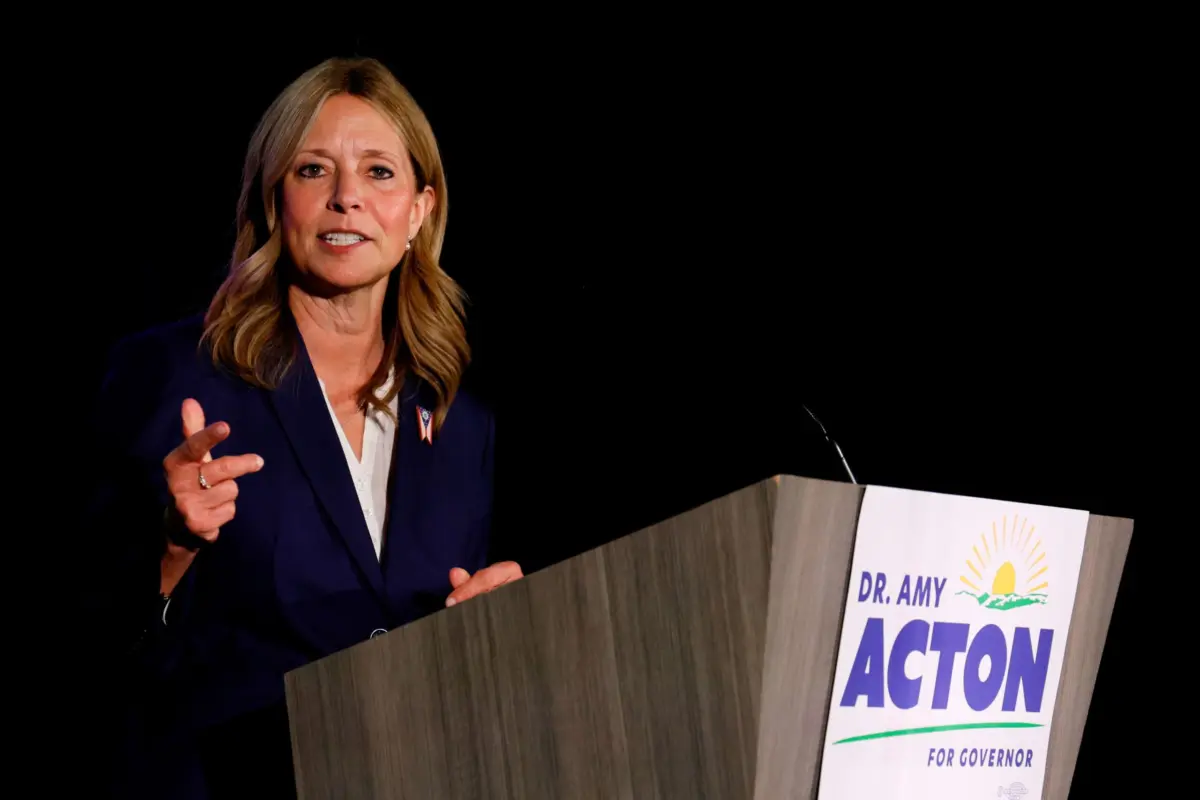

WASHINGTON — In a frightening escalation of political hostility that has once again cast a harsh spotlight on the safety of American public figures, Democratic gubernatorial candidate Dr. Amy Acton narrowly escaped a violent confrontation on Sunday. An armed assailant lunged toward her during a high-traffic campaign stop at the historic Canfield Fair in Mahoning County, Ohio.
While Dr. Acton herself emerged physically uninjured from the harrowing encounter, the chaos left multiple campaign volunteers and bystanders hurt after the suspect forcefully knocked them to the ground. Law enforcement officers and security personnel reacted with swift precision, subduing the attacker and recovering multiple weapons at the scene before placing him under arrest.
The incident arrives at a precarious juncture in the 2026 Ohio gubernatorial race—widely recognized as one of the most fiercely contested and high-profile political battles in the nation. As candidates enter the grueling final six weeks of campaigning ahead of the pivotal November general election, the attack has forcefully upended the discourse. It has transformed discussions from policy debates and economic platforms into an urgent, statewide and national conversation regarding the escalating threat of political violence, the safety of campaign trails, and the deepening ideological fractures plaguing contemporary American democracy.
Detailed Chronology
The events of Sunday afternoon unfolded amidst the bustling, family-friendly atmosphere of the Canfield Fair, a staple of Ohio community life that traditionally draws thousands of voters, local vendors, and political hopefuls looking to interface directly with the electorate.
According to eyewitnesses and preliminary reports released by local campaign officials, Dr. Acton was moving through the fairgrounds, greeting attendees and engaging with supporters, when the security situation drastically deteriorated. Without warning, an individual later identified only as an armed assailant breached the immediate perimeter surrounding the candidate and lunged aggressively toward her.
Campaign volunteers and close security details instinctively moved to intercept the threat, placing themselves between the attacker and Dr. Acton. The ensuing struggle resulted in the assailant violently knocking several volunteers to the ground, causing minor to moderate injuries. Mahoning County Democratic Party Chairman Chris Anderson confirmed in a subsequent statement that the suspect was successfully neutralized and detained by law enforcement on site. Upon searching the suspect, officers discovered "multiple weapons," immediately escalating the severity of the response from local and state authorities.
While the fairgrounds’ local police department initially deferred all inquiries, the investigation was swiftly transitioned to the Mahoning County Sheriff’s Department and supported by the Ohio State Highway Patrol. As investigators work to piece together the exact timeline, motivations, and background of the assailant, questions are mounting regarding how the individual managed to bypass security measures while carrying multiple weapons into a densely populated public event attended by a major statewide candidate.
Supporting Context & Metrics: A Decade of Rising Political Tensions
Sunday’s attempted attack at the Canfield Fair is far from an isolated incident; rather, it represents the latest chilling data point in a broader, deeply concerning decade-long surge in politically motivated violence and vitriol across the United States.
The American political landscape has grown increasingly volatile, marked by a steady drumbeat of high-profile assaults and assassination attempts targeting public servants across the ideological spectrum. This grim timeline includes:
- The 2017 Congressional Baseball Shooting: An attacker opened fire on Republican lawmakers practicing in Alexandria, Virginia, critically injuring several individuals, including congressional leadership.
- The 2022 Assault on Paul Pelosi: An intruder broke into the California home of then-House Speaker Nancy Pelosi, violently attacking her husband with a hammer while searching for the Democratic leader.
- The 2024 Presidential Election Violence: The campaign cycle was seismically disrupted by an assassination attempt against Donald Trump during a Pennsylvania rally, followed by a subsequent security threat targeting him at the White House Correspondents’ Association Dinner in April.
- Recent Lethal Escalations: The nation mourned the tragic assassinations last year of a Democratic Minnesota state lawmaker and her husband, as well as the targeted killing of conservative commentator Charlie Kirk in Utah.
These recurring tragedies have forced campaigns, political committees, and security agencies to fundamentally alter their operational budgets and safety protocols. According to a landmark report released in April by the Public Service Alliance—a nonpartisan organization specializing in the security of public officials—federal political committees spent an unprecedented sum of more than $40 million on expenses explicitly labeled as "security" during the 2023–24 federal campaign cycle alone. This figure represents the highest level of defensive expenditure on record and underscores a bleak new reality: campaigning in the modern United States now requires tactical-level security measures once reserved exclusively for high-ranking heads of state.
Official Statements and Bipartisan Condemnation
In the wake of Sunday’s violence, leaders from across the political spectrum rushed to condemn the attack, expressing collective relief that Dr. Acton was unharmed while offering prayers for the injured volunteers and demanding an immediate end to political hostility.
Addie Bullock, communications director for the Acton campaign, released a strongly worded statement addressing the harrowing ordeal:
"Dr. Acton is incredibly grateful for the swift and decisive action of law enforcement and is praying for the full recovery of those who were injured. This kind of violence has no place in Ohio. Dr. Acton will always stand up to the chaos, hate, and vitriol that pits us against one another."
The condemnation transcended partisan lines, signaling a rare moment of unified legislative and executive pushback against political lawlessness. Republican Senator John Husted of Ohio took to social media platform X to voice his outrage, writing that he and his wife were deeply "disturbed by the attempted attack on Amy Acton today at the Canfield Fair." Husted added, "We are grateful for law enforcement’s quick response. There is no place for this kind of behavior, and it must never be tolerated."
Even political opponents moved swiftly to de-escalate and condemn the actions of the assailant. Connie Luck, communications director for Republican gubernatorial nominee Vivek Ramaswamy, issued a statement on behalf of the campaign:
"Candidates should be able to meet with voters without having to worry about threats or violence. What happened today is completely unacceptable and has no place in politics, and we hope that no one was hurt."
Future Outlook: The Intersection of Public Health Legacy and Campaign Realities
As the 2026 Ohio gubernatorial race enters its definitive final six weeks, the Canfield Fair incident casts a long, complicated shadow over the remainder of the election cycle.
The race itself has long been defined by high stakes and deep ideological contrasts. Dr. Acton first stepped into the national consciousness in 2019, when Republican Governor Mike DeWine recruited her from Ohio State University—where she served as an associate professor of public health—to lead the Ohio Department of Health. When the COVID-19 pandemic swept the globe in early 2020, Acton became the face of Ohio’s aggressive mitigation strategies. Her daily televised briefings offered a calming, empathetic presence to millions of residents, earning her prestigious accolades such as the John F. Kennedy Library Foundation’s Profile in COVID Courage Award, the Columbus Foundation’s Spirit of Columbus Award, and Ohio State’s highest alumni honor, the Alumni Medalist Award.
However, that very same leadership style and the administration’s stringent pandemic policies also drew intense animosity. Acton became a prime target for Statehouse Republicans and citizens frustrated by business closures, mask mandates, and public health restrictions—hostility that ultimately contributed to her stepping down from her post later that year.
Now, as the Democratic nominee, Acton finds herself locked in a high-stakes battle against Republican Vivek Ramaswamy. A prominent tech entrepreneur backed by a personal fortune, high national name recognition, and a coveted endorsement from President Donald Trump, Ramaswamy has leveraged substantial fundraising advantages to saturate Ohio airwaves with advertisements critiquing Acton’s tenure as health director.
With six weeks remaining until voters cast their ballots, political analysts predict that campaigns will face immense pressure to reevaluate security logistics. Open-air rallies, county fairs, and town halls—long considered the bedrock of grassroots American democracy—may see dramatic overhauls in how public figures interact with everyday citizens. Whether the trauma of Sunday’s events will permanently alter the accessibility of candidates in Ohio and across the nation remains one of the most pressing and sobering questions of the 2026 election cycle.

0 Comments