For well over a decade, acclaimed conservation photographer Mac Stone has waded into the murky, mist-shrouded waters of the American South’s most remote wetlands to document a vanishing world. His new photographic monograph, Cypress: The Last Old-Growth Swamps (published September 1, 2026), serves as both an artistic triumph and a stark ecological warning. The compilation captures the primordial majesty of ancient cypress forests—wetland ecosystems characterized by flared buttresses, arching limbs, and a resilience capable of outliving civilizations.
Yet, Cypress is much more than a celebration of the Earth’s longest-lived wetland tree species. It acts as an elegiac reminder of historical devastation. During the nineteenth and twentieth centuries, commercial logging operations stripped away the vast majority of the South’s old-growth forests, erasing millennia-old timber giants and entire species like the Carolina parakeet and the ivory-billed woodpecker. Stone’s multi-year project focuses on the precious, surviving fragments of these primeval tracts. By chronicling everything from microscopic fungi to the endangered Florida panther, the book offers an intimate look into a complex web of life that was nearly lost to history forever.
Detailed Chronology: A Decade Spent in the Swamps
Stone’s deep immersion into the Southern swampland is defined by years of calculated patience, physical endurance, and serendipitous wildlife encounters. His journey reflects a progressive unravelling of secrets hidden deep within the interior of the American Southeast.
2009: The Beidler Forest Catalyst
Stone’s dedication to swamp conservation photography crystalized during his tenure as a naturalist at South Carolina’s Audubon-managed Beidler Forest. It was here that he captured a stark, award-winning moment: an alligator and a turtle sharing a single log to bask in the limited winter sun.
The Bottleneck Effect: In dense cypress swamps, ectotherms face severe limitations in finding adequate spaces to warm their bodies. This natural bottleneck created a localized gathering point that Stone exploited photographically.
The Turning Point: The critical acclaim and emotional resonance of this predator-prey image convinced a young Stone that the hidden dramas of the swamp deserved a much wider audience.
Fieldwork across the Southern Tidelands
In the years following his time at Beidler, Stone expanded his geographic scope, spending weeks and months embedded in some of the most inaccessible wetland ecosystems in North America:
The Black River (North Carolina): Known for its ancient Spanish moss–draped groves, where individual cypress trees have been scientifically verified to be more than two millennia old.
Congaree National Park (South Carolina): Home to a 300-acre tract of towering, undisturbed old-growth bottomland hardwood and cypress forest.
Corkscrew Swamp Sanctuary (Florida): A remote, sodden wilderness where Stone, alongside fellow photographer Carlton Ward Jr. and conservation scientist Peter Houlihan, pursued one of botany’s most elusive mysteries: the pollination of the ghost orchid. After thousands of failed attempts, the team finally captured the first-ever photographic proof of insects—including the giant sphinx moth—pollinating the rare, ethereal white epiphyte.
The Evolution of Perspective: Aerials and Camera Traps
To fully capture the scale of these ecosystems, Stone diversified his technical approach. He frequently shot aerial perspectives from low-flying helicopters, revealing the unbroken canopy of the swamp juxtaposed against encroaching modern development. Concurrently, in the upland fringes of Corkscrew Swamp, he deployed rugged camera traps to document elusive Florida black bears. Despite losing four cameras and multiple specialized lighting strobes to the intense curiosity of passing bears, Stone ultimately secured definitive imagery showcasing how bears utilize trees as scent-rubbing communication hubs.
Supporting Context & Metrics: The Science of Ancient Cypress
Understanding the gravity of Mac Stone’s work requires looking closely at the ecological and dendrochronological science underpinning these old-growth forests. The longevity of Taxodium distichum (the bald cypress) is not merely a biological curiosity; it provides an invaluable archive of Earth’s climatic history.
Dendrochronology and Climate Archives
Experts like Dr. Dave Stahle—a prominent University of Arkansas dendrochronologist who contributed essays to Stone’s book—have utilized ancient cypress trees to reconstruct centuries of historical weather patterns, droughts, and precipitation levels. Because these trees add exceptionally narrow growth rings during periods of extreme environmental stress, living and sub-fossilized cypress trunks serve as natural climate data libraries stretching back well over 2,000 years.
The Architecture of Resilience
Cypress trees possess unique physiological adaptations that allow them to thrive where nearly all other arboreal species perish:
Knees and Buttresses: The flared, fluted bases of old-growth cypress provide essential structural stabilization in saturated, unstable muck soils. While the exact function of cypress "knees" (pneumatophores) continues to be debated by botanists, they are widely believed to assist in oxygen exchange for root systems submerged in stagnant water for months at a time.
Tannins and Rot Resistance: The heartwood of old-growth cypress contains natural preservatives (tannins) that render the timber highly resistant to fungal decay and insect infestation. This biological armor is precisely what allowed them to survive centuries of natural disturbances, only to make them the primary target for historical logging industries seeking impervious building materials.
Microscopic and Macro-Ecological Interconnectedness
Stone’s camera lens frequently pivots away from towering giants to focus on microscopic relationships, illustrating that the health of the canopy is entirely dependent on what happens beneath the soil and within decaying wood:
Mycorrhizal Networks: By lowering his camera to the forest floor to capture an ordinary wolf spider resting under a blue mushroom cap, Stone documented the visible fruiting bodies of underground mycorrhizal networks. These fungi form symbiotic relationships with cypress root systems, facilitating vital nutrient and water absorption while providing sanctuary and forage for small forest-dwelling organisms.
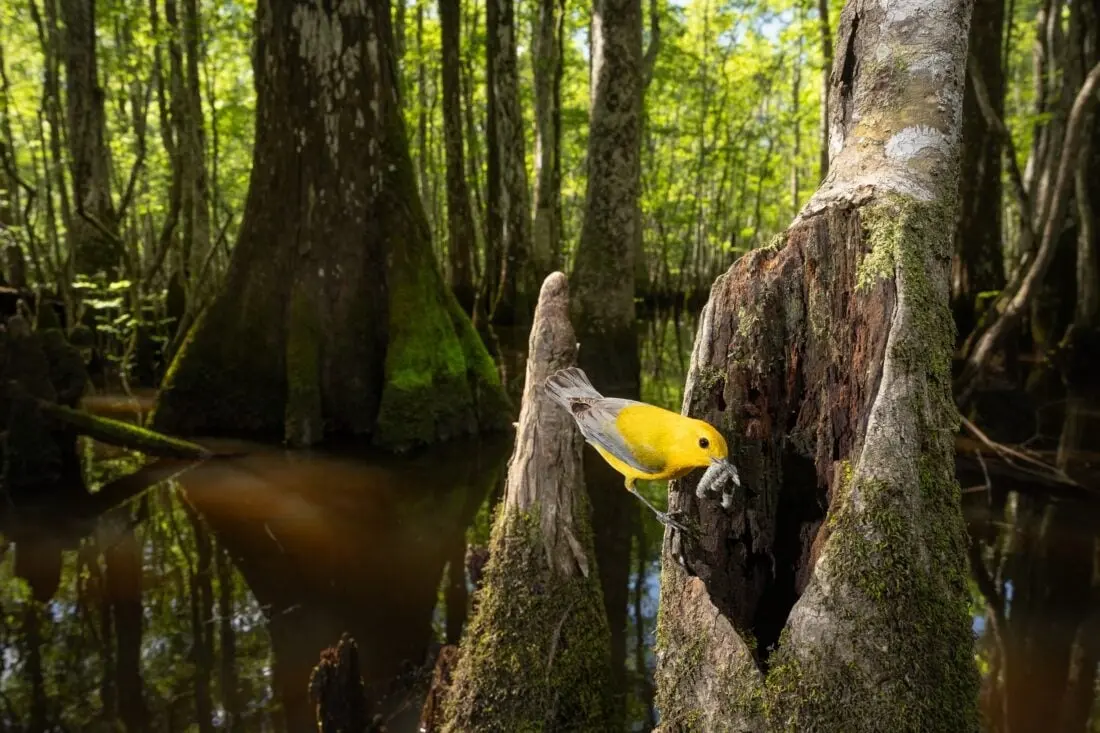
Cavity Nesting Habitats: Hollowed-out trunks of ancient trees serve as essential urban centers for swamp wildlife. Stone’s repeated pilgrimages to a favored giant cypress at Beidler Forest culminated in a magical encounter with a nesting raccoon, as well as remote-triggered portraits of prothonotary warblers—the quintessential swamp bird—delivering grubs to their cavity nests.
Official Statements and Perspectives
The release of Cypress: The Last Old-Growth Swamps has drawn high praise from environmental advocates, scientific researchers, and the artistic community, all of whom emphasize the urgency of preserving the few remaining pristine wetland tracts in the American South.
Mac Stone frequently emphasizes the emotional and psychological necessity of preserving these landscapes, noting:
"Cypress trees, with their flared buttresses and arching limbs, are just amazing. They have this incredible ability to outlast, to outlive, and survive where no other trees can… When you step into an old-growth forest, you just get this feeling that this is what woods are supposed to be like. Everything is mature, shaped by time, and vibrant."
Reflecting on the paradox of Florida’s wild spaces, Stone remarks on the hidden nature of the peninsula’s remaining strongholds:
"You’d think Florida would have surrendered all its secrets by now. But this peninsula remains stubbornly wild at its fringes. And paradoxically, those fringes are often found deep in the interior: swampy, primeval, and difficult to reach. In these sodden, seldom-visited corners, mysteries still cling to the trees."
Conservation scientists like Dr. Dave Stahle have underscored the book’s academic value, noting that visual documentation of these undisturbed ecosystems provides an indispensable bridge between rigorous scientific research and public environmental literacy. By merging art, science, and historical narrative, the collaborators behind Cypress aim to shift public perception regarding swamps—moving away from historical views of wetlands as worthless wastelands to be drained, and toward a modern understanding of them as vital, irreplaceable ecological treasures.
Future Outlook: Conservation Challenges Ahead
Despite the growing appreciation for old-growth ecosystems, the swamps captured in Stone’s monographs face unprecedented contemporary threats. Climate change, shifting hydrological regimes, saltwater intrusion driven by sea-level rise, and unmitigated commercial and residential development continue to pressure the fragile buffers surrounding protected sanctuaries like Corkscrew Swamp, Congaree National Park, and the Black River.
Furthermore, while logging of primary old-growth cypress largely ceased by the mid-20th century, secondary-growth cypress forests are still frequently harvested for mulch and garden products, disrupting the natural succession required to eventually rebuild old-growth characteristics. Conservationists warn that without aggressive, landscape-scale watershed management and strict legal protections, the ecological corridors supporting apex predators like the Florida panther and rare epiphytes like the ghost orchid could become permanently fragmented.
Ultimately, Cypress: The Last Old-Growth Swamps functions as both a historical record of what has been tragically lost and a call to action for what remains. By pulling back the curtain on these dark, watery sanctuaries, Mac Stone challenges society to safeguard the remnants of a primordial American landscape before its final ancient sentinels fade into memory.



0 Comments