
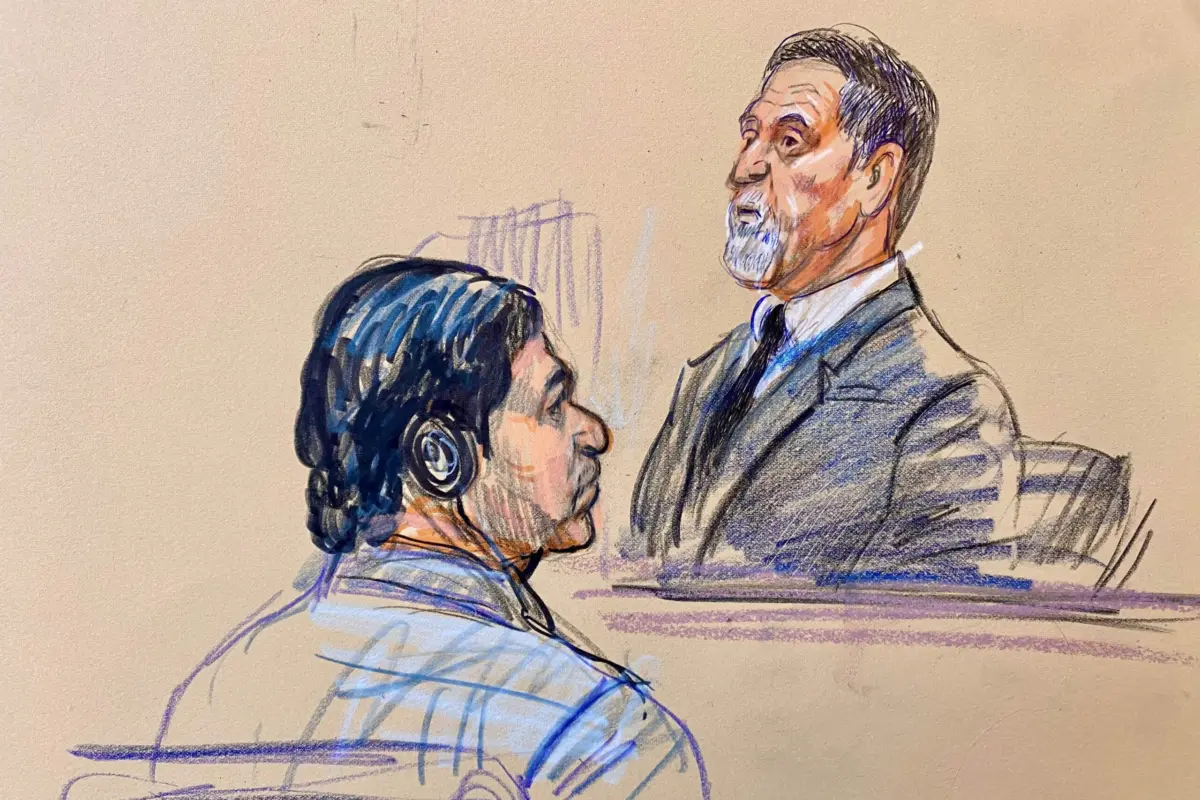

ALEXANDRIA, Va. — In a federal courtroom echoing with the raw grief of grieving military families, an Islamic State operative was sentenced Wednesday to 20 years in federal prison for providing material support to the terrorist organization responsible for the devastating Abbey Gate bombing. The August 26, 2021, suicide attack at the Hamid Karzai International Airport in Kabul killed 13 U.S. service members and approximately 160 Afghan civilians during the final, chaotic days of America’s military withdrawal from Afghanistan.
Mohammad Sharifullah, convicted by a federal jury in Alexandria, Virginia, last April, received the maximum statutory sentence for his single-count conviction in an international terrorism case that has drawn intense global and domestic scrutiny. The case was famously highlighted by President Donald Trump during an address to a joint session of Congress, underscoring the enduring trauma of the Kabul evacuation and the long arm of American counterterrorism jurisdiction.
U.S. District Judge Anthony Trenga delivered the maximum penalty, characterizing Sharifullah as a "dedicated terrorist" who displayed a chilling lack of remorse for the "unfathomable" suffering he helped orchestrate. While the federal jury deadlocked on whether Sharifullah bore direct legal responsibility for the fatalities at Abbey Gate—a distinction that spared him a potential life sentence—prosecutors successfully established that his logistical support, including reconnaissance and route-scouting for ISIS-K, directly facilitated the terrorist cell’s operations during a critical period of vulnerability.
The sentencing hearing brought a harrowing human dimension to the courtroom. Parents of fallen U.S. service members stood merely feet away from the defendant, delivering piercing victim impact statements that bridged the gap between distant geopolitical conflicts and profound personal loss. The proceedings offered a somber capstone to one of the most visible and emotionally charged prosecutions arising from the post-9/11 era, illuminating the enduring legal and moral reckonings of the Afghan withdrawal.
Detailed Chronology
The Genesis of Terror: Radicalization and ISIS-K Allegiance
According to federal court documents and trial testimony, Mohammad Sharifullah’s descent into violent extremism began years before the catastrophic events at Kabul’s airport. Federal prosecutors laid out a timeline tracing Sharifullah’s radicalization back to his teenage years, during which he formally pledged an oath of allegiance to ISIS-K (Islamic State Khorasan Province), the regional affiliate of the Islamic State.
Motivated by an intense ideological animus rooted in opposition to the U.S. military presence in Afghanistan following the September 11, 2001, terrorist attacks, Sharifullah quickly integrated into the militant network. Prosecutors presented evidence that Sharifullah told a journalist of his desire to "catch and kill the crusaders" from the United States. Over the years, his involvement expanded beyond mere rhetoric. Investigators tied him to a swath of violent actions, culminating in a pattern of logistical facilitation that supported the terror group’s broader campaign of destabilization in Central Asia and beyond—including connections prosecutors drew to the March 2024 assault on a Moscow concert hall that left roughly 140 people dead.
The Crucible of August 2021: The Kabul Airport Evacuation
The focal point of the prosecution’s case centered on the frantic final week of August 2021, when American forces and allied nations scrambled to evacuate tens of thousands of foreign nationals and vulnerable Afghans following the rapid collapse of the Western-backed government.
Hamid Karzai International Airport became a desperate bottleneck. Thousands of desperate people crowded around its perimeter gates under the blistering sun. On August 26, 2021, a lone suicide bomber detonated an improvised explosive device (IED) packed with ball bearings near Abbey Gate, one of the primary entry points controlled by U.S. Marines.
While the actual detonation was carried out by Abdul Rahman al-Logari—an Islamic State operative who had recently been released from a Bagram prison facility amid the Taliban’s sweeping territorial gains—investigators scrutinized the underlying network that enabled him. According to government evidence, Sharifullah played an indispensable logistical role in the lead-up to the massacre, specifically tasked with scouting travel routes and navigating the surrounding urban terrain to facilitate the movement of ISIS-K operatives toward the airfield.
Arrest, Extradition, and Trial
Following the withdrawal, intelligence and law enforcement agencies launched an intensive, multi-year global manhunt to identify and apprehend those responsible for the Abbey Gate carnage. Sharifullah was eventually captured abroad—initially detained in Pakistan before being transferred to American custody and brought to the Eastern District of Virginia to face federal terrorism charges.
The trial, which commenced in April 2026, featured testimony from counterterrorism experts, intelligence analysts, and FBI investigators who detailed hundreds of hours of interrogations. The defense team, led by court-appointed public defenders, argued strenuously that the government’s case relied heavily on coerced confessions. They contended that Sharifullah’s statements to the FBI were fabricated out of fear, born from terror of potential torture or abuse while held in Pakistani custody prior to his extradition.
Furthermore, defense attorneys emphasized a crucial nuance in the jury’s verdict: while jurors found Sharifullah guilty of providing material support to a designated foreign terrorist organization, they were deadlocked on whether his actions directly caused the deaths at Abbey Gate. This legal distinction meant that despite the prosecution’s framing of his broader culpability, Sharifullah could not be sentenced to life imprisonment.
Supporting Context & Metrics
The Toll of Abbey Gate
The August 26, 2021, suicide bombing remains one of the single deadliest days for the U.S. military during its two-decade involvement in Afghanistan. The statistical footprint of the attack underscores its historic gravity:
- U.S. Casualties: 13 service members killed in the line of duty (11 Marines, one Navy corpsman, and one Army soldier). Dozens of others sustained severe blast injuries, traumatic brain injuries, and life-altering physical disabilities.
- Afghan Casualties: Approximately 160 Afghan civilians seeking evacuation were killed in the blast, with hundreds more sustaining horrific injuries.
- Operational Context: The attack occurred amidst the largest airborne non-combatant evacuation operation (NEO) in military history, which ultimately airlifted more than 120,000 people out of Kabul over a two-week period.
Legal Parameters and Sentencing Guidelines
The mechanics of federal terrorism sentencing place strict boundaries on judicial discretion based on jury verdicts.
- The Conviction: Sharifullah was convicted on a single felony count of conspiring to provide material support to a designated foreign terrorist organization (ISIS-K).
- The Penalty Range: The statutory maximum for this specific material support charge is 20 years in federal prison. Had the jury returned a unanimous verdict linking his conspiracy directly to the resulting deaths, the charge could have carried a potential life sentence.
- Parties’ Recommendations: Defense attorneys pressed for a 17-year custodial sentence, arguing that his actions were disconnected from the specific execution of the Abbey Gate bombing. Federal prosecutors countered by demanding the absolute maximum of 20 years, emphasizing his deep-seated radicalization and extensive involvement in international jihadist networks.
Official Statements
The emotional weight of the courtroom was largely carried by the statements entered into the record by government officials, judicial authorities, and, most importantly, the families of the fallen.
U.S. District Judge Anthony Trenga did not mince words when handing down the sentence, labeling Sharifullah a committed extremist devoid of human empathy:
"He is a dedicated terrorist who has expressed no remorse for the unfathomable grief and suffering that he has caused."
The prosecution’s sentencing memo painted an equally grim portrait of the defendant’s ideological motivations, noting that:

"From his teenage years, when he pledged an oath of allegiance to ISIS-K, Sharifullah’s carnage was driven by hate. Hate towards Americans."
In contrast, defense counsel maintained that the judicial process overreached regarding the specific scope of his crimes:
"He was brought here because the government believed he participated in the Abbey Gate attack, a theory which it was unable to prove at trial," defense attorneys wrote in their legal filings, emphasizing that their client was never proven to be an ISIS-K mastermind or an active participant in the bombing’s execution.
The most resonant words, however, came from the families of the victims. Mark Schmitz of Missouri, father of 20-year-old Marine Corps Lance Cpl. Jared Schmitz, stepped up to the podium just feet away from where Sharifullah sat in his prison jumpsuit. Demanding that the defendant look him in the eye, Schmitz delivered a tribute to his son’s enduring legacy:
"They may have taken his life, but they’ll never take his legacy. A bomb killed my son. It did not kill what he stood for."
Future Outlook
The conclusion of Mohammad Sharifullah’s trial and sentencing marks a significant milestone in the U.S. government’s ongoing effort to achieve accountability for the tragedies of the 2021 Afghanistan withdrawal. However, it also highlights the profound systemic and legal complexities inherent in prosecuting international terrorism cases stemming from failed states.
For the Department of Justice and federal intelligence agencies, the case underscores the viability—and the limitations—of using domestic material support statutes to prosecute foreign nationals implicated in overseas terrorist plots. While prosecutors successfully secured a maximum 20-year sentence, the jury’s deadlock on the causal link to the Abbey Gate deaths illustrates the formidable evidentiary hurdles involved in tying localized logistical support directly to specific mass-casualty attacks years after the fact.
More broadly, the case ensures that the ghosts of the Afghan withdrawal will continue to haunt political and legal discourse in Washington. As geopolitical tensions shift and the threat landscape evolves—with ISIS-K demonstrating an increased operational capability to project violence globally, as evidenced by recent attacks in Europe and Russia—counterterrorism officials remain hyper-vigilant.
For the families of the 13 service members and the hundreds of Afghans whose lives were shattered on August 26, 2021, Wednesday’s sentencing offers a measure of judicial closure, even as the emotional scars of Abbey Gate remain permanent. As Sharifullah begins his two-decade federal sentence, the echoes of the Kabul airport explosion continue to serve as a stark reminder of the long shadow cast by America’s longest war.

0 Comments