
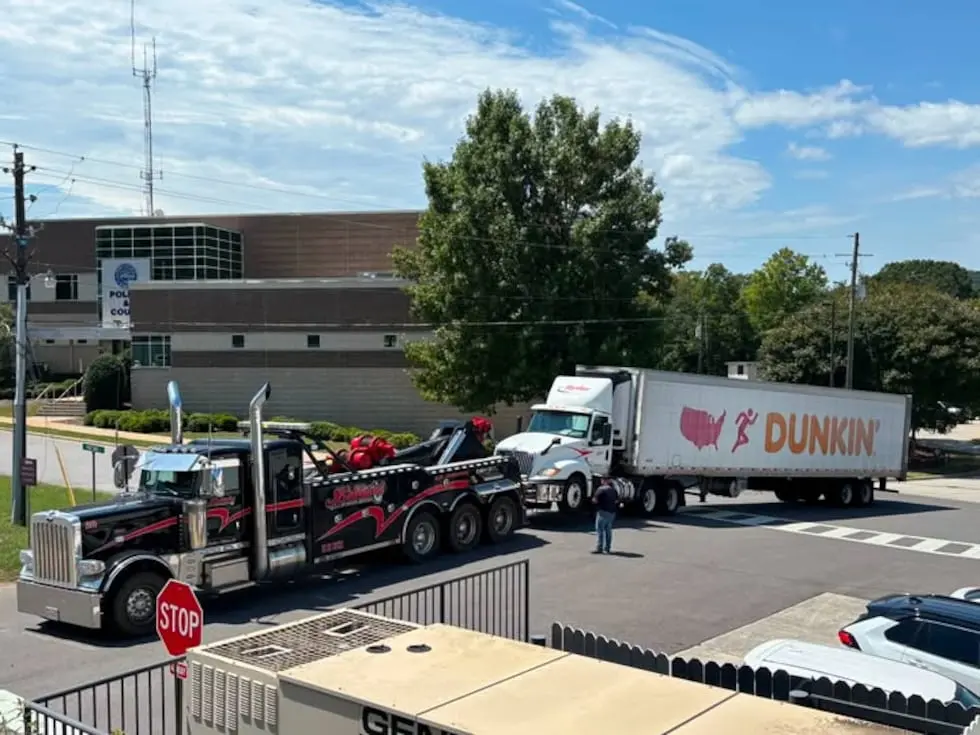

PELHAM, Ala. — In an era where municipal law enforcement agencies routinely confront the grim realities of urban crime, public safety challenges, and complex logistical demands, a momentary collision of fate and culinary cliché brought a rare dose of levity to the Shelby County municipality of Pelham. On a standard afternoon that began with routine administrative operations, the Pelham Police Department found itself at the epicenter of a remarkably serendipitous traffic disruption: a fully loaded commercial delivery vehicle belonging to the prominent national coffee and baked goods franchise Dunkin’ suffered a catastrophic mechanical failure directly outside the department’s main precinct doors.
The incident, which immediately attracted the curious eyes of passing motorists and on-duty personnel alike, transformed a minor municipal traffic inconvenience into a viral internet phenomenon. Leaning heavily into the enduring cultural trope linking law enforcement officers with fried dough confections, the Pelham Police Department’s public information team deployed self-deprecating humor across social media channels, capturing the collective imagination of internet users nationwide.
Beyond the initial wave of digital amusement, the episode serves as a compelling case study in modern municipal public relations, demonstrating the profound utility of humor in bridging the gap between law enforcement agencies and the communities they serve. This comprehensive report details the chronological sequence of the breakdown, investigates the logistical realities of urban commercial transit disruptions, examines the broader cultural phenomenon of police-donut associations, analyzes the official communications issued by municipal authorities, and evaluates the long-term implications of community-policing transparency through digital engagement.
Detailed Chronology
The Prelude: A Routine Afternoon in Pelham
The sequence of events commenced during the height of mid-day operations at the Pelham Police Department headquarters. Administrative staff were processing standard municipal paperwork, patrol units were executing scheduled shift rotations across the city’s commercial and residential sectors, and dispatchers were monitoring the steady hum of standard emergency communications.
Weather conditions across the region were clear, eliminating adverse environmental factors as an immediate cause for concern. Traffic along the primary thoroughfare adjacent to the precinct was operating at normal capacity, moving at a steady pace characteristic of the bustling Birmingham suburb.
The Stalling Point: Mechanical Failure Meets Destination Serendipity
Without warning, the daily routine was abruptly punctuated by the distinct mechanical strains of a heavy-duty commercial vehicle in distress. The vehicle—a multi-ton, refrigerated box truck emblazoned with the unmistakable pink and orange branding of Dunkin’—was navigating the municipal route when its powertrain experienced a sudden, debilitating failure.
According to preliminary witness observations and subsequent departmental debriefs, the vehicle coasted to an unceremonious halt precisely parallel to the front entrance of the Pelham Police Department. The timing and positioning could not have been more mathematically improbable. The truck did not break down miles away on Interstate 65, nor did it stall in an obscure residential cul-de-sac; rather, it settled directly in the line of sight of officers reporting for duty, effectively blocking a vital line of sight and partially impeding local access lanes.
The Immediate Response and Remediation
Recognizing that a stalled commercial vehicle posed both a localized traffic hazard and an irresistible narrative opportunity, on-duty personnel mobilized immediately. Standard protocol for a disabled commercial vehicle involves assessing traffic impediments, ensuring public safety, and coordinating with local towing services to clear the right-of-way as expeditiously as possible.
However, before dispatching standard traffic enforcement protocols, officers couldn’t help but acknowledge the sheer poetic irony of the situation. The precinct’s administrative and patrol staff quickly migrated to the windows and front steps to survey the immobilized sweet-treat cargo carrier.
A heavy-duty wrecker service was promptly dispatched to the scene to hoist and tow the disabled commercial vehicle out of harm’s way. According to subsequent operational summaries released by the department, the recovery operation was executed with maximum efficiency to restore normal traffic flow. Crucially, emergency responders and towing operators confirmed a casualty-free outcome for the precious cargo: no pastries were harmed, crushed, or compromised during the mechanical failure or the subsequent towing process.
Supporting Context & Metrics
The Anatomy of Commercial Fleet Breakdowns
While the Pelham incident generated immense social media traction due to its comedic framing, it highlights a persistent, costly logistical challenge faced by commercial delivery fleets across the United States. Medium- and heavy-duty delivery trucks, such as those utilized by franchise supply chains, operate on relentless schedules designed to stock retail storefronts before dawn and throughout the business day.
According to data compiled by the American Trucking Associations (ATA) and commercial fleet management firms:
- Mechanical Stresses: Urban delivery vehicles experience disproportionate powertrain wear and tear due to frequent stopping, idling, and transmission shifting.
- Economic Impact: An unplanned roadside breakdown of a commercial delivery vehicle costs fleet operators an average of $800 to $1,500 per incident in direct towing, repair, and driver downtime costs, not accounting for the delayed delivery of perishable goods.
- Municipal Intersections: Approximately 12% of all urban commercial vehicle breakdowns occur within 500 feet of municipal, county, or state government facilities, purely driven by the geographic concentration of urban commercial routes intersecting administrative zones.
The Cultural Nexus: Law Enforcement and Confections
To understand why the Pelham Police Department’s post resonated so deeply, one must examine the enduring sociological link between law enforcement officers and donuts. This cultural trope, deeply embedded in American media and folklore, traces its origins back to the mid-20th century.
- Historical Origins: During the 1940s and 1950s, all-night diners and early-morning bakeries were often the only establishments open during the overnight and early morning hours when patrol officers worked their shifts. These locations offered a warm environment, hot coffee, sugary sustenance to combat fatigue during grueling graveyard shifts, and reliable access to operational telephones before the advent of mobile communications.
- Evolution in Pop Culture: Television shows, films, and comic strips crystallized this practical reality into a pervasive cultural shorthand, portraying officers perpetually fueled by coffee and glazed rings.
- Modern Adaptation: Rather than reacting defensively to the stereotype, contemporary police agencies increasingly leverage the trope to humanize law enforcement personnel, demonstrate self-awareness, and build relational capital with the public via social media.
Official Statements and Public Engagement
The Viral Social Media Dispatch
The cornerstone of the Pelham incident’s public profile was the statement issued via the Pelham Police Department’s official Facebook page. Crafting a tone that balanced professional decorum with lighthearted wit, the department’s public information officers wrote:
“We’re not saying officers responded faster than usual… but when a truck full of donuts is involved, you don’t take any chances.”
This strategic piece of micro-copy achieved several vital communications objectives simultaneously:
- Engagement Optimization: By leaning into self-deprecating humor, the department short-circuited adversarial or cynical public commentary, transforming a routine traffic nuisance into a universally relatable punchline.
- Community Rapport: Social media metrics—including shares, likes, and comments—surged within hours of publication, reflecting a high degree of positive digital sentiment from citizens across Alabama and beyond.
- Transparency and Access: The post demonstrated that the agency possesses cultural fluency and a healthy sense of humor, attributes that studies in public administration show significantly enhance public trust and cooperation.
Departmental Follow-Up and Assurances
As inquiries rolled in from local news outlets and concerned citizens regarding the structural integrity of the shipment, Pelham police officials issued a reassuring, tongue-in-cheek update confirming the safety of the confections.
"We are pleased to report that the cargo remains secure," an agency spokesperson noted informally during follow-up inquiries. "No donuts were harmed, injured, or subjected to cruel and unusual punishment during this mechanical failure. The franchise’s inventory has been safely transferred, and public safety has been fully restored."
Future Outlook
The Evolution of Law Enforcement Public Relations
The minor mechanical failure in Pelham, Alabama, offers a profound lens through which to view the ongoing evolution of municipal communications. In an era where police departments are subjected to intense public scrutiny, the ability to utilize digital platforms for light, humanizing engagement is an invaluable asset.
Industry analysts predict several key trends emerging from viral municipal moments like the Pelham Dunkin’ incident:
- Human-Centric Digital Strategies: Agencies are increasingly moving away from purely sterile, crime-stat-only reporting toward narrative-driven, conversational social media campaigns that highlight the everyday humanity of officers.
- Crisis De-escalation Through Humor: When minor operational disruptions occur, addressing them with wit serves as an effective mechanism for diffusing public tension and fostering community goodwill.
- Strengthened Digital Ecosystems: Incidents that capture organic national attention provide smaller police departments with an expanded platform to communicate vital safety messages, recruitment drives, and community outreach initiatives to a vastly wider audience.
Conclusion
Ultimately, the day a Dunkin’ delivery truck broke down in front of the Pelham Police Department will be remembered less as a logistical nightmare and more as a masterclass in spontaneous public relations. By transforming an ordinary mechanical breakdown into a shared cultural moment of laughter, the Pelham Police Department reaffirmed a timeless truth: a sense of humor remains one of the most effective tools in public service.

0 Comments