
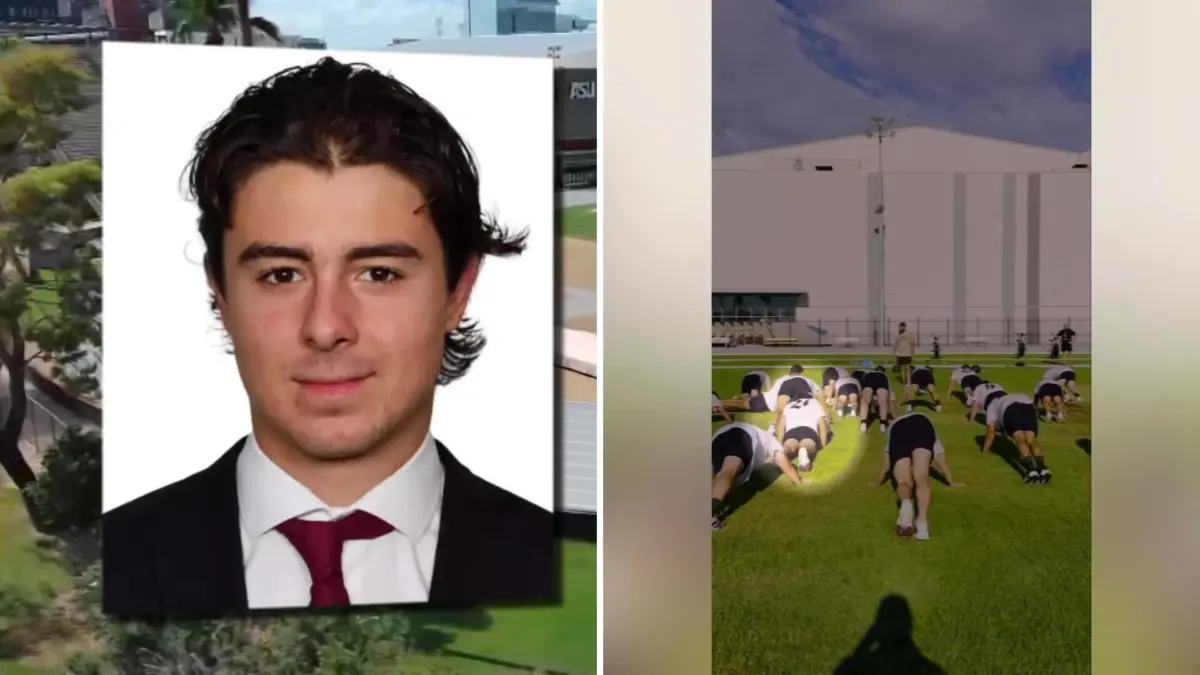

TEMPE, Ariz. — The fallout surrounding a catastrophic preseason training incident at Arizona State University (ASU) has escalated dramatically, thrusting the university’s athletic department into a severe crisis of accountability, transparency, and player safety.
Matthew Mayich, a 21-year-old sophomore defenseman and native of Ontario, Canada, remains hospitalized following a medical collapse on August 20 during an outdoor conditioning session in Tempe. According to legal representatives for the Mayich family, the young athlete’s medical prognosis is grim, with a full recovery deemed highly unlikely.
In the weeks following the incident, the tragedy has catalyzed intense scrutiny over collegiate athletic training protocols, the oversight of external conditioning personnel, and the institutional response of a major NCAA Division I athletic program. On Tuesday, John and Christina Mayich, Matthew’s parents, formally broke their silence through a statement issued by their attorney. They called for the immediate removal of the coaching staff members who oversaw the fateful workout, citing an urgent need to protect current players from potential institutional retaliation while an independent investigation is conducted.
This development follows an explosive open letter sent to ASU President Michael Crow by seven anonymous hockey players. The letter directly challenges the university’s internal review of the event, painting a harrowing picture of a punishing, military-style conditioning session led by an unvetted contractor, characterized by dangerously restricted water access and physical distress that was allegedly ignored by supervisors.
Conversely, legal representatives for the external trainer who led the session have vehemently disputed these accounts, asserting that the workout was standard for Division I athletics and that hydration protocols were strictly managed by the university’s coaching staff. As the ASU Police Department continues its criminal inquiry—with findings ultimately destined for the Maricopa County Attorney’s Office—the case has ignited a fierce national conversation regarding the absolute limits of player safety, institutional liability, and the welfare of student-athletes in collegiate sports.
Detailed Chronology
August 20: The Fateful Workout
On a sweltering late-summer day in Tempe, Arizona, the ASU men’s hockey team assembled for what was initially billed to the players as a routine team-building exercise. Instead, the session transformed into a grueling outdoor conditioning workout.
According to player accounts, the session was led by Timothy Ziesel, a former U.S. Army Green Beret brought in by the program. Over the course of the rigorous drills—which included traditional calisthenics, sprints, pushups, planks, and flutter kicks—environmental stress and physical exertion began to take a severe toll on the roster.
Witnesses report that multiple players began to exhibit visible signs of extreme physical distress, including falling to their knees and vomiting. Despite these alarming indicators, the session reportedly continued unabated. Crucially, players have alleged that water breaks were severely restricted, lasting only seconds, with a mere fraction of the roster—estimated at eight players—able to access hydration. Matthew Mayich was allegedly among those denied or unable to reach water before collapsing.
Late August to Early September: Hospitalization and Initial Revelations
In the immediate aftermath of his collapse, Mayich was rushed to a local hospital. As medical updates began to filter out, the severity of his condition became chillingly clear. By early September, legal counsel representing the Mayich family announced that the young defenseman faced an uphill battle, stating that a full recovery was highly unlikely.
Concurrently, public scrutiny intensified regarding ASU’s training policies. Investigators and legal analysts began questioning the vetting process for external contractors, the oversight of voluntary versus mandatory team workouts, and the specific adherence to NCAA and institutional hydration protocols during extreme desert heat.
Late September: Reports, Letters, and Counter-Statements
The investigative timeline accelerated rapidly in the final week of September:
- September 22: ASU released its internal review regarding the workout leading to Mayich’s collapse.
- September 24: Attorneys representing affected parties formally requested that criminal investigations be initiated into the handling of the team workout.
- September 28: Seven anonymous ASU hockey players bypassed internal athletic department channels, sending a direct letter to ASU President Michael Crow to challenge the university’s official narrative. The letter exposed alleged omissions in the internal review, detailed the lack of background checks for Ziesel, and reiterated demands for independent oversight.
- September 29: John and Christina Mayich released a public statement through their attorney, explicitly backing the players’ concerns, demanding the temporary removal of the coaching staff involved in the workout, and calling for an independent investigation free from the fear of retaliation.
- Late September (Ongoing): Buddy Rake, attorney for trainer Timothy Ziesel, pushed back aggressively against the players’ claims in statements to local media, arguing that the workout was benign by Division I standards and that hydration responsibilities fell squarely on the shoulders of the university’s coaching and training staff.
Supporting Context & Metrics
The controversy at Arizona State University touches upon several critical operational and policy areas within modern collegiate athletics:
External Contractors and Vetting Protocols
A central pillar of the players’ grievance involves the integration of Timothy Ziesel into the team’s training ecosystem. According to the anonymous players’ letter, Ziesel operated as an external contractor—a former Green Beret—without undergoing standard university background checks or possessing recognized athletic safety certifications tailored to collegiate athletes. The transition from a purported "team-building" exercise to a "military-style conditioning session" highlights potential gaps in how athletic departments vet third-party specialists who are granted authority over student-athletes.
Hydration and Environmental Safety in Desert Climates
Tempe, Arizona, presents extreme environmental challenges for outdoor athletic training, particularly during the late-summer months when ambient temperatures regularly soar well past triple digits.
- ASU Hydration Policy: According to legal statements from defense counsel, ASU’s formal hydration protocols require athletic trainers and coaches to supervise pre-hydration regimens meticulously. Athletes are mandated to hydrate at least four hours prior to exertion and consume between 8 to 12 fluid ounces of water roughly 10 to 15 minutes before exercise commences.
- The Contradiction: While university and defense guidelines emphasize strict hydration compliance, player testimonies allege a starkly different reality on the ground during the August 20 session. Claims of restricted, seconds-long water windows and limited access for vulnerable athletes point to a potentially dangerous breakdown between written institutional policy and practical field execution.
Legal and Institutional Exposure
The involvement of multiple legal teams—representing the Mayich family, the external trainer, and anonymous student-athletes—signals immense legal exposure for Arizona State University. With the ASU Police Department’s investigative file destined for the Maricopa County Attorney’s Office, prosecutors will evaluate whether negligence, recklessness, or criminal liability played a role in the catastrophic outcome of a routine preseason workout.
Official Statements
The widening gulf between the institutional narrative, the experiences of the student-athletes, and the grief-stricken demands of the Mayich family is best illustrated through their respective public statements.
The Mayich Family Statement
Released on Tuesday, September 29, through their legal counsel, John and Christina Mayich sought to correct misconceptions about their desires while establishing firm boundaries for accountability:
"We’ve heard some things about what our family wants that aren’t right, so we want to be clear. We want this team to have a great season, and we’ll be cheering for you. But the coaches who ran that workout on August 20 need to be removed while an independent investigation gets to the truth. The players shouldn’t have to worry about retaliation from the people they report to every day. And there are plenty of former college and pro players in the Valley who could step in and help.
Nobody should keep quiet about what they think should happen because they believe that’s what we want. It isn’t. If anyone wants to know what we want, ask us. We want the truth, and we want it done in a way that lets the boys focus on hockey instead of wondering whether their coaches think they talked.
Mostly, we want accountability for what happened to our son, and we want his teammates to be safe."
Defense Counsel Perspective (Buddy Rake, representing Timothy Ziesel)
Representing the external trainer who led the physical conditioning, attorney Buddy Rake strongly defended his client’s actions while shifting focus toward institutional oversight:
"The workout was not punishing unless you consider flutter kicks, pushups, planks, and sprints punishing. Have you ever seen a D1 preseason workout? … As Tim’s attorney, I continue to be of the opinion that the family and parents of Matthew receive complete transparency. Instead of focusing on a non-existent hard workout, the focus should be on how could this happen during a workout that was not as hard as an average D1 conditioning program. There is not a definition of a military workout."
Furthermore, Rake maintained that six ASU coaches and trainers were present during the session, and that water access decisions were strictly governed by university policy rather than his client’s unilateral authority.
Future Outlook
As October begins, the Arizona State University men’s hockey program finds itself at an unprecedented crossroads. The immediate future hinges on several critical developments:
- Police and Prosecutorial Review: The ongoing investigation by ASU Police will ultimately yield a comprehensive report submitted to the Maricopa County Attorney’s Office. Prosecutors will determine whether criminal charges are warranted against any participants, contractors, or coaching staff members.
- Administrative Action and Independent Oversight: Pressure continues to mount on ASU President Michael Crow and athletic department leadership to enact the temporary suspensions requested by both the Mayich family and the anonymous player coalition. Whether the university will cede control to an independent, external investigative body remains a central demand of the campus community.
- Team Morale and Institutional Trust: With players caught in the crossfire between administrative policy, coaching authority, and deep-seated fears of professional or athletic retaliation, restoring trust within the Sun Devil hockey locker room will require profound transparency and structural reform.
Ultimately, the tragedy involving Matthew Mayich has evolved far beyond a localized sports story. It stands as a sobering examination of athlete welfare, the responsibilities of modern coaching staffs, and the absolute necessity of absolute accountability when young lives are entrusted to academic and athletic institutions.

0 Comments