
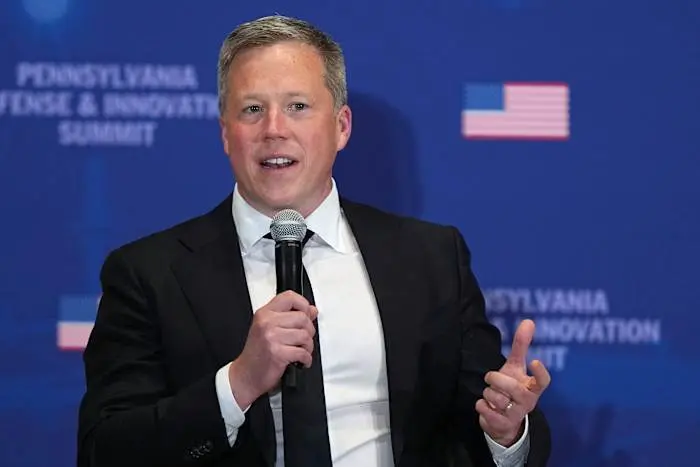

WASHINGTON — In a sudden and politically charged shift within the nation’s defense apparatus, U.S. Army Secretary Dan Driscoll has stepped down from his post after an 18-month tenure defined by high-stakes international diplomacy, aggressive military modernization, and escalating friction with Defense Secretary Pete Hegseth. Driscoll’s departure leaves the nation’s largest military service branch without a Senate-confirmed civilian or top uniformed leader at a time of active global conflict.
Driscoll’s exit, formalized after a final conversation with President Donald Trump regarding the current state of the Army, brings to a head months of simmering tensions within the Department of Defense. While Driscoll maintained robust, bipartisan relationships across Capitol Hill and enjoyed close ties to Vice President JD Vance, his progressive vision for defense procurement and his advocacy for modernization put him on a direct collision course with Hegseth and the Pentagon’s changing administrative ethos.
The ramifications of Driscoll’s resignation extend far beyond administrative musical chairs. It arrives as the United States military intensifies airstrikes against Iran in the Strait of Hormuz following a brief lull in hostilities in the six-month-old conflict. Furthermore, the vacuum left by his departure exacerbates institutional instability in the wake of the ouster of the Army’s top uniformed leader, Gen. Randy George, earlier this year. With key technological initiatives—such as Driscoll’s signature drone modernization program—being abruptly dismantled by acting leadership, lawmakers on both sides of the aisle are sounding the alarm over what they perceive as a troubling departure from strategic competence within the Pentagon.
This report provides an in-depth examination of the events leading up to Driscoll’s resignation, the underlying policy and interpersonal conflicts that triggered it, the strategic implications for America’s land forces, and the broader political fallout echoing through Congress.
Detailed Chronology: The 18-Month Tenure and Accelerated Exit
To understand the abrupt nature of Dan Driscoll’s departure, one must trace the arc of his 18-month tenure, which blended traditional civil-military leadership with extraordinary diplomatic assignments that are rarely handed to a service secretary.
Early Days and Diplomatic Assignments
When Driscoll assumed office as the civilian leader of the U.S. Army, he stepped into a defense ecosystem grappling with the rapid evolution of modern warfare, particularly the lessons emerging from the war in Ukraine. Beyond his domestic mandate to man, train, and equip the force, Driscoll was tapped by the administration for a high-profile, highly unusual secondary assignment: serving as a key negotiator tasked with brokering talks to end the Russia-Ukraine war.
His ability to bridge gaps and navigate complex geopolitical dynamics earned him early praise from both sides of the political aisle. On Capitol Hill, Democrats and Republicans alike viewed Driscoll as a pragmatic, steady hand. His personal rapport with Vice President JD Vance further solidified his standing within the executive branch’s inner circle.
The Rising Tide of Internal Friction
Cracks in the internal architecture of the Pentagon began to show as Driscoll pushed aggressively to break through military bureaucratic red tape. Eager to fast-track the acquisition of advanced drone and counter-drone technologies—capabilities highlighted by the ongoing conflicts in Eastern Europe and the Middle East—Driscoll positioned himself as a champion of rapid innovation.
However, these priorities frequently collided with the more traditionalist or centralized controls favored by Defense Secretary Pete Hegseth. Over the course of the past year, reports of friction between the two civilian leaders multiplied. Matters worsened when Hegseth moved to purge key allies of Driscoll within the Army’s leadership structure.
The Ouster of Gen. Randy George
The turning point in the civil-military power struggle occurred in April, when Hegseth ousted the Army’s top uniformed leader, Gen. Randy George. Gen. George was widely recognized as a close ally and key partner of Driscoll in pushing through institutional reforms.
With Gen. George’s removal, Gen. Christopher LaNeve was installed as the Army’s acting chief of staff. Almost immediately, the institutional direction of the service shifted. Gen. LaNeve abruptly pulled the plug on the specialized drone modernization program that Driscoll had championed, signaling a decisive reversal of the former secretary’s strategic priorities.
The Resignation and Final Statements
Faced with an increasingly untenable administrative environment—and following a direct conversation with President Trump regarding the operational readiness of the Army—Driscoll submitted his resignation.
Late Tuesday night, Driscoll broke his silence via a social media post on X, marking his first public commentary since the White House confirmed his departure on Monday. Eschewing any outward bitterness, Driscoll characterized his time in office as "the honor of a lifetime."
"We could not have made the progress we did without the support of Secretary Hegseth," Driscoll wrote, praising soldiers, their families, and the Army’s civilian workforce for helping to "modernize and accelerate how the Army mans, trains, and equips the most lethal fighting force on the face of the earth."
Despite the polite rhetoric, the underlying reality remained stark: Driscoll’s last full day was Wednesday, and the Pentagon has yet to announce a Senate-confirmed or even a clear interim successor to fill the vital post.
Supporting Context & Metrics: Modernization, Drones, and Congressional Pushback
The departure of Dan Driscoll is not merely a personnel story; it is a battle over the future architecture of American land power. At the heart of the dispute lies the urgent need to adapt the U.S. military to a technological landscape dominated by cheap, lethal unmanned aerial systems (UAS).
The Battle Over Drone Modernization
During his 18-month tenure, Driscoll identified bureaucratic delays in procurement as an existential threat to the Army’s tactical superiority. Traditional defense acquisition cycles often take years—sometimes decades—to field new equipment, a timeline rendered obsolete by the weekly technological iterations seen on the battlefields of Ukraine and the Middle East.
Driscoll spearheaded initiatives designed to bypass conventional red tape, empowering military contractors and forward-deployed units to rapidly prototype, test, and field drone and counter-drone capabilities.
However, under acting Chief of Staff Gen. Christopher LaNeve, the Pentagon abruptly dismantled the specialized drone unit championed by Driscoll. This pivot away from decentralized, rapid-acquisition drone programs has alarmed defense experts who argue the U.S. is falling behind peer competitors in autonomous warfare.
Congressional Alarm and Bipartisan Rebuke
The dismantling of the drone unit did not go unnoticed on Capitol Hill. In a rare display of bipartisan consensus, a group of U.S. senators dispatched a formal letter this week to both Driscoll (prior to his exit) and Gen. LaNeve.
The lawmakers expressed "deep concerns" regarding the elimination of the specialized drone capabilities and formally requested an urgent briefing from Army leadership to justify the decision. The swift congressional pushback underscores a growing rift between legislative oversight committees and the current Pentagon leadership regarding military preparedness.
Strategic Vulnerabilities Amid Ongoing Conflicts
Driscoll’s exit leaves the nation’s largest military branch structurally vulnerable at a critical juncture. The U.S. military has recently resumed launching active airstrikes against Iranian positions and proxies in the Strait of Hormuz following a brief lull in hostilities.
To navigate an active, multi-theater operational environment without a confirmed Army Secretary or a fully settled uniformed command structure introduces significant administrative drag and strategic risk. Defense analysts point out that leadership vacuums during active combat operations can degrade inter-service coordination, slow logistics pipelines, and cloud strategic messaging to international adversaries and allies alike.
Official Statements and Political Fallout
The political shockwaves generated by Driscoll’s resignation have laid bare deep-seated anxieties over the internal culture of the Department of Defense under Secretary Hegseth.
Criticisms from Capitol Hill
While the White House and Driscoll himself maintained a polished narrative in public statements, congressional leaders were far more vocal about the toxic institutional dynamics driving the secretary out of office.
Sen. Jack Reed of Rhode Island, the ranking Democrat on the Senate Armed Services Committee, did not mince words in a scathing statement released Monday:
"Secretary Hegseth is cultivating a culture where dissent is punished and competence is secondary to personal allegiance," Reed stated.
Reed’s assessment reflects a broader concern among defense hawks and moderates in Congress who fear that the ideological alignment demanded by the current Pentagon leadership is systematically purging independent thinkers, pragmatic innovators, and officers who dare to challenge top-down orthodoxies.
Republican Silence and Private Unease
While some congressional Republicans have publicly defended the administration’s prerogative to shape its defense team, conversations behind closed doors reveal significant bipartisan lament over Driscoll’s departure. Lawmakers who worked closely with him on defense authorization bills and military oversight praised his deep grasp of tactical realities and his willingness to engage constructively with both parties.
His loss is viewed by many as a self-inflicted wound for an administration that campaigned on bureaucratic efficiency and military readiness, yet now finds itself sidelining one of its most effective modernization advocates.
Future Outlook: What Lies Ahead for the U.S. Army?
As Dan Driscoll hands over the reins, the immediate future of the Department of the Army remains clouded by uncertainty. The structural challenges he sought to address—bureaucratic inertia, antiquated acquisition timelines, and the imperative to integrate autonomous systems into every echelon of the force—remain pressing and unresolved.
The Leadership Vacuum
The most immediate challenge facing the Pentagon is filling the vacancy left by Driscoll. Finding a candidate willing to step into an environment marked by high-profile friction with Secretary Hegseth, while simultaneously possessing the administrative acumen required to manage a multi-hundred-billion-dollar enterprise, will be a formidable task for the White House. Furthermore, any nominee will face rigorous scrutiny during Senate confirmation hearings, where lawmakers are certain to use the platform to interrogate the administration’s civil-military leadership practices.
Implications for Force Modernization
Internally, the Army must resolve its identity crisis regarding technology and procurement. The abrupt cancellation of Driscoll’s favored drone programs has created a chilling effect among innovators within the ranks who fear that pushing for bold technological shifts may invite professional retaliation. If the Pentagon fails to institutionalize rapid-acquisition frameworks, the U.S. land force risks entering future conflicts equipped for yesterday’s battlefields rather than tomorrow’s wars.
Ultimately, Dan Driscoll’s departure serves as a cautionary tale of the friction between reform-minded technocrats and top-down institutional control. As the U.S. military trades blows in the Middle East and monitors strategic flashpoints globally, the institutional stability of the Army will depend heavily on how the administration manages the fallout from this high-level exit and whether it chooses to prioritize strategic competence over political conformity.

0 Comments