

Executive Overview
In the high-stakes, often anxiety-inducing environment of a modern regional medical center, the prevailing sensory landscape is typically defined by the sterile hum of fluorescent lighting, the rhythmic beep of vital sign monitors, the hurried footsteps of clinical staff, and the quiet, anxious murmurs of families waiting for news. At McLeod Seacoast Hospital in Myrtle Beach, South Carolina, however, that auditory and emotional ecosystem shifts profoundly every Thursday.
As the hospital navigates its busiest day of the week for outpatient procedures and same-day surgeries, the waiting rooms and corridors are gently enveloped in an entirely different frequency: the resonant, celestial cascading notes of a live harp.
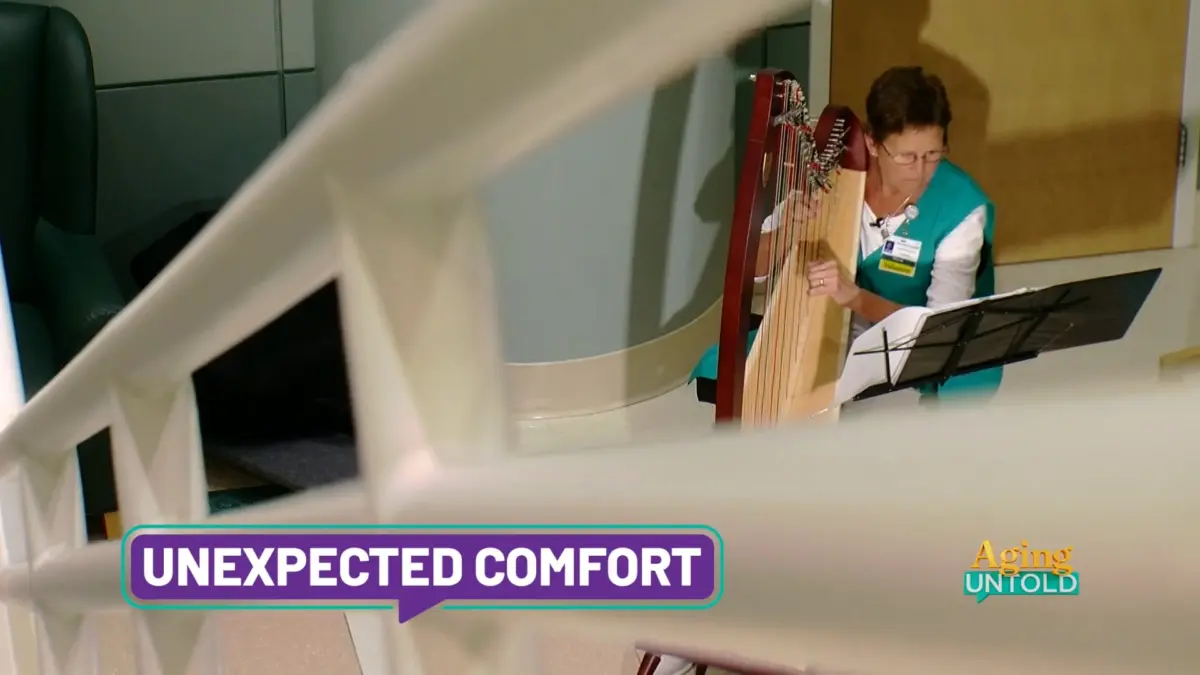
For more than a year, volunteer Peg Mann has dedicated her Thursdays to a unique form of patient and family care. A multi-instrumentalist who also plays the piano and organ, Mann brings her harp into the beating heart of the hospital’s waiting areas. But her contribution extends far beyond musical performance. Her presence is a masterclass in integrative healthcare support—a holistic approach that recognizes the profound connection between emotional well-being, stress reduction, and clinical healing.
Beginning her shifts at the crack of dawn at 5:30 a.m., Mann’s day involves far more than plucking strings. She navigates the facility as a multi-faceted volunteer, escorting vulnerable patients, pushing the hospital’s comfort cart, and offering a compassionate ear to stressed relatives. Yet, it is her time behind the harp that has cemented her status as an indispensable pillar of the McLeod Seacoast community.
This article explores the mechanics of this unique volunteer initiative, examining the psychology of music in clinical environments, tracing a day in the life of a hospital harpist, capturing official perspectives from hospital leadership, and looking at the broader future of arts-in-medicine programs across healthcare systems.
Detailed Chronology: A Day in the Life of a Hospital Volunteer
To truly understand the impact of Peg Mann’s ministry of music, one must examine the arc of her weekly commitment. Her Thursdays do not begin with the soothing strains of classical arrangements; rather, they start in the pre-dawn quiet long before most of the region wakes up.
The 5:30 A.M. Genesis
At 5:30 a.m., while the coastal South Carolina sky is still bruised with the colors of night, Mann reports for duty at McLeod Seacoast Hospital. As part of the facility’s dedicated volunteer and student services program, she does not walk in with her harp case. Her initial responsibilities are grounded in the tangible, high-touch logistical needs of a bustling surgical morning.
Thursdays are intentionally chosen because they represent the peak volume for same-day surgeries at the facility. Patients arrive in waves, many of them fasting, anxious about impending procedures, and wrestling with the unknown. Mann’s early morning hours are spent on her feet, providing vital frontline support. She serves as a patient escort, navigating the labyrinthine hallways to guide individuals safely to their registration points and pre-op bays.
Following her escort duties, Mann transitions to managing the hospital’s "comfort cart." Pushing the cart from waiting area to waiting area, she delivers basic amenities—warm blankets, reading materials, water, and hygiene items—to patients and their families. More importantly, she delivers human contact. In a healthcare setting where clinical efficiency can sometimes inadvertently feel clinical or detached, Mann’s gentle demeanor and attentive listening offer an immediate grounding effect for panicked family members.
Transitioning to the Strings
As the morning progresses and the surgical suites reach maximum operational capacity, the waiting rooms begin to fill with nervous spouses, parents, and children. This is the inflection point of Mann’s shift. She transitions from the logistical support cart to her instrument, setting up her harp in strategic locations designed to maximize acoustic reach without obstructing clinical workflows or emergency pathways.
Once seated behind the grand, intricate wooden frame of her harp, Mann undergoes a metamorphosis. The logistical coordinator fades away, replaced by a focused musician completely attuned to the vibrational qualities of her instrument. For hours, she plucks a curated repertoire of relaxing compositions, hymns, and spiritual selections. Among her signature pieces is a gentle arrangement titled "Angel’s Hymn."
Throughout her musical sets, Mann does not isolate herself behind an invisible barrier. She remains acutely aware of the human drama unfolding around her. When she notices a family member visibly weeping or pacing in distress, she seamlessly integrates breaks into her playing, walking over to offer a comforting word, an embrace, or a listening ear.
"Either they come up and visit, or I take the time to go and visit with them too," Mann notes of her interactions with waiting families. "I get lots of hugs and kisses."
By the time her shift concludes, Mann has traversed the full spectrum of hospital care: from physical logistics and comfort items to emotional counseling and acoustic therapy.
Supporting Context & Metrics: The Science of Music in Healing Environments
While the inclusion of a harpist in a regional hospital waiting room might initially sound like an anomalous luxury, a growing body of medical research validates the profound clinical utility of live music in healthcare settings.
The Psychophysiology of Waiting Room Anxiety
Surgery waiting rooms are traditionally breeding grounds for acute psychological stress. Elevated anxiety levels in family members are well-documented to correlate with increased blood pressure, elevated heart rates, and impaired immune function. For patients undergoing same-day surgery, pre-operative anxiety can complicate anesthesia management, elevate the required dosages of sedatives, and negatively impact post-operative recovery metrics.
Arts-in-medicine programs leverage the concept of psychoneuroimmunology—the study of the interactions between the central nervous system and the immune system. Live, gentle acoustic music, such as that produced by a harp, operates at frequencies and tempos that can induce the "relaxation response," a physiological state diametrically opposed to the fight-or-flight stress response.
Why the Harp?
The choice of the harp as a therapeutic instrument is uniquely intentional. Unlike percussion or brass instruments, which can startle or overwhelm an already sensitive acoustic environment, the harp produces naturally rich, harmonic overtones. The plucked strings create a sustained, decaying resonance that mimics natural sounds—such as flowing water or rustling leaves—which human evolutionary biology interprets as safe and non-threatening.
Furthermore, the physical presence of a harpist introduces an element of visual and auditory distraction. In a psychology context, "positive distraction" diverts cognitive processing away from catastrophic thinking or obsessive worry regarding a loved one’s surgical outcome. When a patient or family member watches a musician deeply absorbed in the physical act of playing, their cognitive load is temporarily shifted, providing a much-needed mental respite.
Mann’s Musical Evolution
Mann’s journey to becoming a hospital harpist is rooted in a lifelong dedication to musical expression. Long before she ever stepped foot into McLeod Seacoast Hospital, Mann mastered the piano and the organ, developing a deep appreciation for liturgical and meditative music.
However, her artistic curiosity led her to expand her musical boundaries. In 2005, she formally added the harp to her repertoire—a notoriously challenging instrument requiring rigorous finger independence, spatial coordination, and physical stamina. Far from treating it as a casual hobby, Mann maintains an ongoing educational commitment, taking professional harp lessons three times a month to refine her technique.
Her performance background spans weddings, church services, and community events, but she has found her most resonant calling within the walls of a medical facility, proving that music can transcend traditional performance venues to serve a deeply humanitarian purpose.
Official Statements: Leadership Perspectives on a Unique Partnership
When volunteer programs are introduced into high-efficiency healthcare systems, hospital administrators must weigh artistic initiatives against clinical priorities. At McLeod Seacoast Hospital, the integration of Peg Mann’s harp playing was met with initial caution, which rapidly blossomed into enthusiastic endorsement.
Overcoming Initial Skepticism
Peggy Skudera, the volunteer manager at McLeod Seacoast who ultimately hired Mann, admits that she was initially hesitant about the prospect of placing a harpist in a hospital setting. The hesitation was not born of a lack of appreciation for the arts, but rather a pragmatic, frontline awareness of the existential realities of hospital care.
"I wasn’t sure a harp was the best place to be in a hospital because my thought was, next stop is heaven," Skudera candidly shared, referencing the common cultural trope associating harp music with the afterlife.
However, any apprehension Skudera initially held evaporated the moment she observed Mann interact with the hospital environment and her instrument. Rather than evoking somber themes, Mann’s playing introduced an aura of profound peace, dignity, and calm.
Witnessing the "Marriage" to the Instrument
Skudera offers a vivid description of Mann’s performance style, highlighting the absolute immersion the volunteer experiences when she begins to play.
"When you see her play it, you can see she is so in tune and so married to that harp," Skudera remarked. "It’s absolutely amazing that she doesn’t know what’s going on around her. She doesn’t know all the people are listening. All the people that are looking at her."
This deep level of focus creates an authentic, unforced ambiance. Because Mann is not playing for applause or validation—preferring to remain strictly in the background—her music feels organic and unpretentious.
A Pillar of the McLeod Family
Over the course of her tenure exceeding one year, Mann has transcended the formal title of "volunteer." According to hospital leadership, she has woven herself into the very fabric of the organization.
"We could not be happier to have her here," Skudera stated, emphasizing that Mann is now considered an integral member of the McLeod family.
For her part, Mann views the relationship as entirely reciprocal. While she pours emotional and physical energy into her shifts—standing for hours, pushing carts, offering hugs, and plucking strings—she insists that the emotional return on investment heavily favors her.
"I feel like I have new friends every day when I go home," Mann reflects. For a volunteer who explicitly states that being the center of attention is "not my cup of tea," the quiet, behind-the-scenes bond she builds with strangers represents the ultimate reward.
Future Outlook: The Expanding Role of Arts in Modern Healthcare
As the healthcare industry continues its post-pandemic evolution, systems are increasingly recognizing that clinical excellence must be paired with compassionate, patient- and family-centered environments. Initiatives like the one championed by Peg Mann at McLeod Seacoast Hospital point the way toward the future of holistic medicine.
The Integration of Integrative Medicine
Hospitals across the United States are steadily institutionalizing "arts-in-medicine" or "humanities in healthcare" departments. No longer viewed as superfluous budget items, these programs are being evaluated for their measurable impacts on patient length of stay, requirements for pain medication, and overall patient satisfaction scores (such as HCAHPS metrics).
By embedding musicians, therapy animals, certified art therapists, and mindfulness practitioners into daily operations, hospitals are addressing the whole patient—mind, body, and spirit. The success of Mann’s residency at McLeod Seacoast demonstrates that even grassroots, volunteer-driven initiatives can have an outsized impact on the institutional culture of a facility.
Scalability and Community Engagement
The model established at McLeod Seacoast highlights the vital bridge that community volunteers can build between a sterile medical institution and the local populace. By opening its doors to unique artistic contributions, the hospital humanizes its spaces, transforming intimidating clinical environments into community sanctuaries of healing.
Looking ahead, hospital volunteer programs are increasingly looking to replicate this success by actively recruiting multi-instrumentalists, vocalists, and creative artists who understand the delicate balance required to perform in a clinical setting. The core requirements—empathy, emotional intelligence, stamina, and professional boundaries—are competencies that can transform routine waiting rooms into spaces of grace.
Conclusion
In an era dominated by rapid technological advancement, electronic health records, and complex surgical interventions, the ancient art of the harp reminds us of the irreplaceable value of simple human presence. Through her unwavering Thursday routine, Peg Mann proves that healing is not solely the domain of scalpels, pharmaceuticals, and monitors. Sometimes, healing begins with a gentle melody, a reassuring hug, and the quiet assurance that, even in moments of profound vulnerability, you are not alone.

0 Comments