
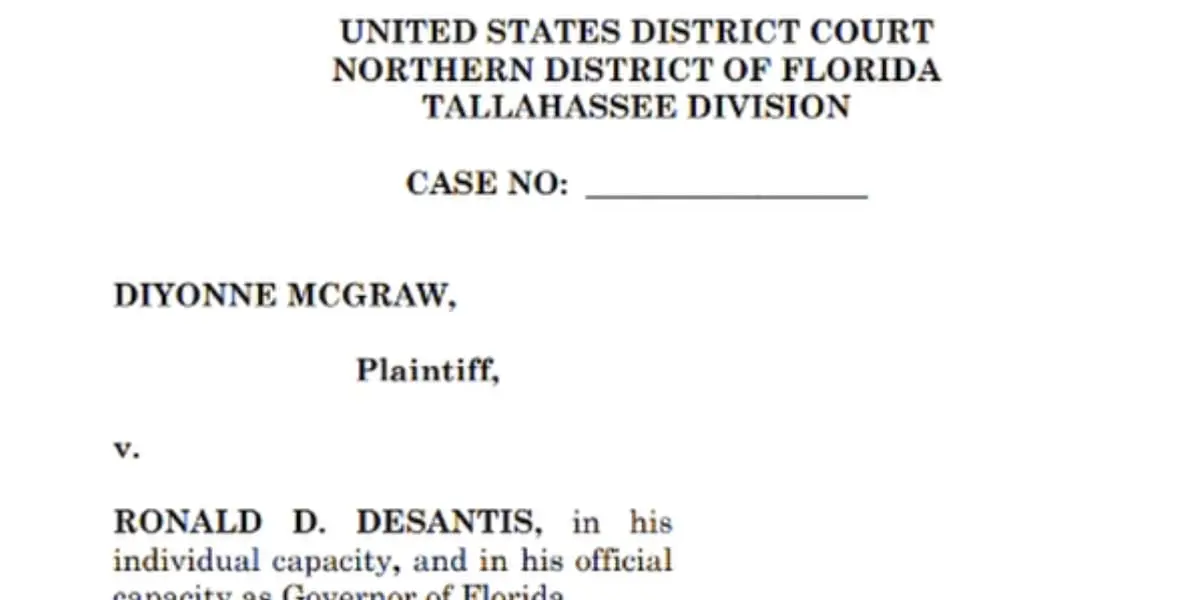

GAINESVILLE, Fla. — More than five years after her controversial ouster from public office, former Alachua County School Board Member Diyonne McGraw is taking her fight to the federal judiciary. In a high-stakes legal challenge filed in the U.S. District Court, McGraw has launched a direct assault on Florida Governor Ron DeSantis’s executive authority, alleging that her abrupt removal from office violated her fundamental constitutional right to due process.
The lawsuit resurrects one of the most polarizing local political flashpoints in North-Central Florida’s recent history. McGraw contends that the executive action stripping her of her elected seat was legally baseless, politically motivated, and executed without the essential constitutional safeguards designed to protect elected officials and the constituents who voted for them.
As this federal litigation unfolds, it threatens to reopen old wounds regarding executive overreach, local governance autonomy, and the murky intersection of residency requirements and constitutional protections in Florida politics.
Executive Overview
The core of Diyonne McGraw’s federal lawsuit hinges on a foundational American legal principle: the right to due process before being deprived of property or liberty—a category that courts have increasingly applied to the rights of democratically elected officials to serve out their terms.
According to court filings, McGraw argues that Governor Ron DeSantis acted unilaterally and without adequate evidentiary foundations when he issued an executive order removing her from the District 4 seat on the Alachua County School Board in 2021. The state’s official justification at the time was that McGraw did not legally reside within the boundaries of the district she was elected to represent—an allegation that McGraw vehemently denied then, and continues to challenge today.
The ramifications of this legal battle extend far beyond McGraw’s individual political career. If the federal court decides in McGraw’s favor, it could establish a significant precedent regarding the limits of gubernatorial power in Florida. Under state law, the governor possesses broad authority to suspend or remove local elected officials for malfeasance, misfeasance, neglect of duty, or failure to meet residency requirements. However, critics and civil rights advocates have long questioned whether these executive suspensions afford officials adequate procedural protections to defend themselves against administrative or political maneuvers.
While McGraw ultimately lost her subsequent re-election bid in 2022, her legal team argues that the damage inflicted by the 2021 removal was both professional and constitutional. The lawsuit seeks judicial recognition of the alleged rights violations, potentially paving the way for damages and a formal legal repudiation of the manner in which her removal was executed.
Detailed Chronology of Events
To understand the gravity of the current federal lawsuit, it is necessary to retrace the timeline of events that began with a historic electoral victory and culminated in an executive removal and a subsequent electoral defeat.
November 2020: A Historic Triumph
Diyonne McGraw secured a decisive victory in the November 2020 general election, winning the race for the District 4 seat on the Alachua County School Board. Her campaign focused heavily on equity in education, closing achievement gaps, and addressing the systemic challenges facing public school students in Alachua County. Her supporters celebrated her win as a step forward for diverse representation on the board.
Spring 2021: The Residency Accusations Surface
Shortly after taking office, whispers and formal inquiries began circulating regarding McGraw’s residential address. Political opponents and concerned citizens alleged that McGraw’s actual, primary residence was located outside the geographic boundaries of District 4. Under Florida law, school board members must reside within the district they represent at the time of election and throughout their tenure.
McGraw maintained that she maintained proper residency within the district, pointing to her living arrangements and the complexities of modern residential definitions. However, the political pressure mounted rapidly, drawing the attention of state-level Republican leaders and the executive office.
June 2021: The Executive Order of Removal
The controversy reached its climax in June 2021, when Governor Ron DeSantis issued an executive order formally removing McGraw from office. The order cited statutory provisions concerning residency requirements, determining that McGraw was ineligible to hold the District 4 seat.
Crucially, McGraw’s legal team argues that this removal was conducted via an administrative fiat that bypassed the rigorous evidentiary hearings and procedural safeguards that should accompany the termination of an official elected by the people. Without a comprehensive fact-finding process or an opportunity to fully challenge the state’s evidence in a neutral forum, McGraw was abruptly stripped of her post.
July 2021: The Appointment of Mildred Russell
To fill the sudden vacancy, Governor DeSantis appointed conservative activist Mildred Russell to the District 4 seat. Russell’s appointment immediately altered the ideological balance and dynamic of the Alachua County School Board, introducing a sharp conservative voice to a board that had historically leaned differently on major policy matters. Russell’s tenure was marked by intense debates over curriculum, mask mandates during the COVID-19 pandemic, and administrative leadership.
August 2022: The Re-Election Bid and Defeat
With the political landscape of Alachua County shifted, McGraw sought to reclaim her political footing during the 2022 election cycle. Running in the newly configured district lines, McGraw faced a challenging political environment. Her removal by the governor had cast a long shadow over her campaign, and she ultimately lost her re-election bid, allowing Russell and other candidates to shape the board’s direction moving forward.
Present Day: The Federal Lawsuit
Refusing to let the matter rest, McGraw and her legal counsel spent years preparing a comprehensive constitutional challenge. By taking the case to federal district court rather than state administrative bodies, McGraw signaled that she views her removal not merely as a local political dispute, but as a systemic violation of federal civil rights and constitutional due process.
Supporting Context & Metrics
The legal battle between McGraw and Governor DeSantis sits at the intersection of local educational governance, state executive overreach, and Florida’s complex statutory framework regarding public office.
The Power of Executive Suspension and Removal in Florida
Under Article IV, Section 7 of the Florida Constitution, the governor holds sweeping powers to suspend municipal and county officials—a category that historically includes school board members—for offenses ranging from malfeasance and misfeasance to incompetence and failure to meet qualifications for office, such as residency.
While these executive powers are designed to ensure accountability and integrity in public office, critics have long argued that the process lacks sufficient checks and balances. Unlike impeachment, which requires legislative action, gubernatorial suspensions are unilateral executive acts. While suspended officials can challenge their suspensions before the Florida Senate—which holds the ultimate authority to reinstate or remove an official permanently—the initial removal is executed swiftly by the governor’s pen.
In McGraw’s case, because the removal was framed around residency qualifications rather than criminal malfeasance, the administrative pathways available to her were severely constrained, prompting her current federal due process strategy.
Alachua County Public Schools: A Snapshot
To understand the stakes of the school board seat, it is essential to examine the district itself. Alachua County Public Schools (ACPS) serves tens of thousands of students across Gainesville and the surrounding unincorporated areas.
- Student Enrollment: Approximately 27,000 to 29,000 students annually.
- Workforce: One of the largest employers in Alachua County, employing over 4,000 teachers, administrators, and support staff.
- Operating Budget: Hundreds of millions of dollars in annual expenditures, covering operational costs, capital improvements, and federal/state educational grants.
- Board Composition: A five-member elected body responsible for setting district policy, approving the annual budget, hiring and evaluating the superintendent, and overseeing the educational welfare of the county’s children.
When District 4 was left vacant by McGraw’s removal and subsequently filled by gubernatorial appointment, it altered the representation of thousands of constituents who had cast their ballots for McGraw’s specific platform of community-driven educational reform.
Official Statements and Legal Arguments
As the federal lawsuit makes its way through the court system, legal analysts, representatives for the governor, and McGraw herself have articulated distinct positions that highlight the profound constitutional questions at stake.
Diyonne McGraw’s Legal Stance
McGraw’s federal complaint centers squarely on the Fourteenth Amendment of the U.S. Constitution, which prohibits states from depriving any person of life, liberty, or property without due process of law.
In her filings, McGraw argues that holding public office, once bestowed by the voters through a legitimate democratic election, constitutes a protected interest. Consequently, removing an elected official requires rigorous procedural safeguards—including notice, an opportunity to confront accusers, an independent evidentiary hearing, and a neutral arbiter.
Her attorneys contend that Governor DeSantis’s 2021 executive order short-circuited these rights, substituting executive decree for constitutional fairness. McGraw’s legal team is seeking judicial relief that acknowledges the constitutional violation, aiming to set a legal boundary on executive authority in future local governance disputes.
The Governor’s Office Response
While formal legal responses from Governor DeSantis’s counsel are being filed in the U.S. District Court, the administration has historically defended its suspension and removal powers as essential to maintaining the rule of law and ensuring that elected officials strictly adhere to constitutional and statutory qualifications.
State attorneys are expected to argue that residency requirements are absolute prerequisites for holding office. Under this legal theory, if an official fails to meet or maintain the statutory residency requirements, they fundamentally lack the legal standing to hold the seat, thereby rendering executive intervention appropriate to correct a vacancy issue. Furthermore, the state is expected to raise procedural defenses, including questions regarding the statute of limitations given that the removal occurred in 2021, as well as arguments concerning executive immunity.
Future Outlook: Legal Precedents and Political Repercussions
The resolution of McGraw v. DeSantis will be closely watched by legal scholars, municipal leaders, and civil rights advocates across Florida and the broader United States.
Potential Legal Outcomes
- Dismissal on Procedural Grounds: The federal court could rule in favor of the state by dismissing the lawsuit based on the statute of limitations, qualified immunity, or the principle of federalism—arguing that state courts and the Florida Legislature are the appropriate venues for resolving disputes regarding local executive removals.
- A Landmark Due Process Ruling: If the federal court denies the state’s motion to dismiss and proceeds to a full trial or summary judgment in McGraw’s favor, it could establish a groundbreaking precedent requiring enhanced procedural due process before a Florida governor can remove an elected official. Such a ruling would fundamentally alter how executive oversight is exercised throughout the state.
- Monetary and Reputational Vindication: While McGraw cannot be retroactively restored to a term that has already expired and been decided by subsequent elections, a favorable ruling would provide significant personal and professional vindication, potentially opening the door for legal damages related to lost compensation and reputational harm.
Broader Political Implications
Beyond the courtroom, this lawsuit serves as a sharp reminder of the ongoing friction between local democratic autonomy and state-level executive power in Florida. In recent years, Florida has seen numerous legislative and executive clashes over local control, spanning education, public health, zoning, and municipal governance.
By challenging the governor’s 2021 action in a federal forum, Diyonne McGraw has ensured that the debate over the limits of executive power will remain at the forefront of Florida’s political discourse. As the federal district court begins reviewing the briefs and scheduling hearings, the case of McGraw v. DeSantis stands as a defining test of the constitutional boundaries governing elected office in the Sunshine State.

0 Comments