
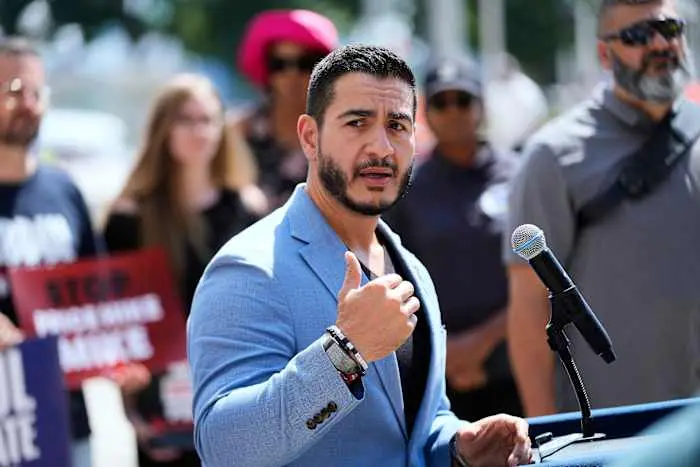

LANSING, Mich. — In a significant political pivot aimed at consolidating a fractured party base, Michigan Democratic U.S. Senate nominee Abdul El-Sayed issued a direct apology on Saturday to the state’s Jewish Democratic Caucus. The address, delivered at a high-stakes state party convention in Lansing, represented El-Sayed’s most direct effort to mend fences with a key constituency following months of turbulence stemming from past statements, controversial associations, and a bruising primary election.
The apology centers on remarks El-Sayed made in the wake of a violent March attack on Temple Israel, a prominent synagogue in a Detroit suburb. By addressing the caucus directly, El-Sayed hopes to move past a sequence of controversies that have complicated his high-profile campaign against Republican nominee Mike Rogers—a race that remains a focal point in the national battle for control of the United States Senate.
Executive Overview
The intersection of foreign policy, domestic security, and local community relations has defined much of Michigan’s 2026 political landscape. Abdul El-Sayed, a progressive physician and former Wayne County health official who secured the Democratic nomination after defeating U.S. Rep. Haley Stevens in a contentious primary, has faced sustained scrutiny regarding his rhetoric concerning the Middle East and antisemitism.
Saturday’s address in Lansing was designed to draw a line under these controversies. Recognizing that party unity is paramount in a battleground state where every demographic block can tip a statewide election, El-Sayed acknowledged that his initial reaction to the March synagogue shooting caused deep pain within the Jewish community.
While the campaign continues to navigate the complex dynamics of the general election against Republican nominee Mike Rogers, El-Sayed’s admission marks a tactical shift toward contrition and coalition-building. Observers note that the success of his Senate bid may well depend on his ability to reassure moderate and Jewish voters that he can effectively represent the interests of all Michiganders, even as national and international issues continue to cast a long shadow over domestic politics.
Detailed Chronology: From Tragedy to Political Fallout
To understand the weight of El-Sayed’s Saturday apology, it is necessary to examine the timeline of events that began in early spring and culminated at the Lansing party convention.
March 2026: The Attack on Temple Israel
The crisis originated on a Sunday in March, when a violent incident shook the Detroit metropolitan area. A man later identified as Ayman Mohammad Ghazali targeted Temple Israel in West Bloomfield Township, a prominent suburban synagogue. According to federal and local law enforcement investigations, Ghazali rammed his vehicle into the facility and opened fire on a security guard before dying by suicide.
Subsequent FBI investigations revealed a tragic personal background: just one week prior to the attack, Ghazali had lost four family members in an Israeli airstrike in Lebanon. The convergence of international conflict and domestic violence immediately heightened tensions across Michigan, a state home to significant Arab-American and Jewish communities.
The Immediate Aftermath and the "Context" Controversy
In the hours following the tragedy, elected officials and community leaders rushed to condemn the violence. However, a video response released by El-Sayed sparked immediate and intense backlash. Addressing the underlying motivations of the shooter, El-Sayed remarked that "hurt people hurt people," referencing the devastating loss Ghazali’s family had suffered overseas.
Critics, including local civil rights organizations, Jewish community leaders, and political opponents, swiftly condemned the phrasing. Opponents argued that the statement served to rationalize or justify a violent antisemitic attack on a house of worship.
For weeks, the comment remained a flashpoint. It compounded existing criticisms El-Sayed had faced during his primary campaign—including scrutiny over his public association with polarizing commentator Hasan Piker—leaving many Jewish Democrats feeling alienated and concerned about the direction of the party’s leadership.
The Summer Primary and the Need for Healing
The controversy persisted through a hard-fought primary battle that pitted El-Sayed against U.S. Rep. Haley Stevens. The primary exposed deep ideological and demographic divisions within the Michigan Democratic Party, pitting progressives against more moderate factions. Although El-Sayed ultimately emerged victorious, securing the nomination, the path forward required urgent bridge-building.
Recognizing that a fractured party could not prevail in November against Republican nominee Mike Rogers, the El-Sayed campaign began strategic outreach to disaffected groups. Saturday’s appearance before the Jewish Democratic Caucus in Lansing was the centerpiece of this reconciliation effort.
Supporting Context & Metrics: The Michigan Senate Landscape
The political chessboard in Michigan is uniquely complex, driven by shifting demographic patterns, economic realities, and national legislative stakes.
The Electoral Math
Michigan is perennial battleground territory. With the U.S. Senate currently balanced on a knife-edge, the seat—formerly held by retiring or open-office dynamics—is one of a handful nationwide that will determine which party controls the chamber.
- The Opponent: Republican nominee Mike Rogers, a former U.S. Representative and intelligence committee chair, presents a formidable challenge. Rogers has leveraged security concerns, economic anxieties, and criticisms of progressive foreign policy stances to rally conservative and independent voters.
- The Margin of Error: Statewide races in Michigan are traditionally decided by razor-thin margins. In 2024 and preceding cycles, victories frequently hinged on turnout in Wayne, Oakland, and Macomb counties, as well as the ability of nominees to hold diverse coalitions together.
- The Demographics: Michigan hosts one of the largest concentrations of Arab-American and Muslim voters in the United States, alongside a vibrant, politically active Jewish community. Balancing the competing domestic priorities, security concerns, and foreign policy perspectives of these constituencies is a high-wire act for any statewide candidate.
The Antisemitism Debate and Progressive Politics
El-Sayed’s struggles reflect a broader national debate within the Democratic Party regarding Israel, Palestine, and the boundaries of acceptable political discourse. Progressive candidates, who often champion Palestinian human rights and criticize Israeli military operations, have frequently found themselves on the defensive regarding how they address antisemitism at home.
Incidents like the Temple Israel attack thrust these ideological debates into stark, dangerous relief, transforming abstract foreign policy discussions into immediate questions of local public safety and community trust.
Official Statements and Public Remarks
The core of Saturday’s news development lay in the precise language used by El-Sayed during his press briefing following the Jewish Democratic Caucus address in Lansing.
Addressing reporters outside the convention hall, El-Sayed did not shy away from the controversy. He confronted the criticism head-on:
“My comments may have been misconstrued to justify something I did not mean to justify,” El-Sayed told reporters. “To anyone who feels like my comments might have been hurtful, I’m really sorry. That was not my intention.”
El-Sayed elaborated on the distinction between offering geopolitical context and managing the immediate trauma of domestic violence against houses of worship:
“What I was trying to do was offer context for why it happened, but it wasn’t the time for context,” he said. “And you don’t ever want to trample somebody’s pain.”
Reaction from the Jewish Democratic Caucus and broader community stakeholders was mixed, reflecting the depth of the initial wound. While some leaders welcomed the acknowledgment as a necessary and sincere step toward healing, others emphasized that words must be backed by sustained engagement, dialogue, and unequivocal protections for vulnerable religious institutions across Michigan.
Meanwhile, the Republican campaign was quick to seize on the ongoing controversy. Representatives for Mike Rogers issued statements arguing that El-Sayed’s initial remarks revealed a fundamental lack of judgment on issues of public safety and national security, signaling that the GOP intends to keep the March incident at the forefront of campaign debates leading up to November.
Future Outlook: The Path to November
As the general election cycle enters its final, intensive stretch, Abdul El-Sayed faces a narrow and demanding path. The primary is behind him, but the political scars remain visible.
Key Milestones Ahead
- Debate Stages: El-Sayed and Mike Rogers are expected to face off in high-profile televised debates. Foreign policy, domestic security, and community relations will undoubtedly serve as central themes.
- Coalition Consolidation: The effectiveness of Saturday’s apology will be measured in the coming weeks by whether major donors, party stalwarts, and grassroots organizers within the Jewish Democratic Caucus actively campaign for El-Sayed.
- General Election Messaging: The campaign must balance energizing its progressive base—which initially rallied around El-Sayed’s policy platforms on healthcare, labor, and economic justice—with reassuring moderate and independent voters who remain skeptical of his past rhetoric.
Conclusion
The road to the U.S. Senate from Michigan has historically demanded broad-based coalitions and disciplined message management. For Abdul El-Sayed, acknowledging past missteps in Lansing on Saturday was a calculated and necessary exercise in political survival and leadership. Whether this act of contrition is sufficient to heal divisions and secure victory in November remains one of the most compelling storylines of the 2026 midterm election cycle.

0 Comments