

By Global News Desk
Published: August 17, 2026
Executive Overview
The diplomatic landscape across the Middle East reached a precarious crossroads on Monday, August 16, 2026, as a critical 60-day negotiating window between the United States and Iran expired without a breakthrough. Hopes for an immediate, comprehensive peace accord to formally end the ongoing hostilities have faded, leaving both Washington and Tehran seemingly as far apart as they were when talks initially commenced two months ago.
Simultaneously, regional tensions continue to ripple outward from ongoing conflicts in Gaza, Lebanon, and strategic maritime corridors. In Tehran, Iranian officials announced they are nearing a bilateral agreement with Oman regarding a managed shipping transit plan for the vital Strait of Hormuz—a crucial economic lifeline that has remained heavily disrupted since the onset of the conflict in late February. However, whether this proposed maritime framework will satisfy stringent U.S. criteria remains entirely uncertain, threatening to prolong an American-led blockade of Iranian ports.
Further compounding the regional crisis, high-stakes shuttle diplomacy is underway on multiple fronts. Middle East negotiator and presidential emissary Jared Kushner held direct talks with Israeli Prime Minister Benjamin Netanyahu in an urgent bid to secure approval for a U.S.-backed, 15-point Gaza road map. These consultations followed Kushner’s recent meetings in Egypt with senior Hamas leadership regarding disarmament. While Hamas has publicly expressed readiness to adopt the road map—urging international mediators to compel Israeli compliance—Prime Minister Netanyahu has balked at its stipulations, demanding the complete disarmament of Hamas prior to any withdrawal of Israeli troops. With Israeli forces currently occupying roughly 60% of the Gaza Strip, the path toward a sustainable ceasefire remains fraught with geopolitical peril.
Detailed Chronology: The Escalating Crisis and Diplomatic Impasse
The Spark of Conflict: February 2026
The current phase of the regional conflagration traces back to February 28, 2026, when coordinated military strikes launched by Israel and the United States targeted strategic infrastructure within Iran. In swift retaliation, Iran effectively closed the Strait of Hormuz—a narrow waterway through which approximately one-fifth of the world’s traded oil supplies historically flowed. The closure crippled international energy markets, prompting the United States to institute a rigorous naval blockade of Iranian ports, choking off vital maritime trade.
The 60-Day Negotiation Window
In the weeks following the initial exchange, international pressure mounted to prevent a wider, protracted regional war. Mediators successfully established a 60-day diplomatic negotiating period aimed at addressing both the maritime blockades and the broader nuclear and security architecture of the region. Throughout this period, backchannel communications facilitated by regional partners like Oman sought to bridge the vast chasm between Washington’s uncompromising security demands and Tehran’s strategic red lines.
As of Monday, August 16, 2026, that 60-day clock expired. Despite intense international scrutiny, no formal extensions have been announced, and representatives from both capitals have failed to sign any binding accords, plunging the diplomatic track into profound uncertainty.
The Diplomatic Shuffle: Kushner’s Regional Tour
Parallel to the U.S.-Iran deadlock, American diplomatic efforts have zeroed in on the shattered Gaza Strip and its humanitarian disaster. Jared Kushner, operating as a special envoy under the auspices of the newly established U.S.-backed "Board of Peace," embarked on a high-stakes diplomatic mission.
On Sunday, August 15, Kushner met with Hamas chief Khalil al-Hayya in Egypt to discuss the technical and security parameters of militant disarmament. Moving swiftly to Israeli soil, Kushner sat down with Prime Minister Benjamin Netanyahu on Monday to press for the adoption of a comprehensive 15-point road map designed to formalize a durable truce. However, the negotiations hit a stubborn procedural wall over the sequencing of troop withdrawals versus militant disarmament.
Supporting Context & Metrics: The Human and Economic Toll
The Strait of Hormuz and Global Energy Markets
The disruption of the Strait of Hormuz represents one of the most severe economic shocks of the 2026 conflict. Prior to the February 28 escalation, the strait served as the world’s most critical petroleum chokepoint, facilitating the transit of nearly 20% of globally traded crude oil. Its closure—enforced by Iranian maritime positioning and met by the U.S. naval blockade—has cast long shadows over international supply chains, driving inflation and energy volatility across Europe, Asia, and the Americas.
Humanitarian Realities on the Ground
While diplomats debate shipping maps and disarmament clauses, the human cost of the protracted war continues to mount across multiple theaters:
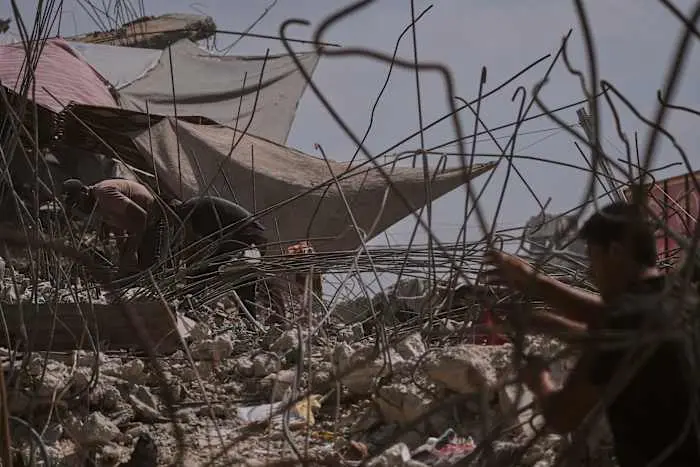
- Gaza City: Daily survival remains an exercise in profound resilience. Palestinians in Gaza City have been documented scavenging through the debris of buildings leveled by Israeli airstrikes, carefully extracting iron and structural rebar. This salvaged material is repurposed for basic construction, hastily built tents, or sold in informal local markets just to secure meager daily sustenance.
- Beirut Suburbs: The wider regional fallout was starkly visible on Sunday, August 16, during the emotional funeral procession in the southern suburbs of Beirut. Mourners gathered to bury Ali al-Haj Hassan, a member of Hezbollah, alongside his wife and four children, all of whom perished in a targeted Israeli airstrike just days prior.
- Territorial Control in Gaza: Military analysts report that Israeli ground forces currently maintain operational control over approximately 60% of the Gaza Strip. Prime Minister Netanyahu’s administration has repeatedly signaled a willingness to push forces even deeper into remaining urban enclaves should political agreements fail to materialize.
Official Statements and Diplomatic Postures
Tehran and the Omani Transit Proposal
Addressing reporters in Tehran on Monday, Iranian Foreign Affairs spokesperson Esmail Baghaei provided a cautious update regarding ongoing maritime discussions with Oman, a neighbor sharing jurisdiction over the mouth of the Strait of Hormuz.
"An understanding has been reached regarding the map of the transit route," Baghaei told reporters during his weekly press briefing.
While comprehensive details remain under wraps, preliminary intelligence and diplomatic leaks indicate that the proposed transit scheme would establish a dual-lane approach. Inbound commercial vessels would navigate through a designated corridor hugging the Iranian coastline, while outbound traffic would exit via lanes closer to Omani waters. Crucially, the interim framework stipulates that navigating ships would transit the strait exempt from operational fees or tolls.
However, Baghaei openly acknowledged the sluggish pace of the bilateral talks, noting:
"We had planned, and still plan, to finalize the understanding in the form of a package: the map plus a joint statement."
Despite Tehran’s optimism regarding the Omani mediation, Washington has maintained that any resolution concerning the strait must be inextricably linked to a broader security settlement before the U.S. will lift its crippling blockade on Iranian ports. It remains highly doubtful whether the Oman-brokered transit layout will satisfy the stringent strategic conditions set down by the White House.
Washington, Hamas, and the Israeli Cabinet
The diplomatic standoff surrounding the 15-point Gaza road map has exposed deep fractures between the United States, its Israeli allies, and Hamas leadership.
Hamas officials have formally communicated their acceptance of the U.S.-backed road map—a framework that explicitly incorporates provisions for militant disarmament. Capitalizing on this position, Hamas leadership has publicly called upon international mediators and the newly formed U.S. "Board of Peace" to leverage their influence and "compel" the Israeli government to sign the agreement without further delay.
Conversely, Prime Minister Netanyahu’s government has flatly rejected the current formulation of the road map. The core point of contention centers on the sequence of implementation:
- The U.S./Hamas Interpretation: The road map envisions phased Israeli troop withdrawals from occupied sectors of Gaza running parallel to gradual disarmament steps.
- The Israeli Stance: Jerusalem insists that Hamas must undergo total and verifiable disarmament prior to the initiation of any military withdrawal by the Israel Defense Forces (IDF). Netanyahu’s administration maintains that leaving 40% of Gaza under militant influence while initiating a pullout presents an unacceptable security vacuum.
Future Outlook: What Lies Ahead
As the 60-day diplomatic deadline lapses without a formal U.S.-Iran accord, the immediate future of the Middle East hangs in a delicate balance. Several critical trajectories will define the region’s stability in the coming weeks:
- The Fate of Maritime Navigation: If Iran and Oman formally release their joint statement regarding the Strait of Hormuz, the international community will watch closely to see how Washington responds. Should the U.S. reject the transit map as insufficient, the continued closure of the strait threatens to provoke renewed naval skirmishes and deepen global economic strains.
- The Gaza Truce Impasse: With Jared Kushner continuing his consultations in Jerusalem, intense pressure is being applied to break the stalemate over the 15-point road map. Failure to bridge the gap between Netanyahu’s demand for unconditional disarmament and Hamas’s insistence on simultaneous Israeli withdrawals could trigger a major new military offensive in Gaza.
- Regional Containment Risks: The steady stream of casualties—from the rubble-strewn streets of Gaza City to mourning processions in Beirut—underscores the ever-present danger of wider regional escalation. As formal diplomatic channels experience severe friction, the risk of miscalculation by proxy actors or sovereign militaries remains dangerously elevated.
International monitors emphasize that unless backchannel negotiators can rapidly inject fresh momentum into the stalled frameworks, the region risks sliding deeper into a prolonged cycle of low-intensity attrition and economic strangulation.

0 Comments