
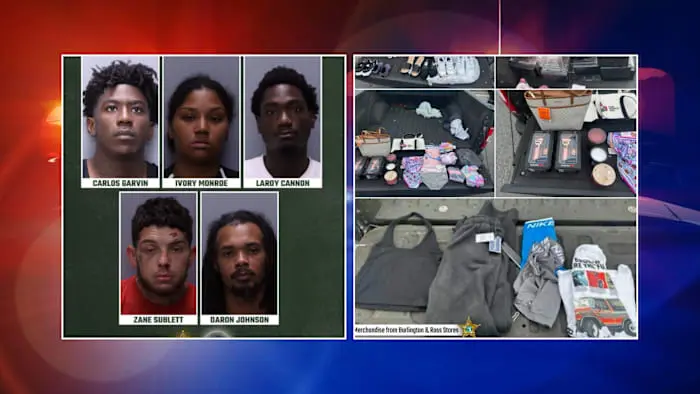

ST. JOHNS COUNTY, Fla. — In a decisive display of inter-agency law enforcement cooperation, local authorities in Northeast Florida have struck a significant blow against coordinated criminal enterprises operating within the region’s booming commercial corridors. A targeted, two-day retail theft blitz executed jointly by the St. Johns County Sheriff’s Office (SJSO) and the Florida Department of Law Enforcement (FDLE) has resulted in multiple arrests, the apprehension of suspects with active out-of-county warrants, and the recovery of thousands of dollars in stolen consumer goods.
The targeted operation, spearheaded by the SJSO Property Crimes Unit, unfolded across August 3 and August 4 in the northern sectors of St. Johns County. Specifically focusing on high-volume commercial shopping hubs along Durbin Pavilion Drive, the tactical initiative was designed to disrupt, dismantle, and deter organized retail crime (ORC) rings that law enforcement officials say drain local economies, endanger the public, and ultimately drive up everyday costs for law-abiding consumers.
Executive Overview
Organized retail theft has evolved far beyond the traditional, opportunistic shoplifter. Modern illicit operations frequently involve sophisticated crews who systematically target national retailers, steal high-demand items in bulk, and rapidly liquidate the merchandise through unregulated online marketplaces, pawn shops, or secondary black-market distribution networks.
Recognizing the escalating threat these multi-jurisdictional networks pose to local merchants and community safety, the St. Johns County Sheriff’s Office partnered with state-level investigators from the FDLE for a concentrated enforcement action. The operation utilized a combination of undercover surveillance, advanced intelligence-sharing, and rapid-response tactical teams positioned strategically around major retail complexes in northern St. Johns County.
Over the course of the two-day blitz, detectives intercepted multiple theft rings in real-time, preventing thousands of dollars in commercial losses. Beyond recovering physical property, the operation successfully apprehended individuals linked to broader criminal networks, including suspects actively evading justice via outstanding warrants across county lines.
The successful sweep underscores a growing trend among Florida law enforcement agencies: treating retail theft not merely as a property misdemeanor, but as an organized criminal enterprise that requires robust, proactive intelligence-led policing.
Detailed Chronology: Day-by-Day Investigation
The carefully coordinated operation played out over forty-eight intense hours, with specialized property crime detectives monitoring high-traffic retail centers to identify suspicious behaviors and intercept theft crews before they could flee the jurisdiction.
Day 1: The Durbin Pavilion Drive Sweep and Burlington/Ross Incidents
The first phase of the operation commenced on the morning of August 3. Members of the SJSO Property Crimes Unit deployed plainclothes detectives and surveillance assets to the bustling Durbin Pavilion Drive commercial district, a primary retail hub known for its high concentration of national department stores and specialty shops.
In the early afternoon, surveillance teams flagged three individuals whose collective behavior inside a local shopping center matched established patterns of organized retail theft crews. Detectives maintained covert visual contact as the suspects—later identified as 20-year-old Carlos Garvin, 25-year-old Ivory Monroe, and 28-year-old Laroy Cannon—entered both the Burlington and Ross retail stores.
According to police reports, the trio systematically selected high-value merchandise, concealed portions of the items, and brazenly walked past the point of sale without attempting to pay. Detectives moved in to intercept the suspects immediately as they exited the buildings into the parking lot.
A subsequent inventory of the recovered property revealed that the group had successfully stolen approximately $1,400 worth of merchandise across the two storefronts. All three suspects were taken into custody without major incident.
However, background checks conducted by arresting deputies uncovered deeper criminal histories and active entanglements with the justice system:
- Ivory Monroe was found to have an active, outstanding warrant for theft out of neighboring Duval County (Jacksonville) at the time of the St. Johns County sweep.
- Carlos Garvin was actively serving a term of probation stemming from a previous, unrelated retail theft conviction.
Garvin, Monroe, and Cannon were formally booked into the St. Johns County Jail and charged jointly with Retail Theft Over $750 Working in Concert, a felony charge that reflects the collaborative nature of their criminal enterprise.
Day 2: Home Depot Interception and Foot Pursuit
The second phase of the operation shifted focus on August 4, targeting home improvement retail giant Home Depot, also situated along the high-traffic Durbin Pavilion Drive corridor.
Loss prevention specialists, working in close coordination with embedded SJSO detectives, alerted law enforcement to a suspect who had allegedly bypassed cash registers with a shopping cart overflowing with unpaid merchandise. The suspect, later identified as 32-year-old Zane Sublett, was observed pushing the heavily laden cart directly toward a waiting sport utility vehicle parked in the fire lane.
As Sublett exited the automated sliding doors, detectives moved in to make contact. Upon spotting law enforcement vehicles closing in on his position, Sublett abandoned the cart and attempted to flee on foot across the asphalt lot. Following a brief foot pursuit, tactical units quickly overtook Sublett and placed him under arrest.
An inspection of the recovered merchandise revealed that Sublett had attempted to make off with more than $1,500 worth of tools, equipment, and home improvement goods. He was subsequently charged with Grand Theft and Resisting an Officer Without Violence.
Simultaneously, other members of the Property Crimes Unit executed a coordinated traffic stop on the getaway SUV that Sublett had been walking toward. The front-seat passenger, identified as 32-year-old Daron Johnson, was detained and subsequently arrested based on active, outstanding warrants. Investigators are continuing to examine Johnson’s potential involvement in the broader logistical network supporting these thefts.
Supporting Context & Metrics: The Scale of Organized Retail Crime
To fully appreciate the significance of the St. Johns County operation, one must examine the broader economic and societal landscape surrounding Organized Retail Crime (ORC). Law enforcement experts emphasize that ORC is fundamentally different from traditional, petty shoplifting. It involves criminal syndicates that target retailers for substantial financial gain, often utilizing coordinated teams, fence operations, and digital marketplaces to launder stolen goods.
The Economic Ripple Effect
While large national retailers frequently absorb billions of dollars in inventory shrinkage annually, the economic burden does not stop at corporate profit margins. Industry analysts point out several direct consequences of unchecked retail theft:
- Consumer Price Inflation: To compensate for ongoing inventory losses, retailers routinely adjust pricing structures upward, effectively passing the cost of theft onto everyday consumers in the form of "inflation taxes" at checkout.
- Reduced Store Availability: In extreme cases, rampant organized retail theft forces corporations to shutter underperforming brick-and-mortar locations entirely, creating retail deserts in suburban and urban communities alike.
- Enhanced Security Costs: Investments in advanced surveillance, electronic article surveillance (EAS) tags, locked display cases, and private security personnel drain capital that could otherwise be allocated toward employee wages, benefits, and store improvements.
Inter-Agency Synergy
The success of the August 3-4 blitz highlights the critical importance of multi-agency task forces. Local police departments and county sheriff’s offices often find themselves constrained by municipal boundaries, whereas mobile theft rings routinely cross county and state lines to commit crimes and evade local detection.
By integrating resources with the Florida Department of Law Enforcement (FDLE), the St. Johns County Sheriff’s Office gained access to statewide criminal databases, advanced analytical intelligence tools, and specialized investigative support that bridged the gap between local incidents and regional crime networks.
Official Statements and Law Enforcement Perspective
Local law enforcement leaders have been vocal about the necessity of aggressive, proactive enforcement strategies to safeguard commercial infrastructure and maintain public confidence in local business districts.
Intelligence Lieutenant West Kennedy of the St. Johns County Sheriff’s Office issued a strong statement underscoring the department’s zero-tolerance stance on organized retail crime rings operating within the county lines:
"Retail theft enforcement plays a critical role in protecting businesses, reducing economic loss, and enhancing public safety," stated SJSO Intelligence Lt. West Kennedy. "This collaborative effort demonstrates the continued commitment to maintaining a safe commercial environment and supporting the community."
Lt. Kennedy further emphasized that retail establishments serve as the lifeblood of the local economy, generating vital tax revenue, providing employment opportunities for residents, and serving as community gathering spaces. When criminal elements target these hubs, the integrity of the local commercial ecosystem is threatened.
FDLE representatives echoed these sentiments, noting that state-level intelligence sharing remains paramount in tracking repeat offenders who travel across Florida’s major highway corridors—such as Interstate 95—to target suburban retail centers before retreating to urban safe havens like Jacksonville or Orlando.
Future Outlook: Proactive Policing and Technological Integration
As retail thieves become increasingly sophisticated—utilizing encrypted messaging apps to coordinate heists, deploying signal-blocking booster bags to defeat security alarms, and leveraging anonymous online platforms to fence stolen items—law enforcement agencies are evolving their countermeasures in tandem.
The Shift Toward Intelligence-Led Operations
Moving forward, the St. Johns County Sheriff’s Office intends to institutionalize the framework utilized during the August blitz. Rather than reacting solely to emergency calls for service after a crime has been committed, the Property Crimes Unit is increasingly moving toward predictive, intelligence-led operations. This includes:
- Real-Time Information Sharing Networks: Expanding secure communication channels between loss prevention personnel at major commercial properties and on-duty patrol and detective units.
- Automated License Plate Readers (ALPRs): Utilizing strategic roadway camera arrays to track known suspect vehicles entering St. Johns County from neighboring jurisdictions.
- Enhanced Surveillance Assets: Deploying mobile observation platforms and undercover details to high-risk retail nodes during peak shopping hours and seasonal surges.
Legal and Legislative Trends
Law enforcement officials are also closely monitoring legislative developments regarding organized retail crime. Florida lawmakers have progressively tightened penalties for individuals who coordinate retail thefts involving multiple actors, cross jurisdictional boundaries, or utilize online marketplaces to traffic stolen merchandise. Prosecutors are increasingly utilizing racketeering and conspiracy statutes to dismantle entire criminal syndicates rather than simply prosecuting low-level operatives.
The recent operation in St. Johns County serves as a clear warning to traveling theft rings: local and state law enforcement agencies are coordinating seamlessly to ensure that commercial districts remain hostile territory for organized criminal enterprises. As the investigation remains ongoing, detectives anticipate that additional charges and potentially further arrests could stem from the intelligence gathered during the two-day sweep.

0 Comments