

Executive Overview
GAINESVILLE, Fla. — In a significant development reshaping the traditional boundaries of Florida politics, a prominent bipartisan cohort of more than two dozen Black leaders has officially launched the Florida Coalition of Black Leaders for Donalds. The newly formed coalition—comprising pastors, law enforcement sheriffs, state lawmakers, entrepreneurs, educators, and civic organizers—has unified to endorse U.S. Representative Byron Donalds for Governor of Florida, alongside his running mate, Lieutenant Governor candidate Bryan Avila.
Should the ticket prove successful at the ballot box, Byron Donalds would make history as the first Black governor of the State of Florida.
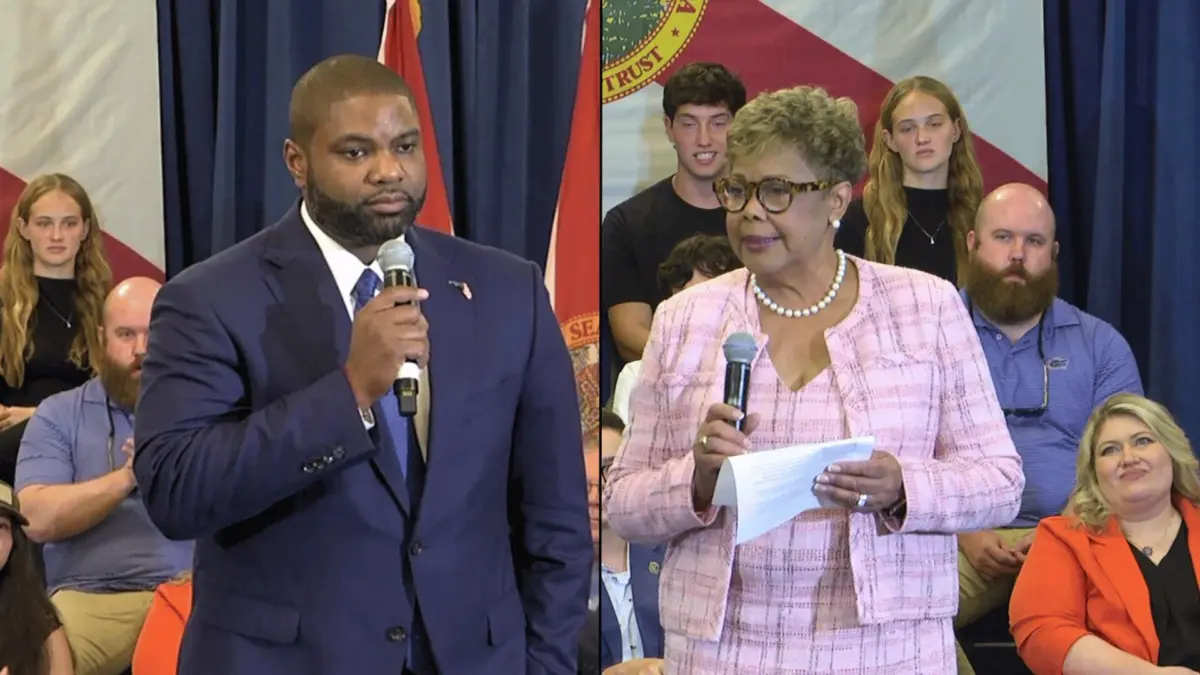
The formation of this statewide coalition underscores an evolving political landscape where historic identity intersects with conservative policy priorities. The group’s creation follows a high-profile town hall event at the University of Florida (UF) in Gainesville, where Gainesville City Commissioner Cynthia Chestnut—a veteran, lifelong Democrat—introduced Donalds to a packed auditorium. Chestnut’s public crossing of party lines to support a Republican gubernatorial contender has already sent shockwaves through state political circles, sparking intense internal debate within the Florida Democratic Party as they rally behind their own candidate, David Jolly.
By framing the gubernatorial race around universal economic and social aspirations—such as safe neighborhoods, high-performing educational institutions, and manageable costs of living—the Donalds campaign aims to build a broad multi-racial and cross-partisan coalition. This in-depth report examines the strategic implications of the newly launched coalition, explores the broader socioeconomic context of the 2026 race, outlines the timeline of recent events, and analyzes the potential trajectory of Florida’s shifting political geography.
Detailed Chronology of Events
The momentum leading to the establishment of the Florida Coalition of Black Leaders for Donalds has accelerated over the past several weeks, marked by strategic endorsements, high-profile public appearances, and contentious intra-party debates.
September 4, 2026: Commissioner Chestnut Breaks Ranks
The foundational fracture in traditional party alignments occurred in early September when Gainesville City Commissioner Cynthia Chestnut formally endorsed Byron Donalds for governor. In her endorsement, Chestnut cut straight to the historic nature of the candidacy, stating plainly, "I want to see a Black governor in Florida." While acknowledging her long-standing Democratic roots, Chestnut argued that the monumental opportunity of electing the state’s first Black chief executive superseded rigid partisan loyalties.
The endorsement immediately drew heavy criticism from progressive activists and local Democratic Party leadership, who questioned how a lifelong champion of Democratic values could support a prominent conservative Republican. Despite the backlash, Chestnut stood firm, maintaining that her allegiance to the progress of Florida’s Black community and local governance transcended partisan orthodoxies.
Late September 2026: Campus Engagement and Policy Debates
As the campaign entered the fall, Donalds ramped up his statewide outreach, focusing heavily on higher education institutions, economic growth, and structural reform. His campaign calendar included strategic stops in university towns designed to capture the attention of younger voters and diverse constituencies traditionally courted by Democrats.
Late September / Early October 2026: The University of Florida Town Hall
The friction between traditional party lines and emerging cross-partisan alliances culminated at a high-profile town hall meeting hosted at the University of Florida. It was here that Commissioner Chestnut formally introduced Byron Donalds to the student body, faculty, and local residents.
During the town hall, Donalds addressed a wide array of policy issues, backing Amendment 3 and outlining his vision for the future of Florida’s education system, economic climate, and public safety framework. The event served as a crucible for the campaign, showcasing how conservative messaging on school choice, economic mobility, and law enforcement can find a receptive audience even within traditionally progressive academic environments.
Early October 2026: Launch of the Coalition
Capitalizing on the momentum generated by the UF town hall and the statewide conversations ignited by Chestnut’s endorsement, the Florida Coalition of Black Leaders for Donalds officially went public. Bringing together more than two dozen influential figures from across the state’s political, religious, and economic sectors, the coalition formalized its structure to mobilize grassroots support, coordinate messaging, and campaign actively for the Donalds-Avila ticket ahead of the general election.
Supporting Context & Metrics: The 2026 Florida Political Landscape
To fully understand the weight of the Florida Coalition of Black Leaders for Donalds, one must examine the demographic, economic, and political shifts defining Florida heading into the late 2026 cycle.
Demographics and Voting Patterns in Florida
Florida has long been recognized as one of the most critical and complex battleground states in the United States. In recent election cycles, the state has trended increasingly red, driven by massive population influxes from other parts of the country, strong economic growth, and significant shifts among Hispanic voters in South Florida.
However, the Black electorate remains a cornerstone of the Democratic Party’s historical base in Florida. Historically, Black voters have voted overwhelmingly for Democratic candidates, driven by civil rights history, social justice advocacy, and economic equity platforms.
Byron Donalds’ candidacy challenges this traditional paradigm. As a nationally recognized conservative African American leader, Donalds represents a distinct political archetype. His presence at the top of the Republican ticket introduces a compelling dynamic: can a conservative Republican successfully peel away a measurable percentage of Black voters—particularly small business owners, working-class families, and politically independent civic leaders—by focusing on universal economic concerns rather than identity politics?
Economic Pressures and Voter Priorities
Recent polling and focus groups across the Sunshine State indicate that voters’ primary concerns center around cost-of-living metrics:
- Housing Affordability: Rapid population growth over the past decade has driven property values, insurance rates, and rental costs to historic highs, squeezing middle- and lower-income families.
- Education and School Choice: Parents across racial lines have increasingly demanded flexibility in their children’s education, making school choice, funding equity, and curriculum transparency paramount issues.
- Public Safety: Maintaining low crime rates, supporting local law enforcement agencies, and ensuring community safety remain consensus priorities for urban and rural voters alike.
The Donalds campaign has leveraged these exact metrics, framing their platform around practical solutions rather than partisan talking points.
Official Statements and Rhetorical Analysis
The launch of the coalition was accompanied by poignant statements from both Byron Donalds and key surrogates, highlighting the strategic framing of the campaign.
Byron Donalds on Universal Floridian Values
In his official remarks addressing the coalition’s launch, Byron Donalds emphasized common ground over ideological division, aiming to broaden his appeal beyond the traditional Republican base:
"Every Floridian wants the same things: a safe neighborhood, a good school, a paycheck that covers the bills, and a shot at owning something that lasts."
Expanding on these themes during his statewide tour, Donalds directly addressed the cross-partisan nature of his support, explicitly rejecting the notion that fundamental quality-of-life issues belong to any single political party:
"That is not a Republican issue or a Democratic issue. It is a Florida issue. I started my own education at FAMU [Florida A&M University], and I have never forgotten what that opportunity meant. Bryan Avila and I are running to bring down the cost of living, back our law enforcement, put a good school in reach of every child regardless of ZIP code, and make sure the doors of opportunity in this state are open to everybody. I am honored to have these leaders standing with us."
Commissioner Cynthia Chestnut on Historic Milestones
Commissioner Chestnut’s decision to back Donalds—and her subsequent role in bridging the gap between conservative policy and diverse community leadership—has reframed the local political conversation in Alachua County and beyond. By highlighting her educational roots at Florida A&M University (FAMU), a historically Black university (HBCU), Chestnut roots her decision in a lifelong commitment to Black advancement and educational access. Her willingness to endure intra-party criticism signals a calculated bet that the elevation of a Black leader to the highest office in the state holds historic value that transcends partisan boundaries.
Future Outlook: Implications for the General Election
As the 2026 gubernatorial race intensifies, the formation of the Florida Coalition of Black Leaders for Donalds introduces several critical variables that will shape the remainder of the campaign cycle.
1. Intra-Party Dynamics Among Florida Democrats
The endorsement of a Republican gubernatorial candidate by a sitting Democratic commissioner like Cynthia Chestnut presents a unique challenge for the Florida Democratic Party. As they rally behind their nominee, David Jolly, party leadership must navigate how to address high-profile defections without alienating moderate voters or appearing intolerant of independent thought within their ranks. Conversely, the coalition’s existence provides Donalds with a powerful shield against accusations of running an exclusionary campaign, allowing him to project an image of broad, cross-demographic appeal.
2. The Battle for the Suburbs and Diverse Working-Class Communities
The ultimate success of the Donalds-Avila ticket may hinge on whether the Florida Coalition of Black Leaders for Donalds can successfully move the needle in key swing counties. If pastors, business owners, and civic leaders affiliated with the coalition can convince even a modest percentage of traditionally Democratic or unaffiliated Black voters to look past party labels and focus on economic pragmatism, it could fundamentally alter the math in tightly contested legislative districts and municipal elections.
3. Campaign Messaging and Policy Execution
Moving forward, the coalition plans to roll out regional events, town halls, and grassroots organizing initiatives. Their primary objective will be to amplify Donalds’ economic messaging—specifically regarding job creation, small business support, tax policy, and educational access—while keeping the historic nature of his candidacy visible to the public.
Conclusion
The launch of the Florida Coalition of Black Leaders for Donalds marks a fascinating inflection point in modern Florida political history. By fusing conservative economic populism with the historic aspiration of electing the state’s first Black governor, Byron Donalds and his supporters are attempting to redraw the electoral map.
While the coalition has stirred controversy within Democratic ranks—exemplified by the intense scrutiny faced by Gainesville City Commissioner Cynthia Chestnut—it has simultaneously injected a new level of competitive energy into the race against Democratic challenger David Jolly. As voters across the Sunshine State grapple with pressing economic concerns, the ability of this bipartisan, diverse coalition to bridge ideological divides may well determine the outcome of the 2026 gubernatorial election and leave a lasting imprint on Florida politics for years to come.

0 Comments