
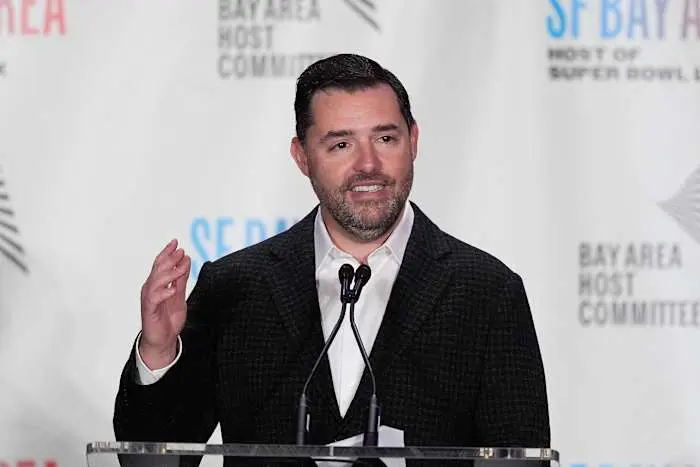

EAST PALESTINE, Ohio — San Francisco 49ers owner Jed York was arrested over the weekend in eastern Ohio, entering a swift plea of no contest to misdemeanor charges of disorderly conduct and possessing criminal tools, according to court records finalized early Monday morning.
The high-profile arrest of the 46-year-old billionaire National Football League owner occurred in East Palestine, Ohio. York’s legal proceedings moved at an extraordinary pace, culminating in a guilty plea, a brief jail sentence that was immediately satisfied by time served, financial penalties, and mandatory community-related restitution.
As of Monday afternoon, neither the San Francisco 49ers organization nor the National Football League office had issued formal statements regarding the arrest or potential league-level disciplinary actions. The development casts an unexpected shadow over one of the league’s most stable and historically prominent franchises just weeks ahead of the league’s annual calendar events.
Executive Overview
The unfolding legal situation involves charges that initially stemmed from an undercover vice or human trafficking sting operation in Mahoning County, Ohio. Court documents indicate that York was taken into custody on Sunday and subsequently booked into local holding facilities before posting a $5,000 bond.
By Monday morning, York appeared before a municipal court judge where prosecutors amended the most severe initial accusation—engaging in prostitution—to a reduced misdemeanor charge of disorderly conduct. Alongside the disorderly conduct count, York pleaded no contest to possessing criminal tools, a charge frequently applied in similar undercover operations where electronic communication devices are utilized to arrange illicit meetings.
Under the terms of the negotiated plea agreement, York received a sentence of one day in jail for each offense, to be served concurrently. Because he had already spent time in custody following his Sunday arrest, the court credited him with one day served, effectively concluding his physical incarceration. In addition to the jail sentence, York was ordered to pay $1,150 in fines and court costs. As a condition of the resolution, authorities returned his cellular phone, while $160 in cash seized during the arrest was redirected to the Mahoning Valley Human Trafficking Task Force. York also completed a designated online educational course as part of the legal disposition.
The incident marks a stark departure from the public profile of York, who has spent nearly two decades at the helm of the 49ers, steering the organization through numerous high-profile athletic triumphs, stadium developments, and corporate expansions.
Detailed Chronology of Events
The sequence of events leading to York’s arrest and rapid court appearance unfolded over a tense 48-hour window in eastern Ohio.
Sunday: The Arrest in East Palestine
According to local law enforcement logs and subsequent court filings, York was detained on Sunday in East Palestine, a municipality in Columbiana County near the Pennsylvania border, though the legal proceedings were administered through the broader Mahoning Valley judicial framework associated with regional task force operations.
Details regarding the precise nature of the sting operation remain constrained by local police department disclosures, but arrests of this nature typically involve coordinated sweeps by regional human trafficking and vice squads targeting illicit solicitation via digital platforms. Following his apprehension, York was transported to a local detention facility, where he was booked on preliminary charges, including engaging in prostitution.
Later that day, legal counsel secured his release after posting a $5,000 bond, setting the stage for a remarkably expedited court appearance early the following morning.
Monday: The Plea Agreement and Sentence
By Monday morning, prosecutors and defense counsel had reached a resolution. When York appeared in court, the state formally amended the primary charge from engaging in prostitution—a first-degree misdemeanor under Ohio law that can carry harsher social and legal stigmas—to disorderly conduct, a lesser misdemeanor.
Concurrently, York faced a charge of possessing criminal tools, a first-degree misdemeanor in Ohio that prosecutors often leverage when a mobile phone or computer is used to coordinate unlawful transactions. York entered a plea of no contest to both amended charges.
The presiding judge accepted the plea and delivered an immediate sentence:
- Incarceration: One day in jail for disorderly conduct and one day in jail for possessing criminal tools, ordered to run concurrently.
- Time Served: Credited with one day served, releasing York from any further physical detention.
- Financial Penalties: Fines and court costs totaling $1,150.
- Restitution & Education: Forfeiture of $160 in cash seized at the scene directly to the Mahoning Valley Human Trafficking Task Force, alongside the completion of an online educational program.
- Property Return: Release and return of York’s personal cellular device to his legal representatives.
Supporting Context & Metrics
The arrest places sudden scrutiny on a prominent figure within the upper echelon of American sports ownership. To understand the gravity of the moment, it is necessary to examine York’s career trajectory, leadership tenure, and the institutional footprint of the franchise he oversees.
Leadership Tenure and Operational History
Jed York belongs to the DeBartolo family dynasty, which has long been synonymous with San Francisco 49ers success. Born in 1979, York graduated from the University of Notre Dame before working in finance. He officially joined the 49ers organization in 2005 in a strategic role before assuming day-to-day operational control from his parents, John and Denise York, in 2008 at the young age of 28. In 2024, he officially assumed the mantle of the team’s principal owner.
His early years overseeing the franchise were characterized by significant organizational turbulence, frequent coaching changes, and public relations missteps. However, York demonstrated an institutional pivot in 2017 by hiring head coach Kyle Shanahan and general manager John Lynch. This leadership tandem transformed the 49ers into one of the most consistently competitive franchises in the National Football League.
Franchise Performance Metrics Under York’s Leadership
- Super Bowl Appearances: The 49ers have reached the pinnacle game of professional football three times during York’s tenure, though they have yet to secure a Lombardi Trophy under his direct ownership reign:
- 2012 NFL Season: Reached Super Bowl XLVII under head coach Jim Harbaugh, losing to the Baltimore Ravens.
- 2019 NFL Season: Reached Super Bowl LIV under Shanahan and Lynch, falling to the Kansas City Chiefs.
- 2023 NFL Season: Reached Super Bowl LVIII, once again dropping a hard-fought contest to the Kansas City Chiefs.
- Postseason Consistency: Under the Shanahan-Lynch administration, the 49ers have established themselves as perennial NFC contenders, regularly making deep playoff runs, capturing division titles, and maintaining elite rosters across both offense and defense.
Real Estate and Corporate Footprint
Beyond on-field operations, York’s business legacy is permanently tied to the franchise’s relocation and real estate ventures. He spearheaded the complex planning, financing, and construction of Levi’s Stadium in Santa Clara, California.
The team officially moved out of its historic home in San Francisco to the state-of-the-art Santa Clara venue in 2014. Under York’s commercial stewardship, Levi’s Stadium has transformed into a premier global entertainment and athletic hub. The facility has successfully hosted:
- Two Super Bowls (including historic matchups and upcoming league showcases).
- Major international soccer matches, including fixtures for major tournaments such as the upcoming World Cup.
- High-profile collegiate athletics, including College Football Playoff national championship games.
- Sold-out stadium concerts featuring global musical acts.
Official Statements and Institutional Silence
In the wake of court records becoming public, the response from key institutional stakeholders has been notably restrained.
The San Francisco 49ers Organization
Representatives for the San Francisco 49ers did not immediately respond to multiple press inquiries from national and local media outlets regarding York’s arrest. The organization’s communications team faces the delicate task of balancing corporate public relations with internal legal assessments, particularly as the team prepares for upcoming league operational milestones.
The National Football League (NFL)
The league office in New York City also declined immediate comment. Under the NFL’s Personal Conduct Policy, owners, executives, players, and team employees are held to rigorous standards regarding legal infractions and public behavior.
Legal experts note that while the policy explicitly grants the Commissioner broad authority to investigate and discipline individuals associated with the league for conduct detrimental to the integrity of the game, the application of such discipline to a primary team owner is a rare and legally complex procedure. Historically, the NFL has addressed owner misconduct through independent investigations, financial penalties, or, in extreme cases, compelled management restructuring, though enforcement mechanisms vary based on the specific nature of the charges and the findings of league-appointed investigators.
Future Outlook: Legal, Reputational, and Franchise Implications
As the initial shock of the weekend’s events settles, attention shifts to the potential fallout for both Jed York and the San Francisco 49ers franchise.
Legal Status and Case Closure
From a criminal standpoint in the state of Ohio, York’s legal exposure has largely concluded. By pleading no contest and accepting the conditions of the plea agreement—paying the $1,150 fine, serving the equivalent of one day in jail via time served, completing the online course, and forfeiting the seized funds to the Mahoning Valley Human Trafficking Task Force—York has satisfied the requirements of the Mahoning County municipal court. In Ohio jurisprudence, a no-contest plea results in a conviction without constituting an admission of guilt for potential civil liability purposes, but it effectively closes the criminal docket for the specified misdemeanor counts.
Reputational and League-Level Scrutiny
The primary challenges moving forward are reputational and regulatory. The 49ers boast a massive global fan base, a pristine corporate sponsorship roster featuring Silicon Valley tech giants, and a culture heavily promoted around community engagement and family values. An arrest involving illicit solicitation and human trafficking task force operations—even when reduced to disorderly conduct—presents a significant public relations hurdle.
Within league circles, the NFL front office will evaluate whether York’s actions violated the league’s personal conduct guidelines. While the misdemeanor reduction from prostitution to disorderly conduct may soften the immediate optics, the involvement of a human trafficking task force ensures that league investigators will review the full investigative file from East Palestine law enforcement.
Impact on Franchise Operations
Domestically, day-to-day football operations led by general manager John Lynch and head coach Kyle Shanahan are not expected to experience immediate disruption. The football infrastructure is designed to operate autonomously regarding roster construction, coaching, and training camp preparations. However, the corporate and ownership layers of the organization will undoubtedly navigate a period of intense media scrutiny as stakeholders, sponsors, and league officials monitor developments.
As the 2026 NFL calendar progresses, the long-term ramifications for Jed York’s standing within the league’s powerful ownership committees and his ongoing leadership role in San Francisco will depend heavily on subsequent evaluations by the NFL commissioner’s office and the public reception of the franchise’s corporate partners.

0 Comments