

Executive Overview
In a decisive and unanimous ruling delivered on a Friday afternoon, the United States Supreme Court brought a definitive end to a high-stakes, months-long legal battle over Missouri’s congressional map. The nation’s highest court rejected an eleventh-hour attempt to implement a Republican-friendly, Donald Trump-backed redistricting plan, ruling that upending district lines while absentee voting is actively underway would trigger catastrophic electoral chaos.
The unsigned high court opinion leaves in place a prior ruling by the Missouri Supreme Court, ensuring that Missouri voters will cast their ballots in the upcoming midterm elections under the exact same congressional boundaries used in the 2022 and 2024 elections. This definitive resolution halts an aggressive Republican strategy—championed by former President Trump and Missouri Governor Mike Kehoe—to extract an additional congressional seat from the state by reshaping a Kansas City-based district held by veteran Democratic Representative Emanuel Cleaver.
The legal war, which sparked at least 16 distinct state and federal lawsuits, created profound confusion for more than a million registered Missouri voters—nearly 25% of the statewide electorate—whose residential addresses were shuffled between districts during the tumultuous procedural ping-pong. With the Supreme Court’s final intervention, the state avoids the unprecedented logistical nightmare of switching district boundaries between its August primary contests and the November general election.
Detailed Chronology: A Timeline of Legal Whiplash
The path to the U.S. Supreme Court’s final intervention was winding, complex, and marked by extraordinary clashes between state and federal judicial authorities.
The Push for Revision (September 2025)
At the direct urging of Donald Trump and Gov. Mike Kehoe, the Missouri General Assembly passed a heavily revised congressional map in September 2025. Designed to secure a 7–1 Republican advantage in the state’s congressional delegation ahead of the midterms, the map targeted the 5th Congressional District, significantly diluting Democratic voting power in the Kansas City metropolitan area by carving up urban neighborhoods and stretching the district deep into conservative rural territory.
The Citizen Petition and State-Level Pushback
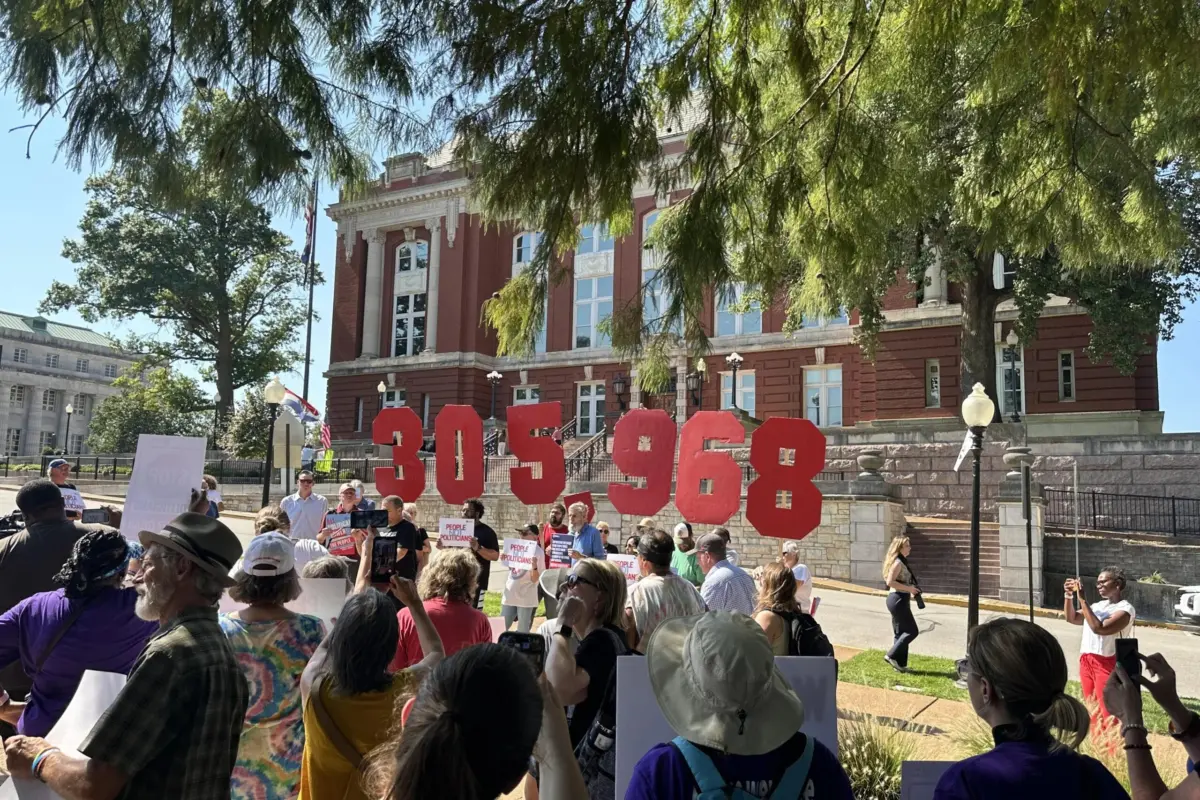
As soon as the map was enacted, grassroots organizations and civic groups mobilized, launching a citizen-led petition drive to force a statewide referendum on the redistricting plan. Under Missouri law, a successful petition suspends the implementation of disputed legislation until voters can weigh in at the ballot box.
However, Republican Secretary of State Denny Hoskins aggressively pushed back against the initiative. On August 4, 2026—the exact legal deadline and the day the new map was used for the state’s primary elections—Hoskins formally rejected the petition, claiming that citizen referendums do not apply to congressional redistricting.
The State vs. Federal Judicial Ping-Pong (September 2026)
The conflict quickly degenerated into a constitutional tug-of-war:
- September 3, 2026: The Missouri Supreme Court ruled unanimously that the referendum petition was entirely valid. The state court ordered Secretary of State Hoskins to reject the new map and revert immediately to the 2022 congressional districts.
- September 8, 2026: The U.S. Supreme Court initially declined to interfere, letting the Missouri Supreme Court’s ruling stand. However, within minutes of that decision, U.S. District Judge Stephen Clark issued a conflicting federal order siding with Republican plaintiffs and mandating the use of the Trump-backed map.
- September 10, 2026: The U.S. Supreme Court stepped in temporarily to block Judge Clark’s order. Concurrently, the Missouri Supreme Court held Secretary Hoskins in civil contempt after he instructed local election authorities to utilize the disputed new map in defiance of state orders.
- Mid-September Appellate Twists: A panel of the 8th U.S. Circuit Court of Appeals subsequently reversed course, ruling that switching district boundaries between the primary and general elections violated the U.S. Constitution and ordering the district court to enforce the new map. This set the stage for the final emergency appeal to the nation’s highest court.
Supporting Context & Metrics: The Human and Political Toll
While political strategists in Washington and Jefferson City sparred over partisan advantage, the protracted legal battle inflicted tangible consequences on election administration and voter confidence across Missouri.
Voter Confusion and Administrative Strain
According to Associated Press estimates, the redrawn boundaries directly impacted approximately 59% of the population within Representative Cleaver’s 5th Congressional District, forcing roughly one million voters statewide into unfamiliar jurisdictions. Because absentee voting opened on a Tuesday under the 2022 map while federal judges were still debating the merits of the new boundaries, local election supervisors faced immense administrative burdens.
Some county clerks were forced to issue warnings advising voters to delay casting absentee ballots until the legal dust settled. Election integrity advocates noted that the uncertainty threatened to suppress turnout among suburban and urban voters who were left entirely unsure of which candidates legally represented them.
The Kansas City Battleground
At the heart of the redistricting effort was Representative Emanuel Cleaver, a fixture of Kansas City politics. Under the revised map, Cleaver’s district shed crucial urban strongholds—which were folded into neighboring Republican-held districts—and was expanded eastward into deep-red rural counties.
Despite the map’s subsequent vacation by the courts, the political landscape had already been severely disrupted. State Senator Rick Brattin, a Republican, won a contentious six-way primary under the revised boundaries and remains the GOP nominee against Cleaver. Because the courts ultimately reinstated the 2022 map lines, Brattin and Cleaver will contest the November election within the traditional, historically competitive boundaries that favor Democratic retention.
Official Statements and Judicial Reasoning
The unanimity of the U.S. Supreme Court’s final opinion underscored the extraordinary nature of the circumstances facing Missouri election administrators.
The Supreme Court’s Unsigned Opinion
Rather than debating the merits of mid-decade partisan gerrymandering or the nuances of state-level referendum powers, the high court based its ruling squarely on the doctrine of electoral stability:
"At this late date, ordering reversion to the 2025 map in the midst of an ongoing election would usher in electoral chaos," the justices wrote in the unsigned opinion. "The District Court and Court of Appeals should not enjoin or otherwise prohibit the use of the 2022 map in the 2026 congressional election in Missouri."
Legal scholars noted that the court invoked the established Purcell principle—the judicial reluctance to alter election rules close to voting dates—to protect the integrity of an election that was already underway via absentee ballots.
Reactions from Key Stakeholders
Plaintiffs in the federal lawsuit, including GOP lawmakers like state Senator Brattin and U.S. Representative Bob Onder, expressed bitter disappointment, arguing that the court’s decision thwarted the constitutional authority of the state legislature to draw maps responding to demographic shifts.
Conversely, voting rights advocates and Democratic organizers hailed the ruling as a monumental victory for the democratic process. They emphasized that the decision honors the power of citizen petition rights enshrined in the Missouri Constitution and prevents last-minute, politically motivated map manipulations from disenfranchising voters mid-election cycle.
Future Outlook: National Implications and What Lies Ahead
Though the immediate crisis in Missouri has reached its legal terminus, the fallout from the 2025–2026 redistricting cycle carries significant implications for future American politics.
The Broader Midterm and Redistricting War
Missouri was just one of roughly a dozen states where political parties sought to aggressively redraw congressional boundaries outside of the standard decennial census cycle to secure an advantage in the midterm elections. With control of the U.S. House of Representatives hanging in the balance, both major political parties viewed mid-decade redistricting as a crucial frontier.
The failure of the Missouri map—coupled with similar judicial roadblocks in other jurisdictions—signals that federal courts remain deeply wary of upending active election cycles, even when backed by heavyweight political figures like Donald Trump.
Potential Long-Term Reforms in Missouri
The intense legal warfare is expected to ignite a renewed legislative and citizen-led push for structural redistricting reform within Missouri. With the citizen referendum process successfully flexing its muscle to stall legislative overreach, good-government groups are already signaling plans to pursue independent redistricting commissions similar to those adopted in states like Michigan and Arizona. Such measures aim to permanently remove partisan mapmaking from the hands of the legislature, ensuring that Missouri voters—rather than politicians—draw the lines that define their representative democracy.

0 Comments