

Executive Overview
As the Florida Gators prepare to step onto the gridiron for the 2026 college football season, the atmosphere in Gainesville is charged with a complex mixture of cautious optimism, institutional reset, and high-stakes evaluation. Entering a critical inflection point in the program’s storied history, the university has turned the page, ushering in the Jon Sumrall era. Sumrall takes the reins of a program eager to recapture its national prominence after years of fluctuating performance and SEC turbulence.
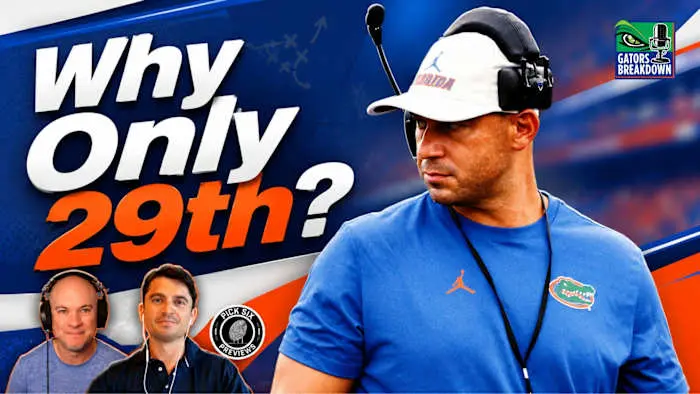
To unpack the realities, projections, and hidden landmines of this transitional year, Gators Breakdown host David Waters recently sat down with prominent college football analyst Brett Ciancia of Pick Six Previews. In a comprehensive deep-dive, Ciancia unspooled his meticulously researched preseason projections, placing the Gators 29th nationally and 12th in the unforgiving Southeastern Conference. While these numbers might initially underwhelm casual observers accustomed to perennial top-ten expectations in Gainesville, a granular look reveals a much more nuanced narrative.
Beneath the surface of a seemingly modest national ranking lies a roster undergoing a fascinating metamorphosis. Sumrall inherits a defensive unit infused with elite, blue-chip talent—boasting an impressive 15 former high-tier recruits embedded deeply within the two-deep depth chart. This influx of sheer athleticism offers a stout foundation that could shock early-season opponents. However, this defensive promise is counterbalanced by glaring vulnerability along the offensive trenches. Lingering depth and performance concerns on the offensive line pose a very real threat to the execution of the new offensive scheme.
Compound these roster dynamics with one of the most punishing schedules in modern college football history—featuring four high-stakes "toss-up" games played exclusively away from the friendly confines of Ben Hill Griffin Stadium—and the 2026 season emerges as a supreme test of coaching acumen, physical resilience, and cultural transformation. Yet, despite the immediate hurdles and the treacherous road ahead, Ciancia remains remarkably bullish on Florida’s long-term trajectory. This report explores the contours of the upcoming season, synthesizing Ciancia’s analytical breakdowns, structural roster challenges, and the institutional blueprint governing Sumrall’s inaugural campaign in the Swamp.
Detailed Chronology: The Road to the 2026 Reset
The trajectory of the Florida Gators program leading into the 2026 season has been defined by a relentless cycle of assessment, strategic restructuring, and high-profile personnel decisions. To fully appreciate where the program stands today, one must examine the chronological sequence of events that forged Jon Sumrall’s arrival and set the stage for the rigorous evaluation delivered by Pick Six Previews.
The Coaching Transition and Institutional Mandate
The foundational shift occurred in the wake of the previous coaching regime’s conclusion, as Florida athletic department leadership realized that incremental changes would no longer suffice in the hyper-competitive landscape of the modern SEC. The arms race of Name, Image, and Likeness (NIL) funding, combined with the complexities of the 12-team College Football Playoff era, demanded a leader with proven cultural-building capabilities, elite defensive acumen, and a track record of maximizing talent.
Enter Jon Sumrall. Known for his tactical rigor, relentless motor, and proven ability to elevate lower-resourced programs to championship contention, Sumrall was identified as the ideal architect to reconstruct the Gators’ foundation. The hiring process was executed with surgical precision behind closed doors, culminating in an introductory press conference that electrified the fan base. Sumrall immediately stressed accountability, physical dominance, and the development of a resilient culture capable of weathering the SEC storm.
Winter Conditioning and Spring Ball: Installing the Foundation
Once the ink dried on Sumrall’s contract, the chronological clock of the 2026 season began ticking rapidly. Winter workouts under the newly minted strength and conditioning staff served as an immediate crucible. Players were subjected to demanding physical benchmarks designed to weed out complacency and establish a new baseline of toughness.
By the time spring practices commenced in March, the primary objectives were twofold:
- Scheme Installation: Introducing entirely new offensive and defensive playbooks that favored balanced efficiency, explosive plays, and disciplined gap integrity.
- Personnel Evaluation: Sifting through a roster that featured a blend of holdover veterans, developmental prospects, and strategic additions via the NCAA Transfer Portal.
It was during these crucial spring sessions that the duality of the 2026 Gators began to crystallize. Observers and insiders noted that the defensive front seven and secondary were flying around with a disruptive energy that had been sporadically absent in prior years. The sheer concentration of blue-chip talent began to manifest on the practice fields, with defenders consistently winning 1-on-1 matchups and making life difficult for the offensive backfield.
Conversely, the spring game and closed-door scrimmages highlighted persistent vulnerabilities on the offensive line. Depth was tested early and often. Injuries and inconsistent pass-protection mechanics exposed a chink in the armor that would dominate summer preview discussions and catch the eye of national analysts like Brett Ciancia.
Summer Evaluations and Preseason Projections
As the calendar turned to the summer months of 2026, national publications, analytical outlets, and forecasting models began releasing their initial slates for the upcoming college football landscape. It was within this context that Brett Ciancia published his comprehensive outlook via Pick Six Previews, subsequently breaking down the data alongside David Waters on Gators Breakdown.
The positioning of Florida at 29th nationally and 12th in the SEC served as a sobering splash of cold water for portions of the fan base, while simultaneously validating the realistic expectations of analytical insiders. Ciancia’s breakdown moved past simple helmet-scouting—the tendency to rank teams based purely on historical prestige—and instead focused on the empirical realities of roster construction, coaching continuity, analytical efficiency metrics, and schedule variance. This set the stage for the grueling summer camp preparations leading directly into the fall kickoff.
Supporting Context & Metrics: Breaking Down the Numbers
To understand why a program of Florida’s historical stature checks in at No. 29 in the national consensus and sits in the lower half of the SEC, one must dive deep into the quantitative metrics and structural components highlighted by Ciancia and Waters.
National and Conference Positioning
- National Rank: 29th
- SEC Rank: 12th
At first glance, a 12th-place conference ranking sounds alarm bells. However, any objective observer of the modern SEC recognizes that the conference has evolved into an absolute gauntlet. With perennial powerhouses, heavy-spending athletic departments, and recent conference expansion, the SEC bottom tier has evaporated. Finishing 12th in the SEC no longer equates to being a mediocre football team; rather, it reflects a conference where half the league could legitimately harbor dark-horse College Football Playoff aspirations. Ciancia’s model places Florida firmly in the upper-middle tier of collegiate football on a national scale, while acknowledging the fierce, internal cannibalization characteristic of the SEC.
The Defensive Surge: 15 Blue-Chip Players in the Two-Deep
The shining beacon of hope for the 2026 Gators—and the primary reason to believe Sumrall can exceed preseason expectations—resides on the defensive side of the ball. Ciancia pointed out a vital metric that casual fans often overlook: 15 blue-chip players (former four- and five-star recruits) embedded within the defensive two-deep.
- Talent Acquisition & Retention: Sumrall inherits a defensive framework that has successfully accumulated high-end athletic talent through previous recruiting cycles.
- Depth and Rotation: Having 15 blue-chip talents in the primary two-deep means the Gators will not experience a catastrophic drop-off when substitutions are made. In the modern SEC, where game-altering fatigue sets in during the fourth quarter of physical contests, defensive line and secondary depth are paramount.
- Scheme Fit: Sumrall’s defensive philosophy relies heavily on pre-snap disguise, aggressive linebackers, and defensive linemen who can win their individual matchups without relying exclusively on blitz packages. The presence of this caliber of athlete allows the coaching staff to play an attacking style, creating negative plays, forcing turnovers, and relieving pressure from an evolving offense.
The Offensive Line Conundrum
While the defense boasts an enviable concentration of elite talent, the offensive side of the ledger presents significant cause for concern. According to Ciancia’s breakdown, the offensive line remains the most volatile position group on the roster heading into the season.
- Depth Deficits: Beyond the projected starters, the drop-off in collegiate experience and physical readiness is stark. An injury to a single key starter could dramatically alter the efficiency of the entire blocking unit.
- Pass Protection and Run Blocking: The SEC features some of the most destructive pass rushers and complex front-seven schemes in the history of the sport. If the Gators’ offensive line struggles to establish a consistent pocket or fails to open running lanes in short-yardage situations, the entire offensive playbook will be severely constricted.
- Mitigation Strategies: To combat these line deficiencies, the coaching staff will likely need to rely heavily on quick-game passing concepts, max-protection schemes, designed rollouts, and the utilization of dynamic running backs to turn potential losses into positive gains.
The Brutal Schedule: Four Toss-Up Games on the Road
Perhaps the most punishing aspect of Florida’s 2026 outlook is the architecture of its schedule. While SEC schedules are notoriously difficult by design, the 2026 slate features a geographical and competitive nightmare for the Gators.
Ciancia highlighted a cluster of four major "toss-up" games that will be contested entirely away from Ben Hill Griffin Stadium. Playing true road games in hostile SEC environments—where crowd noise disrupts snap counts, officiating leans heavily toward the home team, and travel logistics test player recovery—is the ultimate equalizer in college football.
- The Margin for Error: In a toss-up game at a neutral site, a team has roughly a 50% chance of victory based on pure analytics. Moving that game to a hostile opponent’s stadium inherently shifts win probabilities downward.
- Navigating the Gauntlet: For Florida to beat its projected win total, they must steal at least two or three of these hostile road contests. Winning away from home requires elite discipline, flawless special teams play, and the ability to silence opposing crowds early through defensive stops and efficient offensive execution.
Official Statements and Expert Analysis
The dialogue between David Waters and Brett Ciancia on Gators Breakdown provided listeners with an unfiltered, analytically sound look at the realities facing the program. Below are synthesized takeaways and expert commentary capturing the essence of their conversation:
"When you look at why Florida checks in at 29th nationally and 12th in the conference heading into year one, it’s not an indictment of Jon Sumrall or the future of the program; it’s an honest mathematical reflection of roster volatility, schedule variance, and the sheer brutality of the SEC landscape. But if you dig deeper into what Sumrall has inherited defensively—specifically 15 blue-chip players populating that two-deep—there is a physical floor here that will keep them competitive in almost any game."
— Brett Ciancia, Pick Six Previews
Ciancia’s assessment underscores the dual-identity nature of the 2026 Gators. On one hand, analytical models cannot ignore the unproven nature of the offensive line and the statistical probability losses tied to four treacherous road toss-up games. On the other hand, raw athletic talent cannot be faked. The defensive numbers suggest that Florida possesses the caliber of athletes required to disrupt opposing offenses and keep games close, even when the offense is finding its footing.
David Waters, speaking from the perspective of an everyday chronicler of Florida football, emphasized the importance of perspective among the fan base. The transition under Jon Sumrall is a masterclass in building a sustainable program from the ground up.
"Gators fans are naturally conditioned to expect national championship contention every single September. But transitioning into the Jon Sumrall era requires patience, a clear-eyed understanding of roster depth, and an appreciation for the long-term vision. If this defense plays up to its blue-chip billing, and if the coaching staff can scheme around the offensive line concerns, this team is going to be a much tougher out than people nationwide are giving them credit for."
— David Waters, Gators Breakdown
Future Outlook: Building for Tomorrow While Competing Today
As the 2026 season approaches, the overarching narrative for the Florida Gators is one of bridge-building and competitive grit. Jon Sumrall enters his first campaign with eyes fixed on both immediate execution and long-term stabilization.
Immediate 2026 Objectives
- Maximize Defensive Dominance: With 15 blue-chip players in the defensive two-deep, the defense must act as the anchor of the team. Generating turnovers, stopping the run on early downs, and getting off the field on third down will alleviate pressure from an offense still searching for consistent trench play.
- Survive the Road Gauntlet: The coaching staff must implement rigorous crowd-noise simulations in practice and establish conservative, mistake-free offensive game plans for the four critical road toss-up games. Minimizing pre-snap penalties and turnovers away from Gainesville will be the difference between winning and losing close conference battles.
- Protect the Quarterback: Finding creative ways to mask offensive line deficiencies through play-action, max protection, and quick-read passing games will be paramount to offensive survival.
The Long-Term Horizon
What makes Ciancia’s analysis particularly compelling is his underlying bullishness on Florida’s long-term outlook. College football programs do not transform overnight, but the foundational elements required for sustained success—elite defensive recruiting pipelines, a culture of discipline, and a proven, winner-mentality head coach—are now firmly in place in Gainesville.
As Sumrall recruits subsequent classes to address lingering depth issues along the offensive line and further fortifies the roster through targeted high school evaluations and strategic use of the transfer portal, the ceiling of the program rises exponentially. The 2026 season may serve as the crucible in which this new identity is forged, but the structural trajectory points directly upward.
For Gators fans, the upcoming year is a journey of discovery. While national rankings place them at No. 29 and pre-season prognostications warn of a brutal road schedule, the raw ingredients for disruption are present. If the defense lives up to its athletic billing and Sumrall’s tactical brilliance translates immediately to the SEC level, the Swamp may witness the birth of a new era much sooner than the experts anticipate.

0 Comments