

Executive Overview
In the sprawling, high-stakes ecosystem of American collegiate athletics, few traditions match the blistering physical demands, exacting aesthetic standards, and enduring cultural gravity of the University of Alabama’s Crimsonettes. Positioned dynamically at the vanguard of the storied Million Dollar Band, these baton-twirling ambassadors are far more than nostalgic pageantry. They represent a grueling intersection of elite athletic endurance, razor-sharp showmanship, and an unapologetic celebration of Southern glamor.
While outsiders—such as the author’s New York City-based husband, Lex, who readily confuses them with cheerleaders or dance squad competitors—frequently misapprehend their discipline, the reality of the Crimsonette experience is forged in uncompromising grit. Operating under the unforgiving gaze of Bryant-Denny Stadium’s towering jumbotrons, these performers hurl metal shafts heated by the Southern sun twenty feet into the air, execute dizzying mid-air rotations, and anticipate the catch with an unshakeable, stadium-wide optimism.
This deep dive examines the multifaceted world of the Crimsonettes, tracing their evolution from 1980s go-go boots to modern sequined two-pieces, exploring the trailblazing professional achievements of alumni like Tennessee Titans majorette Chloe Holladay, and analyzing the enduring cultural mythology that transforms high-velocity baton twirling into a masterclass in resilience. Through archival context, contemporary metrics, and cultural analysis, this report unpacks why the Crimsonettes continue to capture the American imagination as the ultimate symbol of stamina, glamour, and unyielding spirit.
Detailed Chronology: From Go-Go Boots to Professional Stadiums
The lineage of the Crimsonettes is anchored in a rich timeline of sartorial evolution, athletic escalation, and cultural iconography. To understand where the institution stands today, one must trace its journey through the decades.
The 1980s: The Era of Go-Go Boots and Hair-Spray Fortresses
During the 1980s—an epoch immortalized by childhood memories in Tuscaloosa, Alabama—the Crimsonettes cut a striking figure across Southeastern Conference (SEC) gridirons. Outfitted in pristine white go-go boots and Wonder Woman-style unitards, these performers combined precision marching with high-risk routines. Hair was architectural, teased and sprayed with industrial volumes of lacquer designed to withstand hours of oppressive Alabama humidity without a single strand yielding to gravity. Makeup was applied with theatrical precision, evoking the timeless elegance of framed gallery portraits.
The Evolution of Uniform and Technique
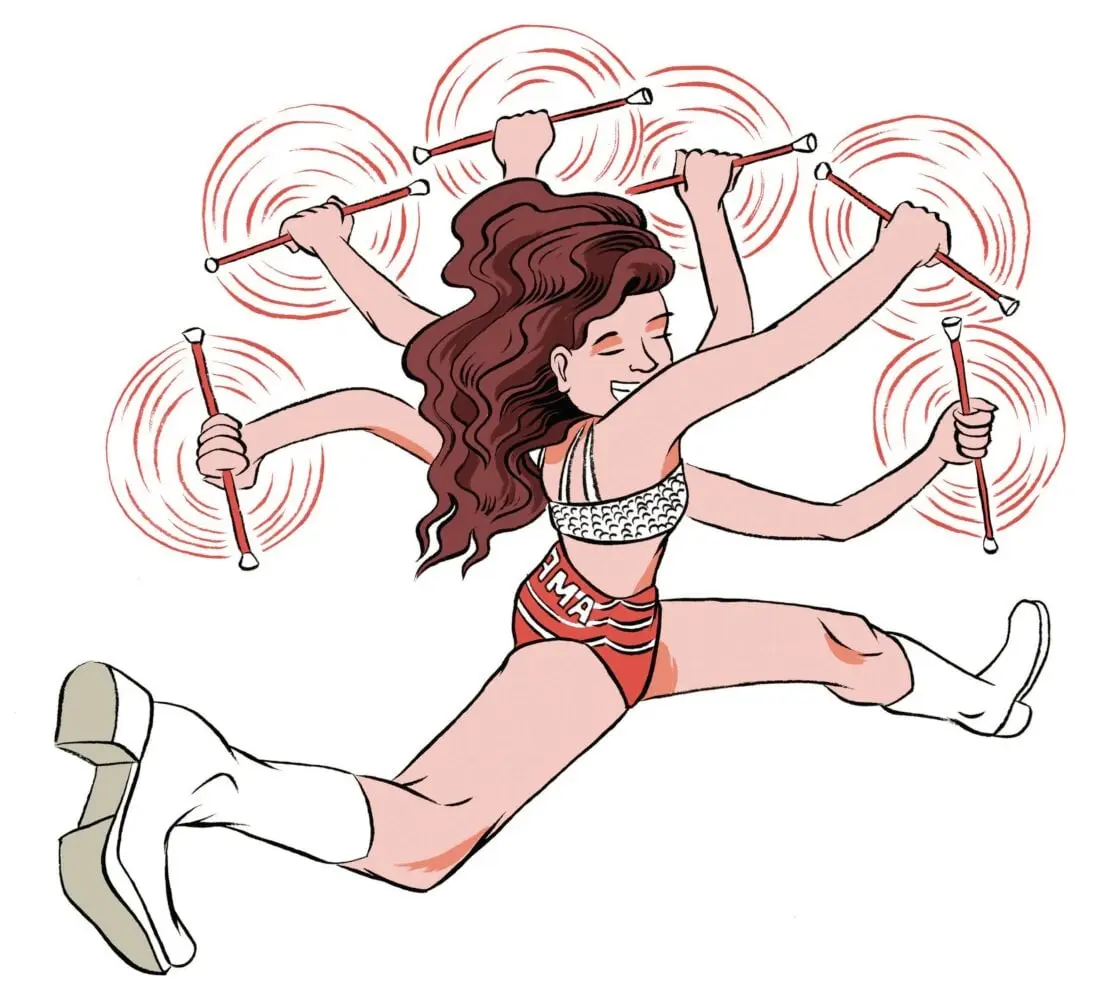
As decades progressed, the aesthetic underwent a modernization matching the changing tides of collegiate sports entertainment. The unitards and go-go boots gave way to thousand-dollar custom two-piece ensembles, featuring signature cowboy boots and shimmering sequins spelling out "BAMA" across hot pants. Yet, despite the sartorial shifts, foundational elements remained untouched: the towering, TRESemmé-fortified hair, the radiant stadium smiles, and the core athletic mandate—hurls, catches, and blind trust in gravity.
Unlike standard collegiate football players who often secure multi-year roster security, the Crimsonettes are subjected to a humbling ritual: annual auditions. No status is permanent; every single spot is fiercely contested year after year, ensuring that complacency has no home within the squad.
2024–2025: Breaking the Professional Glass Ceiling
The historical timeline reached a monumental inflection point with the ascent of Chloe Holladay. A former Crimsonette captain, social media influencer, and 2024 nursing degree graduate, Holladay shattered a two-decade professional drought. In 2025, she secured a position as a majorette for the Tennessee Titans, officially becoming the first and currently only active NFL majorette in twenty years. Holladay’s transition from the collegiate sidelines of Tuscaloosa to the professional turf of Nashville marked a watershed moment for baton twirling, proving that the skill set developed in collegiate marching bands possesses elite, professional-grade athletic value.
Supporting Context & Metrics: The Physics and Economics of "Extra"
To truly comprehend the Crimsonette phenomenon, one must look past the sequins and examine the cold, hard metrics of their craft. Baton twirling at the collegiate level is a high-velocity physics problem executed under extreme cardiovascular stress.
The Biomechanics of the Toss
- Altitude & Velocity: A standard competitive toss requires launching a weighted metal shaft roughly twenty feet into the air.
- Rotation Dynamics: While the baton is airborne, performers execute complex physical maneuvers—including leaps, spins, and blind turns—before re-aligning their spatial awareness to secure the catch.
- Environmental Variables: Performers contend with glaring stadium lights, swirling wind currents, and oppressive thermal humidity, transforming a simple catch into a high-risk athletic gamble.
The Philosophy of Being "Extra"
The rigorous demands of the squad fostered a distinct cultural ethos. Former coach "Mrs. April" Henderson instilled in her squads the foundational mantra: "We are blessed to be a blessing." Channeling this philosophy, Chloe Holladay established the Extra-ette Scholarship to financially support incoming freshman team members selected during the rigorous April tryouts.
When asked about the moniker, Holladay explained that the root of the name stems from her unapologetic embrace of being “extra.” In the lexicon of Southern culture, being “extra” is the ultimate compliment. As cultural observers note, it is Southern Lady Code for "bringing a baton to a knife fight and winning with pizzazz." The Crimsonettes serve as the living embodiment of oversized homecoming corsages coupled with the physical resilience of seasoned linebackers.
Cultural Comparisons and Media Mythology
Baton twirling has long occupied a colorful space in American media lore. Perhaps no cultural touchstone captures the hyperbolic drama of the sport better than the legendary 1986 episode of the sitcom Designing Women. In it, the formidable Julia Sugarbaker delivered a searing defense of her sister Suzanne’s talent, describing a routine where a flaming baton flew higher, further, and faster than any before it, ultimately striking a transformer, showering a darkened arena in sparks, and provoking sixteen and a half minutes of uninterrupted standing ovation.
While modern Crimsonettes do not routinely ignite their equipment or inadvertently disable local power grids, the sentiment remains accurate: baton twirling is a spectacle designed to command absolute attention, eliciting awe through sheer, unadulterated optimism.
Official Statements and Cultural Commentary
The legacy of the Crimsonettes is continuously shaped by those who wear the uniform, those who coach them, and those who observe their cultural footprint from afar.
Chloe Holladay on Leadership and Mentorship:
"Mrs. April taught us early on that we are blessed to be a blessing. When you occupy a space as visible and demanding as the Crimsonettes, you carry a responsibility to lift others as you climb. That is why establishing the Extra-ette Scholarship was so vital—to ensure that financial hurdles never stand in the way of raw talent and dedication."
Helen Ellis, Author and Cultural Historian:
Writing on the intersection of her Tuscaloosa upbringing and contemporary life in New York City, contributing editor Helen Ellis reflects on the enduring psychological pull of the squad:
"If there is such a thing as reincarnation… I want to come back as a Crimsonette. They hurl hot metal rods cooked in the game-day sun twenty feet into the air, do a twirl, and expect to catch them. So they are always looking up. There is no sport more optimistic."
Ellis further highlights the contrast between high-intensity physical disciplines and everyday domestic routines. Despite possessing a twenty-eight-inch Star Line Starlet baton—complete with silver shaft and white rubber ends—gifted by her husband Lex, Ellis admits to keeping her practice confined to safe, low-stakes finger rolls in her living room, storing the equipment in an umbrella stand as a daily prompt.
"On my way out the door, [it reminds me] to meet the day with courage, stamina, glamour, and a little something extra."
Future Outlook: The Next Era of Majorette Athletics
As collegiate athletics continue to commercialize and evolve into high-production entertainment spectacles, the position of the marching band auxiliary unit is undergoing a fascinating renaissance.
- Professional Expansion: Following Chloe Holladay’s landmark placement with the Tennessee Titans, industry analysts anticipate increased curiosity from other NFL franchises regarding the inclusion of professional majorettes. The traditional boundaries between collegiate pageantry and professional sports entertainment are increasingly porous.
- Athletic Recognition: As sports science increasingly validates the rigorous hand-eye coordination, aerobic capacity, and injury-prevention protocols required in baton twirling, public perception is shifting decisively away from outdated beauty-pageant tropes and toward genuine athletic respect.
- Scholarship Growth and Philanthropy: Alumnae-driven initiatives, such as the Extra-ette Scholarship, are laying robust financial foundations for future generations. By institutionalizing peer support, the Crimsonette community ensures that socio-economic barriers do not inhibit access to elite performance opportunities.
Conclusion
The University of Alabama Crimsonettes remain an indomitable fixture of American collegiate tradition. They bridge the gap between rigorous athletic discipline and high-octane theatricality, proving that looking upward—literally and metaphorically—is an act of profound courage. Whether marching across the hallowed turf of Bryant-Denny Stadium or breaking professional barriers in the NFL, the Crimsonettes endure as a sparkling testament to stamina, glamour, and the unwavering power of a well-thrown baton.

0 Comments