

Executive Overview
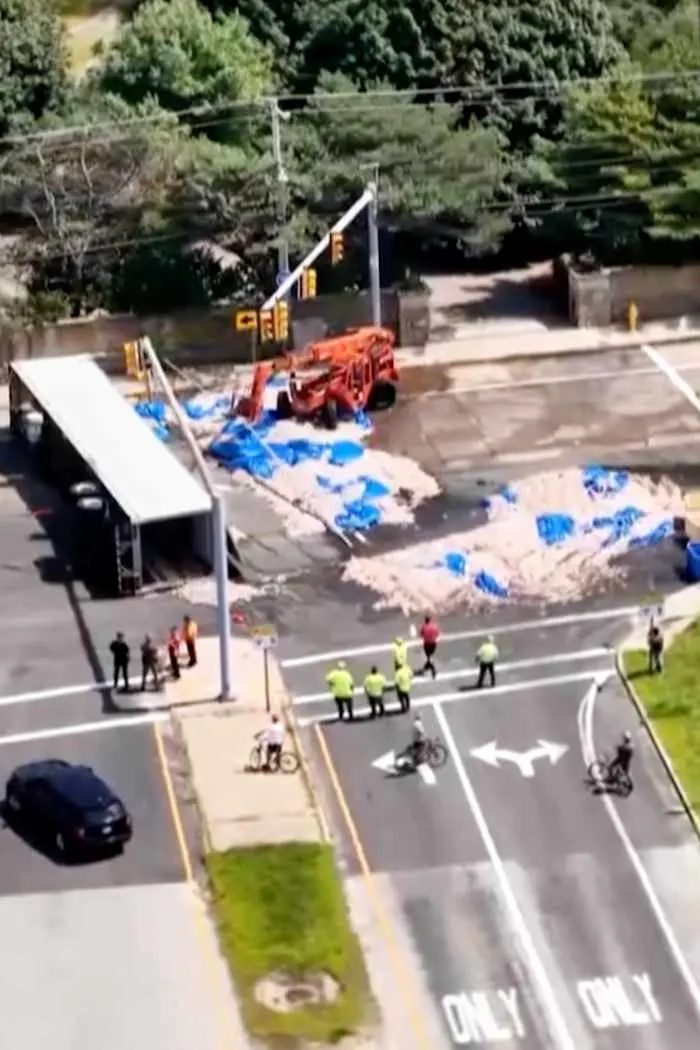
On a sun-drenched Sunday in August 2026, the coastal seaside town of Narragansett, Rhode Island, became the unlikely epicenter of one of the strangest and most pungent transportation mishaps in recent New England history. What began as a routine commercial freight transit quickly escalated into a full-scale biohazard and traffic nightmare when a heavy-duty tractor-trailer experienced a catastrophic mechanical decoupling, shedding a massive cargo of raw squid across a busy municipal intersection.
The incident, instantly and informally dubbed the "Squidpocalypse of ’26" by local authorities and social media commentators alike, transformed a stretch of asphalt into a slick, glistening graveyard of marine protein. As the hours ticked by under a blazing summer sun, the thousands of pounds of unshielded cephalopods began to decompose rapidly, releasing an olfactory assault that tested the resilience of local residents, first responders, and municipal cleanup crews.
While the physical destruction was mercifully contained—with no injuries reported and no secondary vehicular collisions recorded—the logistical and environmental fallout required an intensive, eight-hour operation involving heavy machinery, industrial dump trucks, and specialized sanitation measures. This comprehensive investigative report reconstructs the events of August 16, 2026, examining the mechanics of the crash, the physiological properties of the cargo that made the cleanup uniquely challenging, official responses, and the broader implications for commercial transport safety in coastal communities.
Detailed Chronology: Sunday, August 16, 2026
09:15 AM – The Fatal Turn
The morning air in Narragansett was warm and clear as the tractor-trailer, loaded to capacity with raw squid destined for an out-of-town processing facility, navigated local thoroughfares. According to preliminary reports from the Narragansett Police Department, the transport vehicle was executing a routine turning maneuver when structural stress caused the trailer to dislodge from its hitch mechanism.
The decoupling occurred with sudden violence, sending the fully laden trailer careening onto its side. As the heavy container tipped, its structural integrity yielded, releasing a "substantial portion" of its perishable cargo. Thousands of pounds of raw squid cascaded across the roadway, blanketing the intersection in a thick, gelatinous layer of marine biomass.
09:27 AM – Emergency Dispatch and First Response
Within minutes of the rollover, local emergency dispatchers began receiving frantic calls from motorists and nearby residents reporting a massive obstruction on the roadway, accompanied by an immediate and overpowering scent. Narragansett police units arrived at the scene at precisely 9:27 a.m.
First responders quickly secured the perimeter, shutting down the intersection to all vehicular and pedestrian traffic. Upon inspecting the cab of the truck, officers confirmed that both the driver and a single passenger had emerged from the rollover completely uninjured. Miraculously, no other vehicles had been caught in the path of the falling trailer or the cascading tide of seafood.
11:30 AM – The Thermal Factor and Onset of the Stench
By late morning, the ambient summer temperature began to peak, accelerating the natural breakdown of the marine proteins left exposed on the sun-baked asphalt. Narragansett Police Capt. Ryan Prest noted that the situation deteriorated rapidly as the morning progressed.
"It started to smell bad as the squid sat out in the sun for a few hours," Capt. Prest remarked, summarizing the sensory reality faced by officers securing the perimeter.
Local residents and fishermen quickly realized the gravity of the situation. Richard Stevens, a veteran Narragansett fisherman interviewed by local affiliate WJAR, captured the sentiment of the neighborhood:
"Squid has a distinctive odor to it. It can be very foul smelling, especially if it lands on the road and stays there for awhile."
01:00 PM to 04:00 PM – Mobilization of Heavy Machinery
Standard street-sweeping equipment and manual shovels proved entirely inadequate for the sheer volume and slippery consistency of the calamari cargo. Municipal authorities realized that a heavy industrial intervention was necessary.
Heavy equipment operators were brought in alongside municipal dump trucks. Front-end loaders were deployed to scoop up massive, undulating piles of squid from the tarmac, depositing them into the beds of the dump trucks for disposal. Simultaneously, sanitation crews applied high-pressure water streams to strip away the slick residue left behind by the decomposing mollusks, a substance that local police later joked "put ‘slippery when wet’ to shame."
05:15 PM – Reopening and Clearance
After nearly eight continuous hours of intensive labor, hazardous material washing, and structural clearance, the intersection was finally deemed safe for public transit. At 5:15 p.m., the Narragansett Police Department officially reopened the roadway to regular traffic, concluding the acute phase of the operation.
Supporting Context & Metrics: The Science of the "Squidpocalypse"
To fully understand the magnitude of the Narragansett spill, one must examine the unique biological and logistical factors that elevated a simple trucking accident into a legendary local event.
The Anatomy of Marine Decay
Squid (order Teuthida) are composed primarily of muscle tissue rich in proteins, amino acids, and nitrogen compounds such as trimethylamine oxide (TMAO). When living, these compounds serve critical biological functions; however, upon death and exposure to ambient heat, enzymatic action and bacterial proliferation break down TMAO into trimethylamine (TMA), the chemical compound responsible for the characteristically pungent, fishy odor of decaying seafood.
In an enclosed processing plant or refrigerated transport truck, this process is strictly suppressed by sustained, low temperatures. On an open, sun-baked Rhode Island road in mid-August, however, thermal acceleration caused the breakdown to occur exponentially faster. Within two hours, volatile organic compounds filled the humid air, creating an olfactory radius that extended for blocks.
The Physics of Calamari on Asphalt
Raw squid presents a unique civil engineering challenge when spilled in bulk. The outer mantle of the animal, combined with its internal fluids, creates a high-viscosity, low-friction surface layer. Unlike dry freight or even liquid spills that can be absorbed by sand or chemical agents, a mass of whole squid acts effectively like ball bearings under the weight of tires, rendering traditional braking impossible and creating extreme footing hazards for cleanup personnel.
Quantitative Breakdown of the Incident
- Date of Incident: Sunday, August 16, 2026
- Location: Narragansett, Rhode Island intersection
- Time of Police Dispatch: 09:27 AM
- Time of Roadway Reopening: 05:15 PM
- Total Road Closure Duration: 7 hours, 48 minutes
- Injuries: 0 (Driver and passenger uninjured)
- Secondary Vehicles Involved: None
- Primary Cleanup Equipment: Front-end loaders, industrial dump trucks, high-pressure sanitation units
Official Statements and Investigation
As cleanup operations concluded, attention shifted toward accountability, regulatory compliance, and official inquiry.
Law Enforcement and Regulatory Stance
The Rhode Island State Police Commercial Enforcement Unit immediately launched an investigation into the mechanical failure of the tractor-trailer. Investigators sought to determine whether the decoupling was the result of equipment fatigue, improper hitching, shifting cargo weight distribution, or driver error while navigating the turn.
Despite the dramatic nature of the spill and the extensive municipal resources required to remediate the intersection, law enforcement officials exercised caution regarding immediate punitive measures. Speaking to reporters days after the incident, Capt. Ryan Prest provided an update on the legal status of the driver and transport company:
"We have not issued any citations. I’m not sure if there will be any citations issued by the state police."
As of press time, the Rhode Island State Police Commercial Enforcement Unit has not released its final forensic report on the mechanical failure, and requests for comment regarding potential regulatory fines or safety violations remain pending.
Community Relations and Digital Humor
Recognizing the absurdity of the event, the Narragansett Police Department adopted a lighthearted public relations approach to ease community tensions. On Wednesday, August 19, the department shared a humorous recap of the week on social media, assuring residents that the town was "still recovering" from the historic event:
"The Squidpocalypse of ’26 — the spill that put ‘slippery when wet’ to shame."
The post quickly went viral, drawing national attention and transforming a localized transit disruption into a viral sensation that highlighted the resilience and dry humor of the Narragansett community.
Future Outlook: Preventing Future Marine Mishaps
While the "Squidpocalypse of ’26" ultimately resulted in nothing more severe than a traffic delay, bruised municipal pride, and lingering olfactory memories, transportation safety experts suggest the incident serves as a vital case study for regional logistics management.
Implications for Commercial Seafood Transport
Rhode Island’s coastal economy relies heavily on the seafood processing and transport industry. Millions of pounds of catch traverse local highways annually to reach interstate and international markets. The Narragansett spill underscores the critical need for rigorous pre-trip inspections, particularly concerning trailer hitch security, dynamic load shifting, and temperature-controlled containment integrity.
- Enhanced Hitch Protocols: Transport companies operating in coastal sectors may face increased scrutiny regarding mechanical coupling mechanisms, especially when hauling dense, fluid-heavy seafood payloads that exert dynamic centrifugal forces during turns.
- Rapid-Response Hazmat Protocols for Perishables: Municipalities may need to develop specialized rapid-response protocols for organic biological spills, integrating chemical neutralizers or odor-suppressant foams to minimize community exposure to decomposing protein loads.
- Infrastructure Resilience: Civil engineers designing turns and intersections along designated commercial fishing transit routes may need to incorporate enhanced containment or drainage systems to prevent biological cargo from entering local stormwater systems during accidental releases.
Conclusion
The events of August 16, 2026, will long be etched into the collective memory of Narragansett. From the initial shock of the trailer rollover to the sweltering hours of cleanup and the viral humor that followed, the Squidpocalypse demonstrated both the unpredictable nature of modern logistics and the steady hand of local emergency services. As investigators finalize their review of the commercial transport vehicle, Narragansett has returned to its peaceful coastal rhythms—though residents and local drivers will likely look upon highway transport trucks, and the humble squid, with a newfound wariness for years to come.

0 Comments