

By Anna Williams | September 30, 2026
Executive Overview
On crisp autumn Saturdays in Athens, Georgia, the rituals of college football unfold with sacred precision. Inside Sanford Stadium, wide receivers streak downfield to haul in laser-guided passes, linebackers deliver bone-crushing tackles in the trenches, and running backs churn their legs through narrow gaps for every hard-fought yard. The University of Georgia Bulldogs frequently walk off the turf victorious—though they rarely leave it unscathed. Their jerseys bear the honorable scars of battle: turf burns transformed into tears, stretched seams from holding penalties, and fabric ripped during open-field tackles.
Yet, when the team charges back through the tunnel the following week, they are not clad in pristine, factory-fresh uniforms. Instead, they re-enter the fray wearing those exact same battle-tested jerseys—mended, repatched, reinforced, and meticulously restored to peak condition.
Behind this weekly transformation is an unlikely partnership between a powerhouse SEC athletic program and a local downtown Athens boutique. Community, a sustainable fashion shop known for its visible workroom and advocacy for slow fashion, has quietly become the secret weapon of the Georgia Bulldogs’ equipment room. Founded by German transplant Sanni Baumgärtner, the boutique’s master seamstresses handle the high-stakes, rapid-turnaround alterations and repairs that keep the red and black looking sharp under the blinding stadium lights.
Far more than a simple tailoring job, this collaboration bridges the high-velocity world of Division I athletics with the grassroots ethos of community-based craftsmanship. Every patch sewn, every torn underarm reinforced, and every nameplate swapped tells a story of perseverance, transforming utilitarian sportswear into a living "memory map" of a grueling college football season.
Detailed Chronology: From German Exchange Student to SEC Tailor
To understand how a boutique specializing in sustainable fashion came to service one of the most elite college football programs in the country, one must trace the winding path of owner Sanni Baumgärtner.
Roots in the Classic City
Baumgärtner’s journey to the heart of SEC country began in 1997, when she arrived in Athens, Georgia, as an international exchange student from Germany. Like countless others before and after her, she was instantly captivated by the city’s unique cultural tapestry—a vibrant collision of Southern charm and a countercultural arts scene forged by legendary local indie-rock bands.
While playing music in a local band and selling vintage clothing on the side to make ends meet, Baumgärtner developed a profound passion for textile conservation. She specialized in taking discarded, vintage, or worn-out garments and reimagining them into modern, wearable pieces. This philosophy of reuse and repair formed the bedrock of her entrepreneurial vision.
In 2010, Baumgärtner formally brought this vision to life by opening Community in downtown Athens. The boutique was designed with an intentional transparency: a visible, open-floor workroom where customers could watch clothes being altered, repaired, and constructed right before their eyes. It stood as a direct rejection of fast fashion, emphasizing the tangible human labor required to maintain a wardrobe.
The Accidental Touchdown
The connection to Georgia Athletics—and American football at large—did not arrive through aggressive networking or corporate sponsorships. It happened almost by chance in 2019, nine years after Community first opened its doors.
“It was a happy customer that recommended us to the Georgia athletics equipment team,” Baumgärtner recalls with a smile.
At the time, Baumgärtner’s familiarity with American football was practically nonexistent. Growing up in Germany, football meant association football (soccer), and the complex rules, heavy equipment, and violent collisions of the gridiron were entirely foreign to her. Initially, the prospect of taking on contracts for a powerhouse athletic program felt profoundly intimidating.
“At first I was terrified because the football field is such a big stage,” she admits, acknowledging the immense pressure that comes with outfitting athletes who perform in front of 93,000 screaming fans and millions of television viewers. However, her fears were quickly assuaged by the confidence of her staff. “My seamstresses were not worried at all.”
What started as a tentative trial run has now blossomed into a multi-season fixture of Community’s annual calendar. Seven seasons later, jersey repair has transitioned from an unexpected novelty into a finely tuned, highly synchronized weekly ritual.
Supporting Context & Metrics: Inside the Workroom
Operating behind the scenes of an SEC football powerhouse requires an extraordinary level of logistical precision, specialized equipment, and acute textile knowledge. Modern football jerseys are marvels of advanced material science, engineered from heavy-duty, high-stretch synthetic blends designed to withstand violent tugging while remaining lightweight and breathable. Mending them requires far more than a simple needle and thread.
The Weekly Lifecycle of an SEC Jersey
The pipeline between the Butts-Mehre Heritage Hall football complex and Community’s downtown workroom operates on a punishingly tight schedule:
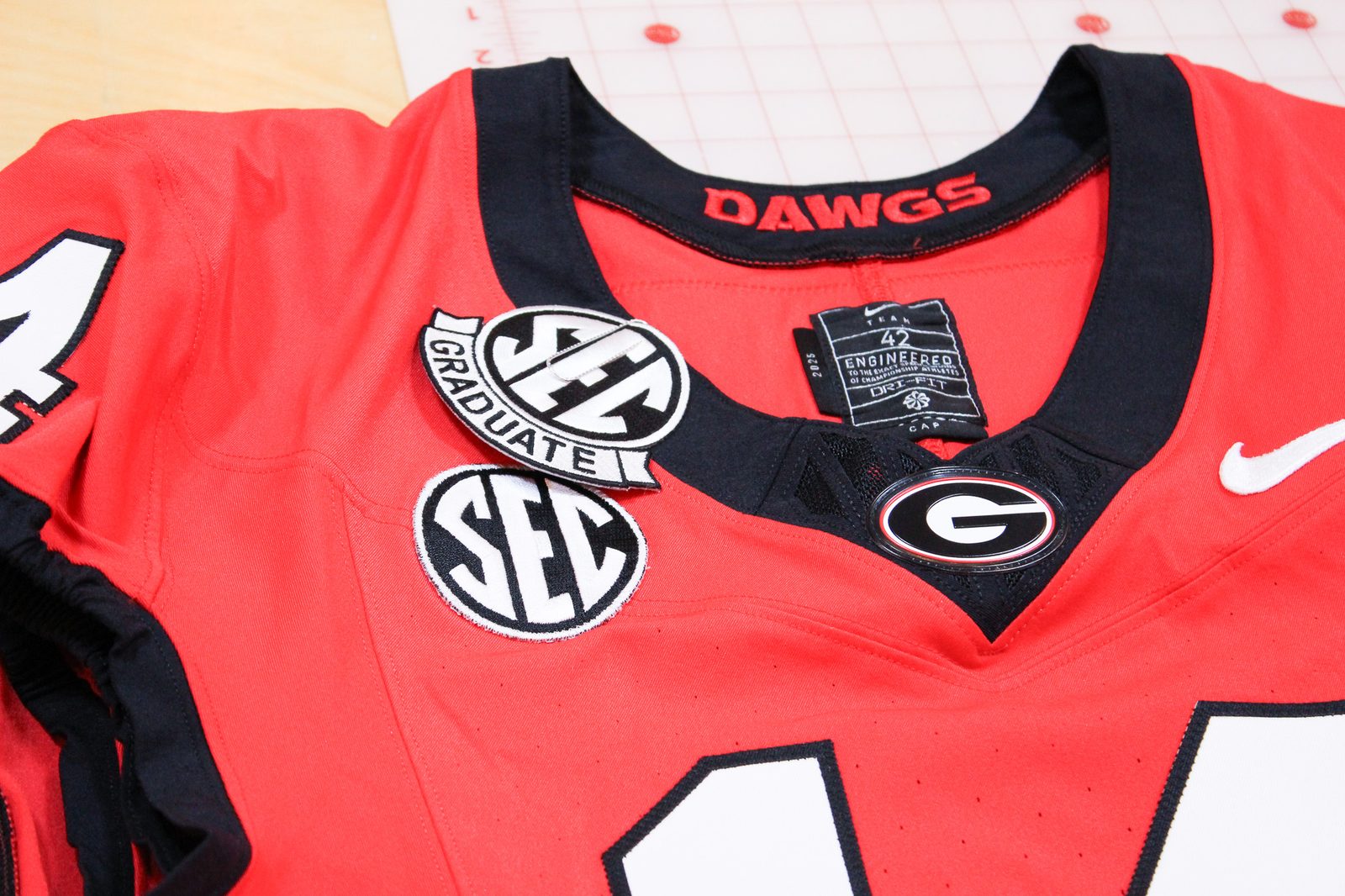
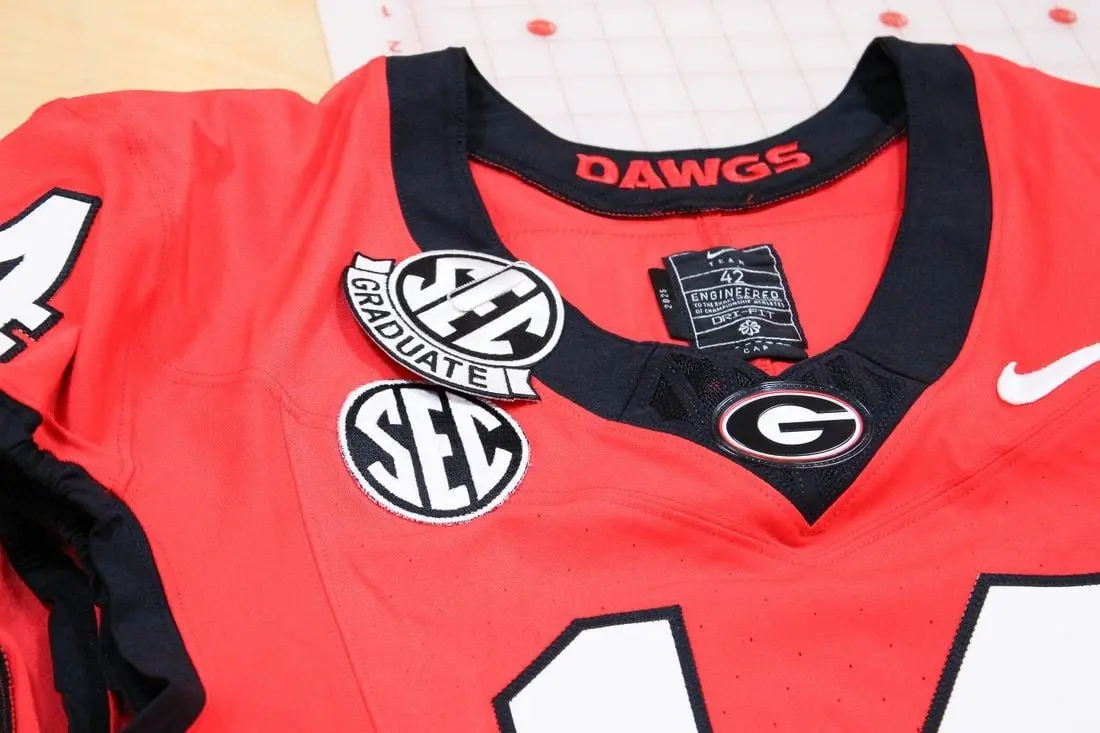
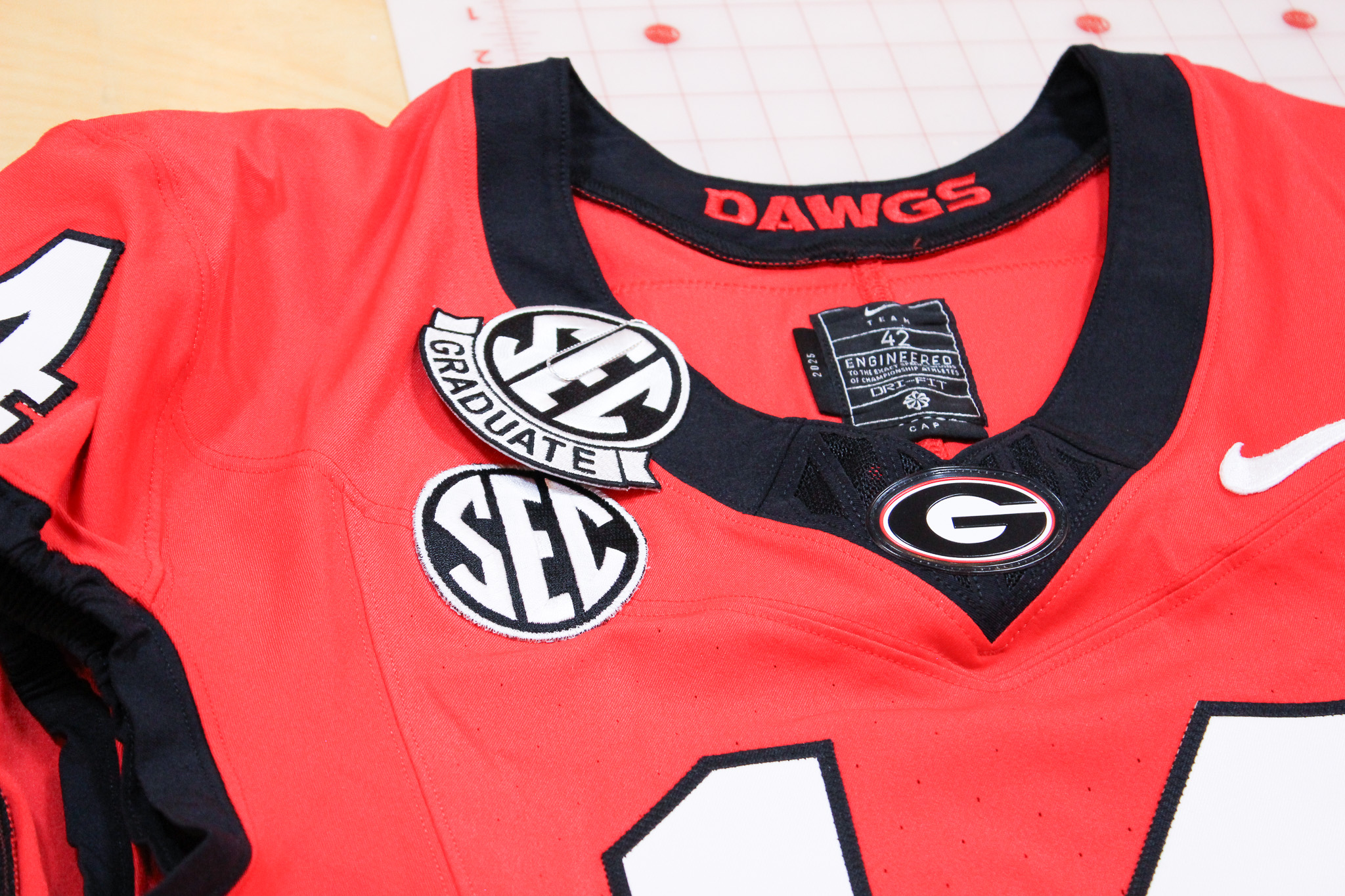
- Pre-Season Preparation: Before a single snap is played, the workroom is inundated with preparatory tasks. Tiffany Poucher, Community’s primary alterations specialist, alongside Baumgärtner, spends weeks sewing on custom nameplates, SEC conference patches, and prestigious graduate patches for players who have already earned their undergraduate degrees.
- The Saturday Battle: Players take the field, absorbing hundreds of high-impact collisions. Fabrics are stretched to their absolute tensile limits; stitching gives way under the force of open-field ankle tackles and jersey grabs.
- The Monday Drop-Off: Shortly after the final whistle blows, UGA football equipment manager Cody Howell delivers the weekend’s casualties to the boutique.
- The Triage and Repair Phase: The seamstresses inspect every garment, categorizing damage from minor popped seams to catastrophic rips.
- The Mid-Week Return: Repaired jerseys are rushed back to the equipment staff, cleaned, inspected, and placed back into rotation ahead of the next Saturday kickoff.
High-Stakes Tailoring
The nature of football injuries introduces scenarios that standard tailoring shops never encounter. Baumgärtner notes that the work can occasionally become dramatic: “It gets pretty rough. Sometimes if a player gets injured, they need to be cut out of their jersey by the medical staff. So we have to piece the whole thing back together for them.”
Beyond emergency repairs, the workroom performs critical performance-enhancing adjustments tailored to individual players’ physiological needs and on-field roles. For example, a star quarterback requires an exceptional range of motion in his throwing shoulder and arms to deliver accurate deep balls. To optimize this movement, the seamstresses will meticulously open the stitching slightly underneath the armpit, relieving tension without compromising the structural integrity of the jersey.
“It’s really exciting to know we can help them perform to the best of their abilities just by making slight modifications,” Baumgärtner explains.
The Postseason Crush
While the regular season demands a reliable weekly rhythm, the postseason brings a staggering surge in volume. Bowl games introduce tight turnaround times—often requiring entire rosters of 120 to 130 jerseys to be retrofitted with specialized bowl patches within a span of just 48 to 72 hours. During these crunch periods, Baumgärtner steps away from administrative duties to join Poucher at the sewing machines, working feverishly to ensure the team steps onto the postseason stage pristine and uniform.
Official Statements & Human Perspectives
The collaboration between Community and the University of Georgia is ultimately defined by the human element—the tactile connection between the people who wear the clothes and the artisans who mend them.
In an era dominated by mass production, where clothing is treated as disposable, this partnership elevates garment repair to a form of storytelling. Baumgärtner reflects deeply on the emotional weight carried by these heavily patched uniforms:
"The jerseys become these memory maps for players. At the end [of their careers], they can look at their jerseys and remember certain moments from the games—where they took a massive hit, how they fought through an injury, or the exact play where a seam gave way during a championship run."
For the players, donning a repaired jersey serves as a physical manifestation of resilience. Every reinforced shoulder yoke and re-stitched hem is a testament to perseverance—both for the athlete enduring the physical toll of an SEC schedule and for the garment surviving the rigors of high-impact competition.
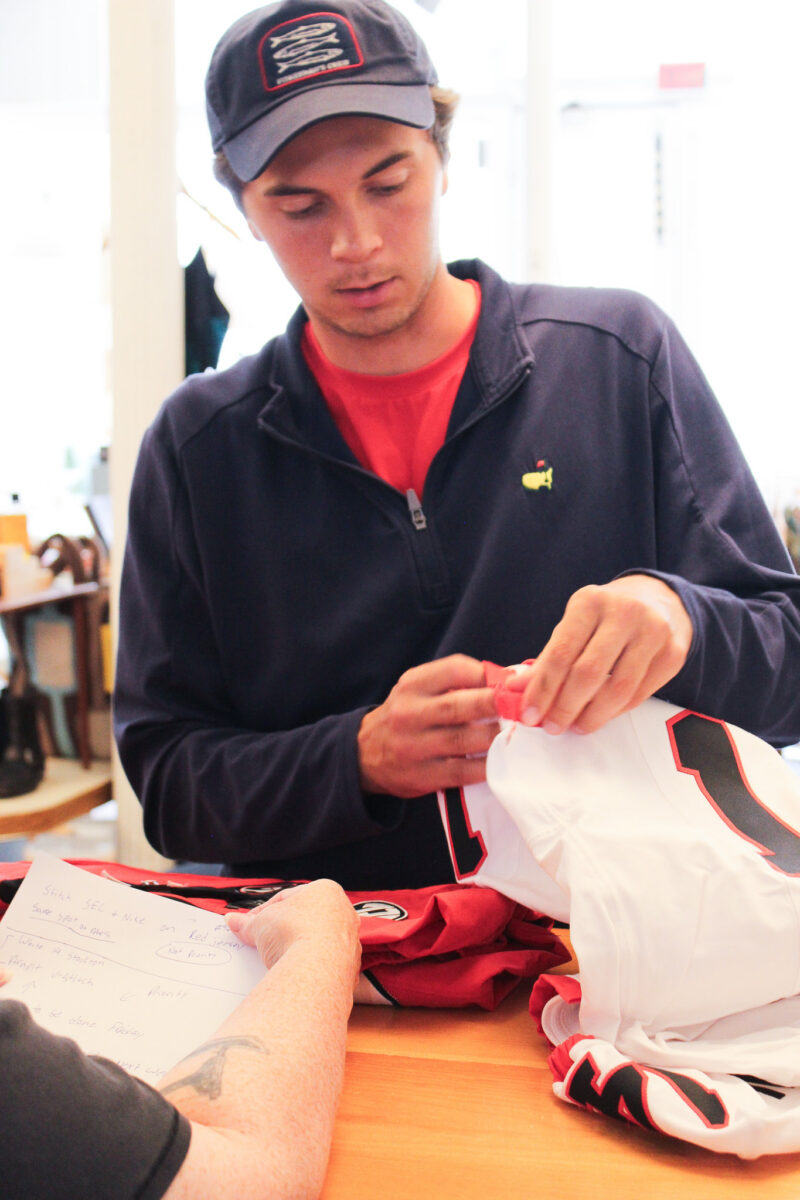
Artisans like Tiffany Poucher rarely step into the limelight, remaining anonymous architects of team pride. Yet, their work is implicitly trusted by athletes whose professional futures depend on the reliability of their gear. By keeping the workroom open and visible to the public, Community reminds everyday consumers that clothes are not ephemeral objects to be discarded at the first sign of wear, but valuable artifacts worthy of care, investment, and preservation.
Future Outlook: The Intersection of Heritage, Athletics, and Sustainability
As college athletics continues to industrialize—characterized by massive television contracts, multi-million-dollar facilities, and hyper-modern equipment—the partnership between the Georgia Bulldogs and Community offers a refreshing counter-narrative. It proves that even at the absolute pinnacle of corporate-sponsored collegiate sports, there is enduring value in hyper-local, artisan-driven craftsmanship.
The implications of this relationship extend far beyond the borders of Athens, Georgia. It challenges athletic departments across the country to reconsider their supply chains and waste management practices. Rather than ordering entirely new batches of uniforms to replace garments with minor tears, programs can look to sustainable local tailoring models to extend the life of high-performance gear.
Furthermore, as the global fashion industry grapples with its staggering environmental footprint, the ethos championed by Baumgärtner and her team serves as a guiding light. By demonstrating that high-performance athletic wear can be successfully repaired, customized, and preserved season after season, Community bridges the gap between grassroots environmentalism and mainstream sports culture.
On Saturdays in the fall, tens of thousands of fans fill Sanford Stadium to roar for touchdowns and celebrate athletic excellence. But away from the roar of the crowd, in the quiet glow of a downtown boutique’s open workroom, the true infrastructure of the team is maintained. Through every threaded needle, reinforced seam, and patched-up tear, Community ensures that the physical history of the Georgia Bulldogs is preserved—one stitch at a time.

0 Comments