

Executive Overview
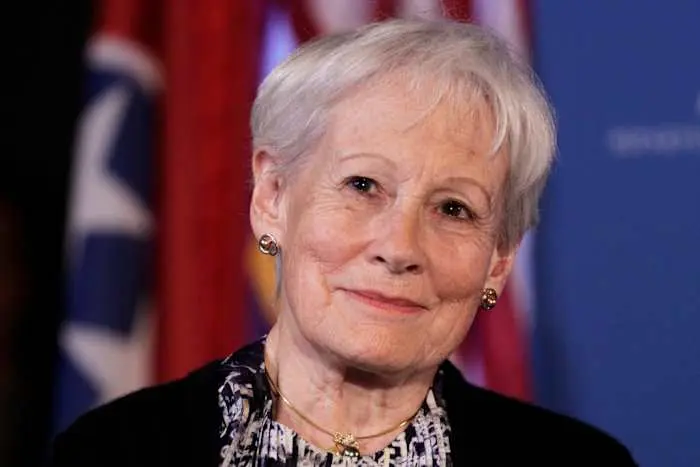
Nancy Kassebaum Baker, a monumental figure in American politics who shattered political barriers as the first woman elected to the United States Senate without succeeding her husband, has passed away at the age of 94. Dying of natural causes at her home, according to her son, Bill Kassebaum, she leaves behind a legacy defined by independent-minded pragmatism, fierce bipartisan collaboration, and a profound, lifelong devotion to the people of Kansas.
Serving three terms in the U.S. Senate from 1979 to 1997, Kassebaum Baker emerged from the political lineage of her father, Kansas Governor Alf Landon, the 1936 Republican presidential nominee. Yet she carved out an entirely unique path defined by quiet dignity, policy depth, and a willingness to break ranks with her own party when her conscience demanded it. She championed landmark legislation—such as the Health Insurance Portability and Accountability Act (HIPAA)—and earned the deep respect of colleagues across the aisle, including the late liberal lion of Massachusetts, Senator Ted Kennedy.
Long after stepping away from Capitol Hill, Kassebaum Baker remained a moral compass within the Republican Party, famously breaking with increasingly partisan orthodoxy in her later years to endorse Democrats and condemn the actions of former President Donald Trump following the January 6 Capitol insurrection. Her death marks the end of an era for a vanishing breed of Midwestern, centrist Republicans who prioritized sensible governance and institutional integrity above factional loyalty.
Detailed Chronology
Early Life and Political Roots (1932–1978)
Born Nancy Landon on July 29, 1932, Kassebaum Baker entered the world as her father, oilman Alf Landon, campaigned for the first of two terms as the governor of Kansas. Growing up in the political spotlight during an era of profound economic turmoil, she absorbed early lessons in public service and civic responsibility. She pursued higher education with a distinct focus on governance and history, earning a bachelor’s degree in political science from the University of Kansas and a master’s degree in diplomatic history from the University of Michigan in the mid-1950s.
Before launching her own historic political career, Kassebaum Baker worked as a radio-station executive, served a formative year on the congressional staff of Kansas Senator James Pearson in the 1970s, and contributed locally as a member of the school board in the Wichita suburb of Maize. Her first marriage to Phil Kassebaum produced four children—including Bill, who later served in the Kansas House of Representatives—before ending in divorce in 1979.
Breaking the Glass Ceiling in the U.S. Senate (1978–1996)
In 1978, at a time when women were drastically underrepresented in the halls of federal power, Kassebaum Baker decided to run for the U.S. Senate. Pundits and political strategists estimated that a competitive statewide race in Kansas would require an astronomical campaign budget of $1 million. Operating on a shoestring budget and spending less than $12,000 in the first quarter of 1978, she initially viewed herself as an underdog in a crowded, nine-person Republican primary that included seasoned state senators and prominent business leaders.
Despite the crowded field, Kassebaum Baker captured the GOP nomination with just under 31 percent of the vote. Running as Nancy Landon Kassebaum, she secured a decisive victory in the general election, defeating former two-term Democratic Congressman Bill Roy with nearly 54 percent of the vote. Her election made national headlines, as she became the first woman in American history to win election to the Senate in her own right, rather than being appointed or elected to fill the unexpired term of a deceased spouse.
Upon taking office, Kassebaum Baker immediately rejected orthodox formulas, famously refusing to endorse a constitutional amendment requiring a balanced budget during her early months in Washington, warning colleagues that "we should be wary of the seemingly simple solution." Her measured, pragmatic approach endeared her to Kansas voters, who re-elected her in landslide victories—winning 76 percent of the vote in 1984 and 74 percent in 1990.
By the time she announced her retirement ahead of the 1996 election, Kassebaum Baker stood out as one of only eight women in the Senate and the sole female chair of a major committee, leading the powerful Labor and Human Resources panel.
Post-Senate Life, High-Profile Marriage, and Public Service
Upon retiring from the Senate in January 1997, Kassebaum Baker returned to her beloved roots in the scenic Kansas Flint Hills, expressing a modest desire to "cuddle up and do needlepoint all day" and spend time with her grandchildren.
However, her retirement from elected office did not mean an end to her public contributions. In December 1996, she married former Tennessee Republican Senator and White House Chief of Staff Howard Baker, creating a historic first: a marriage between two individuals who had both served as U.S. senators. The couple maintained a low-key romance that captured national attention only months before their wedding.
When President George W. Bush appointed Howard Baker as the U.S. Ambassador to Japan in 2001, Kassebaum Baker accompanied him to Tokyo for a four-year diplomatic posting, where she became a respected and influential figure in her own right. Throughout her later years, she continued answering the call to public service, lending her expertise to bipartisan commissions on campaign finance reform under President Bill Clinton and international governance initiatives in Africa.
Supporting Context & Metrics
- Tenure: Served three consecutive terms in the United States Senate representing Kansas from January 3, 1979, to January 3, 1997 (18 years).
- Electoral Dominance: Secured commanding general election victories in conservative Kansas, capturing nearly 54% in 1978, 76% in 1984, and 74% in 1990.
- Legislative Milestone: Co-authored the Health Insurance Portability and Accountability Act (HIPAA) of 1996 alongside Massachusetts Democrat Ted Kennedy, establishing critical protections for worker health insurance coverage.
- Leadership Role: Chaired the Senate Labor and Human Resources Committee, serving as the sole female committee chair in the chamber at the time of her retirement.
- Family Legacy: Daughter of former Kansas Governor and 1936 Republican presidential nominee Alf Landon, who lived to the remarkable age of 100.
- Age at Passing: Died at the age of 94 on Friday of natural causes.
Official Statements
Tributes poured in from across the political spectrum following the announcement of Kassebaum Baker’s passing, highlighting her integrity, independence, and deep love for her home state.
Her son, Bill Kassebaum, shared a poignant reflection with The Associated Press:
"She loved Kansas. She loved people from Kansas and representing Kansas for 18 years in the U.S. Senate. She was an independent-minded Republican who was willing to stand up for what she thought was right, even if that meant going against the party."
Reflecting on her pivotal 1996 retirement and her deep connection to the land, Kassebaum Baker once remarked on her simple ambitions away from the capital:
"I’d rather cuddle up and do needlepoint all day."
When contemplating her diplomatic assignment to Tokyo alongside her husband, she offered a sentiment that captured her enduring Kansas identity:
"All I can say is, I will miss the Kansas prairie."
Future Outlook
The passing of Nancy Kassebaum Baker closes a significant chapter in the history of American political moderation. As contemporary politics increasingly grapples with hyper-partisanship, ideological purity tests, and deep institutional polarization, Kassebaum Baker’s career serves as a powerful reminder of an era when compromise was not viewed as a weakness and cross-party collaboration was essential to effective governance.
While her physical presence is gone, her legacy will continue to resonate through the institutions she shaped, the landmark laws bearing her name, and the enduring standard she set for public servants. For Kansas and the nation at large, Kassebaum Baker remains an inspirational blueprint for leadership rooted in humility, intellectual independence, and an unshakeable commitment to the public good.

0 Comments