

Executive Overview
NORTH AUGUSTA, S.C. — For endurance athletes, the final weeks leading up to an Ironman competition are typically defined by meticulous pacing, high-volume training blocks, and mental preparation. However, for 31-year-old triathlon coach Jonathan Bruney, a routine Sunday morning "race rehearsal" in the Savannah River transformed into a life-or-death survival scenario.
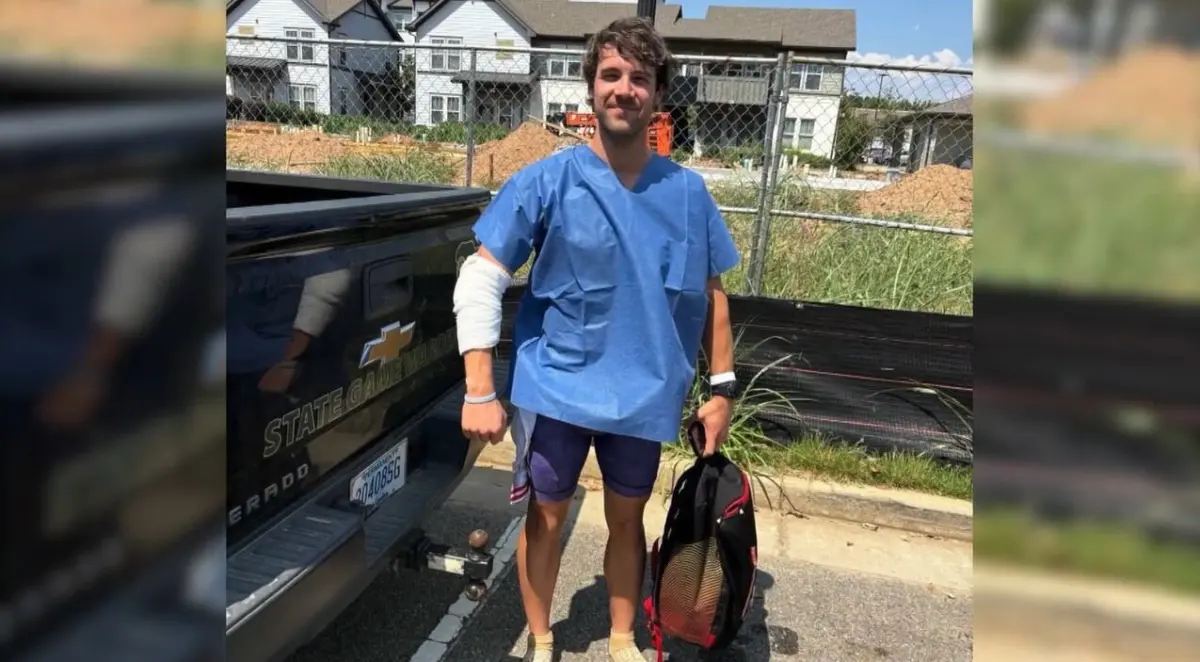
Leading a team of athletes from NVDM Coaching through a simulation swim ahead of the upcoming Ironman Augusta, Bruney was targeted by a four- to five-foot American alligator roughly 1,000 yards into the water. Striking without warning from the murky depths, the reptile clamped its jaws onto Bruney’s upper right arm. Relying on sheer adrenaline, quick thinking, and a localized survival instinct, Bruney jammed his thumb into the alligator’s eye socket, forcing it to release its grip before a catastrophic "death roll" could occur.
While alligator attacks on humans remain statistically rare—particularly in monitored racing venues—this high-profile incident has ignited regional conversations regarding water safety, ecosystem coexistence, and the unpredictable nature of open-water training in the American South. Despite suffering deep lacerations that required immediate emergency intervention and extensive sutures, Bruney escaped permanent muscle damage. Remarkably, he insists the ordeal will not deter him from coaching, competing, or stepping back into the water for race day.
Detailed Chronology: From Race Rehearsal to Sudden Ambush
The Simulation Plan
The morning of Sunday, August 24, began with optimal conditions and high morale. Bruney, an experienced coach, had brought several of his athletes to the border of Georgia and South Carolina to run through a complete Ironman simulation. The itinerary was straightforward yet rigorous: a swim down a designated stretch of the Savannah River, followed by a cycling leg along the official course, and concluding with a run on the North Augusta Greeneway.
The objective was simple: build athletic confidence and mitigate pre-race anxieties for upcoming September competitions. Around 10:00 a.m., the cohort gathered at the boat ramp adjacent to SRP Park in North Augusta, South Carolina—the exact location utilized by thousands of athletes during official race events.
Fully geared for open water, the team donned bright triathlon wetsuits and towed high-visibility neon safety buoys. Prior to entering the current, Bruney and his peers visually inspected the waterway from a nearby bridge.
"We had walked up on the bridge, looked in the water," Bruney recalled. "I knew there could be a chance of maybe a few alligators here or there, but I would never put my athletes into any sort of danger. And the chances of that are extremely rare."
The Strike
Approximately 1,000 yards into the swim, the group found themselves roughly 60 yards offshore. An athlete swimming slightly ahead spotted an alligator resting near the riverbank and successfully altered their trajectory to avoid it.
Seconds later, Bruney—swimming at the front of the main pack in a white triathlon suit—experienced a sudden, violent impact.
"Basically, out of nowhere, it hit me," Bruney stated. "It was a pretty big impact to my right side… it felt as if my elbow had made a hard impact, maybe like diving on a gym basketball court."
Initially, Bruney assumed he had collided with a submerged log or piece of river debris. That miscalculation vanished instantly as a sharp, freezing pain shot up his arm. Turning his head, he locked eyes with a four- to five-foot alligator that had clamped its front left foot and powerful jaws securely around his upper right arm.
Recognizing the split-second window before the predator could initiate a rotational "death roll"—a predatory maneuver designed to dismember prey—Bruney’s survival instincts engaged.
"I immediately thought, ‘I need to get this off of me’ because I didn’t want him to spin or death roll and do even more damage," Bruney explained.
Recalling wildlife safety lore, Bruney targeted the animal’s most vulnerable sensory organs. Reaching across the creature’s snout, he drove his thumb directly into its eye socket. The defensive countermeasure was instantaneous; the alligator released its grip, allowing Bruney to break free from the beast.
Emergency Response and First Aid
Behind the lead group, triathlete Matthew Davis was locked in his own rhythm, initially unaware of the biological threat unfolding meters ahead.
"I could see some commotion in the water in front of me but didn’t think nothing of it," Davis noted. "I sighted again, and I could see they were climbing up onto a dock. That was not normal."
Urgent shouts from fellow swimmers echoed across the water. Davis surged toward the wooden dock, hoisted himself upward, and was immediately met with alarming news: "Jonathan’s been bit."
Bruney was standing on the dock in a state of acute shock, bleeding profusely from a severe gash to his upper arm. Demonstrating invaluable presence of mind, Davis—a certified wilderness first responder—improvised a life-saving medical intervention. Utilizing his pocketknife, he sliced the nylon cord off his own neon swim buoy to fashion an effective tourniquet.
"I told him, ‘It’s gonna hurt,’" Davis said. "I squeezed as hard as I could, and I could watch the bleeding stop as we applied the tourniquet."
With none of the athletes carrying cellular devices during the aquatic simulation, a frantic search for help ensued. The group began pounding on the doors of riverside residences. Eventually, they intercepted a local resident walking his dogs, who immediately contacted 911 dispatchers.
Emergency medical services arrived promptly, transporting Bruney to a local medical center. Attending physicians evaluated the wound, confirming that while the laceration was deep and necessitated a rigorous cleaning procedure and numerous stitches, the bite providentially targeted superficial skin and adipose (fatty) tissue, sparing major nerves and muscle tissue.
Supporting Context & Metrics: Evaluating the Threat of Alligators
Statistical Reality vs. Public Perception
While alligator encounters consistently generate sensational media coverage, regional wildlife authorities emphasize that unprovoked attacks on humans remain statistically rare.
According to data compiled by researchers at the Savannah River Ecology Lab (SREL), an individual is statistically far more likely to be struck by lightning, bitten by a venomous snake, or win a state lottery than to sustain a severe, unprovoked injury from an American alligator. The American alligator (Alligator mississippiensis) is native to the southeastern United States, thriving in slow-moving freshwater rivers, swamps, marshes, and lakes across South Carolina and Georgia.
Wildlife experts note that alligators are ectothermic (cold-blooded) ambush predators. They typically view humans as potential threats rather than prey items. However, encounters can spike during seasonal mating periods (spanning May through June) or when human activity intersects with nesting sites, feeding grounds, or murky waters with low visibility where mistaken identity can trigger a defensive or opportunistic strike.
Regional Ecosystem Dynamics
The Savannah River represents a dynamic, shared natural corridor. Environmental groups stress that urban and recreational expansion along the riverfront inherently increases the frequency of overlap between human athletes and indigenous wildlife.
In a public statement addressing the incident, the nonprofit advocacy group Savannah Riverkeeper framed the event within the broader reality of regional ecology:
"The recent alligator attack is a sobering reminder that when we swim in the Savannah, we are entering an ecosystem — one inhabited by fish, turtles, snakes, birds, alligators and a thousand other things that have no particular interest in accommodating us," the organization stated via social media. "That doesn’t mean we shouldn’t enjoy the river. Quite the opposite. It does, however, mean we should respect it."
Official Statements and Institutional Responses
Following the Sunday morning attack, local and state wildlife agencies initiated standard protocols to assess the risk level to the public.
- South Carolina Department of Natural Resources (SCDNR): Agency representatives confirmed they were immediately notified of the incident. Conservation officers conducted shoreline sweeps and water patrols in the vicinity of SRP Park to locate the specific reptile involved. Despite extensive searches throughout Sunday afternoon, the animal was not captured or sighted again. Wildlife officials note that relocating or euthanizing wild alligators is typically reserved for animals that display persistent habituation to humans or present an immediate, verified threat to public safety.
- NVDM Coaching Leadership: Jonathan Bruney has maintained transparent communication with his athletic roster, emphasizing accountability, safety protocols, and mental resilience. While his coaching philosophy remains anchored in rigorous preparation, he has updated his team briefings to include enhanced environmental awareness guidelines for open-water training sessions.
- Medical Prognosis: Orthopedic and trauma specialists have ordered Bruney to undergo a strict three- to four-week recovery period, mandating total abstinence from swimming to prevent aquatic bacterial infections while the deep tissue stitches heal.
Future Outlook: Resilience on the Road to Ironman Augusta
Despite the psychological and physical trauma of surviving an apex predator ambush, Jonathan Bruney’s trajectory toward the upcoming Ironman Augusta remains unbroken.
Medical clearance pending, Bruney intends to participate in the September competition, albeit with a slight strategic modification to his race-day positioning.
"I’ll still be racing. I’ll still be coaching and pursuing the passion," Bruney affirmed. "I told my athletes, ‘I am a coach that will fight off and take a gator bite to protect you and make sure you’re having a successful swim.’"
His peer and first-responder, Matthew Davis, shares this philosophical shift. Rather than abandoning open water, Davis advocates for a healthy balance of caution and respect.
"Am I scared of the water? No. But do I have a very healthy respect for the water and what’s in it? Absolutely," Davis remarked, characterizing the event as a textbook freak accident.
Bruney echoed these sentiments, reminding local athletes and outdoor enthusiasts that coexistence requires mindfulness rather than avoidance.
"We didn’t see anything, but once again, we know they’re in there," Bruney concluded. "It’s Georgia. It’s the South. It happens."
As race day approaches, the athletic community along the Savannah River stands united: better prepared, deeply respectful of the ecosystem they share, and reminded that endurance sports demand resilience not only against physical fatigue, but against the wild, unpredictable forces of nature itself.

0 Comments