

Executive Overview
Bilateral tensions between Washington and Ottawa have reached a historic boiling point following a provocative public address by Vice President JD Vance. Speaking on Monday to workers and executives at a major domestic manufacturing facility, the Vice President referred to Canada as a "state"—a slip of the tongue that he immediately characterized as a "Freudian slip" before launching into a wider critique of Canadian defense spending and national sovereignty.
The rhetorical misstep, which quickly reverberated across international media channels, occurred against the backdrop of an escalating economic confrontation. Just hours prior, President Donald Trump announced an aggressive protectionist trade policy: a sweeping 50% tariff on all imported Canadian automobiles, auto parts, and steel, set to take effect on January 1. In swift response, Canadian Prime Minister Mark Carney vowed a robust, retaliatory stance, promising "dollar-for-dollar" counter-tariffs beginning next month.
This convergence of verbal provocation and punitive economic measures has plunged North American trade and security partnerships into deep uncertainty. For decades, the world’s longest undefended border symbolized an unbreakable alliance built on shared democratic values, integrated supply chains, and mutual defense through NORAD and NATO. Today, that framework is under severe strain as protectionist trade policies collide with growing demands from Washington for its neighbors to shoulder greater burdens of their own defense.
This comprehensive report examines the sequence of events leading up to Vice President Vance’s remarks, analyzes the economic and military metrics shaping the current crisis, details the official reactions from both capitals, and outlines the perilous future outlook for cross-border relations.
Detailed Chronology
The Buildup to Economic Brinkmanship
The seeds of the current diplomatic crisis were sown over months of mounting trade friction, supply chain realignments, and political shifts in both nations. While the United States has increasingly pivoted toward economic nationalism and domestic industrial revitalization, Canada has navigated complex political transitions while attempting to safeguard its export-driven economy.
- Late Fall 2025: Whispers of sweeping trade penalties circulate within Washington’s inner economic circles. U.S. domestic manufacturing advocates push for stronger measures to protect domestic automakers from foreign competition, pointing to shifting global trade balances and lingering post-pandemic supply chain vulnerabilities.
- December (Early): Negotiations regarding automotive standards and steel import quotas stall between U.S. trade representatives and Canadian counterparts. Tensions mount over differing regulatory approaches to environmental standards and industrial subsidies.
- Monday Morning: President Donald Trump takes to social media, bypassing traditional diplomatic channels to announce a dramatic escalation in trade policy: the immediate imposition of a 50% tariff on all Canadian cars, auto parts, and steel, scheduled to take effect on January 1.
- Monday Afternoon: Canadian Prime Minister Mark Carney convenes an emergency cabinet meeting in Ottawa. Shortly thereafter, the Prime Minister’s Office issues a firm declaration of intent to implement dollar-for-dollar retaliatory tariffs starting the following month, signaling that Canada will not absorb the economic blow without a fight.
The Manufacturing Facility Address
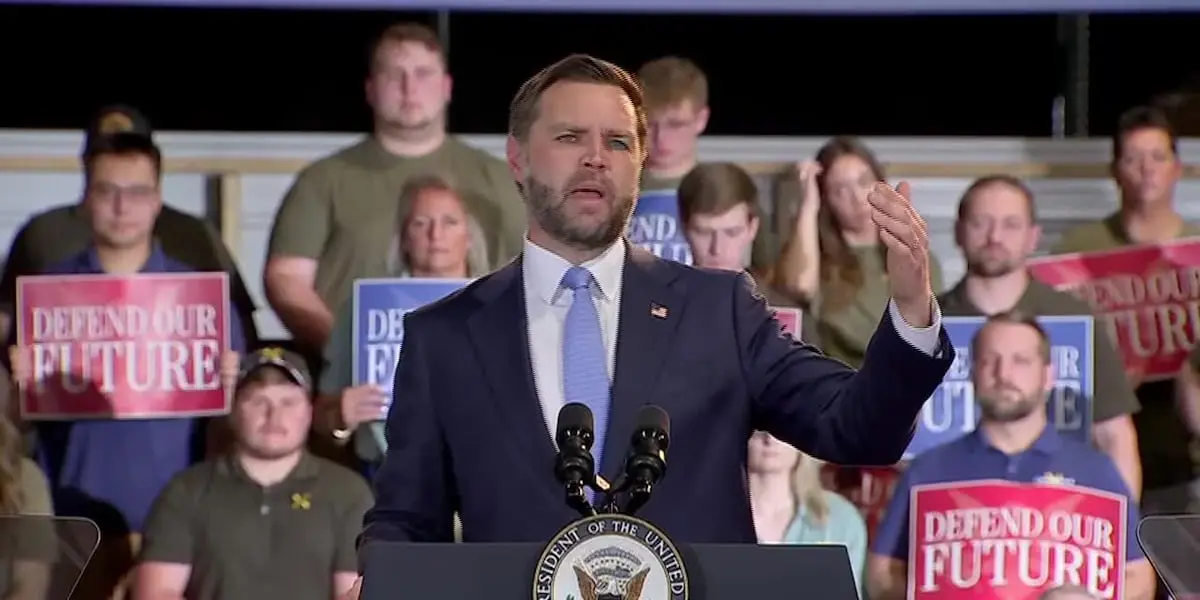
Later on Monday, Vice President JD Vance stepped up to the podium at a key manufacturing facility to champion the administration’s new trade agenda. Aiming to rally blue-collar workers around the White House’s protectionist platform, Vance sought to justify the heavy tariffs by painting Canada as a neighbor that has long benefited from American economic generosity and security guarantees without paying its fair share.
It was during this core defense of the administration’s foreign and economic policy that the controversial linguistic stumble occurred.
"We have to remember, Canada is a state, sorry, Freudian slip. That was actually an accident," Vance told the gathered crowd, pausing briefly before continuing his critique. "Canada is a country that has underinvested in its military that quite literally would get invaded by a foreign country were it not for the umbrella of protection provided by the United States of America."
The remark was captured live by broadcast networks and instantly flooded digital platforms, dominating news cycles from coast to coast and transforming an economic dispute into an intense cultural and national sovereignty debate.
Supporting Context & Metrics
To fully understand the gravity of Vice President Vance’s comments and the severity of the impending tariffs, one must examine the hard economic and military metrics that underpin the U.S.-Canada relationship.
Economic Interdependence and the Automotive Sector
The North American automotive manufacturing sector is one of the most thoroughly integrated supply chains on earth. Vehicles assembled in Ontario, Michigan, Ohio, and Mexico frequently cross international borders multiple times before final sale, utilizing components manufactured across the continent.
- Bilateral Trade Volume: Total goods and services trade between the United States and Canada routinely exceeds $700 billion annually, making it one of the most vital economic partnerships in global commerce.
- The 50% Tariff Impact: Economists warn that a 50% levy on cars, auto parts, and steel will instantly disrupt assembly lines across the Midwest and Southern Ontario. Component costs are projected to skyrocket, leading to higher vehicle prices for American consumers and potential layoffs throughout the industrial heartland.
- Retaliatory Reach: Prime Minister Carney’s promise of "dollar-for-dollar" retaliation means that targeted U.S. exports entering Canada—ranging from agricultural products to consumer goods—will face steep reciprocal duties, threatening jobs in export-dependent American states.
Defense Spending and the "Security Umbrella"
Vice President Vance’s core policy critique—that Canada has underinvested in its military and relies heavily on the United States for national security—touches upon a long-standing debate within NATO and North American defense circles.
- NATO 2% Target: For years, Washington has pressured all NATO member states to meet the alliance guideline of spending at least 2% of Gross Domestic Product (GDP) on national defense.
- Canadian Defense Metrics: Historically, Canada’s defense expenditures have hovered between 1.2% and 1.4% of its GDP. While successive Canadian governments have pledged long-term modernization plans for the Canadian Armed Forces—including major investments in Arctic surveillance, naval procurement, and aerospace defense—critics in Washington argue that the pace of these acquisitions remains far too slow given the volatile geopolitical climate.
- NORAD and Continental Defense: The North American Aerospace Defense Command (NORAD) represents a joint binational effort monitoring the skies of the continent. However, the vast expanse of the Canadian Arctic remains exceptionally difficult to patrol, leaving the northern approaches of North America heavily reliant on U.S. early-warning radar networks, satellite capabilities, and strategic deterrence.
Official Statements and Global Reactions
The fallout from the Vice President’s speech and the White House’s tariff announcement triggered a rapid succession of formal statements, diplomatic protests, and commentary from political leaders across the political spectrum.
The White House and Vice President’s Office
Defending the remarks, administration officials doubled down on the substance of Vice President Vance’s message, even as they downplayed the semantic slip. A senior administration official, speaking on condition of anonymity, emphasized that the primary focus must remain on trade fairness and burden-sharing.
"The Vice President was speaking bluntly about economic and security realities," the official stated. "For too long, American workers have competed on an uneven playing field, and American taxpayers have underwritten the security of allies who fail to meet their own defense commitments. The time for tough conversations and decisive action is now."
Ottawa’s Swift and Resolute Response
In Ottawa, the reaction was swift and unified across party lines. Prime Minister Mark Carney’s administration condemned the characterization of Canada as a "state" as an insult to Canadian sovereignty, while firmly rejecting the legitimacy of the incoming tariffs.
"Canada is a proud, sovereign, and independent nation," Prime Minister Carney stated during an emergency press briefing on Parliament Hill. "No amount of rhetoric, slips of the tongue, or coercive economic pressure will shake our resolve. We value our historic friendship with the American people, but we will never bow to economic bullying. Our retaliatory measures will be swift, targeted, and dollar-for-dollar."
Opposition leaders in the Canadian Parliament similarly denounced the Vice President’s comments, calling for an immediate diplomatic demarche and urging national unity in the face of what they termed an unprecedented assault on Canadian independence.
International and Diplomatic Fallout
Global allies and trade experts expressed profound alarm at the deteriorating relationship between the two North American neighbors. European Union trade officials noted that a full-scale trade war between the U.S. and Canada could destabilize multilateral trade frameworks and disrupt global commodity markets. Meanwhile, defense analysts in London and Brussels voiced concern that public friction between Washington and Ottawa could weaken NORAD coordination at a time when Arctic security is facing renewed geopolitical competition from rival global powers.
Future Outlook
As the calendar ticks closer to the January 1 implementation date for the 50% tariffs, the immediate future of U.S.-Canada relations remains fraught with peril. Several key trajectories are likely to define the unfolding crisis:
1. The Threat of Escalation
Should the tariffs go into effect on New Year’s Day and Canada immediately follows through with its promised retaliatory duties, both economies will face immediate inflationary pressures. Industry groups representing automakers, steel producers, and agricultural exporters are intensifying lobbying efforts in Washington and Ottawa to carve out exemptions or force a negotiated settlement before the deadline.
2. The Sovereignty Debate and Public Sentiment
Vice President Vance’s "state" remark has already sparked a wave of national pride and anti-protectionist sentiment north of the border. Boycotts of U.S. goods and travel advisories are being discussed organically on Canadian social media platforms. This grassroots backlash could force Ottawa to maintain a hardline negotiating posture, making political compromise difficult for both Prime Minister Carney and the White House.
3. Long-Term Realignment of North American Security
Beyond trade, the crisis raises fundamental questions about the future of continental defense architecture. If Washington continues to publicly question Canada’s sovereignty and defense contributions, Ottawa may accelerate independent military acquisitions and seek closer strategic partnerships with other democratic allies in Europe and the Indo-Pacific to diversify its diplomatic dependencies.
Ultimately, the events of this week mark a profound inflection point. Whether cooler heads can prevail through backchannel diplomacy before January 1—or whether North America is entering a protracted era of economic nationalism and fractured alliances—will depend heavily on the willingness of both administrations to step back from the brink of a historic trade war.

0 Comments