

WASHINGTON — In a major escalation of its economic campaign against Tehran, the Trump administration has moved to cut off the United Arab Emirates-based branches of Egypt’s second-largest bank from the U.S. financial system. The aggressive maneuver accuses the financial institution of serving as a vital monetary conduit for the Iranian regime, a policy shift arriving precisely as the ongoing U.S.-led military conflict against Iran marks its volatile six-month milestone.
The regulatory action against Banque Misr UAE represents the opening salvo of a broader, uncompromising enforcement strategy spearheaded by Treasury Secretary Scott Bessent. Rather than imposing immediate, sweeping sanctions that risk fracturing global trade, Washington is utilizing targeted regulatory pressure to choke off illicit international lifelines supporting the Islamic Republic.
As geopolitical tensions continue to roil Middle Eastern energy markets and global supply chains, the White House has made it clear that international financial institutions facilitating commerce with Tehran will face severe systemic consequences.
Executive Overview
The U.S. Department of the Treasury announced a formal Notice of Proposed Rulemaking (NPRM) targeting the UAE operations of Banque Misr. Under the newly proposed regulation, the bank’s Emirati branches would be completely severed from direct and indirect access to the U.S. financial system, effectively blocking its ability to clear transactions in U.S. dollars—the world’s primary reserve currency.
Key takeaways from the unfolding geopolitical and economic development include:
- The Target: Banque Misr UAE, the Emirati arm of Egypt’s state-aligned Banque Misr, accused by Washington of acting as a premier financial facilitator for Tehran.
- The Mechanism: A Treasury Department proposal leveraging Section 311 of the USA PATRIOT Act to isolate the bank, rather than deploying traditional block-listing sanctions.
- The Broader Campaign: Part of a coordinated enforcement pivot announced by Treasury Secretary Scott Bessent to pressure international entities maintaining commercial ties with heavily sanctioned Iran.
- Strategic Restraint: The administration is intentionally avoiding direct sanctions on major superpower trading partners like China and India for now, opting instead for a deliberate 30-day compliance window to encourage orderly disengagement.
- Collateral Actions: Accompanying measures include targeted Office of Foreign Assets Control (OFAC) sanctions on specific operatives in Dubai and a Hong Kong-based front company linked to Iranian money laundering networks.
Detailed Chronology of Events
The escalation against Banque Misr UAE did not occur in a vacuum; it is the culmination of months of heightened intelligence assessments, shifting geopolitical alignments, and a recalibration of Washington’s secondary enforcement mechanisms.
Pre-Announcement Intelligence Gathering
In the weeks leading up to the Treasury’s announcement, U.S. intelligence and financial intelligence units (FinCEN) intensified tracking on illicit networks utilizing Gulf financial hubs to bypass existing American sanctions. Despite extensive multilateral restrictions on Iran’s banking sector, investigators flagged a pattern of sophisticated trade-based money laundering and currency stabilization schemes moving through the UAE. Banque Misr UAE repeatedly surfaced in investigative dossiers as a critical node facilitating cross-border liquidity for Iranian state-owned enterprises and proxy networks.
The Friday Rulemaking Announcement
On a Friday that signaled an abrupt end to the traditional workweek for international financial compliance officers, the Treasury Department published the NPRM targeting Banque Misr UAE. The regulatory filing triggered immediate compliance reviews across multinational banks operating in the Middle East. Under the terms of the proposal, any U.S. financial institution would be prohibited from opening or maintaining a correspondent account for, or on behalf of, the targeted Emirati branches.
Bessent’s Monday Policy Unveiling
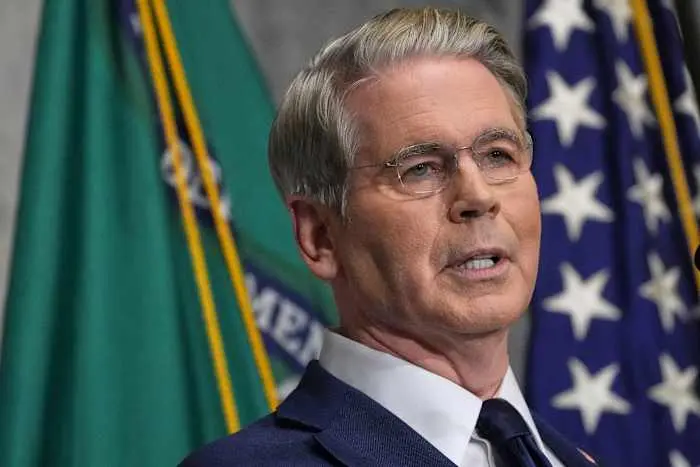
Just days after the regulatory filing, Treasury Secretary Scott Bessent addressed the press at the Treasury Department in Washington on Monday, August 24, 2026. During the briefing, Bessent laid out the administration’s comprehensive new doctrine regarding nations and institutions that continue to transact with the Islamic Republic.
Emphasizing that the U.S. war against Iran had crossed the six-month threshold, Bessent articulated a clear ultimatum: foreign banks and corporations must choose between maintaining access to the robust architecture of the U.S. dollar or sustaining commercial relationships with a designated state sponsor of terrorism.
Supporting Context & Metrics: The Architecture of Isolation
To fully comprehend the significance of targeting Banque Misr UAE, one must analyze the broader macroeconomic battlefield upon which the U.S. and Iran are currently engaged.
The Macroeconomic Toll on Iran
Six months into the military and economic campaign, Iran’s domestic economy is under unprecedented duress. The Iranian rial has suffered catastrophic devaluations, exacerbated by stringent restrictions on petroleum exports and international trade.
| Economic Indicator | Status as of August 2026 | Impact of U.S. Sanctions |
|---|---|---|
| Iranian Rial ($IRR$) | Historic lows | Extreme inflationary pressure, severe erosion of citizen purchasing power |
| Petroleum Exports | Critically depressed | Major shipping lanes constrained; secondary buyers heavily scrutinized |
| Foreign Exchange Reserves | Severely depleted | Reliance on offshore proxy accounts and regional shadow banks magnified |
| Global Financial Access | Near-total exclusion | Reliance on non-compliant regional institutions like Banque Misr UAE |
The Geopolitical Balancing Act: China, India, and the UAE
While the action against an Egyptian bank operating in the UAE is significant, financial analysts are closely monitoring Washington’s calculated restraint toward larger economic actors. China and India—both heavily reliant on foreign energy imports and maintaining historical trade ties with Tehran—have largely avoided direct, sweeping secondary sanctions thus far.
By targeting a mid-tier regional player like Banque Misr UAE, the Trump administration is sending a warning shot across the bow of the global financial system. Secretary Bessent’s strategy relies on compelling smaller enablers to self-correct, thereby isolating Tehran without triggering a wider trade war with Beijing or New Delhi that could paralyze the fragile post-pandemic global economy.
Official Statements and Diplomatic Reactions
The administrative move has drawn sharp reactions from across the globe, highlighting the delicate intersection of sovereign banking, regional diplomacy, and international security policy.
Washington’s Unyielding Stance
In his official statement released alongside the Treasury’s Friday filing, Secretary Bessent did not mince words regarding the consequences of defying U.S. extraterritorial financial jurisdiction:
"For months, the administration has warned that Iran’s enablers cannot continue to enjoy access to the U.S. dollar and the global financial system. Banque Misr UAE decided to find out the hard way, and today, we are taking the first step in holding it accountable for its continued, egregious support of the Iranian regime."
Bessent expanded on this posture during his Monday press conference, emphasizing that the administration’s goal is not indiscriminate destruction, but strategic compliance. "We want countries to have an opportunity to shift away from Iran before it is too late," Bessent told reporters. "Our objective is to prevent the upending of the global financial system while completely draining the financial oxygen feeding Tehran’s military apparatus."
Supplementary OFAC Actions
Demonstrating that the regulatory filing against Banque Misr was part of a multi-pronged enforcement sweep, the Treasury’s Office of Foreign Assets Control (OFAC) simultaneously updated its sanctions database. The new designations targeted:
- The Dubai Branch Manager of Bank Melli: An individual identified as directly orchestrating illicit capital transfers between Iranian state entities and UAE shell companies.
- A Hong Kong-Based Front Corporation: A corporate entity utilized to launder and obfuscate the origins of funds generated through illicit petroleum and commodity transactions.
Future Outlook: The Road Ahead
As the regulatory process moves forward, several critical milestones will dictate the trajectory of U.S. economic enforcement against Iran’s international financial enablers.
The 30-Day Public Comment Period
The proposed rule against Banque Misr UAE is subject to a strict 30-day public comment period managed by the Treasury Department. During this window, legal representatives, compliance officers, and international stakeholders will submit briefs, arguments, and defense strategies. However, financial analysts note that Section 311 actions proposed by the Treasury rarely fail to reach final implementation, meaning the 30-day window functions more as a phased wind-down period than a genuine negotiation space.
Upcoming G20 Ministerial Engagements
The economic offensive is slated to go global next week. Treasury Secretary Scott Bessent is scheduled to represent the United States at the upcoming Group of 20 (G20) finance ministers meetings. There, Bessent will hold a series of high-stakes, bilateral meetings with his counterparts from the world’s leading developed and developing economies.
The primary agenda item for the U.S. delegation will be lobbying international partners to align their domestic regulatory frameworks with Washington’s anti-Iran campaign. By building a multilateral coalition of enforcement, the U.S. hopes to close remaining loopholes in jurisdictions across Asia, Europe, and the Middle East.
Conclusion
The targeting of Banque Misr UAE marks a pivotal turning point in the economic dimension of the U.S.-Iran conflict. By successfully marrying military escalation with precise, extraterritorial financial strangulation, the Trump administration is systematically dismantling the shadow banking networks that have long kept Tehran solvent. As the 30-day comment period ticks down and G20 diplomacy gets underway, global financial institutions are receiving an unambiguous message: alignment with Iran is a liability the modern international banking system can no longer afford to bear.

0 Comments