

Executive Overview
OCALA, Fla. — In an era where digital clout often supersedes basic situational awareness, a Sunday evening social media stunt in Ocala, Florida, turned catastrophic. An 18-year-old male pedestrian sustained severe, life-altering injuries after being struck by a vehicle while sitting in a stolen or borrowed restaurant chair in the middle of a busy thoroughfare, actively filming a haircutting video intended for online audiences.
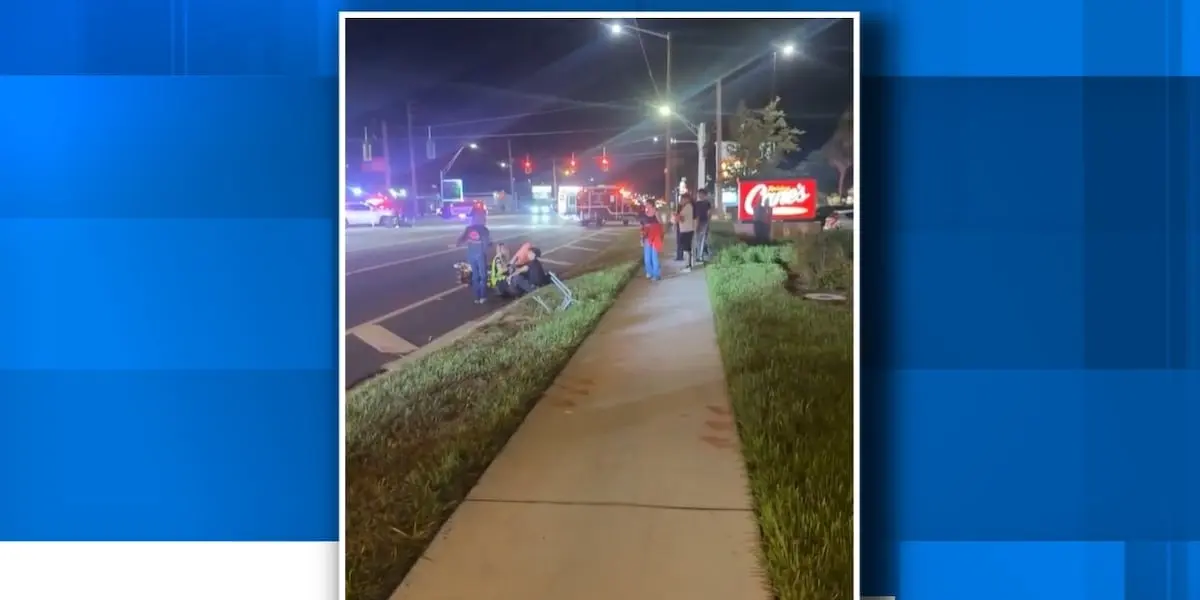
The incident, which occurred at approximately 8:00 p.m. on Sunday along Southwest College Road near 17th Road, highlights a deeply concerning and increasingly prevalent societal trend: content creators performing high-risk, unauthorized stunts on active roadways for the sake of digital engagement, views, and algorithmic visibility. According to the Ocala Police Department (OPD), the victim was part of a three-person group that had positioned themselves directly within a paved roadway median. Armed with barbering tools, a smartphone camera, and a chair reportedly hauled out from a nearby fast-food establishment, the group attempted to capture a trending TikTok-style challenge.
What began as a bid for online virality swiftly devolved into a horrific traffic collision when a westbound Chevy Silverado collided with a Lexus SUV entering the intersection from the Ocala West Plaza. The impact diverted the pickup truck directly into the median, striking the teenager seated in the makeshift roadside barbershop.
Emergency responders rushed the severely injured 18-year-old to a local trauma center. While investigators have confirmed that neither motorist involved in the crash showed signs of impairment or criminality, the incident has ignited intense local and national discussions regarding pedestrian safety, municipal right-of-ways, and the profound legal, ethical, and safety hazards associated with modern social media stunts. This comprehensive report explores the chronology of the crash, the mechanics of the collision, witness testimonies, the rising tide of reckless roadside content creation, and the broader implications for public safety enforcement in the digital age.
Detailed Chronology of the Event
To fully understand how a routine Sunday evening commute transformed into a chaotic crash scene, investigators have pieced together a precise timeline of events leading up to, during, and immediately following the collision on Southwest College Road.
Pre-Incident Setup: The Roadside Salon
Hours before the crash, the three teenagers—including the 18-year-old victim—began staging their video production. According to preliminary police findings and witness statements gathered at the scene, the group acquired a commercial-grade chair, which was identified as property belonging to the nearby Raising Cane’s restaurant.
Rather than setting up their impromptu studio in a controlled environment, a public park, or a sidewalk safely removed from vehicular traffic, the creators chose the center median of Southwest College Road near 17th Road. This corridor is known for high vehicular volumes, particularly during evening hours when shoppers exit commercial spaces such as the Ocala West Plaza.
Positioning themselves in the narrow concrete median, one teen sat in the chair while another wielded clippers to simulate or perform a haircut. The third individual operated a recording device, framing shots with passing evening traffic in the background to maximize the video’s aesthetic appeal and urban backdrop.
The Collision Sequence: 8:00 P.M.
As darkness began to settle over Marion County, the routine flow of traffic on Southwest College Road was violently interrupted.
- The Approach: A Chevy Silverado was traveling westbound along Southwest College Road, operating under normal traffic conditions. Simultaneously, a Lexus SUV was attempting to enter the roadway from the Ocala West Plaza, preparing to navigate into the flow of traffic.
- The Primary Impact: Due to factors still under active investigation by the Ocala Police Department, the Chevy Silverado and the Lexus SUV collided within the intersection. The exact angle of impact caused the Silverado to lose directional control.
- The Secondary Impact: Veering off its straight path, the multi-ton pickup truck careened toward the center median—the exact location where the 18-year-old was seated for the camera.
- The Strike: Before the teen could react or abandon the chair, the Silverado struck him. The sheer kinetic energy of the collision caused catastrophic injuries.
Immediate Aftermath and Emergency Response
Panic ensued immediately following the impact. Witnesses reported hearing the screech of tires followed by a heavy metallic crash, instantly replaced by screams from the remaining members of the content-creation crew.
Yaj Lerom, a witness who was present at the scene and had interacted with the teens shortly before the incident, captured video footage that vividly illustrates the immediate terror of the aftermath. Speaking with local media outlets, Lerom recounted the chilling speed at which the situation deteriorated. One of the surviving teens reportedly told him in a state of shock, "As soon as I look back, the car hit him."
Emergency dispatchers received multiple 911 calls reporting a severe two-vehicle crash involving a pedestrian down. Within minutes, units from the Ocala Police Department and Marion County Fire Rescue arrived at the scene. First responders secured the perimeter, diverted westbound traffic, and administered emergency medical care to the injured teenager. Due to the severity of his trauma, he was rapidly transported to a regional hospital, where he was admitted in serious condition.
Supporting Context & Metrics: The Epidemic of Roadside Stunts
The Ocala incident is far from an isolated occurrence; rather, it is a symptom of a broader, highly perilous cultural phenomenon driven by the economics of social media platforms like TikTok, Instagram Reels, and YouTube Shorts.
The Algorithm and the Economy of Attention
In the modern digital landscape, user engagement—measured in views, likes, shares, and comments—directly translates to financial compensation, brand sponsorships, and social capital. Algorithms favor high-contrast, visually arresting, and boundary-pushing content. Consequently, content creators continually push the envelope to capture scrolling users’ attention within the crucial first three seconds of a video.
Roadways, intersections, and active traffic lanes have increasingly become chosen backdrops for these stunts. Creators mistakenly view asphalt, highway shoulders, and medians as neutral performance spaces, ignoring the massive kinetic energy and unpredictability of multi-ton motor vehicles moving at high speeds.
Pedestrian Safety Statistics in Florida
Florida consistently ranks among the most dangerous states in the United States for pedestrians. According to recent data from the National Highway Traffic Safety Administration (NHTSA) and Florida Highway Safety and Motor Vehicles (FLHSMV):
- High Fatality Rates: Florida cities frequently top metropolitan lists for pedestrian fatalities and severe injuries per capita.
- Distraction Factors: Both driver distraction (often involving mobile devices) and pedestrian distraction (such as listening to music with headphones or focusing on screens) are primary contributors to urban and suburban traffic accidents.
- Infrastructure Vulnerability: Medians are designed primarily as traffic-calming devices, pedestrian refuge islands for legal street crossings, or turning lanes—not as stationary workspaces, staging areas, or recreational zones.
By occupying a median with bulky furniture (the restaurant chair) and equipment, the teens fundamentally altered the intended function of the roadway infrastructure, creating an unavoidable visual and physical hazard.
Official Statements and Ongoing Investigation
Law enforcement and municipal officials have moved swiftly to gather facts, secure evidence, and issue public statements regarding the incident on Southwest College Road.
The Ocala Police Department’s Stance
Officers from the Ocala Police Department have established that criminal charges are unlikely against the drivers involved, though the comprehensive traffic investigation remains open.
- Impairment Ruled Out: Standard field sobriety evaluations and investigative protocols confirmed that neither the driver of the Chevy Silverado nor the driver of the Lexus SUV showed any signs of impairment by alcohol or controlled substances.
- No Other Injuries: Aside from the 18-year-old pedestrian, no occupants of either vehicle or the remaining two content creators sustained physical injuries, though several witnesses and participants were treated for acute psychological shock.
- The Investigation Scope: Investigators are currently analyzing dashcam footage, witness statements, and physical skid marks to determine the exact sequence of events that led the Silverado to leave its lane and strike the median. Authorities are also reviewing the origin of the chair taken from the local Raising Cane’s, which may introduce secondary property theft considerations depending on store management’s formal complaints.
Public and Social Media Reactions
As news of the crash spread across local community groups and statewide social media feeds, reactions were sharply divided between expressions of sympathy for the injured young man and harsh rebukes of the reckless behavior that precipitated the tragedy.
- Condemnation of Stunt Culture: Many users expressed profound frustration over the normalization of blocking traffic, obstructing public rights-of-way, and risking life and limb for transient online fame. Comments flooded local reporting pages pointing out that public infrastructure belongs to all citizens and should not be co-opted as a private film set.
- Calls for Accountability: Legal analysts weighing in on the public forums noted that while the drivers were cleared of impairment, the pedestrians could potentially face civil liability or municipal citations for creating a hazardous condition on a public roadway and utilizing stolen private property (the restaurant chair) to facilitate the stunt.
Future Outlook: Prevention, Policy, and Digital Responsibility
The severe injury of the Ocala teenager serves as a grim cautionary tale that must prompt institutional action across multiple sectors—from law enforcement and tech platforms to educational institutions and families.
1. Municipal and Law Enforcement Enforcement
Local police departments across Florida and the nation are increasingly forced to adapt to crimes and accidents born from internet challenges. Moving forward, municipal authorities are likely to implement zero-tolerance policies for unauthorized filming in active roadways. Increased patrols around high-traffic commercial corridors, combined with swift citations for obstructing traffic, may serve as necessary deterrents.
2. Platform Accountability and Content Moderation
Social media giants—particularly ByteDance (TikTok), Meta (Instagram), and Alphabet (YouTube)—face ongoing criticism for hosting and indirectly incentivizing dangerous challenges. While platforms frequently deploy content warnings or remove videos that violate community guidelines regarding self-harm and dangerous activities, algorithms often promote these clips before moderation teams can intervene. Critics argue that platforms must implement more robust detection mechanisms for roadway stunts and demonetize or ban accounts that repeatedly glorify or engage in life-threatening public disruptions.
3. Public Awareness and Educational Outreach
Ultimately, preventing future tragedies requires a cultural shift among digital creators. Educational initiatives in high schools and community centers must address the real-world consequences of virtual risk-taking. Young creators must be taught that no video, view count, or viral moment is worth a permanent disability or the loss of life.
As the 18-year-old victim continues his recovery in a Central Florida trauma center, his story stands as a sobering reminder to the digital generation: the laws of physics are absolute, and the asphalt is no place for an audience.

0 Comments