
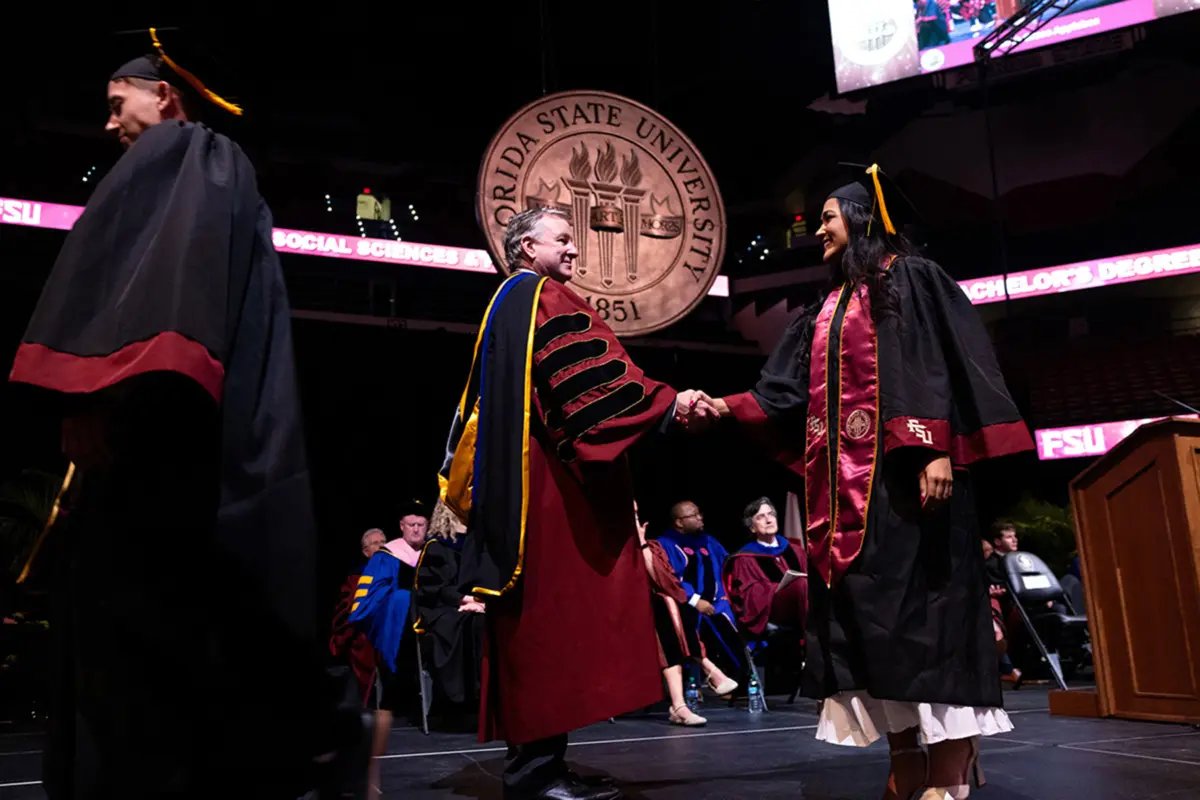

TALLAHASSEE, Fla. — In an era when higher education faces mounting scrutiny over student debt, prolonged time-to-degree metrics, and institutional efficiency, Florida State University (FSU) has delivered a masterclass in student success. The university announced a historic milestone: a remarkable 82% four-year graduation rate, establishing a new benchmark for the State University System of Florida and surging into elite national territory.
The new figure represents an impressive four-percentage-point jump from last year’s previous record of 78%. More importantly, it punctuates a meteoric five-year climb that saw FSU’s four-year graduation rate rise by nine percentage points, moving up from 73% in 2021. According to projections utilizing the most current publicly available data compiled by FSU’s Office of Institutional Research, this new figure ties the university with the prestigious University of Michigan at No. 7 among public universities nationwide.
This historic achievement arrives alongside robust indicators of institutional health. FSU successfully maintained its record-shattering six-year graduation rate of 86% and established a brand-new high watermark for community college transfer student success.
Executive Overview: A Paradigm Shift in Higher Education
The staggering trajectory of Florida State University’s academic metrics is not the result of happenstance, but rather of a deliberate, institutionalized transformation. Over the past decade, FSU leadership has systematically dismantled traditional silos between academic affairs, student support services, and financial aid systems, replacing them with a proactive, data-driven framework.
The implications of an 82% four-year graduation rate extend far beyond campus prestige. For students and their families, graduating on time drastically mitigates the financial burden of higher education, eliminating the costs of tuition, housing, and living expenses associated with extra semesters. Furthermore, it enables graduates to transition seamlessly into the workforce or advanced graduate programs ahead of national timelines, maximizing their lifetime earning potential.
FSU Four-Year Graduation Rate Trajectory:
2021: 73%
 ───> 2026: 82% (+9% increase in five years)
Beyond the four-year metric, FSU’s broader academic ecosystem continues to hum at peak efficiency. The university boasts an astonishing 97% first-year retention rate, cementing its status among the top four public institutions nationally for student retention. Simultaneously, global demand for an FSU education has scaled unprecedented heights: the university received nearly 97,000 applications for the Fall 2026 freshman class alone—the largest applicant pool in institutional history.
Detailed Chronology: The Making of a Student Success Powerhouse
FSU’s ascent to the upper echelon of American public higher education was forged through a series of intentional structural reforms, strategic investments, and administrative innovations over the last ten years.
The Foundation: Graduation Planning and Strategies
Nearly a decade ago, FSU took a pioneering step by establishing the Graduation Planning and Strategies (GPS) Office. Tasked with optimizing graduation efficiency and eradicating institutional roadblocks, the GPS Office transformed how academic advisors intervened in student pathways. By combining targeted completion campaigns with intensive case management, the office dramatically reduced the friction points that frequently delay degree completion. In recognition of its transformative impact, the initiative earned the prestigious Outstanding Advising Program Award from the National Academic Advising Association (NACADA) in 2022.
Centralizing Leadership: The Office of Student Academic Success
Recognizing that sustainable excellence required unified oversight, FSU President Richard McCullough engineered a critical administrative evolution in 2025. He established the Office of the Vice President for Student Academic Success and appointed Joe O’Shea as its inaugural leader. This strategic maneuver consolidated fragmented recruitment, retention, and graduation programs under a single administrative umbrella, ensuring that resources are deployed seamlessly across the student lifecycle.
The Culture of Data Engagement
At the heart of FSU’s modern success is a cultural embrace of advanced data analytics. Faculty and staff no longer rely on retrospective evaluations; instead, they utilize sophisticated tracking mechanisms to monitor student progress continuously. By identifying early warning signs—such as micro-shifts in attendance, LMS (Learning Management System) engagement drops, or performance dips in gateway courses—advisors can intervene proactively. These data-informed insights allow university leaders to direct scholarship funds and targeted support precisely where they are needed most before a student drifts off the four-year track.
Supporting Context & Metrics: Analyzing the Data
While the four-year graduation rate captures national headlines, a holistic examination of FSU’s performance data reveals institutional strength across multiple categories.
The Six-Year Benchmark
While accelerating time-to-degree is a primary institutional goal, FSU has simultaneously preserved its long-term completion integrity. The university maintained its benchmark six-year graduation rate at 86%, preserving a standard that places FSU firmly among the elite tier of research institutions nationwide. This dual achievement proves that FSU’s acceleration initiatives do not compromise comprehensive student completion or academic rigor.
Transfer Students Setting New Records
Historically, four-year and six-year metrics focus primarily on traditional, first-time-in-college (FTIC) freshmen. However, FSU has intentionally expanded its focus to embrace transfer pathways, particularly through Florida’s robust community college network.
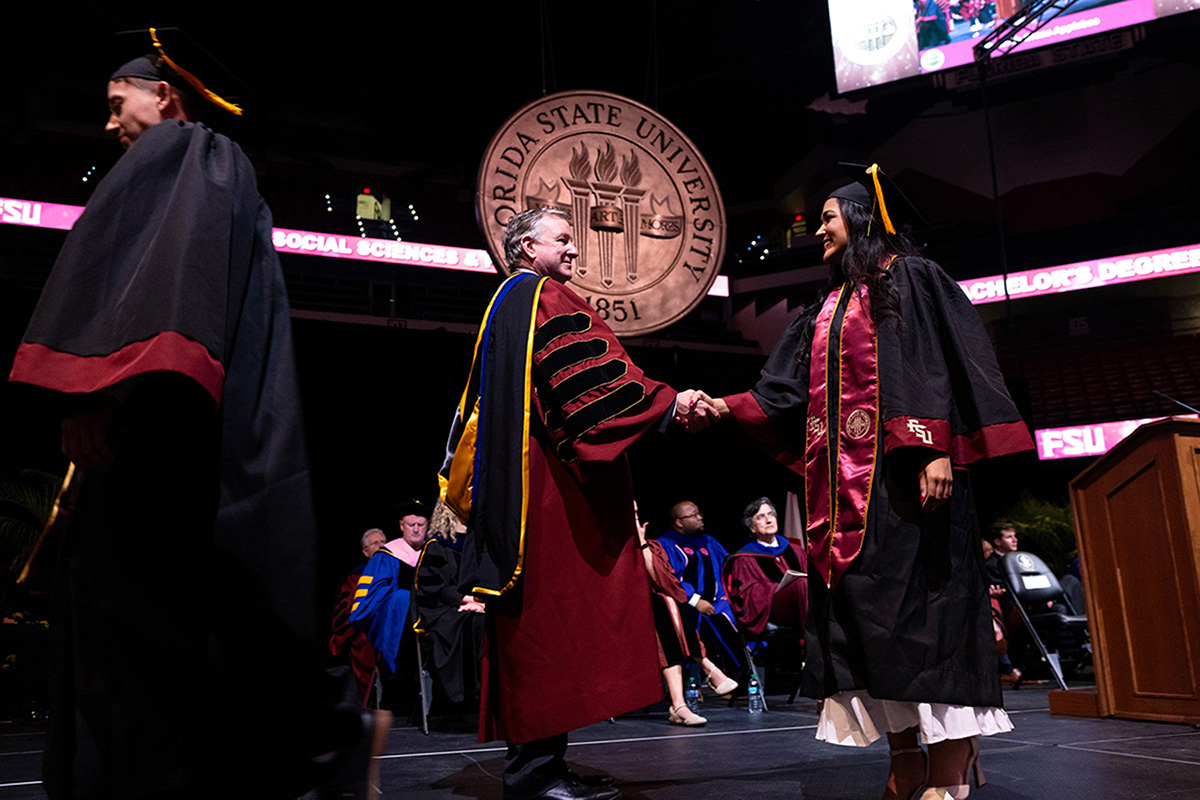
The university’s three-year graduation rate for students who transfer with an Associate in Arts (A.A.) degree from a Florida College System institution reached a historic high of nearly 85%. This performance builds directly upon last year’s record-setting 80% mark and establishes FSU as the undisputed leader within the State University System of Florida for transfer student integration and success.
Key FSU Success Metrics at a Glance:
┌──────────────────────────┬───────────┐
│ Metric                   │ Rate      │
├──────────────────────────┼───────────┤
│ Four-Year Graduation     │ 82%       │
│ Six-Year Graduation      │ 86%       │
│ Transfer 3-Year Grad     │ ~85%      │
│ First-Year Retention     │ 97%       │
└──────────────────────────┴───────────┘
National Standing and Public Comparisons
With a projected four-year graduation rate of 82%, FSU sits shoulder-to-shoulder with the country’s most storied academic institutions. Tying with the University of Michigan at No. 7 among national public universities underscores how regional powerhouse institutions can rival—and occasionally surpass—traditional ivy-covered flagships through disciplined, student-centered innovation.
Official Statements: Leadership Perspectives
The historic milestones achieved by the university drew praise from top institutional leadership, who emphasized that student success is a collective, community-wide endeavor.
FSU President Richard McCullough pointed directly to the intentionality of the university’s investments:
"An 82% four-year graduation rate is an extraordinary achievement and a new record for FSU and the State University System of Florida. We have been very intentional about investing in student success, from advising and academic support to scholarships and other resources that help students stay on track. I could not be prouder of our students or the faculty and staff whose commitment to them has made FSU one of the very best public universities in the country."
McCullough further contextualized the university’s long-term philosophy regarding admissions and student outcomes:
"Our goal is not simply to bring outstanding students to Florida State. It is to give them an outstanding education and help them graduate ready to lead, serve, and succeed. Our graduation rate says something powerful about the experience we are providing, and we’re not done yet."
Joe O’Shea, Vice President for Student Academic Success, echoed these sentiments, highlighting the collaborative synergy among faculty and staff:
"I’m deeply grateful to all the faculty and staff across FSU who work to provide a world-class education to our students. This remarkable new record reflects our university-wide commitment to academic excellence and holistic student support, shown through our investments in advising, teaching, scholarships, and programming that help students reach their full potential."
Future Outlook: Sustaining Momentum in a Competitive Landscape
As Florida State University absorbs the waves of incoming students for the Class of 2030—drawn by a record-shattering applicant pool of nearly 97,000—the challenge shifts from attaining excellence to sustaining it.
Higher education analysts will undoubtedly watch FSU closely to see whether an 82% graduation rate represents a ceiling or a stepping stone. University leadership insists it is the latter. By continuing to refine its predictive analytics infrastructure, expanding targeted financial aid initiatives, and deepening partnerships within the Florida College System for transfer pipelines, FSU has positioned itself to absorb scale without sacrificing quality.
The message emanating from Tallahassee is clear: the traditional university model of protracted degree timelines is obsolete. By pairing rigorous academic standards with compassionate, data-backed operational support, Florida State University has redefined what is possible for a major public research institution, setting a formidable standard for higher education nationwide.

0 Comments