Nestled within the rapidly developing expanse of Osceola County, Florida, Peghorn Nature Park and Trail serves as an intriguing intersection of regional heritage and conserved natural beauty. Managed by the City of St. Cloud, this 1.2-mile sanctuary bridges the gap between Central Florida’s modern suburban growth and its rugged, 19th-century frontier origins. Named in honor of the historic "Cracker" cattle that once roamed these very pinelands and hammocks a century ago, the property offers a multi-layered experience that moves visitors seamlessly from an immersive pioneer outpost to pristine, carefully preserved wetland ecosystems.
Spanning a compact yet ecologically diverse footprint, the park provides an accessible escape for hikers, naturalists, and history enthusiasts alike. Visitors begin their journey at a historic, repurposed residence functioning as the Trailhead Center, before stepping out into a landscape dominated by towering bald cypress trees, dense hardwood hammocks, and vital bayhead wetlands. Unlike massive state forests or remote wilderness tracts, Peghorn Nature Park functions as an urban nature preserve that successfully balances public accessibility with environmental stewardship. Featuring well-maintained crushed-shell pathways, extensive boardwalks, and historical re-creations—including a functioning blacksmith forge, a historic log schoolhouse, and a community-centered memorial—the park offers a comprehensive study in how local municipalities can honor their past while protecting fragile native habitats.
Detailed Chronology: Navigating the Peghorn Trail System
The exploration of Peghorn Nature Park and Trail is a sequential journey that demands a mindful pace. The path is not merely a means of physical exercise; it is an interpretive walkthrough of cultural artifacts and botanical wonders.
The Trailhead Center and Pioneer Outpost
The trek begins at the property’s focal point: a weathered, historic structure retrofitted to serve as the Trailhead Center. Upon entering, visitors are greeted by interior shelves lined with regional artifacts, historical literature, and memorabilia that establish an educational tone for the visit. For those requiring enhanced accessibility, an alternative route avoids the front threshold by guiding visitors along a paved concrete sidewalk encircling the exterior of the building, where a gentle ramp ascends to a rear entryway.
Just beyond the structure, the concrete path diverges, mapping out the preliminary cultural loop of the park. Heading eastward brings hikers into immediate contact with a historic homestead infrastructure, featuring a functioning blacksmith forge, a traditional chicken coop, and a nursery area. Traveling westward leads past a striking, historically accurate log schoolhouse complete with an authentic bell mounted above the open doorway and a fluttering flag overhead. This setup transports observers back to late 19th-century pioneer life in Osceola County.
Venturing into the Canopy: The Blue and Orange Trails
To begin the primary hike in a counterclockwise trajectory, visitors leave the schoolhouse grounds behind, noting the directional signage that marks the official trailhead. The corridor shifts from concrete to a well-drained, crushed-shell path flanked by welcoming wooden benches.
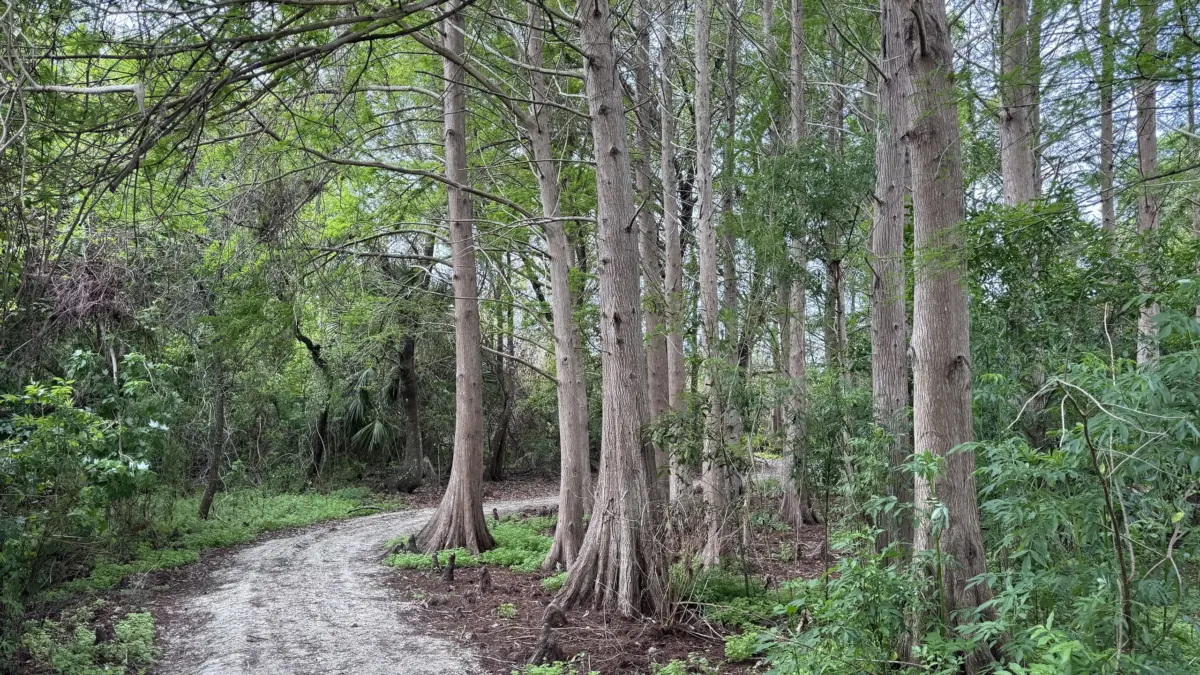
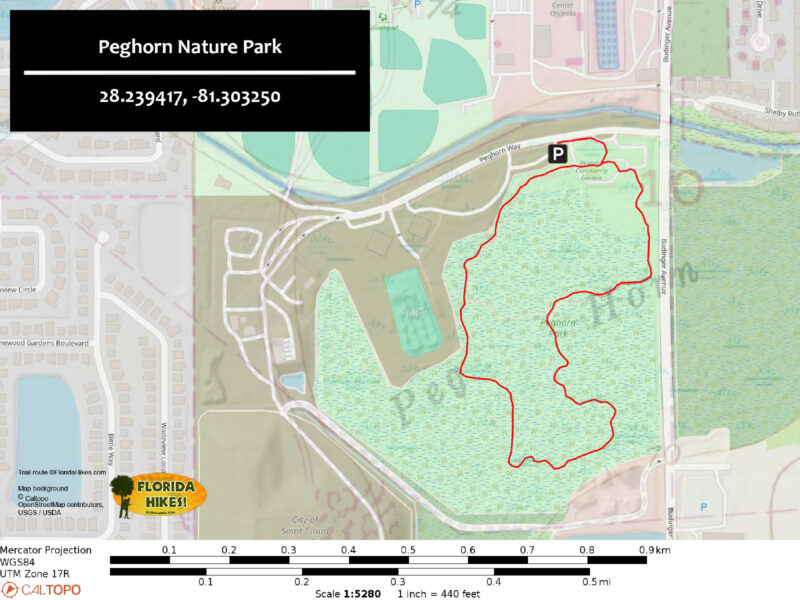
As the path pushes deeper into the property, it enters a deep, cooling shade canopy dominated by majestic bald cypress and sprawling live oaks. At approximately the 0.25-mile mark, hikers encounter a trail junction intersecting with the park’s Orange Trail and a wooden boardwalk. Continuing straight on the primary Blue Trail leads deeper into the interior forest. Here, the landscape transforms into a classic Florida woodland floor. Ferns and sprawling blackberry brambles crowd the path edges, while loblolly bay trees and native lyonia shrubs intertwine overhead, tightly laced with wild grapevines.
The Hammock Loop and Wetland Boardwalks
At the 0.7-mile mark, a localized side trail—marked cleanly with green directional arrows—invites hikers on a brief detour into a dense hardwood hammock. This micro-ecosystem offers a denser, more enclosed environment rich in canopy shade and leaf litter, highlighting the subtle topographical shifts characteristic of Central Florida terrain.
Rejoining the primary path, hikers approach the eastern intersection of the Orange Trail. Navigating a right turn here places visitors onto an extensive boardwalk system engineered to traverse a fragile wetland. This dynamic aquatic zone is populated by native willows, vibrant red maples, and fragrant sweetbay magnolias. Stepping off the boardwalk at the far end, the trail opens abruptly onto the banks of a tranquil pond complete with an elevated observation deck, ideal for avian photography and quiet reflection.
The Return via Rainbow Bridge
As the Blue and Orange trails briefly converge near the pond’s edge, the Orange Trail breaks away to traverse a minor footbridge hugging the waterline. Meanwhile, the Blue Trail directs hikers across the Rainbow Bridge—a vibrant, artistically painted memorial structure dedicated to honoring lost animal companions.
Beyond the bridge, the natural surface trails yield once more to the concrete sidewalk network. The final stretch of the walk curves past an active chicken run before terminating precisely where it began: at the rear of the Peghorn Trailhead Center.
Supporting Context & Metrics
Understanding the operational parameters and ecological makeup of Peghorn Nature Park requires a review of its core metrics and logistical details:
Official Name: Peghorn Nature Park and Trail
Land Manager: City of St. Cloud Parks and Recreation Department
Location: St. Cloud, Osceola County, Florida
Physical Address: 2101 Peghorn Way, St. Cloud, FL 34769
Total Trail Length: Approximately 1.2 miles (inclusive of main loops and side paths)
Admission Fees: Free to the public
Operating Hours: Monday through Saturday, 8:00 AM to 6:00 PM (Closed Sundays)
Pet Policy: Leashed dogs are welcome throughout the park and trails.
Amenities: Indoor restrooms located within the Trailhead Center, educational exhibits, historical re-creations, accessible parking directly in front of the trailhead, and wooden observation decks.
Ecological and Geographical Context
The park sits within the watershed of the greater Kissimmee River basin, an area historically characterized by flatwoods, seasonal wetlands, and transitional ecotones. The preservation of the 1.2-mile trail system acts as a crucial buffer against urban sprawl in St. Cloud. By maintaining a mix of crushed-shell paths and elevated boardwalks, the City of St. Cloud ensures that foot traffic minimizes soil compaction and root damage to the delicate root systems of the bald cypress and sweetbay magnolias.
Furthermore, the park’s proximity to other regional conservation efforts—such as the Lake Runnymede Conservation Area, Lake Lizzie Conservation Area, and Cherokee Point Conservation Area—creates a vital ecological corridor for local fauna, including migratory birds, white-tailed deer, and various native reptiles.
Official Statements
Municipal and environmental authorities emphasize the dual mission of Peghorn Nature Park: education and preservation.
Representatives from the City of St. Cloud Parks division have frequently noted that the park was intentionally designed to serve as an outdoor classroom. In public statements regarding the maintenance and programming of historical outposts like the blacksmith forge and the log schoolhouse, city officials stress that understanding the hardships of early Cracker settlers fosters a deeper appreciation for the natural resources that sustained them.
"Peghorn Nature Park is more than just a walking path; it is a living chronicle of St. Cloud’s heritage," municipal literature notes. "By uniting our pioneer history with the delicate ecosystems of our local wetlands, we provide visitors with a holistic understanding of why conservation in Osceola County is paramount to our community’s identity."
Local trail advocates and park naturalists also highlight the property’s accessibility as a major achievement in municipal park planning. Ensuring that visitors of all physical abilities can experience the interior bayheads via compliant ramps and sturdy boardwalks aligns with modern recreational standards, transforming what could have been an exclusive wilderness tract into an inclusive public asset.
Future Outlook
As Central Florida continues to experience unprecedented demographic expansion and residential development, urban green spaces like Peghorn Nature Park face both increased demand and unique management challenges. The future outlook for the park hinges on balanced, sustainable stewardship that can accommodate growing visitor numbers without compromising ecological integrity.
Plans for the facility moving forward center on infrastructure resilience and enhanced educational outreach. Municipal maintenance schedules prioritize the continuous upkeep of the boardwalk timber and the crushed-shell surfaces, which are routinely impacted by seasonal heavy rainfall and subtropical weathering. Additionally, the City of St. Cloud continues to evaluate opportunities for expanding interpretive programming within the pioneer village, utilizing living history demonstrations at the blacksmith forge and schoolhouse to engage younger generations.
Regionally, Peghorn Nature Park is expected to remain a cornerstone of Osceola County’s eco-tourism framework. As surrounding conservation areas like Lake Lizzie and Lake Runnymede draw hikers seeking wilder, more expansive landscapes, Peghorn will likely maintain its unique niche as an accessible, family-friendly gateway into the region’s past and natural present. Through disciplined oversight and community involvement, the park stands well-positioned to protect its fragile cypress wetlands and historical treasures for decades to come.








0 Comments