Tucked safely into the sweeping curve of a sheltered northwesterly cove off Lake Harris lies one of Central Florida’s most deceptively rich waterfront sanctuaries: Venetian Gardens Park. For generations, this municipal green space in Leesburg has offered locals and travelers alike a scenic respite defined by ancient live oaks draped in swaying streamers of Spanish moss, bustling lines of ducklings navigating the shoreline, and inquisitive purple gallinules that readily approach human visitors. Yet, beyond its superficial charm as a pleasant lakeside strolling ground, Venetian Gardens represents a fascinating intersection of Depression-era public works history, ecological restoration, and modern municipal landscape planning.
This authoritative trail report and investigative feature examines the 1.1-mile multi-park loop connecting the Venetian Center, Ski Beach Park, and Rogers Park. By charting the physical geography, historical evolution, and infrastructure management of the grounds, we provide an in-depth guide for outdoor enthusiasts, conservationists, and casual visitors looking to experience a masterclass in Florida lakefront preservation. Operated under the stewardship of the City of Leesburg, the park successfully balances public recreational demands with the preservation of native flora and fauna habitats, providing a fully accessible pathway network that bridges the past with the present.
Detailed Chronology of the Route
For those looking to walk the perimeter and explore its interwoven island features, understanding the chronological progression of the trail is essential. The route unfolds across a carefully engineered, multi-phase trek that seamlessly blends paved accessibility with immersive natural observation.
Phase One: The Waterfront Departure and Floating Docks
The journey begins at the primary trailhead situated between the Ski Beach Bar & Grill and the Venetian Center along East Dixie Avenue. Venturing out from the expansive green lawn behind the Venetian Center, hikers follow a wide, reliable concrete pathway leading directly to a series of floating docks. These structures rise and fall gently atop the undulating waters of the cove, framing a distant horizon dominated by the open expanse of Lake Harris.
Turning right onto the main waterfront corridor, the path guides visitors toward a major junction near a prominent footbridge. This preliminary stretch is famous for its avian activity; informational signage introduces hikers to the purple gallinule—a striking rail characterized by iridescent plumage, long yellow-green legs, and a vivid red-and-yellow bill. Accustomed to human presence, these birds frequently emerge from the marshy edges near the bridges, offering exceptional wildlife viewing opportunities.
Phase Two: Navigating the WPA-Era Islands
As the trail progresses, hikers encounter a series of historic islands situated within the water channel to the right. Fringed by native marsh vegetation such as spatterdock and duck potato, these landmasses trace their origins back to a 1925 dredging project. Originally, the cove was a dense sawgrass marsh. To establish a functional harbor and boat channel, engineers dredged the substrate, leaving behind spoil piles secured behind a rim dike.
A decade later, in 1936, laborers employed by the federal Works Progress Administration (WPA) during the height of the Great Depression began landscaping these spoil islands, planting the first ornamental species. Over the decades, natural ecological succession has taken over; today, native species vastly outnumber the original ornamental plantings.
Passing beneath the cooling shade of lakefront pond cypresses, visitors encounter the first of several pedestrian bridges leading to the inner islands. While the main trail remains fully accessible, these side-spurs offer optional round-trip excursions that add roughly a tenth of a mile per crossing. It is important to note that the inner islands do not interconnect with one another; only the primary island fronting the Venetian Center features a fully developed interior pathway. Every island, however, is outfitted with shaded benches, making them ideal quiet zones for birdwatching and contemplation.
Phase Three: Transition to Ski Beach Park
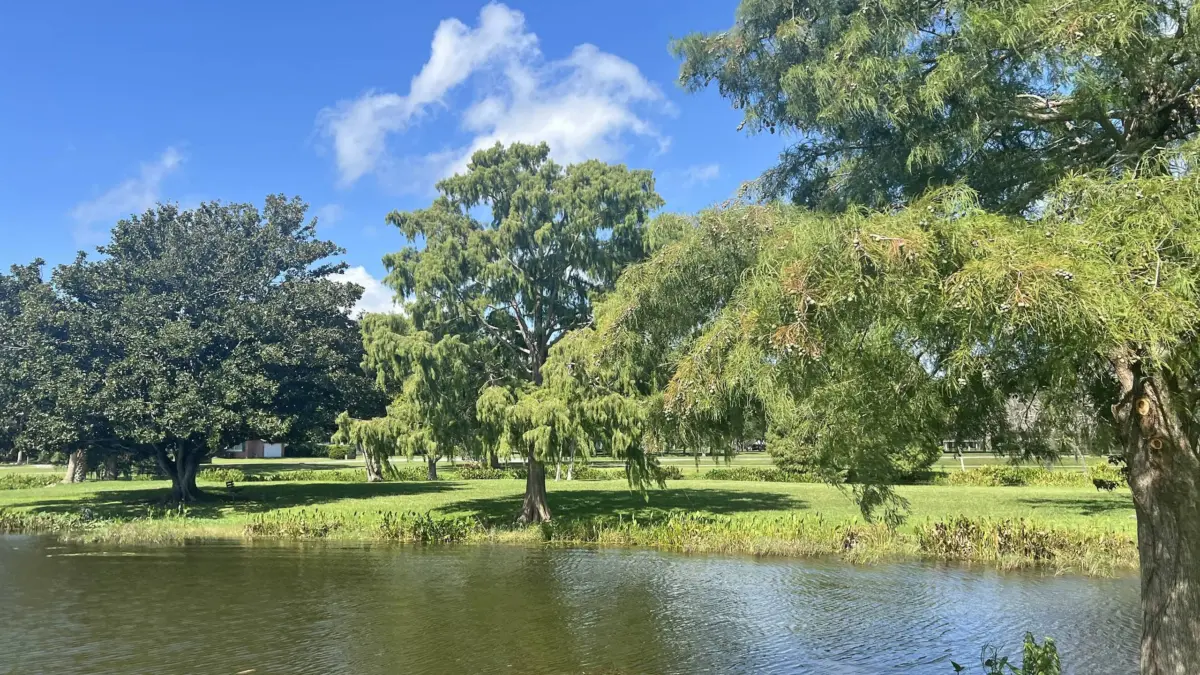
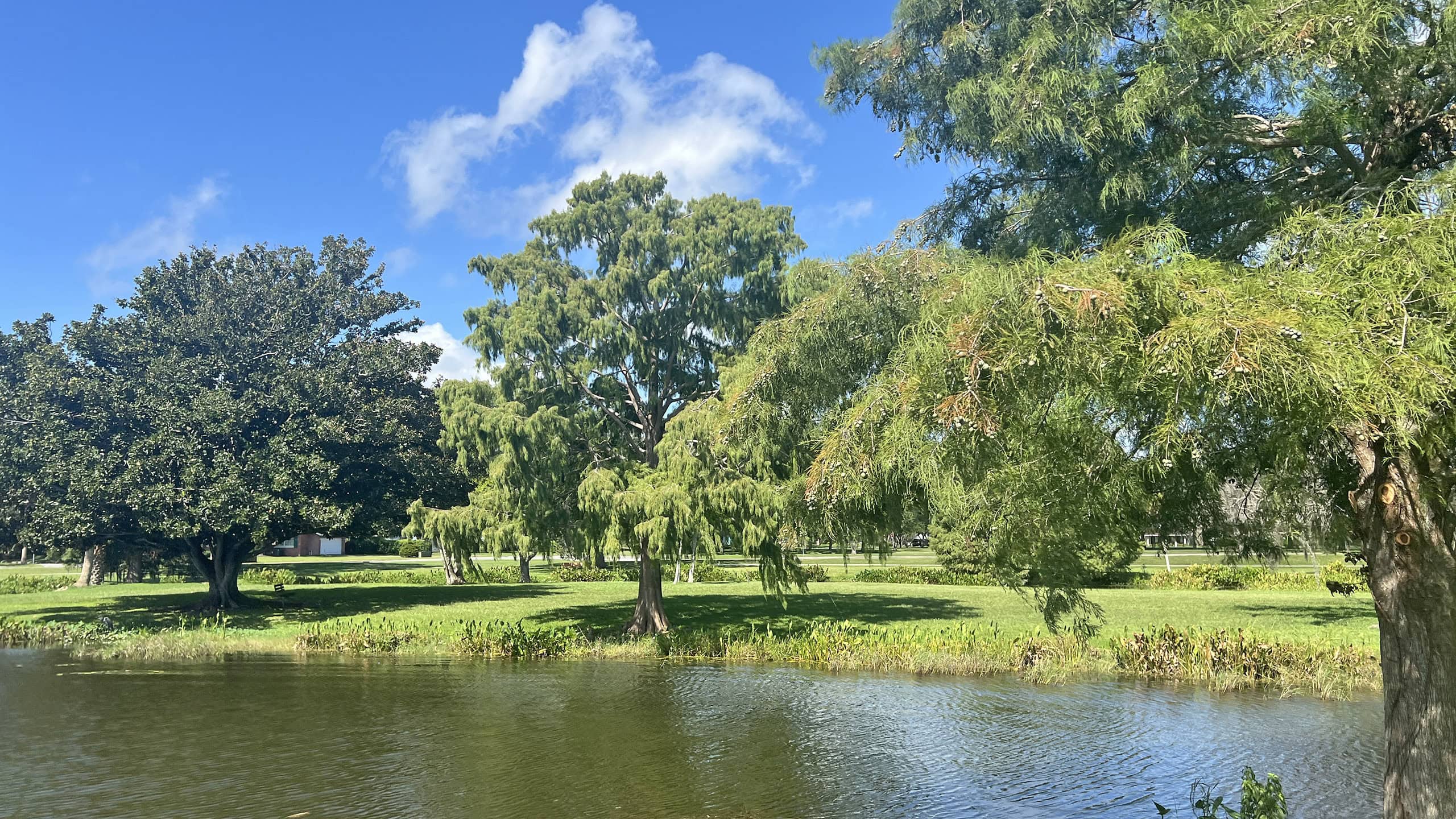
Continuing past an accessible waterfront picnic pavilion equipped with modern grilling amenities, the concrete pathway sweeps closer to the water’s edge. Here, open-water vistas open up, revealing clusters of floating water lilies in the channels and groups of white ibis foraging in the shadows of lakeside cypress trees.
At approximately the 0.3-mile mark, the trail guides walkers past a mature sycamore and beneath a sprawling live oak, culminating in a graceful bridge crossing that deposits visitors directly into Ski Beach Park. From this juncture, hikers can choose to retrace their steps for a shorter waterfront out-and-back journey or press forward to complete the full loop. Continuing the route requires following the path across the park access road, navigating past the public restroom facilities, and exiting through a designed gap in the park fence onto a sidewalk bordering Lakeshore Drive.
Phase Four: The Elevated Rim and Rogers Park
Once on the sidewalk, a right turn leads past the primary park entrance, where an asphalt path ascends to a slightly higher elevation along the outer rim of Venetian Gardens. This elevated vantage point provides sweeping, panoramic views across the landscaped islands that were less visible from the low-lying shoreline trail. Concrete seating platforms shaded by grand live oaks offer welcome rest stops along this sunnier leg of the journey.
Wildlife encounters remain a constant feature of the trek; roadside warning signs alert drivers and pedestrians alike to crossing duck families, which can frequently be observed shepherding their almost-fledged ducklings close to the water’s edge. By the 0.5-mile mark, the route passes secondary parking bays, curving steadily toward Rogers Park.
At approximately 0.7 miles, the trail runs parallel to the Rogers Park parking infrastructure. A well-engineered system of stairs and ramps provides direct access to Rogers Park’s modern amenities, including a children’s playground featuring rope-climbing elements, public restrooms, and a popular seasonal splash pad.
Phase Five: The Final Stretch and Historical Tribute
Reaching the northern terminus of the pathway near East Dixie Avenue, hikers encounter the park’s main restroom complex nestled within an open green space. Turning right, visitors pass between protective vehicle stanchions onto a broad, oak-shaded sidewalk that parallels Dixie Avenue. Elevated safely above the grassy slope, this corridor delivers unobstructed vistas across the interior waterways before terminating near the Venetian Center parking lot.
Recent municipal routing adjustments mean that the original approach to the nearest island bridge is no longer fully accessible; visitors requiring ADA-compliant pathways must navigate around the Venetian Center parking lot to utilize the newer front-facing bridge. For non-restricted hikers, crossing the grass leads to a long wooden pedestrian bridge at the 0.9-mile mark.
Upon stepping onto the circular concrete pathway of this final island, hikers are encouraged to move counterclockwise through a landscape of towering shade trees, vibrant azalea gardens, and a historic public gazebo. Embedded within the paving are highlighted stone inscriptions featuring powerful quotations from Dr. Martin Luther King Jr., culminating in a prominent monument dedicated to the Black pioneers of Leesburg.
Exiting the island via the bridge directly facing the Venetian Center doors, a final right turn along the waterfront path brings visitors full circle back to the trailhead, logging a precise total distance of 1.1 miles.
Supporting Context & Metrics
Trail and Facility Specifications
Official Location: Leesburg, Florida (Lake County)
Total Loop Length: 1.1 miles (with optional island spurs adding 0.1 miles per crossing)
Trailhead Coordinates: 28.805297, -81.875207
Physical Address: 201 E Dixie Ave, Leesburg, FL 34748
Access Fees: Completely Free of Charge
Operating Hours: Sunrise to 11:00 PM daily
Land Management Agency: City of Leesburg Parks and Recreation Department
Administrative Contact: 352-728-9885
Restroom Facilities: Available at the primary trailhead, Ski Beach Park, and Rogers Park
Pet Policy: Dogs are welcome but must remain on a physical leash at all times; owners are strictly required to clean up after their pets.
Prohibited Activities: Smoking and picking or damaging native plants are strictly prohibited throughout the park boundaries.
Geographic and Ecological Context
Venetian Gardens occupies a prime hydrological position within the Harris Chain of Lakes, one of Central Florida’s premier freshwater ecosystems. Lake Harris serves as the anchor water body for the Ocklawaha River basin. The park’s design harnesses natural lake breezes, creating a microclimate that remains noticeably cooler than surrounding urban areas—a phenomenon locally praised as natural air-conditioning.
Ecologically, the transformation of the property from a continuous sawgrass marsh into a manicured municipal park has paradoxically created a high-value urban wildlife corridor. The coexistence of open lawns, dense canopy trees, dredge spoil islands, and shallow marsh edges supports a diverse array of resident and migratory species, including:
Avian Life: Purple gallinules (Porphyrio martinica), white ibises (Eudocimus albus), wood ducks (Aix sponsa), great blue herons (Ardea herodias), and various species of egrets.
Aquatic Flora: Spatterdock (Nuphar advena), duck potato (Sagittaria lancifolia), and American white water lilies (Nymphaea odorata).
Arboreal Canopy: Pond cypress (Taxodium ascendens), southern live oak (Quercus virginiana), and American sycamore (Platanus occidentalis).
Official Statements
Municipal authorities and local land managers emphasize the dual mission of Venetian Gardens Park: serving as a community hub for active recreation while functioning as an educational bridge to local natural history.
In an official statement regarding park utilization, the City of Leesburg Parks and Recreation Department noted:
"Venetian Gardens is more than just a recreational park; it is a historic crown jewel of our municipal park system. The ongoing maintenance of our boardwalks, pavilions, and trail loops is designed to ensure that visitors of all physical abilities can connect with the natural beauty of Lake Harris. By integrating modern accessibility standards with the preservation of our WPA-era landscaping and native plantings, we provide a safe, engaging environment for families, outdoor enthusiasts, and environmental historians alike."
Local conservation advocates and trail guides have similarly lauded the multi-park integration. Sandra Friend, renowned outdoor writer and author of numerous Florida hiking guides, highlighted the unique experiential value of the loop:
"Tucked into the curve of a cove off Lake Harris, Venetian Gardens offers an environment that feels simultaneously manicured and wild. The presence of accessible waterfront pathways paired with the raw, untamed beauty of the dredge islands gives hikers a micro-adventure that is rarely found within an urban municipal footprint. It stands as a testament to thoughtful park design in the Sunshine State."
Future Outlook
As Central Florida continues to experience rapid population growth and suburban expansion, the management of urban green spaces like Venetian Gardens becomes increasingly critical. Municipal planners in Leesburg face the ongoing challenge of balancing high-density public recreational demands—such as events at the Venetian Center, splash pad utilization at Rogers Park, and boat traffic in the harbor—with the ecological health of the Lake Harris shoreline.
Future infrastructure investments for the park focus on climate resilience, shoreline stabilization, and enhanced accessibility compliance. City engineers are currently evaluating sustainable stormwater management practices to mitigate the impacts of seasonal heavy rainfall and lake level fluctuations on the lower pedestrian loops. Additionally, interpretive signage programs are slated for expansion, ensuring that the historical contributions of Depression-era workers through the WPA, as well as the cultural legacy of Leesburg’s Black pioneers commemorated on the island monuments, continue to educate future generations.
For the everyday visitor, Venetian Gardens remains a dynamic public asset—a place where conservation, recreation, and local heritage converge along the glistening shores of Lake Harris.







0 Comments