

Executive Overview
For the intrepid saltwater angler, the equation has always remained stubbornly consistent: distance equals solitude, and solitude equals success. When you burn fuel to escape the congested boat traffic and heavily pressured reefs flanking South Florida and the northern Bahamas, the ocean invariably opens its arms. This exact ethos served as the tactical blueprint for a 252-mile open-ocean crossing aboard a center console from Miami’s Haulover Inlet straight to the southwestern tip of Eleuthera Island.
While legendary Bahamian destinations in the Abacos draw massive fleets from Palm Beach and Fort Pierce, and hotspots like Bimini, Spanish Wells, Cat Island, and San Salvador command substantial media attention, Cape Eleuthera remains a relatively low-profile gem. Anchored by the luxurious and deeply dredged Cape Eleuthera Resort & Marina—capable of accommodating vessels up to 200 feet—this secluded outpost acts as a premier launchpad for targeting pelagics and reef-dwellers in Exuma Sound and the open Atlantic.
Despite boasting some of the most dynamic bathymetry, aggressive bottom topography, and lightly pressured fisheries in the Bahamas, the region sees remarkably low angling pressure. For a dedicated crew of veteran anglers, this remote cruising paradise delivered a masterclass in offshore innovation, tactical adjustments, and world-class bottomfishing.
Detailed Chronology: The Passage and the Pursuit
The Departure and Customs Clearance
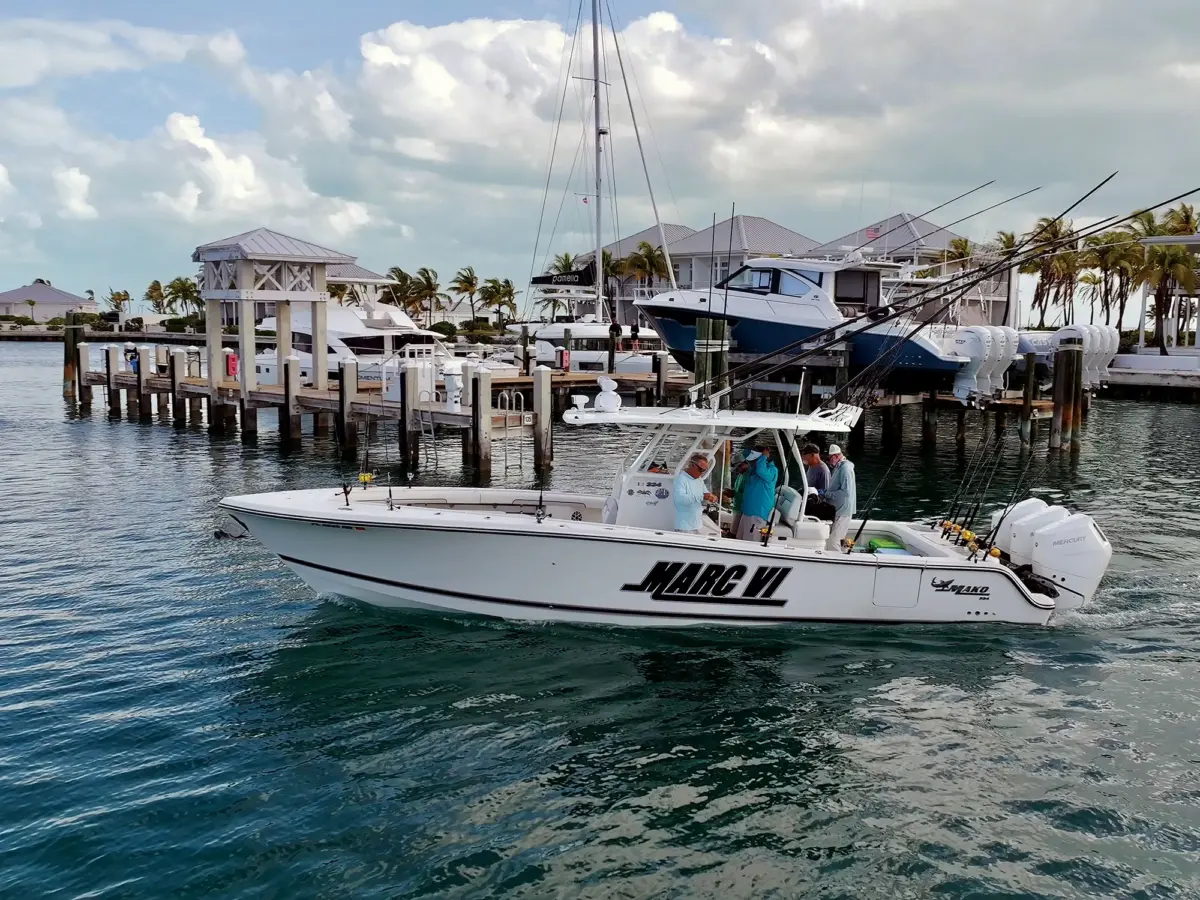
The journey commenced at 6:00 a.m. at North Miami’s TNT Marine Center. Crew members Harry Vernon, Mark Schmidt, Rob “The Swede” Greene, and videographer Charles Gonzalez meticulously loaded the MARC VI—a high-performance Mako 334 center console—with tackle, duffel bags, life jackets, throw cushions, and an emergency EPIRB. By 7:15 a.m., the vessel officially cleared Haulover Inlet, setting a swift pace toward the first major waypoint: Bimini.
Covering the initial 50-mile run to Bimini, the crew handled bureaucratic formalities efficiently. Utilizing the Bahamas’ online portal at Click2Clear.com a week prior, all cruising and fishing permit applications, vessel specifications, and crew manifests had been submitted and paid for in advance. Presenting their PCR number on-site at Bimini allowed Customs and Immigration officials to quickly stamp and issue legal cruising and fishing permits within an hour. Legally authorized to fish Bahamian waters, the crew pressed onward.
Navigating the Banks to Exuma Sound
From Bimini, the MARC VI ran the Bank for 68 miles into the deep sapphire trenches of "The Pocket." Skirting Chub Cay after a 15-mile leg, the crew continued for another 35 miles to the Nassau Harbour entrance. To ensure operational safety and establish a comfortable fuel buffer, the team topped off tanks in Nassau before crossing the Yellow Bank.
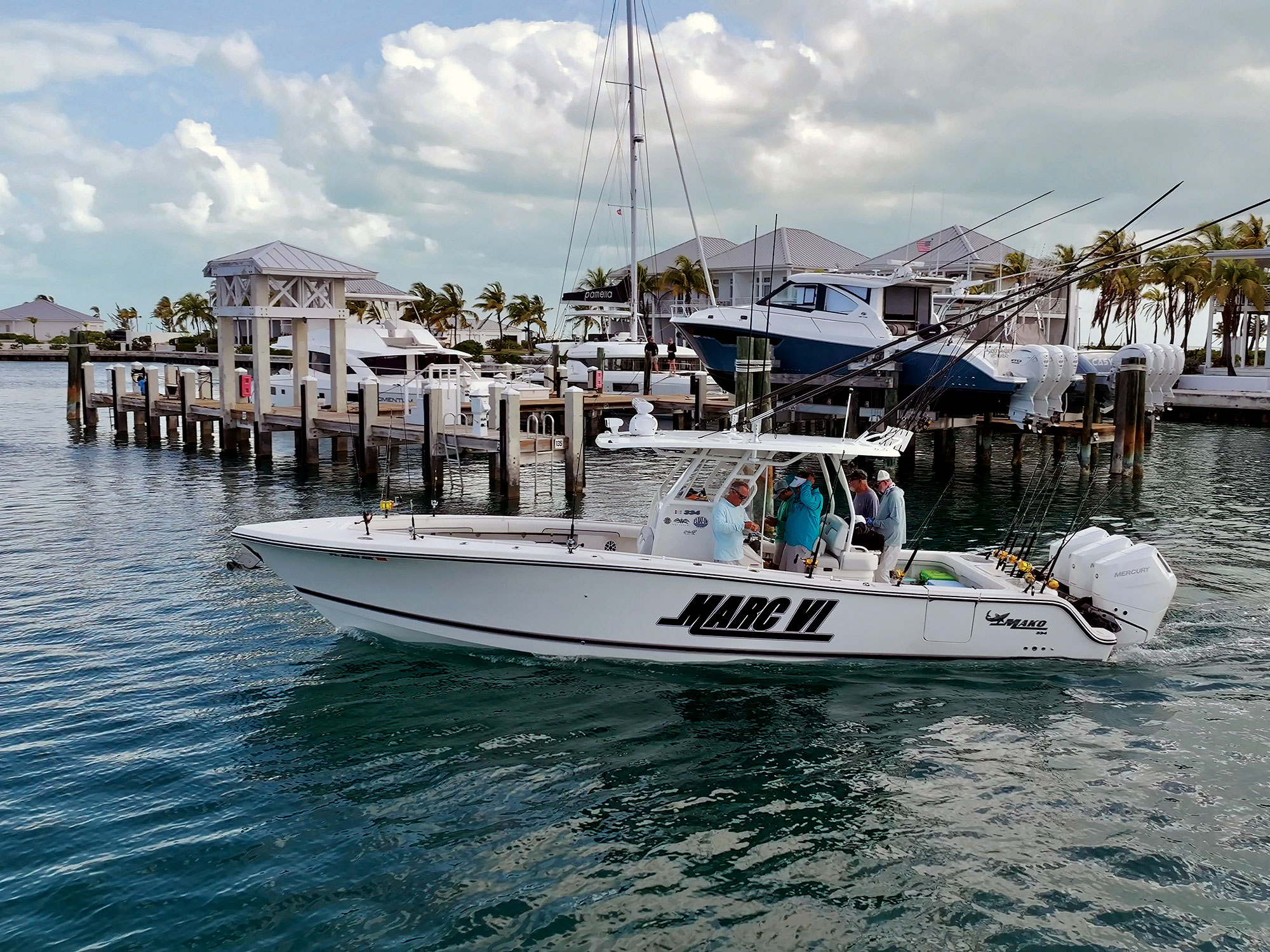
Cruising 40 miles across the shallows brought them to Ship Channel Point, the threshold of deep Exuma Sound. A final 44-mile run delivered the vessel directly to the slips at Cape Eleuthera Resort & Marina. The grueling 252-mile trek consumed 253 gallons of fuel. After docking, washing down the boat, and checking into their oceanfront accommodations, the crew reconvened for dinner to prepare for the days ahead.
Cracking the Tuna Code in the Atlantic
On their first full fishing day, unfavorable northeast winds pushed surface conditions away from the lee, prompting the crew to cross "The Bridge"—an underwater reef system ranging from 25 to 60 feet deep that connects southern Eleuthera to Little San Salvador—and head into the open Atlantic.
Initially rigged for blue marlin, the spread featured five circle-hook ballyhoo and chugger combinations deployed on Penn International 50s, supported by an elaborate teaser configuration. Early action was slow as the ocean slumbered through a morning lull. However, as a 2:00 p.m. solunar period approached, the sea erupted. Flying fish showered the surface, and diving birds marked a massive blitz of blackfin and yellowfin tunas crashing small baitfish against the backdrop of Little San Salvador.
When initial heavy trolling spreads failed to turn the heads of the larger feeding yellowfins, the crew pivoted. Swapping the heavy gear for light spinning tackle yielded a brief hook-up before the fish pulled free. Recognizing that brute force was failing, the skipper adjusted the spread: the flat lines were replaced with Rapala X-Rap Magnum Xtreme and Rapala Countdown Magnum swimming plugs, while a far-center rigger was rigged with a small pink-skirted ballyhoo on an 80-pound test fluorocarbon leader.
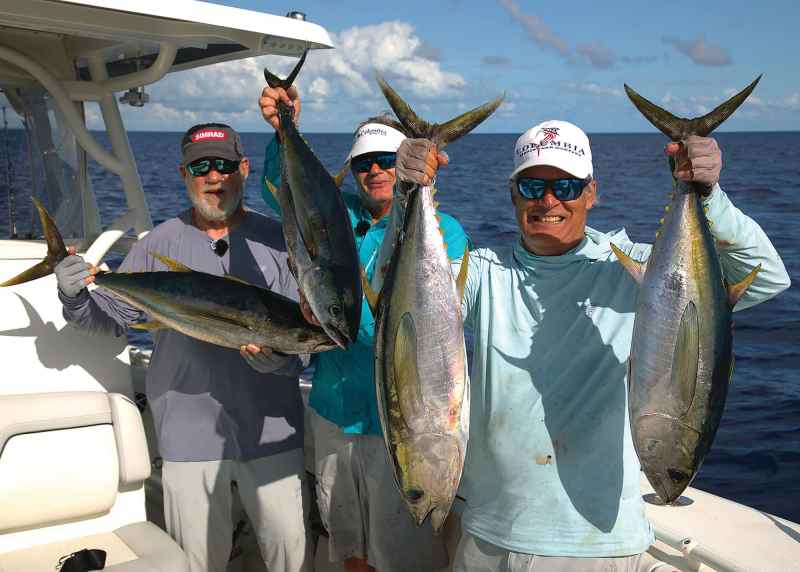
The tactical adjustment proved revolutionary. The reel clickers screamed as a quality yellowfin inhaled a Rapala swimmer. Moments later, another fish slammed a plug. The apex of the day arrived in the form of a chaotic quadruple-header involving both Rapalas, the small pink-skirted ballyhoo, and a large ballyhoo chugger. Though two fish shook free, the crew successfully boated two prime yellowfins. Shortly after, a juvenile billfish entered the spread before fading back into the deep blue, marking the end of the bite as the ocean fell quiet once more.
Supporting Context & Metrics
Navigating Weather Systems and Inshore Tactics
When a powerful late-season front swept through the area, bringing sustained northeast-to-east winds upwards of 25 knots, the resort side of Exuma Sound provided an effective geographic lee. Rather than wasting a day shoreside, the team adapted by deploying small Rapala swimming plugs rigged on 50-pound fluorocarbon leaders across shallow patch reefs ranging from 10 to 20 feet deep. This inshore pivot produced steady action, with numerous groupers, barracuda, and jacks released, offset by the occasional loss of a plug to aggressive cero mackerel.
The Yellowtail Snapper Fishery
Exuma Sound and the surrounding reef complexes support an extraordinarily robust population of yellowtail snapper. Anchoring over productive structural coordinates in 70 feet of water, the crew deployed a large mesh chum bag to draw fish up from the bottom. Once sonar units confirmed schools rising through the water column, fishing commenced using light knocker rigs, 1/0 inline circle hooks, small yellowtail jigs, and baits consisting of silversides, ballyhoo strips, and squid.
Because quality yellowtails in this region possess the strength to dive back into jagged coral formations, heavy-duty tackle—including 20-pound-class main lines and 20-pound fluorocarbon leaders—proved essential for "horsing" fish away from reef hazards and local sharks. The resulting bite was relentless, highlighted by impressive specimens:
- Mark Schmidt opened the scoring with a solid schooling fish.
- Harry Vernon followed with an even larger specimen.
- Videographer Charles Gonzalez landed a personal-best yellowtail.
- The expedition’s trophy fish measured an exceptional 27 inches, hauled aboard by the skipper.
Deep-Drop Operations
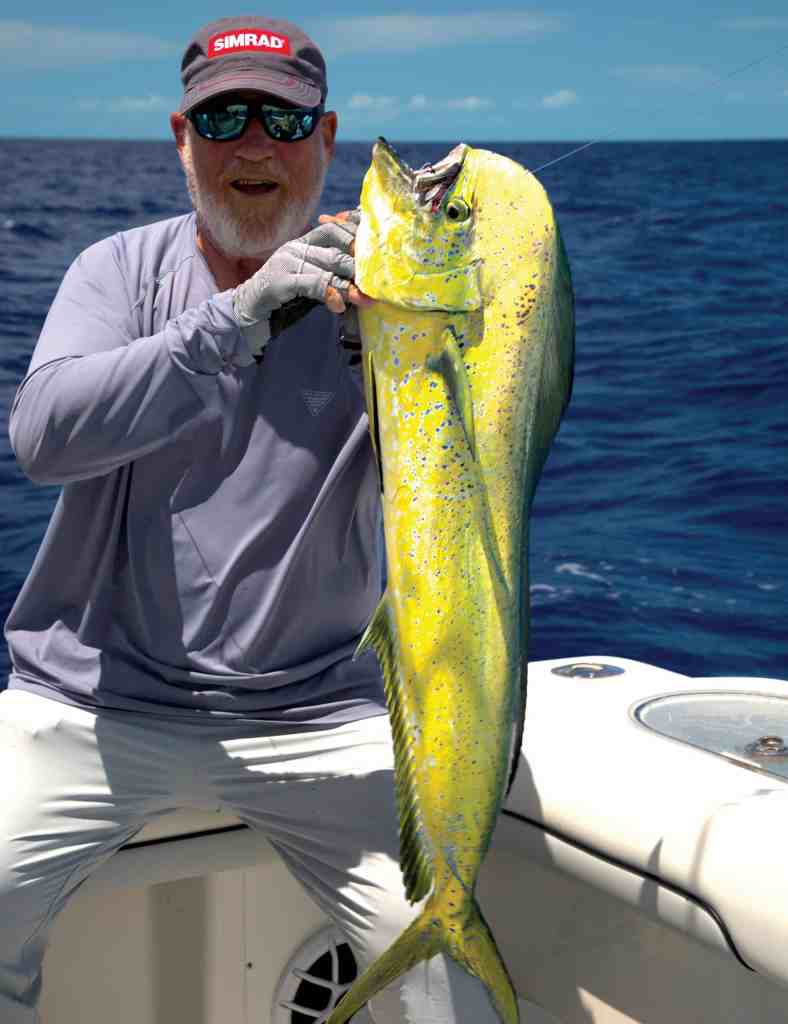
On the final day of the expedition, the crew transitioned to deep-dropping to test the vertical contours of Exuma Sound. Relying entirely on sonar marks rather than pre-plotted coordinates, they targeted structural breaks tight to the bottom between 600 and 1,000 feet. Operating a pair of Penn Fathom electric reels spooled with squid-baited hooks during controlled drifts, the anglers successfully harvested yelloweye, wenchman, and blackfin snappers before returning to the marina at 1:00 p.m. to prep the boat for the return voyage.
Official Statements and Industry Insights
Reflecting on the unique character of the destination, Justin Dubowitz, manager at Cape Eleuthera Resort & Marina, offered clear perspective on what makes the property an angler’s sanctuary.
"We deeply cherish the tranquility and incredible abundance here—the undeniable fruits of our secluded geographic location," Dubowitz noted. "It sits at just enough of a cruising distance from South Florida to naturally deter the massive weekend crowds, preserving an authentic, high-end island experience for those willing to make the run."
Veteran captain and outdoor journalist George Poveromo echoed these sentiments, emphasizing the strategic advantage of the venue’s isolation. Having conducted multi-day crossings to Cape Eleuthera across successive vessel platforms—from a Mako 284 in 2015 to a Mako 334 in 2018 and 2026—Poveromo has witnessed firsthand the consistent, low-pressure fishery the region sustains.
"Get far away from people, and you’ll catch more fish," Poveromo stated. "With modern center consoles featuring extended fuel ranges, massive fish-holding capacities, and ultra-efficient high-horsepower outboards, the barrier of entry has shrunk dramatically. Anglers would be wise to experience this fishery before word spreads completely."
Future Outlook: A Shifting Horizon for Bahamian Angling
The timing of an expedition to the Out Islands dictates success. April and May historically serve as prime migration windows for white and blue marlin, mahi-mahi, yellowfin tuna, and late-season wahoo. However, localized water temperature fluctuations can temporarily disrupt pelagic pathways. During this specific April deployment, cooler-than-normal water temperatures delayed the vanguard of pelagic migrations across both Eleuthera and Cat Island 60 miles to the south.
Oceanographic forecasting tools, such as Roffer’s Ocean Fishing Forecasting charts, accurately tracked a massive body of warm water pushing toward Devil’s Point at Cat Island, triggering exceptional offshore fishing just as the expedition concluded. While the timing meant missing the peak warm-water arrival, the trip still yielded extraordinary mixed-bag results under predominantly favorable weather windows.
As marine technology continues to evolve, the once-daunting 250-mile open-ocean voyage from South Florida to the Out Islands is becoming increasingly accessible. Larger center consoles, advanced navigation suites, and satellite weather integration are transforming remote outposts like Cape Eleuthera from hidden secrets into mainstream destinations. For now, however, the area remains an angler’s paradise—a place where pristine reefs, aggressive pelagics, and absolute solitude still reign supreme.
Where to Stay
Cape Eleuthera Resort & Marina
- Website: capeeleuthera.com
- Phone: +1 (242) 334-8500
- Instagram: @capeeleuthera
- Facebook: Cape Eleuthera Resort & Marina

0 Comments