The landscape of North Central Florida conservation has undergone a subtle yet significant transformation with the public integration of the Longleaf Ecology and Forestry Society (LEAFS) Preserve. Established originally as a non-profit organization in 1993 by environmental advocates John and Mary Lou Winn, LEAFS was designed from its inception to serve as a living laboratory and public showcase for the delicate, fire-dependent ecology of the longleaf pine ecosystem. For decades, the property functioned as a specialized educational touchstone. However, a pivotal transition occurred in 2022 when the Winns officially donated the property to the Alachua Conservation Trust (ACT), cementing its permanent status as a protected public resource.
Spanning distinct tracts characterized by a harmonious blend of historical silviculture and aggressive ecological restoration, the LEAFS Preserve North Tract offers an immersive look into Florida’s native habitats. Situated near the eastern shore of its namesake water body in Waldo, Florida, the North Tract—accessed seamlessly through Alachua County’s Lake Alto Park—features an intimate yet ecologically rich 1.2-mile trail system. Comprising the 0.9-mile Blueberry Trail and the 0.3-mile Lake Edge Trail, this protected expanse bridges the gap between historical land stewardship and modern recreational access.
This report provides a comprehensive examination of the LEAFS Preserve North Tract, detailing its operational history, geographical layout, trail mechanics, ecological composition, and the broader implications of its management under the Alachua Conservation Trust.
Detailed Chronology
1993: Foundation and Ecological Vision
The genesis of the LEAFS Preserve traces back to 1993, when John and Mary Lou Winn established the Longleaf Ecology and Forestry Society. At a time when rapid suburban development threatened remaining tracts of native Florida wilderness, the Winns envisioned an independent entity dedicated to the preservation, study, and public interpretation of the longleaf pine (Pinus palustris) ecosystem. Historically, longleaf pine forests covered vast expanses of the southeastern coastal plain, but centuries of logging, turpentine extraction, and fire suppression had reduced these vital habitats to a fraction of their historical range.
The Winns managed their property as a private sanctuary and educational landscape, demonstrating that active forestry and conservation could coexist. Their objective was to maintain the ecological integrity of the uplands while allowing natural succession and targeted reforestation efforts to heal the land.
2022: Stewardship Transition to Alachua Conservation Trust
As land management demands evolved and the imperative to secure permanent public access grew, John and Mary Lou Winn made the landmark decision to transition ownership of the property. In 2022, the entirety of the LEAFS Preserve was officially donated to the Alachua Conservation Trust (ACT), a nationally accredited land trust dedicated to protecting the natural, historic, and scenic resources of North Central Florida.
This transfer ensured that the property would be safeguarded in perpetuity from commercial encroachment. Furthermore, it integrated the preserve into ACT’s broader network of regional sanctuaries, opening the gates for systematic trail maintenance, ecological monitoring, and public recreational programming.
Present Day: Public Integration and Trail Operations
Today, the North Tract of the LEAFS Preserve operates as a premier destination for day-hikers, naturalists, and conservation enthusiasts. Accessed via the southwestern corner of the Lake Alto Park parking lot, the property invites visitors to explore a carefully curated trail system that highlights both the managed timber history and the rewilded understories of the region. Through the joint efforts of county infrastructure and ACT oversight, the preserve remains open daily from sunrise to sunset, offering free public access and cementing its role as a cornerstone of Alachua County’s ecotourism landscape.
Supporting Context & Metrics
Geographical and Logistical Parameters
Understanding the physical footprint of the LEAFS Preserve North Tract is essential for both casual visitors and ecological researchers. The property is managed with a low-impact footprint designed to protect sensitive shoreline and upland biomes.
Official Name: LEAFS Preserve North Tract
Land Manager: Alachua Conservation Trust (ACT)
Primary Location: Waldo, Florida (Alachua County)
Physical Address: 17800 NE 134th Place, Waldo, FL 32669
Total Trail Length: 1.2 miles (inclusive of intertwined loops)
Component Trails:
Blueberry Trail: 0.9 miles (marked with blue diamonds/arrows)
Lake Edge Trail: 0.3 miles (marked with orange diamonds)
Operational Hours: Sunrise to sunset, 365 days a year
Admission Fees: Free
Amenities: Restrooms located at the Lake Alto Park trailhead; parking area with boat ramp access; informational kiosk and trail maps.
Pet Policy: Leashed dogs are welcome.
Contact Information: Alachua Conservation Trust office at 352-373-1078
Navigation and Access Route
For visitors arriving from the regional hub of Gainesville, accessing the North Tract requires a straightforward drive northeast through Alachua County:
From the intersection of University Avenue and Main Street in downtown Gainesville, head east on University Avenue for approximately 0.8 miles.
Turn left onto State Road 24 (East University Avenue/SR-24) and continue for roughly 13 miles.
Turn right onto SW 2nd Place, followed by an immediate right after 0.2 miles onto US-301 North.
Continue on US-301 for 2.4 miles, then turn left onto NE 114th Avenue, making an immediate left onto County Road 1471.
After 1.5 miles, turn left onto NE 134th Place. Lake Alto Park is situated at the terminus of this road (0.3 miles). The designated trailhead for the LEAFS Preserve is located in the southwestern corner of the paved parking lot.
Trail Mechanics and Route Breakdown
The journey through the LEAFS Preserve North Tract is structured to provide an interpretive experience of changing micro-climates over a relatively short distance:
The Trailhead Start: Visitors begin their trek at the informational kiosk in the southwestern corner of the Lake Alto Park parking lot. Heading right, the route initiates along a short segment of the Blueberry Trail, clearly marked with blue diamonds.
The Lake Edge Junction: At approximately 0.1 miles, hikers reach a junction where the trail intersects with the Lake Edge Trail (marked with orange diamonds). Continuing straight transitions the path southward into a dense corridor of sparkleberry (Vaccinium arboreum), native oaks (Quercus spp.), and loblolly bay (Gordonia lasianthus), interspersed with juvenile longleaf pines.
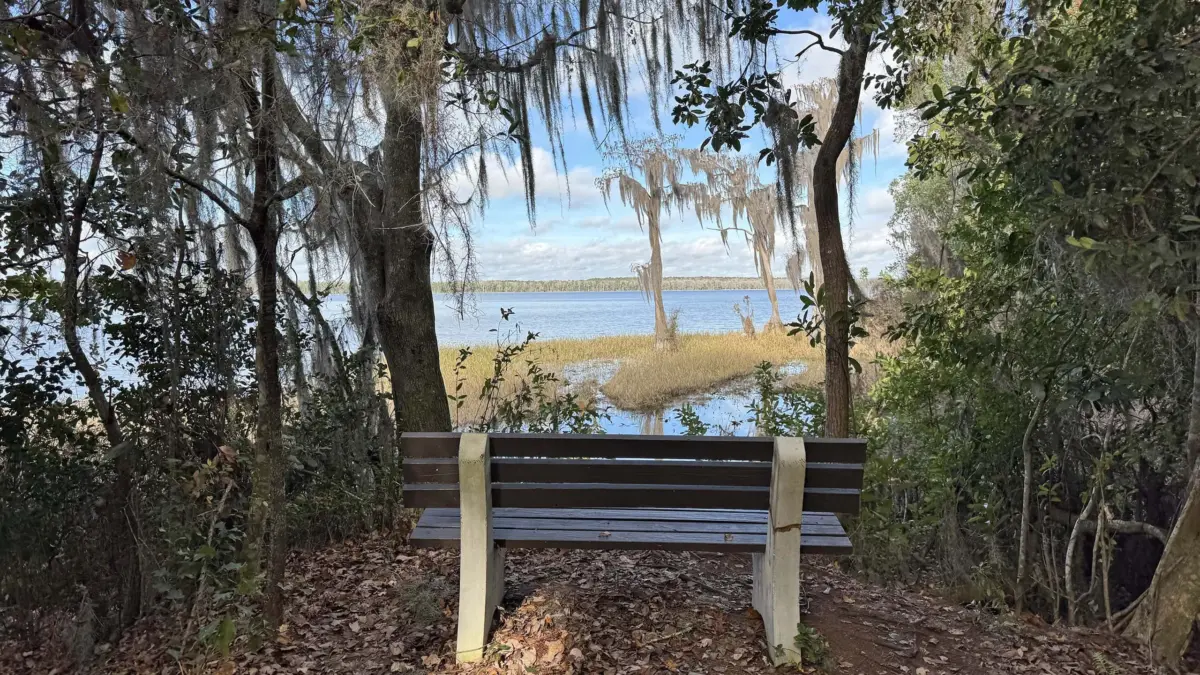
The Lake Alto Overlook: At the 0.25-mile mark, a short western spur leads off the main path directly to the bluff overlooking Lake Alto. Here, a strategically placed wooden bench offers panoramic views of glassy, tea-colored waters framed by an impressive stand of cypress trees (Taxodium spp.) draped in Spanish moss (Tillandsia usneoides).
Completing the Loop: Returning to the main path, hikers travel an additional 200 feet to the southern terminus of the Lake Edge Trail. Re-joining the Blueberry Trail via a right turn, the route guides trekkers through a matrix of historical tree-farming infrastructure and natural regeneration zones. Rows of historically planted pines transition seamlessly into lush understories dominated by saw palmetto (Serenoa repens). Squared-off turns and posts featuring blue directional arrows guide hikers safely back to the trailhead, culminating in a 1.2-mile circuit.
Official Statements
The preservation and public integration of the LEAFS Preserve have elicited strong endorsements from regional conservation leadership, emphasizing the critical intersection of private philanthropy and public stewardship.
"The donation of the LEAFS Preserve by John and Mary Lou Winn represents a profound act of conservation foresight. For decades, they nurtured this land not merely as private property, but as an ecological classroom. By entrusting the Alachua Conservation Trust with its future, they have guaranteed that the lessons of the longleaf pine ecosystem will remain accessible to the public, fostering a deep, generational appreciation for Florida’s native natural heritage."
— Alachua Conservation Trust Executive Leadership
Land management specialists highlight the dual nature of the property as both a recreational asset and an active restoration site.
"Properties like the LEAFS North Tract are invaluable because they show the resilience of Florida’s uplands. When you walk these trails, you are witnessing the direct results of careful stewardship—where historical silviculture meets natural rewilding. The integration of the Blueberry and Lake Edge trails allows visitors to experience everything from high-and-dry pine flatwoods to the tranquil, moss-draped bluffs of Lake Alto in a single, cohesive afternoon."
— Regional Trail Management and Conservation Outreach Assessment
Future Outlook
As urban pressures continue to mount across Alachua County and the broader North Florida region, the long-term outlook for the LEAFS Preserve North Tract centers on enhanced ecological resilience, educational outreach, and regional trail connectivity.
Ecological Management and Restoration
Under the stewardship of the Alachua Conservation Trust, future management protocols for the LEAFS Preserve will likely focus on active habitat restoration. While historical timber operations left distinct rows of planted pines across portions of the landscape, ongoing management strategies—including controlled prescribed burning and the removal of invasive species—will aim to restore a more natural, multi-aged longleaf pine-wiregrass ecosystem. Prescribed fire is an indispensable tool in these environments; it reduces hazardous fuel loads, controls hardwood encroachment, and stimulates the germination of fire-adapted native flora and fauna.
Community Engagement and Ecotourism
The proximity of the LEAFS Preserve to Lake Alto Park and regional waterways positions it as an emerging hub for North Florida ecotourism. Future initiatives by ACT and county partners may involve expanded interpretive signage, guided educational hikes, and school group programs designed to carry on John and Mary Lou Winn’s original 1993 mission: teaching the public about the irreplaceable value of longleaf pine ecology.
Furthermore, as regional trail networks expand—connecting natural areas such as the Lake Alto Preserve North and the Little Orange Creek Preserve—the LEAFS Preserve stands to benefit from increased visitation by hikers, birdwatchers, and conservationists seeking authentic, low-impact wilderness experiences in the Sunshine State.






0 Comments