
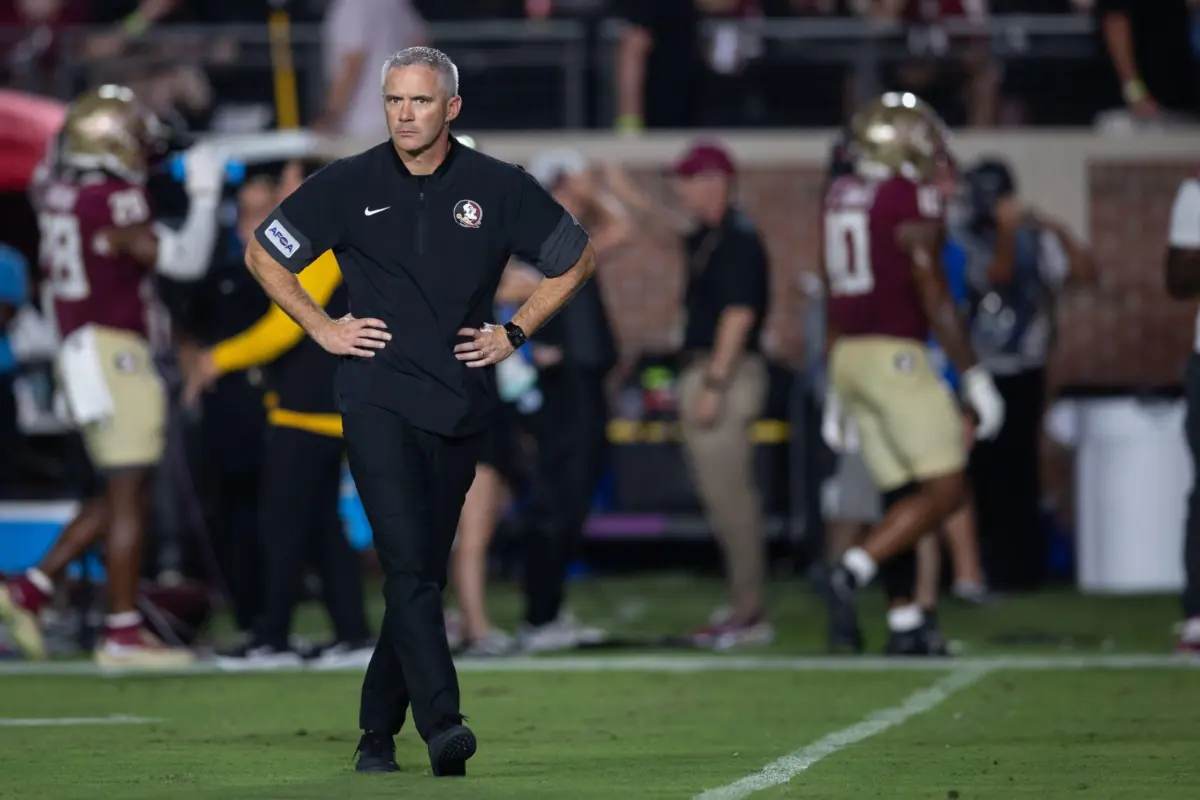

Executive Overview
College football is an unforgiving ecosystem where yesterday’s miracle worker is tomorrow’s buyout candidate. For the Florida State Seminoles, the descent from undefeated conference powerhouses to a program floundering in irrelevance has been swift, stunning, and deeply systemic.
Following a catastrophic 49-point demolition at the hands of Notre Dame in November 2024, the administration under Athletic Director Michael Alford faced a stark financial and operational reality. Head Coach Mike Norvell had just inked a lucrative, eight-year, $84 million contract extension during the prior offseason, rendering a direct coaching change financially untenable for a department unwilling to absorb an astronomical buyout. Instead, FSU opted for a brutal structural purge: parting ways with nearly the entire supporting cast rather than the man at the helm.
What followed was an aggressive, albeit desperate, offseason overhaul designed to hit the stylistic reset button and salvage a deteriorating foundation. Norvell brought in veteran offensive architect Gus Malzahn and unorthodox defensive coordinator Tony White. Yet, fourteen games into this grand experiment, the returns have proven disastrous.
Plagued by abrupt retirements, scheme disconnects, catastrophic defensive breakdowns, and a stagnant offense that has forced Norvell back into a play-calling role in which he appears increasingly ill-suited, the Seminoles find themselves trapped in a vicious cycle. Florida State has now dropped eight of its last ten games against Power Four opponents. The crisis on Bobby Bowden Field is no longer merely a personnel issue—it is a comprehensive indictment of modern coaching, strategic miscalculations, and an administration attempting to stitch together a sinking ship with short-term financial tape.
Detailed Chronology: From the Notre Dame Debacle to Present Disarray
To understand the current state of Florida State football, one must trace the domino effect triggered on a chilly November night in 2024. The 49-point blowout against Notre Dame laid bare a roster devoid of identity and a coaching staff completely outmatched. With FSU sitting at an abysmal 1-9 record, the final three weeks of the season—consisting of a bye week followed by matchups against FCS opponent Charleston Southern and a struggling Florida squad—transformed into an extended scouting and rebuilding window.
Recognizing the writing on the wall, the athletic department pulled the trigger on sweeping staff changes the very next day. Offensive coordinator Alex Atkins, defensive coordinator Adam Fuller, and wide-field receivers coach Ron Dugans were relieved of their duties. Shortly thereafter, the program transitioned legendary defensive line coach Odell Haggins into an off-field administrative role, severing one of the last remaining emotional tethers to FSU’s glorious past.
Armed with a three-week head start on the rest of the college football landscape, Norvell set out to reshape his program’s trajectory. However, his hiring strategy reeked of a head coach hedging his bets.
On offense, Norvell turned to Gus Malzahn—a familiar face who had given Norvell his initial big break in the coaching ranks and whose offensive philosophies mirrored Norvell’s own. Malzahn quickly populated his offensive room by pillaging UCF, bringing along offensive line coach Herb Hand and wide receivers coach Tim Harris Jr.
On the other side of the ball, Norvell executed a sharp pivot, hiring Tony White away from Nebraska. White, possessing zero prior professional relationship with Norvell, brought an exotic and rarely seen 3-3-5 defensive scheme that had yielded top-20 defensive metrics in Lincoln. White quickly fortified his staff by bringing defensive line coach Terrance Knighton and safeties coach Evan Cooper with him from Nebraska, aiming to inject NFL-caliber pedigree into Tallahassee.
Yet, football games are won on Saturdays, not on the whiteboards of winter press conferences. Fourteen games removed from those wholesale changes, not a single one of Norvell’s splash hires has delivered sustainable success.
The tipping point arrived early: Malzahn abruptly retired right before spring practices, thrusting Norvell back into the uncomfortable spotlight of calling offensive plays. Meanwhile, White’s revolutionary defense has routinely been shredded by opposing offenses, culminating in a devastating, self-inflicted home loss where FSU dominated the turnover margin (4-1) and time of possession, only to walk off the field empty-handed.
Supporting Context & Metrics: The Anatomy of Statistical Failure
The statistical underpinnings of Florida State’s collapse paint a harrowing picture of a team fundamentally broken in all three phases of the game. Despite holding statistical advantages in traditional indicators against recent opponents—such as winning the turnover battle and committing fewer penalties—the Seminoles consistently shoot themselves in the foot through glaring schematic failures and execution breakdowns.
The Offensive Stagnation Under Norvell’s Return to Play-Calling
Expectations for the FSU offense entering the season were admittedly modest, but the unit has functioned with zero functional momentum or creativity. Malzahn’s sudden departure forced Norvell back into the offensive coordinator’s headset, a role where his recent body of work has failed to inspire confidence.
In a recent Monday night outing, the offensive ineptitude reached a crescendo:
- Third-Down Efficiency: The Seminoles converted an abysmal 2-of-15 attempts on third down.
- Fourth-Down Gambles: While FSU went 2-of-4 on fourth down, their first gamble—a confounding 4th-and-1 call at their own 45-yard line—resulted in a turnover on downs and an immediate defensive collapse that yielded a 14-7 deficit.
While Malzahn’s single season in Tallahassee was undeniably volatile, the flatlined monotony of the offense under Norvell’s renewed play-calling has left fans longing for the unpredictability of the Malzahn era.
Tony White’s Defense: Theory Versus Reality
Tony White arrived in Tallahassee heralded as a defensive "mad scientist." Armed with an aggressive 3-3-5 alignment and bolstered by assistants with extensive NFL backgrounds in Knighton and Cooper, the defense was expected to suffocate opposing aerial attacks. The metrics from Nebraska suggested an elite unit in the making.
Instead, theory collided harshly with reality:
- Yardage Bleed: Against the Mustangs, White’s unit surrendered nearly 600 yards of total offense, yielding an astronomical 8.7 yards per play.
- Third-Down Conversions: Opponents routinely converted 8 of 14 third-down opportunities.
- Explosive Play Deficit: Coverage busts continue to plague the secondary, highlighted by three separate receptions allowed of 50-plus yards or more.
The front seven, heavily praised by the coaching staff throughout fall camp, has proven entirely toothless.
- Pass-Rush Inadequacies: Of the seven FSU defensive linemen with 10 or more pass-rush snaps, not a single player earned a Pro Football Focus (PFF) pass-rush grade above 65.0.
- Zero Sacks: The Seminoles failed to record a single sack in the contest. As local media noted with grim irony, Terrance Knighton has posted as many cryptic Twitter messages since fall camp (3) as Florida State has registered defensive sacks this season.
- Individual Disconnects: High-profile contributors have vanished. Following a stat-less performance from Daniel Lyons, Mandrell Desir—one of the highest-paid players on the roster—failed to record a single tackle.
The back-end of the defense has fared no better. Despite a week dedicated heavily to communication drills—even utilizing artificial crowd noise during practice to simulate hostile environments—the safeties routinely operated on entirely different wavelengths. While Ashlynd Barker turned in a commendable individual effort, transfers CJ Richard Jr. and Ma’Khi Jones struggled immensely. Playing over 59 snaps each, both safeties earned PFF coverage grades below 60.0 (categorized as below average), with Richard managing a team-best total defensive grade of just 60.3.
Ultimately, the defensive strategy collapsed upon itself: because the front seven could not generate organic pressure, White was forced to manufacture pressure through exotic blitzes, leaving the secondary exposed in vast expanses of open grass.
Official Statements and Reactions
The disconnect between the coaching staff’s preseason optimism and the stark realities on the field has grown increasingly palpable during postgame media sessions. Mike Norvell, visibly searching for answers, attempted to frame the ongoing losses as a series of marginal, high-leverage failures rather than a systemic structural collapse.
"Tonight, coming off of it, just another close game, a lot of one plays," Norvell remarked during his postgame press conference. "You think back through it, some of the explosive plays that we gave up defensively, some of missed opportunities there offensively."
Yet, these platitudes ring hollow to a fan base and media corps watching a once-proud program disintegrate in real-time. The narrative of "one-play differences" ignores the cumulative weight of structural deficiencies: defensive linemen failing to win individual matchups, safeties running away from assignments, and an offensive play-caller unable to manufacture rhythm against disciplined opponents.
The defensive staff, led by White and Knighton, has largely retreated behind closed doors, offering few public explanations for why a scheme that flourished in the Big Ten has disintegrated so completely within the Atlantic Coast Conference landscape. The silence from the athletic administration is equally deafening; Michael Alford and the FSU brass are well aware that publicly backing a coach tied to an eight-figure buyout only to fire him months later would represent an administrative disaster of epic proportions.
Future Outlook: The Inevitable Reckoning
In the modern landscape of college athletics, securing the right coordinators can instantly alter a program’s trajectory, transforming perennial losers into playoff contenders overnight. Mike Norvell recognized this dynamic in the wake of his 2024 nightmare, moving swiftly to secure two of the most discussed tactical minds on the market in Gus Malzahn and Tony White.
Unfortunately for the head coach, those hiring decisions were effectively his last roll of the dice.
The structural flaws now embedded within Florida State football extend far beyond a single bad half or an unlucky bounce of the football. From an offensive identity crisis sparked by unexpected retirements to a defensive scheme that looks utterly lost against dynamic athletes, the program is suffering from a terminal lack of cohesion.
As the losses mount and the gap between Florida State’s financial investments and on-field performance widens, Mike Norvell stands on borrowed time. The 2025 campaign, designed to be a reclamation project, is rapidly accelerating toward an inevitable, high-stakes coaching search in Tallahassee—proving once and for all that financial pragmatism in avoiding a buyout only delays, rather than prevents, the ultimate reckoning.

0 Comments