

Executive Overview
Across the United States, an impending demographic wave is colliding with a rigid, antiquated real estate market. Between 10 million and 14 million older adults occupy a precarious space known to economists and housing advocates as the "missing middle." These are middle-income seniors who earn too much to qualify for government-subsidized housing or Medicaid, yet fall drastically short of the vast fortunes required to buy into traditional luxury continuing care retirement communities (CCRCs) or high-end independent living complexes.
Collectively, this demographic commands hundreds of billions of dollars in accumulated wealth and home equity. They are prime candidates to downsize, and many actively desire the social connection, security, and maintenance-free environment that modern senior communities promise. Yet, they remain stuck.
The vast majority of newly constructed senior housing developments target ultra-high-end clientele, where profit margins are immense and waiting lists are long. Consequently, millions of middle-income seniors are trapped in the suburban homes where they raised their families—properties that are frequently ill-suited, unsafe, or physically burdensome for aging bodies. This "residential stickiness" creates a massive bottleneck in the broader housing ecosystem, preventing younger families and first-time buyers from accessing single-family starter homes.
However, a radical new paradigm in suburban Boston is proving that the middle-market senior living model is not only viable, but wildly successful. Developed by the non-profit housing organization 2Life Communities, Opus Newton has spent its inaugural year obliterating the myth that affordable, high-end-feeling senior communities cannot be built. By completely rethinking architecture, care delivery, operational staffing, and community engagement, Opus has charted a promising course forward for America’s aging middle class.
Detailed Chronology: From Concept to Reality at Opus Newton
To understand how Opus Newton achieved the seemingly impossible—selling out its 172 apartments before construction even wrapped and currently maintaining a staggering waiting list of nearly 300 prospective residents—one must examine the evolutionary timeline of its development.
The Genesis of 2Life’s Mission
Long before breaking ground on Opus Newton, CEO Amy Schectman and her core leadership team spent decades entrenched in the low-income senior housing sector, managing multiple subsidized campuses throughout the greater Boston metropolitan area through their non-profit parent organization, 2Life Communities.
Working within the constraints of subsidized housing taught Schectman and her team a masterclass in resourcefulness, architectural efficiency, and deep community building. When they turned their sights toward the missing middle, they did not approach the project with the mindset of luxury developers looking to strip away amenities. Instead, they viewed the challenge through the lens of additive value—figuring out how to deliver an upscale lifestyle by ruthlessly eliminating unnecessary overhead costs.
Groundbreaking and the First Year
Opus Newton officially opened its doors in December 2024. Nestled in an affluent Boston suburb where median single-family home values hover around an astronomical $1.5 million, the campus was designed from the ground up to target middle-income households.
Unlike traditional luxury CCRCs in the area that demand entry fees well north of $1 million alongside monthly maintenance dues averaging $8,000, Opus structured its financial model to align with the realities of middle-class retirement. The community features 172 modern apartments, backed by a refundable entry-fee structure (80% is returned to the resident or their estate upon moving out or passing away) and monthly rents designed to accommodate individuals with annual incomes starting around $50,000.
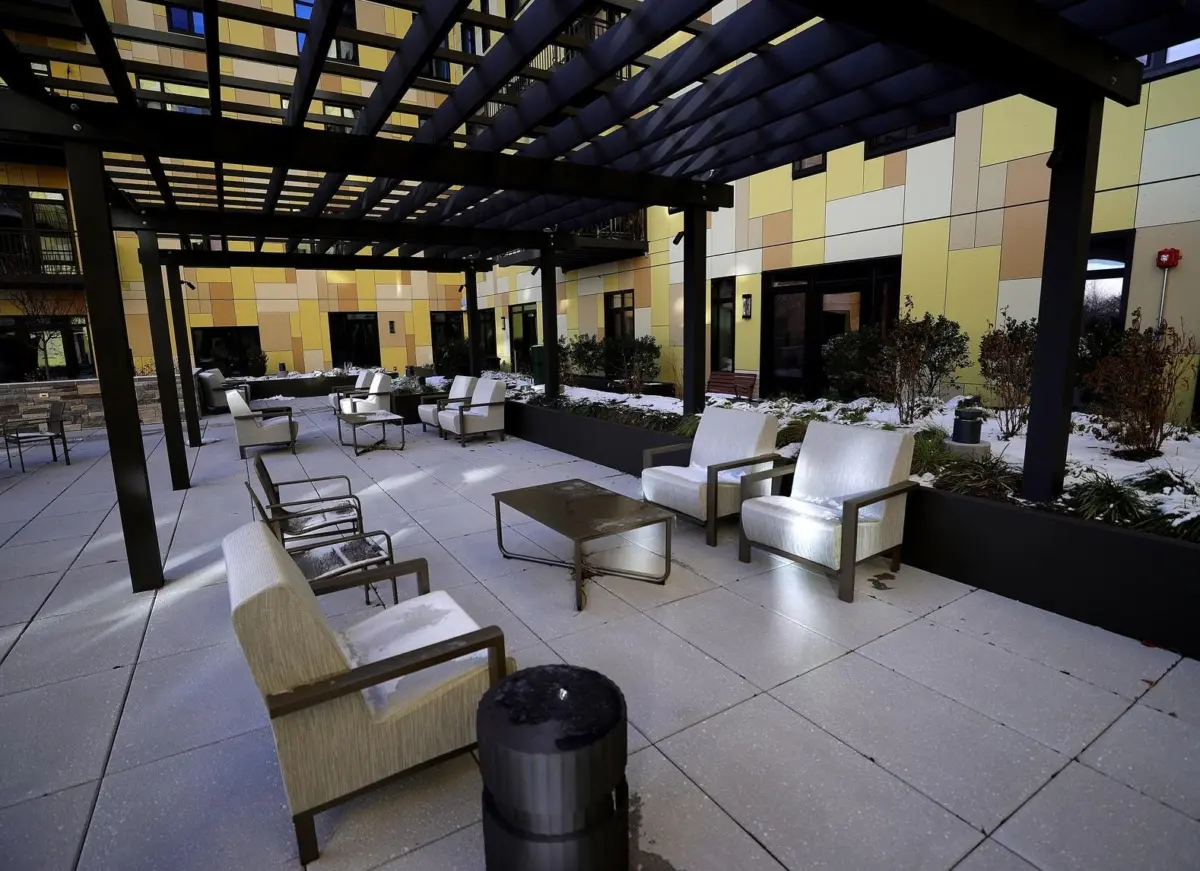
Within its first twelve months of operation, Opus Newton has transformed from an experimental blueprint into a bustling, vibrant micro-city. Visitors walking through its sunlit interior courtyards and active common rooms encounter an environment indistinguishable from a luxury resort—disproving the cynical assumption that "affordable" senior care must feel institutional or austere.
Supporting Context & Metrics: Decoding the Middle-Market Economics
To grasp the magnitude of the achievement at Opus Newton, one must examine the hard numbers defining the American senior housing crisis and the creative financial architecture that makes this specific model function.
The Financial Architecture of Opus Newton
- Target Audience: Middle-income seniors comfortable with entry fees roughly equivalent to half the median home value in their local community, with baseline annual incomes starting around $50,000.
- Entry Fees: Averaging approximately $800,000 (80% fully refundable).
- Monthly Rents: Ranging from $2,000 to $4,500 depending on apartment square footage.
- Second-Person Monthly Fee: An average of $900.
- Local Comparison: In the immediate Boston suburban market, median home values reach $1.5 million. Competing high-end CCRCs routinely demand entry fees exceeding $1 million and monthly fees of $8,000 or more, pricing out retired teachers, firefighters, nurses, and civil servants.
The Macroeconomic Ripple Effect
The inability of middle-income seniors to relocate is not merely a personal housing inconvenience; it is a profound macroeconomic bottleneck. When older adults remain in large, multi-bedroom family homes well into their eighties due to a lack of intermediate options, inventory for young families evaporates. This structural stagnation directly inflates housing prices and locks millennials and Generation Z out of the housing market. By providing an attractive landing spot that feels like an upgrade rather than a compromise, middle-market communities like Opus act as a release valve for the entire residential real estate pipeline.
Official Statements and Operational Innovations
How does Opus Newton maintain its high standards while charging roughly half the market rate of its luxury competitors? The secret lies in a series of calculated departures from traditional Cereal-and-Brick senior living conventions.
Eliminating the Skilled Nursing Burden
Traditional CCRCs historically incorporated massive, highly regulated skilled nursing facilities (SNFs) on-site. While intended to provide cradle-to-grave security, SNFs are massive financial anchors. They drive up construction costs, require complex regulatory compliance, and expose operators to exorbitant liability insurance expenses.
Opus Newton completely discarded the traditional SNF model. By operating strictly as a residential and assisted living campus without a designated skilled nursing wing, the development slashed both upfront construction outlays and ongoing operational overhead.
In-Apartment Aging in Place
Rather than utilizing designated, segregated assisted living wings—which often require residents to uproot and move into a different room as their care needs escalate—Opus keeps residents in their original apartments.

CEO Amy Schectman explains that prospective residents rarely fear the entry fee, because they understand the equity tied up in their current homes. Their true anxiety lies in sustaining monthly rent over a multi-year retirement horizon. To alleviate this, Opus contracts directly with an on-site home care agency.
Instead of enforcing the industry-standard four-hour minimum shifts common among independent home health agencies, Opus aides are stationed on-site and can deliver care in nimble, 30-minute increments. This radically reduces out-of-pocket costs for residents. Furthermore, it serves as a massive financial saver for married couples, who otherwise face the exorbitant cost of maintaining two separate units if care needs diverge for one spouse.
Restructuring Dining and Culinary Economics
Food service is historically one of the most expensive and wasteful departments in senior living. High-end communities often hemorrhage money maintaining gourmet, restaurant-style operations around the clock.
Opus took a pragmatic, cost-effective approach:
- Meals focus on high-quality, comforting home-style fare (think meatloaf and grilled salmon) rather than elite culinary excesses (such as walnut lobster or strawberry pasta).
- Each resident receives a $400 monthly dining credit.
- Full breakfast and lunch are served daily, but full dinner service is restricted to three evenings a week.
- Once the monthly credit is exhausted, residents pay ala carte (dinner entrees generally run between $20 and $25).
The Power of Resident Volunteerism
Perhaps the most innovative—and culturally defining—aspect of Opus Newton is its requirement that all physically and cognitively able residents contribute at least 10 hours of volunteer service each month.
Residents seamlessly step into operational roles across the campus:
- Staffing and greeting visitors at the front desk.
- Setting and clearing communal dining tables.
- Organizing, scheduling, and running recreational programs.
During any given week, Opus boasts dozens of resident-led activities, ranging from book clubs and fitness classes to full-scale theatrical productions spearheaded by a resident who spent their career as a professional theater director.
This volunteer model achieves a dual victory. Economically, it drastically trims corporate payroll and staffing overhead. Psychologically and socially, it fosters an authentic sense of ownership, purpose, and camaraderie. Every resident interviewed notes that this communal interdependence is the primary reason they chose Opus—proving that purposeful engagement is a powerful substitute for costly top-down staffing.
Future Outlook: Can the Opus Model Scale Nationally?
Despite its runaway success in suburban Boston, industry analysts and housing advocates are raising critical questions regarding the long-term scalability and durability of the Opus model.
Navigating the Frailty Transition
The most pressing operational question facing Opus Newton’s leadership as the community matures is how it will handle the inevitable progression of resident frailty. While the current population is relatively young, active, and healthy, time marches on.
What happens when independent seniors develop advanced cognitive decline or severe physical impairments? Currently, Opus offers adult day services for cognitive decline but lacks dedicated memory care units. CEO Amy Schectman and her team are already actively rethinking how to integrate memory care infrastructure without inflating costs or breaking the fragile middle-market financial model.
The Leadership and Culture Dependency
Another hurdle to replication is the unique alchemy required to launch such a community. Opus relied heavily on the institutional knowledge of a deeply committed, mission-driven non-profit leadership team (2Life Communities) coupled with a pioneering cohort of outgoing, enthusiastic early residents willing to embrace a self-governing, high-participation lifestyle. Can for-profit developers, private equity firms, or regional operators without non-profit roots successfully replicate a community that relies so heavily on volunteerism and cultural buy-in?
Defining the Future of the "Middle-Middle"
The term "middle-income" is broad, encapsulating a massive spectrum of Americans. At one end are seniors who narrowly miss qualifying for government subsidies or Medicaid; at the other are more affluent retirees who still find traditional luxury CCRCs completely out of reach.
There will never be a silver-bullet, one-size-fits-all solution for every older adult caught in this chasm. However, for the core "middle-middle"—career public servants, educators, civil engineers, and healthcare workers—Opus Newton has successfully engineered a viable, replicable blueprint.
As America’s demographic clock ticks forward, the lessons learned from this Boston suburb will undoubtedly serve as a vital case study for developers, policymakers, and communities nationwide striving to solve the missing middle crisis once and for all.

0 Comments