

By Derrick Conover
Published: November 21, 2025
Categories: Agriculture, Crops, Horticulture | Tags: Agriculture, SV Ag Update
Executive Overview
Blueberries have rapidly emerged as one of the most promising and lucrative specialty crops in North Florida. For small- and medium-scale agricultural producers looking to diversify their operations, optimize land use, and tap into strong, enthusiastic local markets, blueberry farming presents an exceptional opportunity.
Thanks to a unique combination of mild winters, naturally acidic sandy soils, and robust consumer demand, Columbia County is ideally situated to support profitable blueberry production. Whether a grower is planting a single experimental acre or expanding an established commercial enterprise, understanding the foundational requirements of the crop is essential. From choosing between Southern Highbush and Rabbiteye varieties to implementing advanced microjet irrigation and precision pest management, this guide provides a comprehensive roadmap for establishing a healthy, high-yield blueberry patch in North Florida.
Detailed Chronology: Establishing Your Blueberry Operation
Transitioning land into a productive blueberry farm requires careful, phased planning over several seasons. To achieve optimal establishment and long-term viability, growers should approach the process through a structured timeline:
Phase 1: Site Selection and Soil Preparation (6 to 12 Months Prior to Planting)
Before purchasing a single plant, prospective growers must evaluate their land. Blueberries require specific soil conditions—most notably, an acidic environment with a pH ranging between 4.5 and 5.5.
- Soil Testing: Conduct thorough soil tests well in advance of planting to determine baseline nutrient levels and pH.
- pH Adjustment: If the soil pH is too high (above 6.0), applications of elemental sulfur may be necessary to bring the chemistry down to the ideal range.
- Drainage Evaluation: Blueberries demand well-drained soils. Saturated roots lead quickly to root rot and plant decline. Growers should identify low spots prone to standing water and consider installing raised beds to improve aeration and drainage.
Phase 2: Variety Selection and Infrastructure Design (3 to 6 Months Prior)
Once the site is prepped, growers must decide which cultivars best suit their production goals, labor availability, and capital investment.
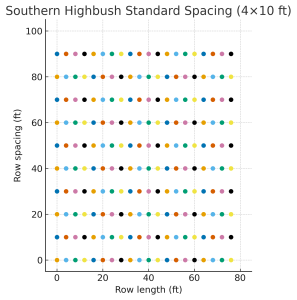
- Mapping the Layout: Determine plant spacing based on the chosen variety and management style (standard vs. high-density systems).
- Irrigation Installation: Because North Florida experiences unpredictable dry spells—particularly during the critical spring fruit-set window—installing an efficient microjet or drip irrigation system is non-negotiable. Setting up fertigation infrastructure at this stage allows for precise nutrient delivery directly to the root zones.
Phase 3: Planting and Early-Stage Management (Year 1)
- Planting Window: The ideal time to plant containerized or bare-root blueberry plants in North Florida is during the dormant winter months, allowing plants to establish root systems before spring flush.
- Mulching: Apply a thick layer of organic mulch (such as pine bark or pine needles) around the base of the plants to retain soil moisture, suppress weeds, and maintain soil acidity.
- Flower Bud Removal: For Southern Highbush varieties in their first year, commercial growers often remove early flower buds to direct the plant’s energy into robust vegetative growth and root establishment rather than fruit production.
Phase 4: Production, Harvesting, and Scaling (Years 2 and Beyond)
- First Commercial Harvest: Depending on the variety and management intensity, light harvests begin in Year 2, with full commercial yields typically realized by Years 3 through 5.
- Expansion: Many beginning growers in Columbia County find success by starting with a manageable one-acre plot, allowing them to refine their harvest, labor, and marketing strategies before scaling up to larger multi-acre operations.
Supporting Context & Metrics: Why Blueberries Thrive in North Florida
The agricultural viability of blueberries in Columbia County is backed by distinct environmental and economic factors that minimize input hurdles while maximizing market returns.
Natural Environmental Advantages
- Soil Profile: Much of Columbia County features naturally sandy, acidic soils. This biological head-start means growers can establish productive patches with minimal soil modification compared to regions with heavy alkaline clays.
- Chill Hours: Successful blueberry production relies on a specific accumulation of winter "chill hours" (temperatures between 32°F and 45°F) to break dormancy and ensure uniform spring blooms. Columbia County typically receives between 300 and 500 chill hours annually. This range is optimal for low-chill Southern Highbush cultivars and sits well within the ideal range for Rabbiteye varieties, guaranteeing consistent year-to-year yields.
- Plant Density: Under proper management, a single acre of land can support between 600 and 1,500 blueberry plants, depending entirely on the chosen spacing geometry and production system.
Variety Deep Dive: Choosing the Right Cultivar
Growers must weigh the pros, cons, and spacing requirements of distinct production systems to match their labor and irrigation capabilities.
1. Southern Highbush Blueberries
- Best For: Early-season fruit production, capturing premium market prices when fresh berries are scarce nationwide.
- Popular Cultivars: ‘Emerald’, ‘Jewel’, ‘Meadowlark’, and ‘Suziblue’.
- Standard Spacing: Typically planted at 3 to 4 feet between plants within rows, with 10 to 12 feet between rows.
- Characteristics: These varieties yield fruit earlier in the spring, allowing growers to capitalize on high initial market demand. However, they demand intensive management, strict irrigation protocols, and close monitoring for pests and diseases.
2. High-Density Southern Highbush Systems
- Best For: Intensive commercial production on tightly managed, fully irrigated acreage.
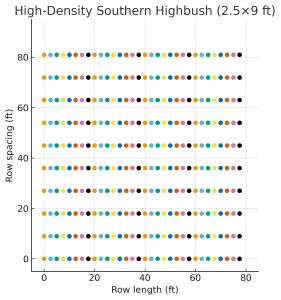
- Recommended Spacing: 2.5 feet × 9 feet.
- Characteristics: This advanced configuration maximizes yield per acre and produces early, abundant crops. It requires absolute precision in weed control, soil fertility, and continuous drip or microjet irrigation.
3. Rabbiteye Blueberries
- Best For: Low-input growers, organic operations, or sites with limited irrigation infrastructure.
- Popular Cultivars: ‘Climax’, ‘Brightwell’, and ‘Powderblue’.
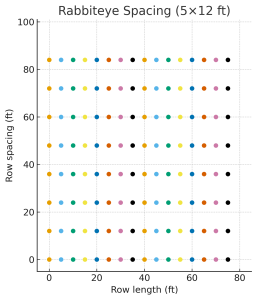
- Recommended Spacing: 5 to 6 feet between plants within rows, with 12 to 14 feet between rows.
- Characteristics: Rabbiteye varieties are traditionally more resilient, vigorous, and tolerant of marginal soils. While they fruit later in the season than Southern Highbush plants, they offer a reliable harvest with lower overall input costs.
Official Insights & Irrigation Considerations
Agricultural extension guidance emphasizes that water management is often the single most critical factor determining the success or failure of a North Florida blueberry venture.
The Case for Microjet and Drip Irrigation
While established Rabbiteye varieties possess deep root systems that can occasionally survive on natural rainfall alone, changing regional precipitation patterns over recent growing seasons have made reliance on rainfall risky. For Southern Highbush and high-density plantings, microjet or drip irrigation is strongly recommended.
Drip and microjet systems offer several distinct operational benefits:
- Reliable Establishment: Young plants require consistent, low-volume moisture to develop robust root systems without becoming waterlogged.
- Early Fruit Production: Uninterrupted hydration during the spring swell prevents fruit drop and ensures uniform sizing.
- Integrated Fertigation: Modern drip setups allow growers to inject water-soluble fertilizers directly into the irrigation stream, delivering precise macro- and micronutrients straight to the root zone while minimizing waste and weed stimulation in row middles.
Future Outlook: A Profitable Horizon for Growers
As consumer demand for locally sourced, fresh produce continues to accelerate across North Florida, the market for Columbia County blueberries remains exceptionally strong. Outlets ranging from the Lake City Farmers Market to bustling regional U-pick operations demonstrate that local residents actively seek out high-quality, recognizable specialty crops.
Whether you are a beginning grower looking to break into commercial agriculture or an established farmer seeking a reliable crop for diversification, blueberries offer a compelling value proposition:
- High Market Recognition: Consumers immediately recognize and value fresh berries, making sales channels more reliable than those for niche or unfamiliar specialty fruits.
- Scalable Investment: The ability to start small (such as a single test acre) allows growers to master cultivation techniques before committing extensive capital to expansion.
- Favorable Regional Climate: Natural soil acidity and dependable chill hours provide a firm foundation for sustainable yields.
With thoughtful planning, precise variety selection, strict adherence to recommended spacing and irrigation protocols, and proactive pest management, blueberries can serve as a cornerstone of agricultural profitability in Columbia County for decades to come.

0 Comments