

By Jay Capasso (UF/IFAS Extension), Jason Mallard (UGA Cooperative Extension), and Phillip Edwards (UGA Cooperative Extension)
Published: December 4, 2024 | Updated: September 9, 2025
Executive Overview
Agricultural irrigation remains one of the most critical operational tools for modern farming, directly dictating crop yield, resource conservation, and long-term farm profitability. However, simply applying water to a field is no longer enough to meet the economic and environmental demands of contemporary agriculture. To truly optimize water resources, farm managers and growers must master two distinct yet interconnected performance metrics: Distribution Uniformity (DU) and Irrigation Efficiency.
While these terms are frequently used interchangeably in casual agricultural discussions, they measure entirely different aspects of an irrigation system. Distribution Uniformity evaluates how evenly water is spread across an entire field by an overhead system, such as a center pivot or linear move setup. Irrigation Efficiency, on the other hand, measures the proportion of applied water that is actually utilized beneficially by the crop—typically to satisfy evapotranspiration (ET) demands.
Understanding and improving these metrics yields profound benefits: minimized water waste, lowered energy costs, reduced fertilizer leaching, and more uniform crop growth. Recognizing the vital nature of these metrics, regional agricultural authorities—including the University of Florida’s Institute of Food and Agricultural Sciences (UF/IFAS) Extension and the University of Georgia (UGA) Cooperative Extension—are actively providing resources, mobile irrigation laboratories, and technical evaluations. Through these initiatives, growers in the Southeast can pinpoint operational inefficiencies, upgrade outdated infrastructure with financial assistance, and secure the sustainability of their operations for decades to come.
Detailed Chronology: The Evolution of Irrigation Diagnostics and Regional Support
The systematic evaluation of agricultural irrigation systems has evolved significantly over the past few decades, transitioning from subjective visual assessments to data-driven, highly technical field audits.
The Shift Toward Precision Agriculture
Historically, farmers relied on visual cues—such as plant wilting or surface pooling—to gauge whether an irrigation system was performing adequately. This approach often resulted in over-irrigation in certain zones and severe water stress in others. In the late 20th and early 21st centuries, the widespread adoption of center pivot and linear move overhead irrigation systems revolutionized crop production in regions like Florida’s Suwannee Valley and the agricultural belts of Georgia.
However, as infrastructure aged, researchers and extension agents recognized that mechanical wear, pressure fluctuations, and design flaws were quietly draining farm profitability through wasted water and inflated energy bills. This realization catalyzed the development of standardized diagnostic techniques, most notably the "catch-can" test, which allowed extension specialists to quantitatively measure water application patterns across a working field.
Institutional Intervention: Mobile Irrigation Labs and Extension Services
To bridge the gap between academic research and on-the-farm execution, agricultural agencies established specialized testing services. In Florida, Mobile Irrigation Labs (MILs) were deployed to travel directly to farms, offering hands-on evaluations of center pivot and linear move systems. These labs provide growers with precise data regarding their system’s Distribution Uniformity and overall efficiency.
Concurrently, the UGA Cooperative Extension established rigorous system evaluation protocols across Georgia, pairing technical audits with educational outreach. Recognizing that equipment upgrades can represent a significant capital expense for growers, state and federal partnerships emerged. Programs administered through the Florida Department of Agriculture and Consumer Services (FDACS)—specifically tied to Best Management Practices (BMP) enrollment—alongside USDA Natural Resources Conservation Service (NRCS) cost-share initiatives in Georgia, began offering crucial financial backing. Today, these diagnostic and financial frameworks form a comprehensive safety net, empowering growers to systematically modernize their irrigation practices.
Supporting Context & Metrics: Decoding DU and Efficiency
To effectively manage water resources, growers must look past the pump and examine the intricate mechanics of how water travels from the source to the crop root zone.
What is Distribution Uniformity (DU)?
Distribution Uniformity is the mathematical expression of how evenly water is distributed across a given field. For modern center pivot and linear overhead irrigation systems, achieving a DU of 90% is widely considered an attainable and desirable benchmark. A 90% DU means that 90% of the field receives water in a uniform, highly predictable manner, drastically reducing localized water waste and ensuring that every plant receives an equitable share of moisture.
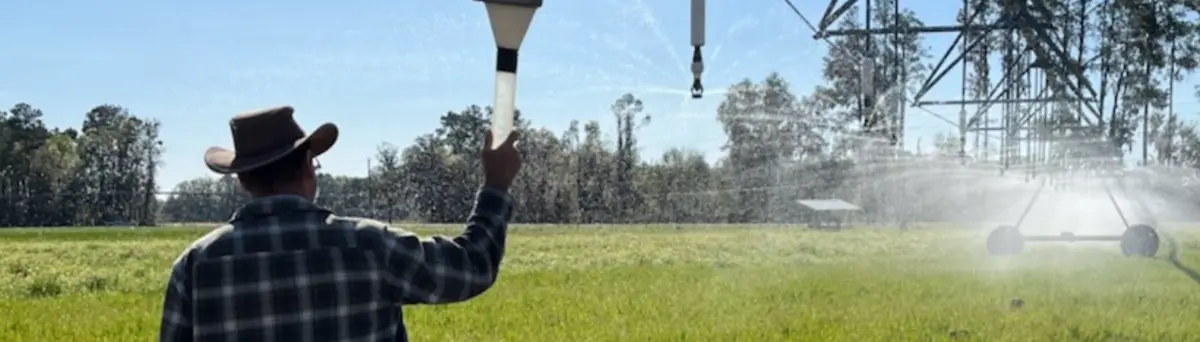
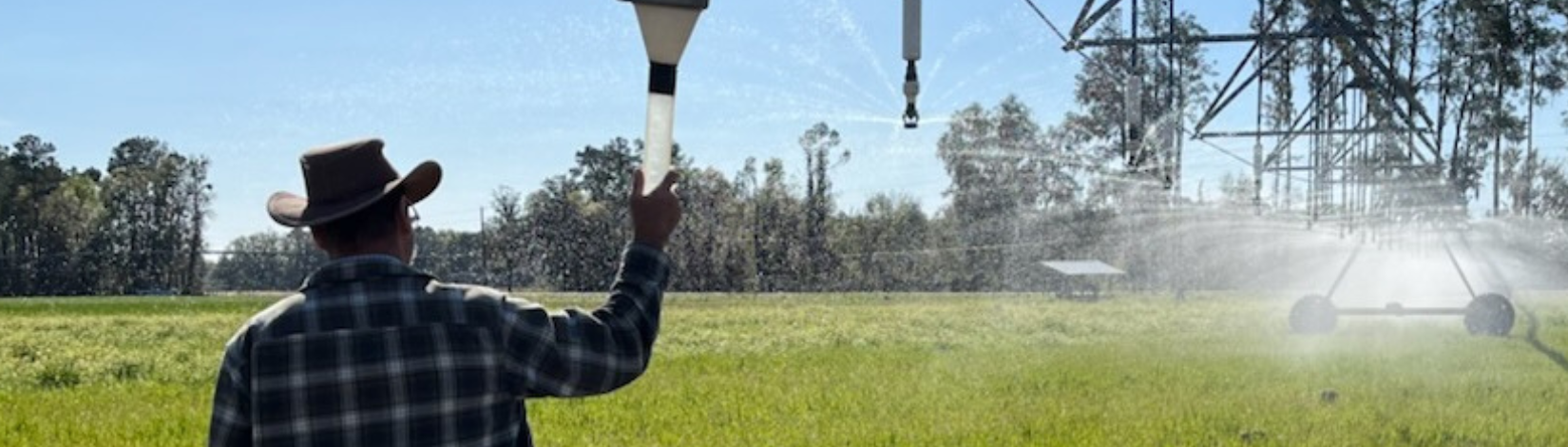
The industry-standard method for calculating DU is the catch-can method. This procedure involves distributing a grid of catch containers across the field within the path of the irrigation system. Once the system completes a pass, the depth of water in each container is meticulously measured. The DU is then calculated using the following formula:
$$textDU = left( fractextAverage depth of water collected in the lowest 25% of containerstextTotal average depth of water applied across the entire field right) times 100$$
The Dual Role of DU: Water and Nutrient Management
While uniform water distribution is inherently valuable for preventing drought stress and waterlogging, its importance multiplies when integrated with fertigation—the practice of injecting liquid fertilizers directly through the irrigation system.
When a system possesses a high DU, injected nutrients are delivered across the field with matching precision. Conversely, a poor DU results in severe spatial variability in fertilizer application. Some zones receive excessive nutrient loads—leading to potential leaching, groundwater contamination, and vegetative lodging—while neighboring zones experience nutrient deficiencies. Maintaining optimal DU ensures uniform crop uptake, smoothing out maturity timelines and eliminating growth variability across the harvest.
Dissecting the Factors That Impact DU
Numerous mechanical, environmental, and operational variables can degrade a system’s Distribution Uniformity:
- Flow Rate Variability and Pressure Differences: Friction losses within pipes, changes in field elevation, and faulty pressure regulators can drastically alter water flow to individual sprinklers. Stable pressure is the bedrock of uniform irrigation; pressure variations cause irregular spray patterns, accelerated mechanical wear, and unnecessary spikes in energy consumption.
- Nozzle Wear and Clogging: Over time, abrasive sediments and mineral deposits erode or block sprinkler nozzles, distorting discharge rates and throwing off application patterns.
- Sprinkler Spacing and Design Flaws: Improper engineering during system installation or haphazard modifications can create overlapping or neglected zones.
- End Gun Alignment Issues: End guns cover expansive perimeters, but if misaligned, their output can excessively overlap areas already saturated by standard overhead sprinklers, ruining uniformity near field edges.
- Environmental Interference: High winds can deflect spray droplets, while tall, dense crop canopies can intercept water before it reaches the ground.
- Operational Practices and Edge Effects: Transitional inconsistencies during system startup and shutdown, variations in pipe diameters, and natural "edge effects" where sprinkler arcs overlap at field boundaries all contribute to localized distribution disparities.
Irrigation Efficiency: The Rest of the Equation
While DU measures evenness, Irrigation Efficiency measures utility. It evaluates what proportion of the total water applied is actually put to beneficial use by the crop:
$$textEfficiency = fractextWater Beneficially UsedtextTotal Water Applied$$
In the humid and semi-humid Southeast, irrigation efficiency almost exclusively refers to the percentage of water utilized to meet crop evapotranspiration (ET) demands—the combined process of water evaporation from the soil and transpiration from the plant. Unlike arid regions, where irrigation efficiency calculations must account for leaching salts away from the root zone, Southeastern growers rarely face soil salinity crises. In rare instances, beneficial uses may include climate control (such as frost protection) or intentional weed germination ahead of targeted eradication.
Measuring efficiency accurately is notoriously difficult because it requires knowing precisely how much water successfully penetrates the soil and reaches the active root zone. This is where modern soil moisture monitoring hardware becomes indispensable.
The Critical Intersection: Soil Moisture Sensors, DU, and Efficiency
Soil moisture sensors serve as the diagnostic compass for modern irrigation scheduling, allowing growers to track real-time moisture depletion in the root zone. However, the placement of these sensors is critical to their utility.
If a grower installs a soil moisture sensor in a zone of the field suffering from poor Distribution Uniformity—such as an under-watered high spot or an over-watered low spot—the data transmitted will be fundamentally skewed. The sensor will not reflect true field conditions, leading the grower to make erroneous irrigation scheduling adjustments. To maximize both system efficiency and sensor accuracy, hardware must be deployed in statistically representative areas determined by prior irrigation audits.
Official Statements and Regional Expert Insights
Agricultural authorities across the Southeast emphasize that irrigation management is no longer a matter of guesswork, but a precise science requiring institutional collaboration.
Experts from the UF/IFAS Extension note that regional growers face unique environmental challenges, including sandy soils with low water-holding capacities. These soil characteristics mean that poor distribution uniformity results in rapid nutrient leaching and localized crop failure. Extension specialists advocate for routine system audits, asserting that catching minor mechanical faults early prevents catastrophic yield losses during peak growing seasons.
Similarly, representatives from the UGA Cooperative Extension stress that water resource sustainability in the broader Southeastern agricultural corridor depends heavily on proactive management. UGA specialists point out that many growers absorb hidden financial losses simply because their center pivots operate under incorrect pressures or worn nozzles. By utilizing institutional evaluation services, growers can transform their irrigation systems from financial liabilities into precise, high-efficiency assets.
Furthermore, state and federal agencies reinforce these educational initiatives through tangible support. Programs managed by FDACS—particularly for participants enrolled in Best Management Practices (BMP) programs—alongside USDA NRCS funding channels, provide critical cost-share opportunities. These programs help growers shoulder the financial burden of retrofitting old pivots, replacing pressure regulators, and installing advanced variable-rate irrigation (VRI) technology.
Future Outlook: The Next Frontier in Precision Irrigation
As agricultural technology advances, the future of irrigation management points toward hyper-localized automation and data integration. The integration of artificial intelligence with real-time weather forecasting, drone-based thermal imaging, and soil sensor arrays will soon allow center pivots to adjust application depths dynamically on the fly.
Variable-Rate Irrigation (VRI) systems represent the vanguard of this movement, enabling pivots to alter application rates across micro-zones within the same field based on topography, soil type, and real-time crop demand. However, agricultural engineers caution that advanced technology cannot compensate for foundational mechanical flaws. Even the most sophisticated VRI software will underperform if the underlying hardware suffers from poor Distribution Uniformity, pressure irregularities, or clogged nozzles.
Moving forward, the roadmap for Southeastern growers is clear. Long-term profitability and environmental stewardship will rely on a three-pronged approach:
- Routine Auditing: Engaging with regional Mobile Irrigation Labs and Extension services to baseline DU and efficiency.
- Infrastructure Maintenance: Proactively replacing worn nozzles, monitoring pressure regulators, and correcting alignment issues.
- Data-Driven Scheduling: Utilizing strategically placed soil moisture sensors to align irrigation runtimes precisely with crop evapotranspiration needs.
By embracing these principles, growers can secure optimal crop yields, protect valuable regional water resources, and navigate an increasingly competitive agricultural landscape with confidence.
For more information on local Mobile Irrigation Laboratories, regional evaluations, and water conservation cost-share programs, growers are encouraged to visit the FDACS Mobile Irrigation Labs portal or reach out directly to their local UF/IFAS Extension or UGA Cooperative Extension office.

0 Comments