

Executive Overview
In an era defined by intense sociopolitical polarization and a fracturing public discourse, academic institutions across the United States are increasingly searching for effective ways to model constructive dialogue. Florida State University (FSU) is taking a major step toward addressing this challenge by welcoming renowned cultural commentator, bestselling author, and journalist David Brooks to campus.
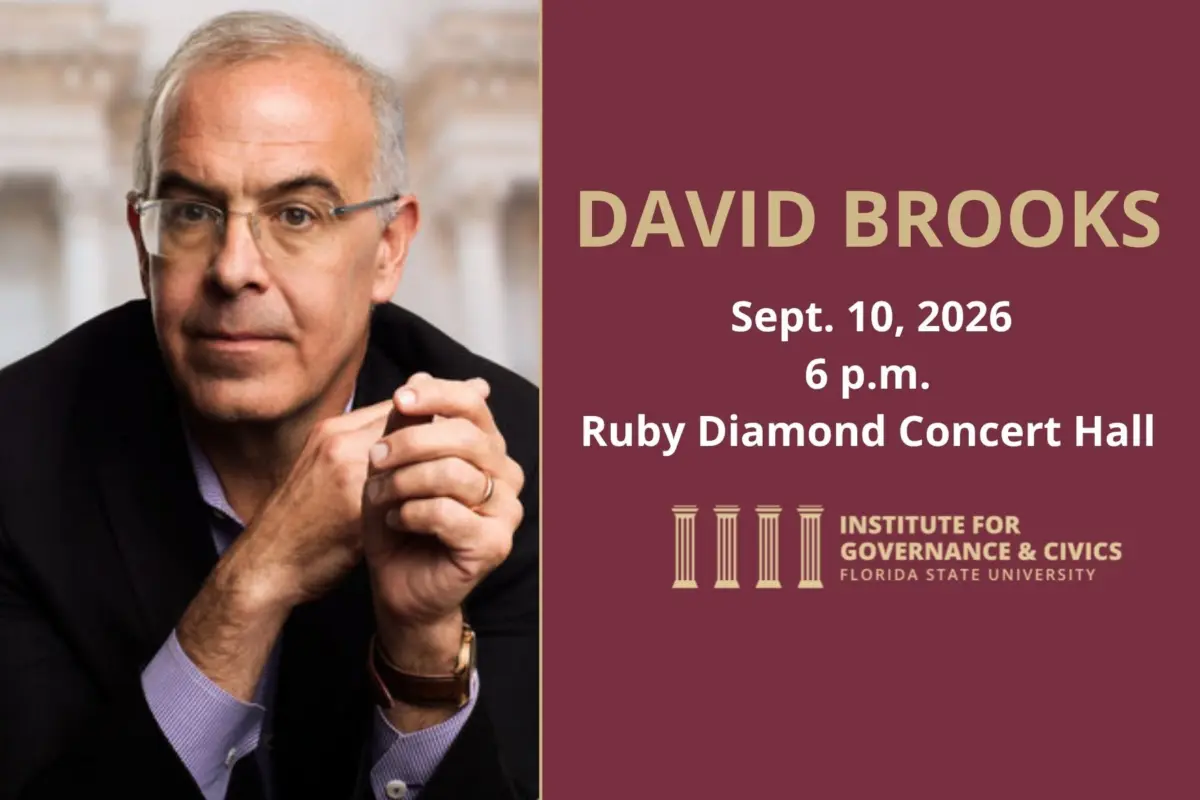
Scheduled for September 10, 2026, at 6:00 p.m., the marquee event will feature a public conversation between Brooks and FSU President Richard McCullough. Hosted by the university’s Institute for Governance and Civics (IGC) inside the historic Ruby Diamond Concert Hall, the evening will center on core pillars of contemporary civic life: character, ethical leadership, and the art of engaging thoughtfully across ideological, cultural, and political divides.
The visit arrives at a critical juncture for higher education. Universities are routinely scrutinized for their handling of free expression, ideological diversity, and student polarization. By bringing in a public intellectual of Brooks’s stature—who recently transitioned to The Atlantic as a staff writer after a distinguished 22-year tenure at The New York Times, and who currently serves as Yale University’s inaugural presidential senior fellow—FSU is doubling down on its commitment to creating spaces for open, nonpartisan inquiry.
University leadership hopes the event will serve as both a compelling intellectual exercise and a practical framework for students navigating an increasingly fractured social and political landscape. Advanced registration is strongly encouraged for the free public event, which is expected to draw a capacity crowd.
Detailed Chronology: From Presidential Gathering to Campus Showcase
The genesis of David Brooks’s upcoming appearance at Florida State University traces back to a serendipitous meeting of minds among higher education executives.
The Spark of Inspiration
Months prior to the announcement, FSU President Richard McCullough attended a national gathering of university presidents, where Brooks was invited as a keynote speaker. While discussions of higher education often devolve into partisan talking points or hyper-defensive institutional posturing, McCullough was immediately captivated by Brooks’s refreshingly objective, nonpartisan analysis of the American academy.
Rather than viewing higher education through a strictly left-right paradigm, Brooks offered an analytical, public intellectual’s assessment of the institution’s historical trajectory, its current cultural stumbling blocks, and its untapped potential to shape the next generation of citizens.
"I was just completely blown away and fascinated by his take on higher education," McCullough reflected. "I thought it was a very fair perspective. It was not political. It wasn’t right or left. It was just, as a public intellectual, his assessment of what we had done."
Mobilizing the Administration
Deeply moved by Brooks’s insights on character and the intellectual life of leadership, McCullough returned to Tallahassee with a clear mandate: bring David Brooks to Florida State University.
Upon his return, McCullough consulted with Provost and Executive Vice President for Academic Affairs Jim Clark. Clark, who was already well-versed in Brooks’s extensive literary and journalistic catalog—including seminal works like The Road to Character and How to Know a Person—instantly recognized the value of the proposal. Working in tandem with the administrative leadership team, Clark helped coordinate the logistical and academic alignment required to secure the high-profile visit.
The initiative was quickly adopted by the Institute for Governance and Civics, whose mission aligns seamlessly with Brooks’s lifelong inquiry into community building, relational intelligence, and moral formation.
Supporting Context & Metrics: The State of Student Discourse
The partnership between FSU leadership and the IGC to host David Brooks is not merely symbolic; it is rooted in empirical data concerning student sentiment, campus culture, and the state of modern communication.
Bridging the Empathy Gap
According to Ryan Owens, director of the Institute for Governance and Civics, internal research conducted by the institute reveals a fascinating paradox among contemporary college students. On one hand, university students overwhelmingly desire opportunities to engage in free-flowing, uninhibited discussions about complex, controversial social and political issues. On the other hand, a significant percentage of students harbor deep-seated anxieties that their peers will reject, ostracize, or penalize them for holding dissenting viewpoints.
This "empathy gap" has created an environment of self-censorship on many American campuses, where students routinely bite their tongues out of fear of social reprisal. The IGC’s core mission is designed to dismantle this culture of hesitation by promoting what Owens describes as a "free market of conversation and ideas."
"We talk about changing the culture of things so that people believe in a free market of conversation, a free market of ideas, openness, and are willing to discuss and engage with ideas that may or may not be comfortable to you," Owens explained.
Why Models Matter
By hosting a public dialogue between two prominent figures who model intellectual humility and rigorous curiosity, the university hopes to provide students with a tangible blueprint for civil discourse.
"I think it’s important for students to see leadership behind efforts like this," Owens noted. "To have two very important, prominent individuals up there talking about that problem and talking about things that we can do to improve on it is an incredibly useful model for students to see, to observe, and to follow."
Rather than shielding students from uncomfortable ideas, the IGC and FSU administration are championing an approach that embraces intellectual friction as a necessary component of personal growth and democratic resilience.
Official Statements and Leadership Perspectives
The significance of David Brooks’s visit is underscored by the impassioned endorsements of FSU’s top administrators.
President Richard McCullough on the "Intellectual Life of Leadership"
President McCullough has continually emphasized that true leadership extends far beyond operational management or institutional fundraising; it requires a deep commitment to moral clarity and character development.
"I’m just fascinated by that sort of intellectual life of leadership. I feel like David has such a brilliant perspective on leadership and what it takes to lead with character."
— FSU President Richard McCullough
McCullough has described Brooks as a "master storyteller" and has urged the entire campus community—particularly undergraduates and graduate students—to clear their schedules for the September 10 event. "I hope the students will not miss the opportunity to be in Ruby Diamond to hear this," McCullough said. "I hope that it will be standing room only, because this is a kind of once-in-a-lifetime thing to hear somebody like this speak."
David Brooks: A Lifetime Dedicated to American Life
To understand the weight of Brooks’s upcoming appearance, one must examine his illustrious career in journalism and public letters.
Brooks began his professional journalism journey working as a gritty police reporter in Chicago, an experience that grounded his worldview in the realities of everyday human struggle. He later spent nearly a decade at The Wall Street Journal, serving variously as a foreign correspondent stationed in Brussels and as an editor.
As his profile grew, Brooks helped launch The Weekly Standard as a senior editor and became a household face through his long-running analysis on PBS NewsHour. For 22 years, he served as a deeply influential opinion columnist for The New York Times, where his columns frequently examined the intersection of politics, psychology, sociology, and morality.
In early 2026, Brooks embarked on a new professional chapter, leaving The Times to join The Atlantic as a staff writer. Simultaneously, he accepted a prestigious appointment as Yale University’s inaugural presidential senior fellow. In this five-year role, Brooks leads lectures, seminars, and public conversations designed to help students wrestle with fundamental questions regarding meaning, community integrity, and the health of civic institutions.
His written works have consistently struck a chord with readers seeking deeper meaning in a fragmented culture. Books such as The Social Animal: The Hidden Sources of Love, Character, and Achievement, The Road to Character, and How to Know a Person: The Art of Seeing Others and Being Seen have established him as one of the preeminent moral voices of his generation.
Future Outlook: Cultivating Civic Resilience at FSU
As Florida State University looks toward the fall 2026 semester, the visit of David Brooks serves as a cornerstone event for the Institute for Governance and Civics. Established to promote rigorous scholarship, nonpartisan analysis, and civic engagement, the IGC is rapidly positioning FSU as a national leader in the movement to restore civil discourse to higher education.
The challenges facing American democracy—ranging from epistemic bubbles on social media to institutional distrust and deepening partisan animosity—cannot be solved by administrative policy alone. They require a cultural shift within the institutions tasked with educating the leaders of tomorrow.
By bringing a thinker of Brooks’s caliber to the Ruby Diamond Concert Hall, FSU is actively investing in that cultural shift. The dialogue between President McCullough and David Brooks promises to challenge assumptions, provoke introspection, and inspire students to approach their ideological differences not with hostility, but with curiosity and respect.
Event Details At-A-Glance
- Event: A Conversation with David Brooks and FSU President Richard McCullough
- Hosted By: Florida State University Institute for Governance and Civics (IGC)
- Date: Thursday, September 10, 2026
- Time: 6:00 p.m. (Doors open at 5:00 p.m.)
- Venue: Ruby Diamond Concert Hall, Florida State University Campus
- Admission: Free and open to the general public
- Registration: Advanced registration is strongly encouraged via the official FSU ticketing portal.
- Media Inquiries: Media personnel planning to cover the event should confirm their attendance in advance. Interview coordination can be arranged by contacting
[email protected].

0 Comments