

Executive Overview
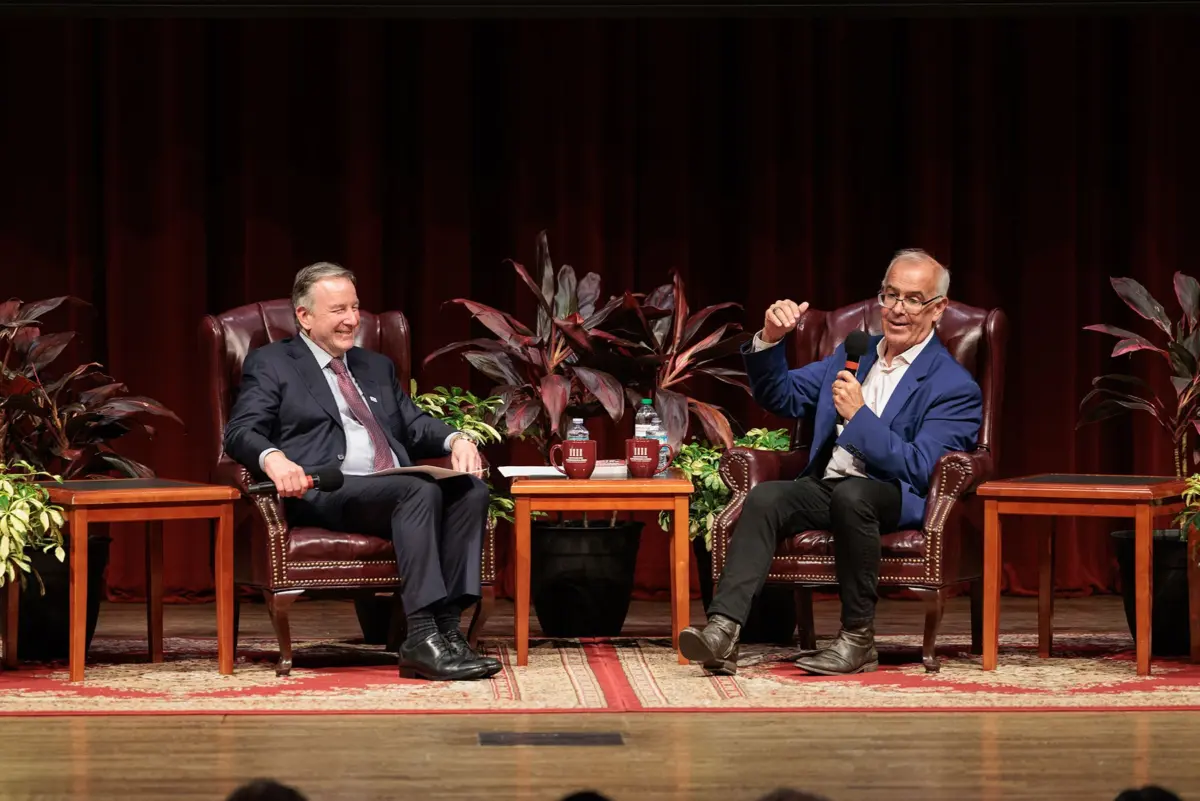
In an era defined by rapid technological disruption, societal polarization, and institutional skepticism, the role of higher education is undergoing a profound reassessment. Addressing a packed house at Florida State University’s historic Ruby Diamond Concert Hall, bestselling author, cultural commentator, and The Atlantic staff writer David Brooks delivered a compelling keynote address on Thursday, September 10, 2026. As the premier event for the Institute for Governance and Civics (IGC) Fall 2026 Speaker Series, Brooks’s address focused on the indispensable value of universities as the moral and cultural anchors of American society.
Invited to campus by FSU President Richard McCullough—who was profoundly moved by Brooks’s philosophy at a national gathering of university leadership—the event served as both an intellectual awakening and a strategic examination of the future of academia. Throughout his keynote and subsequent onstage conversation with President McCullough, Brooks argued that the proliferation of artificial intelligence has rendered basic information abundant, shifting the core mission of higher education from the mere transfer of data to the cultivation of human curiosity, character, and civic resilience.
With introductory remarks delivered by IGC Director Ryan Owens and Provost and Executive Vice President for Academic Affairs Jim Clark, the evening underscored FSU’s ongoing commitment to fostering rigorous public discourse. This comprehensive report details the chronological unfolding of the event, the broader socioeconomic and technological context shaping Brooks’s arguments, official perspectives from FSU leadership, and the long-term implications of higher education’s evolving mandate.
Detailed Chronology of the Event
The evening’s proceedings unfolded within the majestic architecture of Ruby Diamond Concert Hall, drawing students, faculty, civic leaders, and community members from across the Florida panhandle.
Pre-Event Setup and Opening Remarks
The atmosphere inside the hall crackled with anticipation well before the 7:00 PM start time. The event marked the flagship gathering for the Institute for Governance and Civics, an organization dedicated to strengthening democratic institutions, fostering civil discourse, and examining the structural underpinnings of American society.
The program commenced with introductory remarks from Ryan Owens, director of the IGC. Owens outlined the foundational mission of the institute, emphasizing the critical need for spaces where diverse perspectives can be debated openly and constructively. Following Owens, Provost and Executive Vice President for Academic Affairs Jim Clark took the stage to introduce the guest of honor. Clark highlighted Brooks’s extensive career—spanning decades of cultural observation, political commentary, and deep sociological analysis—framing him as one of the most vital voices in contemporary American discourse.
The Keynote Address: Rediscovering "The Gleam"
Stepping up to the podium to a warm, extended ovation, David Brooks launched into a wide-ranging, reflective address. Rather than relying solely on abstract political theory, Brooks wove together historical anecdotes, cultural observations, and personal recollections to diagnose the current state of American society.
Central to his address was the concept of "the gleam"—a metaphor Brooks used to describe the spark of intellectual passion and human engagement visible in the eyes of an excited student or a deeply invested citizen.
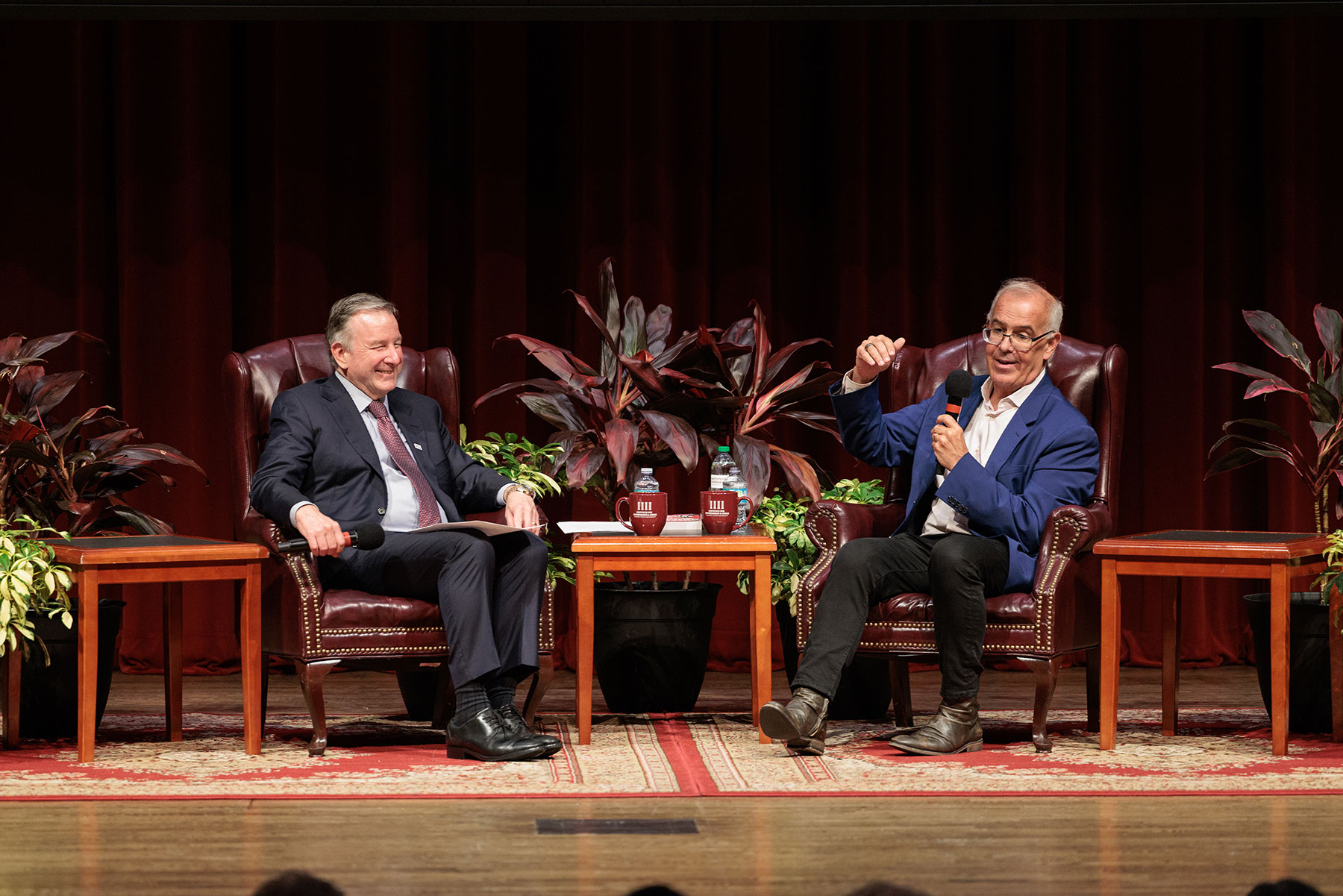
"The gleam is my vision of America," Brooks told the audience. "We are a country that energizes. We’re not the most civilized culture, we’re not the most cultured culture, but we’re about energy and movement. That is the spirit of our democracy."
Brooks diagnosed modern American culture as plagued by widespread pessimism, deep political polarization, and an epidemic of loneliness. In such an environment, he argued, institutions that foster genuine human connection and ignite individual passions are more critical than ever. He positioned higher education not merely as a utilitarian job-training pipeline, but as a transformative human ecosystem.
The Fireside Conversation: Brooks and McCullough
Following the keynote, FSU President Richard McCullough joined Brooks on stage for a dynamic, unscripted conversation that dug deeper into the logistical, cultural, and philosophical challenges confronting modern universities.
President McCullough explained that his decision to bring Brooks to Tallahassee stemmed from a conference of university presidents where Brooks had spoken candidly about the soul of modern campuses. During their dialogue, the two leaders unpacked the friction between traditional academic values and modern pressures—such as hyper-specialization, hyper-competitiveness, and student mental health crises.
Brooks emphasized that a university education must purposefully disrupt students’ comfort zones, compelling them to encounter ideas, texts, and human beings they might otherwise never cross paths with. President McCullough echoed these sentiments, noting that FSU continues to prioritize institutional environments where students learn not just what to think, but how to empathize and collaborate across ideological divides.
Supporting Context & Metrics: Higher Education in the Age of AI
To fully appreciate the weight of David Brooks’s remarks at FSU, it is necessary to examine the broader technological, cultural, and institutional landscape of 2026.
The AI Paradigm Shift and Cognitive Scarcity
One of the most provocative segments of Brooks’s address focused on the disruptive emergence of artificial intelligence. For centuries, the fundamental bottleneck in human progress was access to knowledge and information. Libraries, universities, and specialized archives served as exclusive gateways to intellectual capital.
Today, generative AI tools have rendered raw information ubiquitous and instantly accessible. This technological leap has created a profound philosophical crisis for educational institutions. As Brooks pointed out, humanity now faces a stark fork in the road:

- The Path of Cognitive Atrophy: Some individuals and students will utilize AI as a cognitive crutch, outsourcing deep thought, synthesis, and creative struggle to algorithms, ultimately dulling their mental acuity.
- The Path of Cognitive Amplification: Others will leverage AI to offload tedious mechanical tasks, freeing up mental bandwidth to engage in harder, deeper, and more imaginative thinking.
"In my view, what a school’s purpose is in the age of AI is to teach people to want to think hard, to care about subjects so much that they’re going to be willing to think hard and keep their mental skills sharp," Brooks asserted.
This perspective shifts the core metric of educational success. Standardized testing and rote memorization—already losing ground in pedagogical design—are rendered virtually obsolete by artificial intelligence. Instead, universities are increasingly evaluated on their ability to cultivate intrinsic motivation, emotional intelligence, and relentless intellectual curiosity.
Institutional Trust and the "Cathedrals of Culture"
Brooks’s commentary arrives at a time of historically low public trust in American institutions, including government, media, healthcare, and higher education. According to longitudinal sociological surveys, confidence in higher education has experienced a notable downward drift over the past decade, driven by debates over campus free speech, tuition costs, and political polarization.
Yet, Brooks fiercely defended the intrinsic value of these institutions, labeling them the "cathedrals of our national culture." He argued that while national political systems are often gridlocked by short-term electoral incentives and endless fundraising cycles, true, enduring cultural and societal renewal originates within stable, mission-driven institutions like universities. FSU, through initiatives like the Institute for Governance and Civics, is positioning itself at the vanguard of this institutional renewal, explicitly designing programs to repair the frayed fabric of American civic life.
Official Statements and Leadership Perspectives
The collaboration between FSU leadership and a national intellectual of David Brooks’s stature highlights a deliberate institutional strategy to place civic literacy and moral philosophy at the center of the student experience.
President Richard McCullough’s Vision
Reflecting on the motivations behind the invitation, President McCullough emphasized the urgent need for universities to move beyond transactional models of education.
"When I first heard David Brooks speak, I was struck by his unique ability to diagnose not just the economic or structural challenges of our time, but the spiritual and relational ones," McCullough noted. "At FSU, we are immensely proud of our academic rigor and our rising national standing. But academic excellence must be paired with character development. Bringing thinkers like David Brooks to campus challenges our students, our faculty, and our community to reflect deeply on what kind of society we are building together."
Insights from the Institute for Governance and Civics
The Institute for Governance and Civics (IGC) has quickly established itself as a vital hub for cross-disciplinary research and public programming at Florida State University. Director Ryan Owens noted that the Fall 2026 Speaker Series was specifically curated to address the health of American democracy.

"Democracy requires more than just functional legal frameworks; it requires habits of the heart and mind—tolerance, curiosity, civic courage, and mutual respect," Owens said following the event. "David Brooks’s keynote perfectly encapsulated the mission of the IGC. By challenging us to look past partisan divisions and examine our deeper responsibilities to one another, he has set an extraordinarily high bar for our fall series."
Future Outlook: The Road Ahead for FSU and Higher Education
As the Fall 2026 semester gathers momentum, the ripple effects of David Brooks’s visit are expected to reverberate across FSU’s campus culture, curriculum design, and public outreach initiatives.
Integrating Character and Rigor
Looking forward, FSU leadership plans to leverage the insights gained from the IGC Speaker Series to inform ongoing curricular discussions. As universities grapple with the integration of generative AI into classrooms, the emphasis is shifting toward experiential learning, undergraduate research, and interdisciplinary dialogue—areas where human presence, mentorship, and shared physical spaces are irreplaceable.
Brooks’s observation that universities must help students "find new things to love" serves as a guiding philosophy for student retention and holistic development. By fostering environments where students can discover lifelong passions, institutions can combat the rising tides of student alienation and mental health distress.
Upcoming IGC Programming
The Institute for Governance and Civics has announced that Brooks’s keynote is merely the opening salvo in a robust lineup of events scheduled for the remainder of the Fall 2026 semester. Upcoming panels, lectures, and workshops will continue to explore critical themes at the intersection of governance, technology, civil liberties, and American civic health.
For students, faculty, and community members eager to engage further with these vital topics, the institute encourages active participation in its upcoming events. Comprehensive schedules, ticket information, and archival recordings of the Fall 2026 Speaker Series kickoff can be accessed directly through the official IGC portal at igc.fsu.edu.
In an age where the noise of information often drowns out the signal of wisdom, Florida State University’s commitment to hosting profound, unvarnished conversations ensures that its campus remains not just a center of learning, but a true cathedral of national culture.

0 Comments