

Executive Overview
For decades, the American workforce is sustained by a singular, universally understood carrot on a stick: retirement. Millions of workers navigate the daily grind, grueling commutes, and endless corporate meetings with the comforting vision of a golden horizon. In this idealized future, alarm clocks are permanently silenced, stress is relegated to a distant memory, and every waking hour is dedicated to long-suppressed passions. Whether it is mastering oil painting, writing a novel, traveling to undiscovered corners of the globe, or simply enjoying unstructured days, the "bucket list" serves as the psychological anchor keeping employees tethered to their desks.
Yet, a sobering psychological and statistical reality threatens this rosy projection. When the final day of work arrives and the farewell cake is eaten, the vast majority of retirees discover a jarring discrepancy between their imagined lifestyle and their daily routine.
According to behavioral insights and comprehensive data from agencies like the Bureau of Labor Statistics (BLS), human beings are fundamentally creatures of habit. Simply ceasing to work does not automatically translate into a renaissance of self-actualization. Instead, without deliberate behavioral intervention, old routines simply expand to fill the void left by a career. Far from embarking on epic adventures or launching creative second acts, millions of retirees slide into a passive lifestyle dominated by television and comfort zones.
Achieving an ideal retirement is not merely a financial calculation; it is a profound behavioral challenge. This investigative look examines why our retirement dreams so often fail to materialize, the psychological barriers of ingrained habit, and what it truly takes to shatter the status quo and design a post-work life of genuine purpose.

Detailed Chronology: The Anatomy of a Deferred Dream
The lifecycle of a retirement dream typically follows a predictable trajectory, moving from youthful optimism to mid-career fantasy, and finally, to the stark reality of the post-work transition. Understanding this timeline reveals why intentions frequently fall short of execution.
Phase 1: The Accumulation Decades
During the peak earning years of early and mid-adulthood, individuals build more than just 401(k) balances—they accumulate physical possessions, professional identities, and rigid behavioral patterns. Throughout decades of corporate life, daily existence is externally regulated. Project deadlines, email inboxes, morning stand-ups, and meeting calendars dictate how every hour is spent.
Concurrently, people accumulate physical clutter. Books, tools, souvenirs, and memorabilia find permanent homes in closets, garages, and attics under the psychological safety net of "I might need this someday." This accumulation extends to habits. Because free time is scarce—fragmented between work, family obligations, and basic household maintenance—deep self-directed pursuits are perpetually postponed. The mind relies on comfortable, low-effort routines, such as streaming television or scrolling through digital devices, to unwind at the end of a taxing day.
Phase 2: The Pre-Retirement Proclamation
As retirement approaches within a five-to-ten-year window, psychological anticipation peaks. This is the era of the mental bucket list. Future retirees draft ambitious manifestos of change:

- "As soon as I retire, I’m going to clean out the entire house from top to bottom."
- "I’m going to write that fiction novel I’ve been outlining in my head."
- "I’m going to learn Italian, travel internationally every quarter, and volunteer locally."
At this stage, these ideas provide immense emotional comfort. They act as a psychological buffer against the monotony or stress of ongoing employment. However, they remain theoretical constructs, untested by the reality of unstructured time.
Phase 3: The Collision with Reality (The First Year)
When retirement finally commences, a brief honeymoon period typically ensues. Travel plans are executed, sleep schedules normalize, and the sheer relief of no longer answering to an employer dominates the emotional landscape.
However, within six to twelve months, the euphoria fades. The underlying behavioral architecture of the individual’s life remains unchanged. Without the external framework of a job, the vacuum is not automatically filled by high-minded pursuits. Instead, the path of least resistance takes over. The clutter in the garage remains untouched because the habit of discarding items was never developed. The novel remains unwritten because the discipline of daily, self-directed writing was never practiced during the working years.
As time marches on, the grand visions quietly recede, replaced by a comfortable, albeit occasionally stagnant, daily routine.

Supporting Context & Metrics: What the Data Reveals
To understand why retirement aspirations so frequently stall, one must look beyond anecdotal accounts and examine empirical time-use data. The U.S. Bureau of Labor Statistics (BLS) tracks how Americans distribute their hours across various life stages, providing a revealing window into the retired demographic.
The BLS Time-Use Studies: Where Does the Time Go?
When researchers analyze the daily schedules of employed individuals versus those who are retired or not in the labor force, a clear pattern emerges. When work is removed from the equation, the hours previously dedicated to employment are redistributed, but not necessarily in the ways lifestyle gurus preach.
- The Expansion of Existing Habits: Rather than radically pivoting to entirely new spheres of activity, retirees tend to scale up the hobbies and passive habits they already practiced while working.
- The Television Dominance: According to BLS leisure and sports data, television viewing consumes the lion’s share of free time gained in retirement. While charts indicate a substantial rise in overall "Leisure and Sports" hours following the exit from the workforce, a deep dive reveals that over half of that time is spent watching television or movies.
- The Minimal Footprint of Physical and Creative Activity: Rigorous physical exercise, active community volunteering, and intensive creative pursuits (such as art, music, writing, and photography) account for only a fractional percentage of the average retiree’s day. Statistically speaking, there is little evidence to suggest that mass populations spontaneously adopt exotic, high-engagement lifestyles upon retirement.
The Psychology of Inertia
Why do these statistics persist despite universal good intentions? Behavioral psychologists point to the profound weight of habit loops. Decades of neural pathways reinforced during working life make it profoundly difficult to initiate self-directed discipline without external accountability.
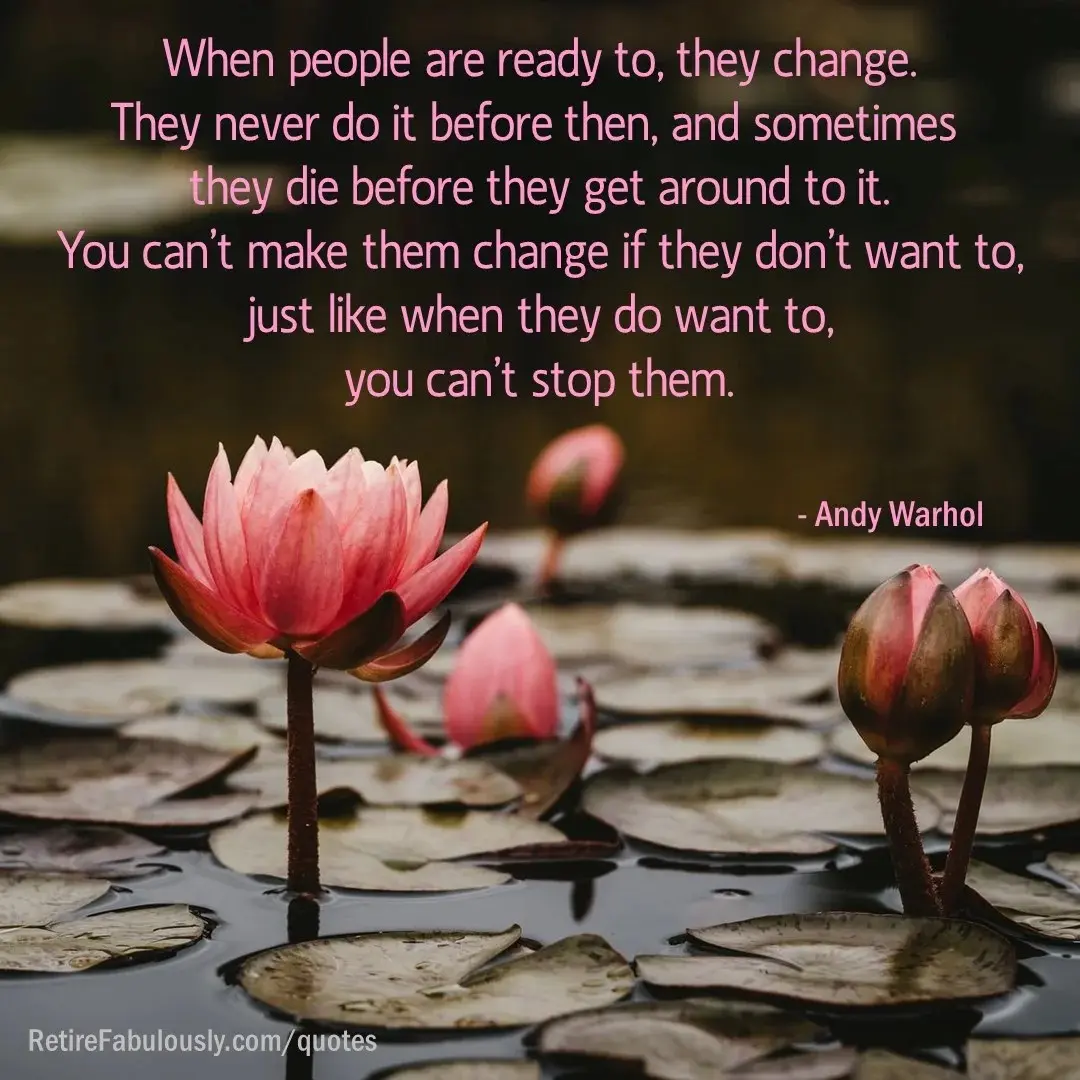
Andy Warhol famously observed:

"When people are ready to, they change. They never do it before then, and sometimes they die before they get around to it. You can’t make them change if they don’t want to, just like when they do want to, you can’t stop them."
This quote captures the core dilemma of retirement planning. Financial readiness is quantifiable—you can calculate a portfolio’s safe withdrawal rate down to the decimal. Psychological and behavioral readiness, however, cannot be automated. It requires a conscious act of will, a willingness to step out of deep-seated comfort zones, and an intentional restructuring of daily life.
Official Perspectives & Expert Insights
Transition experts, lifestyle designers, and retirement authors emphasize that the transition from a career-driven identity to a passion-driven lifestyle is one of the most significant psychological hurdles an individual can face.
Industry thought leaders note that most pre-retirees underestimate the loss of structure and social connection that accompanies leaving a job. Coworkers often form the primary scaffolding of an individual’s social life; without proactive initiative, retirement can rapidly lead to isolation.

Furthermore, lifestyle guides—such as those explored in specialized retirement literature like Smooth Sailing Into Retirement—stress that redefining identity is paramount. Workers are conditioned to introduce themselves by their job titles ("I am an engineer," "I am an accountant," "I am a manager"). Shedding this professional skin requires building a new personal narrative anchored in what you do, what you create, and how you experience the world, rather than what you were paid to produce.
Experts argue that intentionality is the bridge between a daydream and reality. Change does not happen by accident. If an individual wishes to relocate to a new country or city, they must mentally prepare for the friction of rebuilding a support network: finding new service providers, navigating unfamiliar neighborhoods, and forging friendships from scratch. If they wish to cultivate financial prudence after a lifetime of impulse spending, they must actively rewrite their relationship with consumerism.
Future Outlook: Charting a Conscious Path Forward
As global demographics shift and life expectancies extend well into the eighties and nineties, retirement is no longer a brief twilight phase—it can easily span two to three decades. This longevity transforms retirement from a period of passive rest into a potential second chapter of profound personal growth.
However, realizing this potential demands a paradigm shift. Society must stop treating retirement planning as an exclusively financial math problem. Preparing for a fulfilling post-work life requires a proactive, behavioral audit long before the final retirement party.

Actionable Steps for the Aspiring Retiree:
- Audit Your Habits Now: Examine your current daily and weekly routines. If you plan to write a book in retirement, are you writing for 15 minutes a day now? If you plan to downsize, can you donate one bag of unused items this week? Building the muscle of change while still working makes future transitions seamless.
- Embrace Intentional Discomfort: Recognize that any meaningful pursuit—whether learning a musical instrument, mastering a new language, or moving to an unfamiliar region—will temporarily disrupt your comfort zone. Anticipate this friction rather than using it as an excuse to retreat.
- Build a Self-Directed Framework: Replace corporate calendars with personal structures. Establish non-negotiable blocks of time dedicated to creative outlets, physical fitness, and social engagement.
- Redefine Success: Measure the quality of your retirement not by the absence of work, but by the presence of deliberate, self-fulfilling creation and connection.
The definition of insanity is doing the same things and expecting a different result. Expecting a vibrant, active, and fulfilling retirement to spontaneously emerge from a passive, habit-bound lifestyle is a gamble few dreamers win. By confronting our behavioral inertia head-on, committing to intentional transformation, and treating our post-work years as a blank canvas requiring active brushstrokes, we can finally turn our retirement fantasies into an enduring reality.

0 Comments