
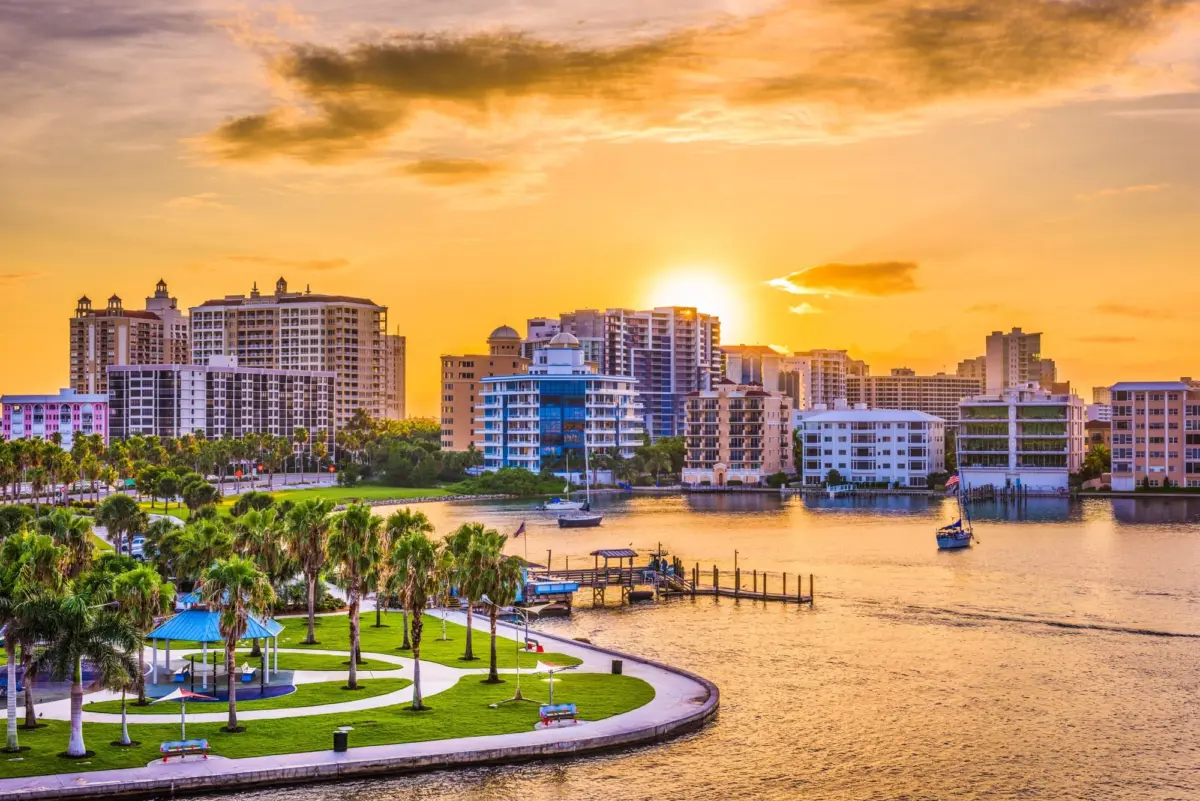

SUNSHINE STATE SPECIAL REPORT — Florida has long held a mythical status in the American imagination as the ultimate promised land for retirees. For decades, the narrative was simple: pack up the belongings, trade the snow shovel for a sunhat, and settle into a quiet coastal condominium or a sprawling, sun-drenched sunbelt subdivision. But the criteria by which retirees choose their golden-year havens have evolved dramatically.
A comprehensive new ranking by Travel + Leisure identifying the "10 Best Places to Retire in the South" has cast a luminous spotlight on this shifting landscape. Most notably, the publication’s elite roster features three distinct Florida communities: Sarasota, Lake Nona, and The Villages.
Far from being a monolithic block of shuffleboard courts and ocean breezes, Florida’s dominant showing on the list illustrates a profound evolution in modern retirement planning. Together, these three communities represent a masterclass in demographic adaptation, offering a glimpse into the diverse, highly specialized lifestyles demanded by today’s retirees—from culture-driven coastal elegance and futuristic wellness-oriented planning to hyper-active, purpose-built community design.
Executive Overview: The Changing Face of Southern Retirement
For generations, the calculus of retirement was straightforward: find a warm climate, secure a low-maintenance home, and stretch a fixed income as far as possible. Today’s retirees, however, approach this life stage with entirely different expectations. They are healthier, more technologically literate, increasingly focused on preventative wellness, and unwilling to compromise on intellectual stimulation or cultural engagement.
Travel + Leisure’s latest compilation acknowledges this generational pivot. While the broader Southern region features an array of historic charm, mountain vistas, and coastal retreats—stretching from the Carolinas to the Tennessee highlands—Florida’s heavy representation signals that the state remains the undisputed epicenter of senior relocation. Yet, the inclusion of Sarasota, Lake Nona, and The Villages proves that Florida is no longer relying solely on weather and tax incentives to draw newcomers.
Instead, the state is competing on the sophisticated nuances of livability. Sarasota caters to the arts aficionado and the beach lover; Lake Nona appeals to the technocrat, the wellness enthusiast, and those who demand cutting-edge medical infrastructure; and The Villages provides an unrivaled blueprint for continuous social engagement and physical activity.
This report examines how these three distinct destinations earned their national accolades, analyzes the underlying economic and demographic metrics driving their success, incorporates expert perspectives, and projects what these trends mean for the future of American communities.
Detailed Chronology: The Evolution of Florida’s Premier Retirement Hubs
To understand how Sarasota, Lake Nona, and The Villages arrived at the pinnacle of Travel + Leisure’s rankings, it is instructive to look at the distinct historical arcs that shaped each destination into a modern retirement powerhouse.
Sarasota: From Circus Winter Quarters to Cultural Epicenter
Sarasota’s journey to becoming a retirement sanctuary spans nearly a century. Long before it was heralded for its Gulf Coast beaches, the city gained international renown as the winter quarters of the Ringling Bros. and Barnum & Bailey Circus in the 1920s. John Ringling infused the area with a deep appreciation for the arts, establishing the foundational architecture and cultural institutions that define the city today.
Through the mid-to-late 20th century, Sarasota evolved as a haven for artists, architects—giving rise to the iconic Sarasota School of Architecture—and affluent retirees seeking a refined coastal lifestyle. Over the past three decades, municipal and private investments transformed downtown Sarasota into a walkable, cosmopolitan urban core framed by world-class theaters, ballet companies, and museums. Simultaneously, the protection of natural treasures like Siesta Key and Lido Key ensured that its ecological beauty remained pristine. Today, Sarasota’s status as an established retirement market is the culmination of decades of intentional urban planning that fused natural coastal assets with high culture.
Lake Nona: The Rise of the Smart Medical City
In stark contrast to Sarasota’s century-long cultural maturation, Lake Nona is a marvel of twenty-first-century master planning. Situated in southeast Orlando, just minutes from the international airport, Lake Nona was largely undeveloped timberland and cattle ranching acreage as recently as the early 2000s.
The turning point arrived with the conception of the Lake Nona Medical City—a massive, multi-billion-dollar health and life sciences cluster anchored by institutions like the University of Central Florida College of Medicine, the Orlando VA Medical Center, and Nemours Children’s Health. Developers envisioned more than just a medical hub; they engineered a futuristic, master-planned smart city centered around wellness, high-speed fiber-optic connectivity, autonomous shuttles, and green building design.
As the community matured, it naturally began attracting not only young professionals and families but also forward-thinking retirees. These are individuals who refuse traditional age-segregated living and instead seek an intellectually stimulating, technology-enabled environment where wellness is woven into the very fabric of daily infrastructure.
The Villages: A Century-Spanning Masterclass in Scale
The roots of The Villages trace back to the 1960s, when founders H. Harold Schwartz and Gary Morse began selling mail-order real estate plots in rural Central Florida. Initially envisioned as a mobile home park called Orange Blossom Gardens, the development underwent a radical reinvention in the 1980s and 1990s as a master-planned community exclusively for adults aged 55 and older.
By pioneering a model centered on golf cart transportation, self-contained town squares, and an astonishingly dense calendar of clubs and recreational activities, The Villages exploded in scale. Over the decades, it expanded across three counties (Lake, Sumter, and Marion), steadily absorbing thousands of new residents each month to become one of the fastest-growing and largest master-planned retirement communities in the world. Its inclusion in national rankings today underscores the enduring appeal of a hyper-structured, amenity-rich environment designed from the ground up to eliminate isolation and foster effortless socialization.
Supporting Context & Metrics: Why These Three Cities Excel
The accolades bestowed by Travel + Leisure are not born of mere aesthetic charm; they are backed by rigorous socio-economic indicators, healthcare access metrics, and demographic realities.
1. Sarasota: Culture, Coastline, and Comprehensive Care
- Healthcare Infrastructure: Sarasota’s healthcare ecosystem is anchored by Sarasota Memorial Health Care System, a massive, award-winning public health system recognized nationally for clinical excellence, specialized cardiology, and oncology care. For aging populations, proximity to top-tier medical facilities is a paramount deciding factor.
- Economic Indicators: The median home value in Sarasota reflects its desirability, skewing higher than the national and state averages. However, the affluent demographic influx has spurred robust commercial growth, high-end dining, and strong property appreciation, making it an attractive market for wealth preservation and lifestyle investment.
- Walkability and Livability: Unlike sprawling suburban developments, Sarasota’s downtown core offers high walkability scores, granting residents easy access to farmers’ markets, art galleries, fine dining, and waterfront parks without relying entirely on automobiles.
2. Lake Nona: Innovation, Infrastructure, and Wellness
- The Medical City Impact: Lake Nona’s density of healthcare innovation provides residents with immediate access to cutting-edge clinical trials, preventative medicine specialists, and state-of-the-art diagnostic facilities—a massive draw for retirees proactively managing their health.
- Technological Integration: As a certified Gigabit community, Lake Nona offers frictionless digital infrastructure. Smart-home integration, telemedicine accessibility, and app-based community engagement tools appeal heavily to tech-savvy "baby boomers" and early-adopting Gen-X retirees.
- Active Design Principles: The community features over 40 miles of trails, parks, community gardens, and the 600,000-square-foot Drive Shack and Lake Nona Performance Club facilities, ensuring that physical wellness is an inescapable, integrated component of everyday life.
3. The Villages: Unmatched Scale, Cost Efficiency, and Social Capital
- The Economics of Scale: Because of its sheer size, The Villages operates with remarkable economic efficiency. The cost of living and property maintenance is often more accessible compared to coastal enclaves like Sarasota, allowing fixed-income retirees to stretch their nest eggs further.
- Social Infrastructure: Loneliness is one of the greatest silent threats to aging populations. The Villages combats this with over 3,000 active clubs—ranging from woodworking and pickleball to foreign language study and ballroom dancing—virtually guaranteeing an instant, robust social network for newcomers.
- Internal Mobility: The community boasts a sprawling network of dedicated golf cart paths spanning over 100 miles, allowing residents to navigate to grocery stores, medical offices, town squares, and golf courses safely and independently, even as driving conventional automobiles becomes less appealing in advanced age.
Official Statements and Industry Perspectives
Urban planners, demographic researchers, and real estate economists have weighed heavily on what the prominence of these three Florida locales signifies for the future of American housing.
Dr. Elena Vance, a senior urban sociologist specializing in aging populations at the University of Florida, notes that the diversification of Florida’s retirement offerings marks a mature market response to changing generational values.
"For decades, retirement communities were treated as homogeneous holding pens designed around a single metric: warm weather," Dr. Vance explains. "What we are seeing today, as highlighted by communities like Sarasota, Lake Nona, and The Villages, is a profound bifurcation in what retirees want. Some demand intellectual enrichment and high culture in a walkable coastal setting; others want cutting-edge medical technology and intergenerational smart-city connectivity; while many still crave the hyper-social, self-contained village model. Florida’s genius has been its ability to successfully incubate all three models at a world-class level."
Real estate market analyst Marcus Sterling points to the economic resilience of these regions, noting that their appeal transcends cyclical market downturns.
"When you look at Sarasota, Lake Nona, and The Villages, you aren’t just looking at places where people buy homes; you are looking at deeply entrenched lifestyle brands," Sterling says. "Retirees today are shifting capital out of high-tax, high-cost northern states not merely to escape the snow, but to buy into ecosystems that actively enhance their health, extend their independence, and preserve their wealth through strong property value appreciation. These three markets have cracked the code on modern longevity."
Healthcare executives within the Lake Nona Medical City echo these sentiments, emphasizing that healthcare is no longer just a reactive service—it is the foundational anchor of community design.
"The modern retiree does not want to live in the shadow of a hospital; they want to live inside a community where health, nutrition, fitness, and medical innovation are seamlessly interwoven into the streetscape," noted a senior administrator at the Lake Nona Institute during a recent regional urban planning symposium. "Lake Nona was built precisely on the thesis that if you design a community for wellness from day one, people will live longer, healthier, and more engaged lives."
Future Outlook: The Next Horizon of Retirement Living
As America’s demographic wave—commonly known as the aging of the Baby Boomer generation—reaches its peak over the next decade, the lessons learned from Sarasota, Lake Nona, and The Villages will reverberate far beyond Florida’s borders.
Municipalities across the United States are closely studying these three models to understand how to attract and retain affluent, active, and demanding retirees. Several key trends are poised to shape the future of retirement living in the years ahead:
1. The Blurring of Age-Segregated and Intergenerational Living
While traditional enclaves like The Villages will retain immense popularity among those seeking age-peer socialization, communities like Lake Nona point toward an intergenerational future. Modern retirees increasingly reject the notion of being siloed away from younger generations. The integration of K-12 schools, university campuses, and young professional housing alongside active-adult neighborhoods creates a vibrant, multi-generational energy that keeps communities dynamic.
2. Wellness as Infrastructure
The post-pandemic era has permanently elevated health consciousness among older adults. Future retirement developments will be forced to move beyond the token community pool or basic fitness center. Proximity to advanced biotech hubs, telehealth integration, circadian lighting in residential architecture, and nutritional urban planning will transition from luxury amenities to baseline expectations.
3. Climate Resilience and Sustainable Infrastructure
As coastal markets like Sarasota continue to draw high volumes of residents, long-term sustainability and climate resilience will dictate property values and insurability. Developers are investing heavily in elevated construction, sophisticated stormwater management systems, renewable energy grids, and hurricane-hardened infrastructure to ensure that these retirement paradises remain secure for decades to come.
4. Smart Mobility and Autonomous Transit
The golf cart culture pioneered by The Villages and the autonomous shuttle trials in Lake Nona foreshadow a massive shift in senior mobility. As autonomous vehicle technology matures, retirement communities will rely less on traditional automobile infrastructure, designing pedestrian-first, highly accessible environments that prolong personal autonomy and reduce isolation for non-drivers.
Conclusion
The inclusion of Sarasota, Lake Nona, and The Villages in Travel + Leisure’s elite ranking of Southern retirement destinations is much more than a routine travel accolade. It is a powerful validation of Florida’s unmatched capacity to reinvent the American dream of aging in place.
Whether an individual seeks the high-minded coastal elegance of Sarasota’s museums and Gulf breezes, the high-tech, wellness-centric innovation of Lake Nona’s Medical City, or the boundless, built-in social connectivity of The Villages’ sprawling recreational empire, the message is clear: retirement is no longer a retreat from life. It is an invitation to begin an entirely new, highly customized chapter.
As other states and municipalities look to capture the attention—and economic capital—of the nation’s retiring generations, they will find a high bar set by these three Florida exemplars. For now, the Sunshine State firmly retains its crown, proving that when it comes to the art of the good life in the American South, diversity of lifestyle is the ultimate luxury.

0 Comments