

Executive Overview
For decades, the cultural narrative surrounding retirement has been framed as an extended, sun-drenched vacation—a utopian horizon where the relentless demands of the modern workplace vanish, replaced entirely by stress-free days of self-fulfillment, leisure, and bucket-list adventures. From mastering the acoustic guitar to penning a debut novel, touring historic European capitals, or relocating to a coastal sanctuary, future retirees maintain elaborate visions of how they will spend their hard-earned freedom.
Yet, beneath the glossy brochures and hopeful daydreams lies a stark, uncomfortable reality: the vast majority of these ambitious post-career plans never materialize.
According to behavioral analyses and lifestyle data, retirement does not inherently transform a person into a proactive explorer, a disciplined creator, or a dedicated philanthropist. Instead, when the structural scaffolding of a decades-long career is removed, human beings default to their most deeply ingrained habits. Without intentional behavioral restructuring, the void left by employment is rarely filled with bold, transformative pursuits. Rather, it is quietly occupied by amplified versions of pre-existing routines—most notably, an increase in sedentary screen time.

Achieving an ideal retirement requires much more than a robust financial portfolio; it demands a willingness to dismantle lifelong habits, step far outside the psychological comfort zone, and embrace profound personal transformation.
Detailed Chronology: The Evolution of Retirement Intentions Versus Reality
To understand why so many well-laid retirement plans falter, one must examine the psychological timeline of the transition from the workforce to leisure. This trajectory typically unfolds across three distinct phases, each fraught with behavioral hurdles.
Phase 1: The Incubation of Aspiration (Decades Before Retirement)
Throughout active working years, individuals utilize the concept of retirement as a psychological defense mechanism against workplace burnout. During late-night planning sessions or quiet weekends, the "bucket list" is born. People convince themselves that once they are freed from corporate hierarchies, project deadlines, and alarm clocks, their latent creativity and adventurous spirit will naturally surge to the surface.

However, psychological research shows that human beings are creatures of comfort and habit. The behaviors practiced for forty years—such as reacting to emails, consuming media after dinner, and deferring difficult organizational or creative tasks—become neurological pathways. When individuals promise themselves that "someday" they will radically change their lifestyle, they underestimate the sheer inertia of decades-old routines.
Phase 2: The Collision with Reality (The First Five Years Post-Retirement)
Upon crossing the threshold into retirement, the initial honeymoon phase is often characterized by a profound sense of relief. The alarm clock is silenced; the daily commute is eliminated. Yet, as the weeks turn into months, an unsettling vacuum emerges.
Without the external discipline of a job title, project milestones, and meetings, many retirees discover they lack the self-directed framework required to execute their grand designs. For instance, an individual who spent seven years declaring an intention to downsize a cluttered home—filled with decades of accumulated books, tools, and keepsakes—frequently finds the house precisely as it was. The lack of immediate, forced urgency (such as an impending relocation) allows procrastination to reign.

Similarly, aspiring writers or artists who dreamed of dedicating hours daily to creative endeavors find themselves paralyzed by a lack of daily structure. Having spent a career governed by external demands, they struggle to generate internal discipline, ultimately watching their creative ambitions sidelined by minor chores and digital distractions.
Phase 3: The Default Loop (Long-Term Retirement)
By the time retirees settle into the intermediate and later stages of post-work life, the initial momentum toward reinvention has typically faded. Rather than launching into a "Renaissance" of learning, traveling, and creation, the lifestyle crystallizes into a predictable pattern. As empirical data reveals, habits left unexamined do not transform; they expand. The retirement lifestyle often morphs into a quiet loop of domestic maintenance, passive entertainment, and social contraction.
Supporting Context & Metrics: What the Data Reveals About Post-Work Habits
While popular imagination paints retirees as globetrotting adventurers or hyper-productive artisans, empirical data from authoritative sources tells a vastly different story.

The Bureau of Labor Statistics Time-Use Insights
Data compiled by the Bureau of Labor Statistics (BLS) regarding how older adults allocate their time provides a sobering look at post-employment behavior. When work is removed from the daily equation, the hours are rarely commandeered by rigorous physical activities, extensive volunteering, or intensive artistic endeavors.
Instead, BLS charts indicate that pre-existing daily activities simply scale upward to fill the newly available hours. The most dramatic and statistically significant expansion occurs in television viewing and passive media consumption.
- The Leisure Mirage: While statistical categories for "Leisure and Sports" naturally spike following retirement, a deeper inspection of the subcategories reveals that more than half of that allocated time is claimed directly by the television screen.
- Physical Activity Deficits: Actual, intentional physical exercise or rigorous outdoor recreation comprises a minute fraction—roughly 5%—of total reported leisure time among retirees.
- Stagnation of High-Engagement Pursuits: Statistically, there is no evidence to suggest that a major cohort of retirees spontaneously adopts complex, high-engagement pursuits like mastering a new language, intensive photography, or craft-making in statistically significant numbers.
The Psychology of Clutter and Accumulated Inertia
Behavioral economists and lifestyle experts point out that material accumulation serves as a physical manifestation of psychological habits. Throughout adult life, individuals accumulate possessions not merely out of utility, but out of a habituated fear of scarcity ("I might need this screw later") or emotional attachment to the past.

Downsizing a home requires confronting these psychological anchors. Without a deliberate, systematic commitment to changing one’s relationship with material goods, the physical clutter of a working life follows individuals straight into retirement, eating up domestic space and demanding ongoing maintenance energy that could otherwise be directed toward new experiences.
Official Insights & Philosophical Perspectives
Achieving a vibrant retirement has less to do with financial readiness—though capital is certainly necessary—and everything to do with psychological readiness. Experts across psychology and philosophy have long understood the immovable nature of human habit without conscious intervention.
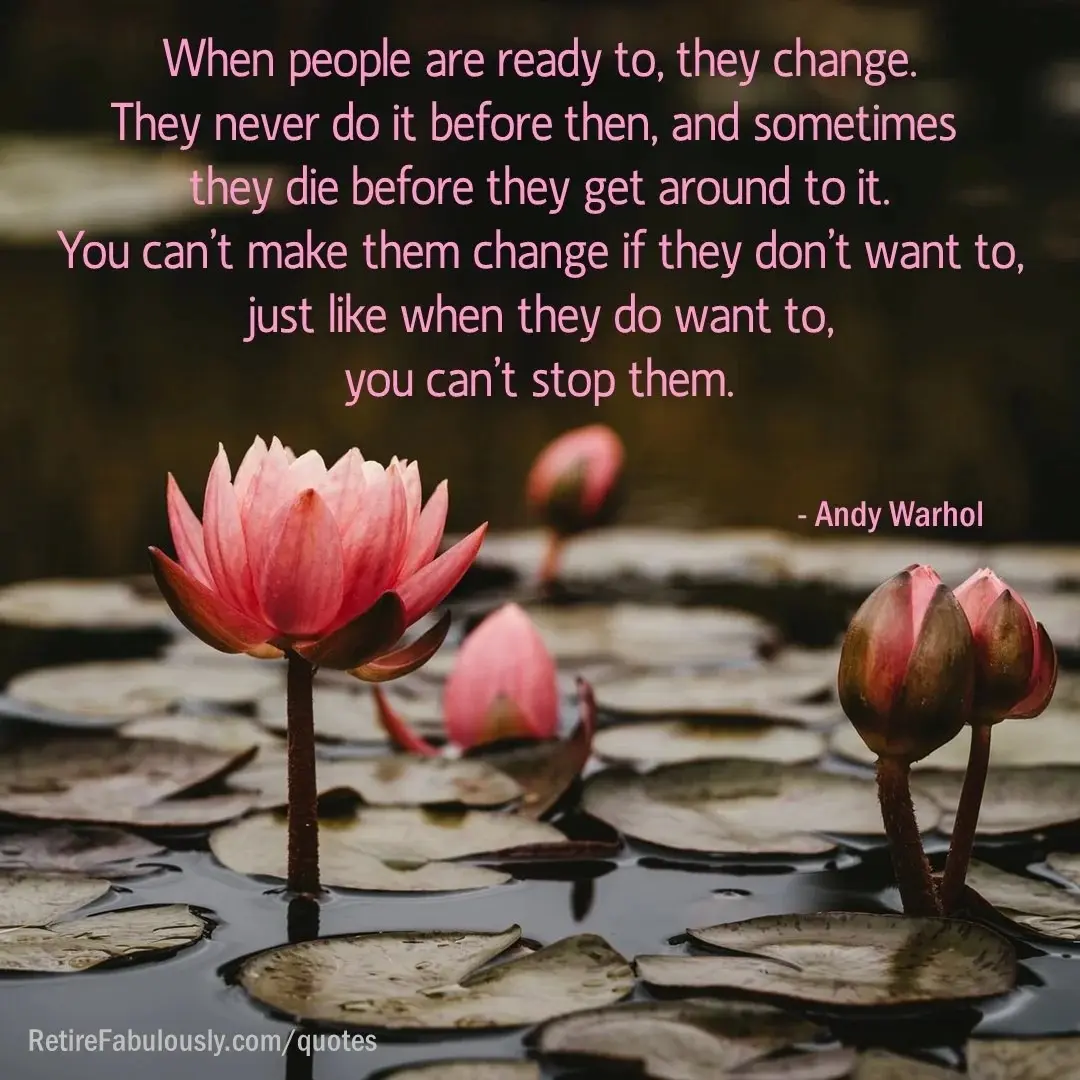
Reflecting on the nature of human transformation, the legendary artist and cultural icon Andy Warhol famously observed:

"When people are ready to, they change. They never do it before then, and sometimes they die before they get around to it. You can’t make them change if they don’t want to, just like when they do want to, you can’t stop them."
This sentiment strikes at the heart of the retirement conundrum. Society often treats retirement as a magical chronological milestone that forces change upon an individual automatically. In truth, chronology changes nothing. A person who spent their working life avoiding difficult emotional tasks, resisting creative risks, or shying away from social expansion will not suddenly become a fearless adventurer on the Tuesday after their retirement party.
Retirement lifestyle planners and authors who specialize in the psychological transition—such as veteran commentators and authors focusing on post-work identity—emphasize that individuals must actively shed their former job titles to build a new identity. If a person’s self-worth and daily structure are entirely derived from their corporate identity, retirement can trigger an identity crisis rather than a liberation.

True retirement design requires what behavioral psychologists call intentional disruption: actively rewriting daily priorities, establishing rigid self-directed schedules for creative or physical pursuits, and deliberately burning the bridges of passive comfort.
Future Outlook: Reimagining the Blueprint for the Golden Years
As demographic shifts bring aging populations into the retirement phase in unprecedented numbers, the cultural conversation must pivot away from financial accumulation alone toward behavioral preparation.
To avoid falling into the statistical trap of the sedentary, television-dominated retirement loop, prospective and current retirees must adopt a proactive blueprint for change:

- Audit Your Habits Now: Do not wait until your final day at work to decide how you will structure your time. Begin practicing self-directed time management years in advance by carving out 30 to 60 minutes daily for creative, physical, or intellectual pursuits.
- Embrace Radical Downsizing as Psychological Liberation: Treat the clearing of closets, garages, and attics not as a burdensome chore, but as a symbolic clearing of mental bandwidth. Shedding physical excess creates the literal and figurative room required for new experiences.
- Redefine Social Networks: Many workers rely entirely on office environments for social interaction. Preparing for retirement means intentionally building community connections, joining clubs, or taking classes well before leaving the workforce to prevent isolation.
- Accept the Discomfort of the Unknown: Whether moving to a foreign country, learning a complex instrument, or writing fiction, the path to an ideal retirement demands stepping out of the comfort zone. Growth cannot occur within the safe confines of lifelong habits.
Ultimately, the ideal retirement is not something that happens to you; it is something you construct through deliberate, often uncomfortable acts of will. By recognizing that habits will default to comfort unless actively challenged, individuals can break free of the retirement paradox and finally turn their lifelong bucket lists into lived reality.

0 Comments