

Executive Overview
For decades, the standard cultural narrative surrounding retirement has painted a picture of absolute liberation. We are told to envision a golden horizon populated by stress-free mornings, unhurried travel itineraries, and an abundance of time dedicated to self-fulfilling pursuits that were perpetually sidelined during our working years. From learning a new language and mastering oil painting to completing a sprawling bucket list of global adventures, the modern retiree’s mental blueprint is remarkably ambitious.
Yet, beneath the glossy veneer of these idealized scenarios lies a sobering reality: a vast chasm separates the retirement we dream of from the retirement we actually live.
As behavioral psychologists and retirement planning experts increasingly note, transitioning from a structured career to a fulfilling, self-directed lifestyle is not merely a matter of stopping work—it is an exercise in profound personal reinvention. Achieving an ideal retirement demands a deliberate disruption of lifelong habits, the courage to step outside established comfort zones, and a rigorous commitment to behavioral change. Without this intentional pivot, retirees frequently find that rather than stepping into an exhilarating renaissance, they simply slide into an expanded version of their past routines, dominated overwhelmingly by the glow of the television screen.
Detailed Chronology & Personal Reflections: The Anatomy of Inaction
To understand why retirement aspirations so often stall, one must examine the friction between long-term intentions and daily behavioral patterns. This phenomenon is vividly illustrated through personal accounts from those who have crossed the threshold of retirement, observing firsthand how difficult it is to alter the trajectory of a lifetime.

Consider the universal ambition of downsizing. For many adults, decades of accumulation leave behind homes bursting with physical artifacts: books, electronics, legacy cookware, tools, and keepsakes saved for hypothetical future needs. Years before stepping away from the corporate grind, individuals often make solemn pacts with themselves: Once I retire, I will clear out the attic, the closets, and the garage.
Yet, tracking this goal over a multi-year timeline frequently reveals a stark lack of progress. Seven years into retirement, many individuals look around their homes to find the same clutter occupying the same spaces. The barrier to progress is rarely a lack of desire; rather, it is the absence of daily habits aligned with the goal. Having spent an entire adult life accumulating and retaining items rather than discarding them, the retiree runs up against ingrained psychological friction. Without the immediate external pressure of an impending move, the status quo comfortably wins out.
A similar narrative plays out in creative pursuits. Many aspiring retirees harbor latent ambitions—such as writing fiction, composing music, or mastering photography. They may carry five distinct novel outlines in their heads, fueled by the romantic notion that retirement will finally provide the uninterrupted space required to bring these stories to life. However, advice from seasoned authors universally stresses a non-negotiable rule: writing requires daily discipline, a non-debatable allocation of fifteen minutes to two hours every single day, prioritized above chores, emails, and social media.
For individuals emerging from decades-long corporate careers, however, daily life has historically been governed entirely by external forces: project deadlines, incoming emails, and a rigid meeting calendar. Coming home from work meant reacting to immediate demands rather than charting an autonomous, self-directed course. Consequently, when the external scaffolding of the corporate workplace is removed, the newly minted retiree often lacks the self-directed discipline required to protect and execute creative time. The intention remains, but the behavioral muscle required to sustain it has never been developed.

Supporting Context & Metrics: What the Data Tells Us About Retirement Leisure
While personal anecdotes highlight the psychological hurdles of retirement, comprehensive labor data confirms that these struggles are systemic rather than isolated. Government research provides a sobering mathematical look at how humans actually allocate their time once freed from the obligations of employment.
Data collected by the Bureau of Labor Statistics (BLS) through its ongoing American Time Use Survey offers a revealing window into the older demographic. When examining the transition from employment to retirement, statistical trends challenge the popular perception of retirees embarking on whirlwind adventures, mastering complex arts, or engaging in rigorous community service.
[Employed vs. Non-Employed Daily Leisure Allocation (BLS Trends)]
-------------------------------------------------------------------------
Employment Status     | Average Daily Leisure & Sports Time
-------------------------------------------------------------------------
Employed              | Moderate baseline (heavily weighted to weekends)
Not Employed          | Significant expansion across the board
-------------------------------------------------------------------------
Primary Driver of Expansion: Television viewing and passive media consumption.
The BLS data demonstrates that when work is removed from an individual’s daily ledger, the activities already present simply swell to fill the newly emptied hours. The most dramatic statistical spike occurs in passive media consumption, specifically television viewing.
When looking broadly at the BLS category labeled "Leisure and Sports," an optimistic observer might celebrate the sharp increase in hours dedicated to this column post-retirement. However, a deeper drill-down into the data reveals a startling caveat: over half of that newly acquired leisure time is consumed directly by watching television. In contrast, active physical pursuits, travel, volunteering, and artistic endeavors account for a negligible fraction of the overall daily average—often hovering around roughly 5% of total leisure time.

Statistical models tracking older populations reveal no widespread, data-backed evidence indicating that a significant percentage of retirees pivot into dynamic, demanding new hobbies on a mass scale. Instead, the inertia of previous habits reasserts itself. If an individual did not read books, exercise regularly, or travel extensively while working, the mere cessation of employment rarely acts as a magical catalyst to initiate these behaviors.
As the famous adage often attributed to various thinkers notes: The definition of insanity is doing the same thing over and over again and expecting different results. Expecting a vibrant, radically transformed retirement lifestyle while maintaining the exact same daily routines, coping mechanisms, and comfort-zone boundaries is a statistical impossibility.
Behavioral Psychology and Expert Insights: The Catalyst for True Transformation
If structural freedom alone is insufficient to spark a vibrant retirement, what actually drives change? Behavioral experts emphasize that transformation is rarely passive; it requires deliberate, conscious intent.
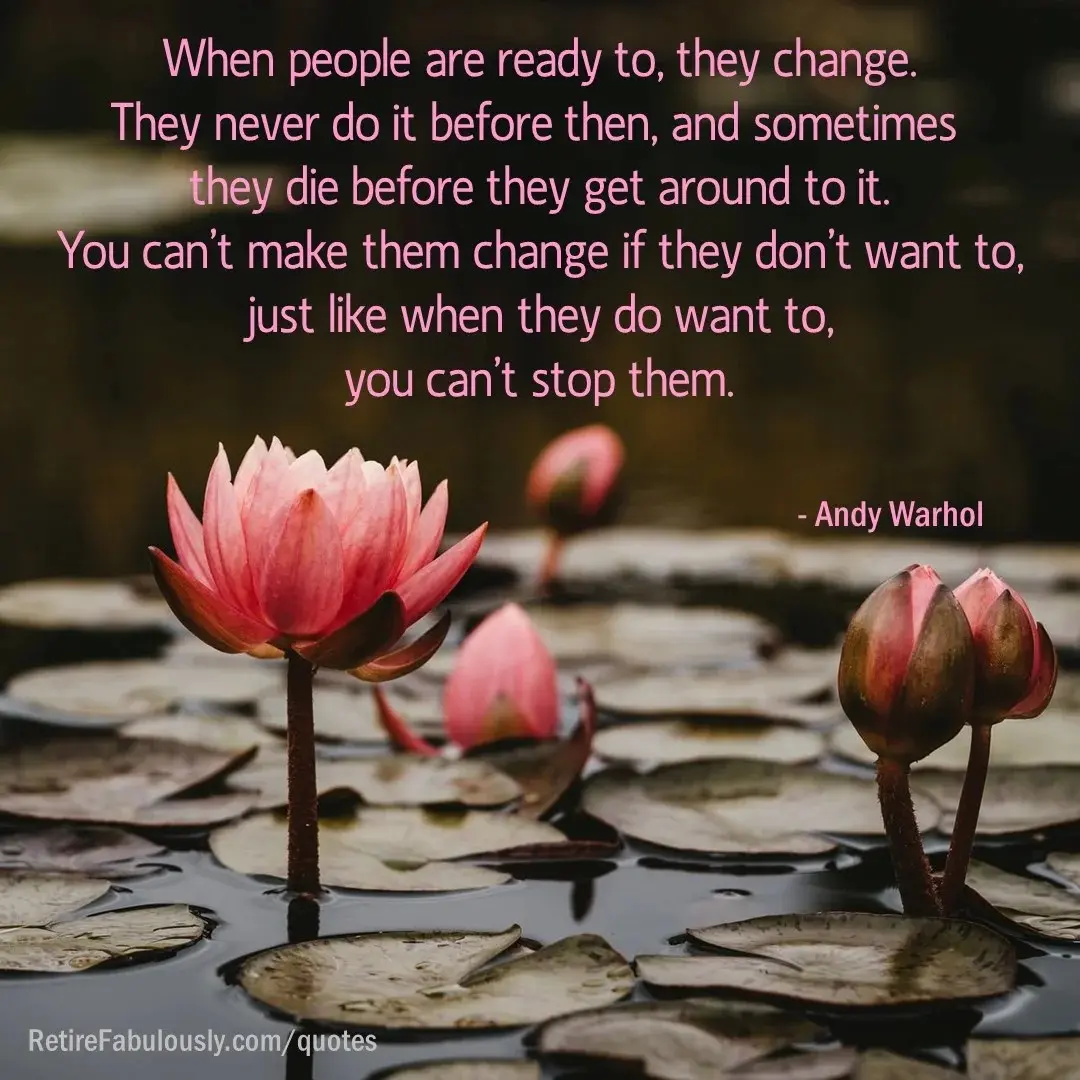
Reflecting on human psychology, the renowned artist and cultural icon Andy Warhol famously observed:

"When people are ready to, they change. They never do it before then, and sometimes they die before they get around to it. You can’t make them change if they don’t want to, just like when they do want to, you can’t stop them."
This quote cuts to the core of the retirement paradox. Individuals frequently declare that they want a different lifestyle, but true readiness requires moving past wishful thinking into deep psychological commitment.
Retirement experts, such as veteran author and lifestyle planner Dave Hughes, note in works like Smooth Sailing Into Retirement that the emotional hurdles of leaving the workforce are chronically underestimated. The book guides individuals from their final months of employment through their inaugural year of retirement, mapping out the tectonic shifts in identity that occur when a person is suddenly stripped of their former job title.
Key psychological dimensions that demand proactive management include:

- Identity Reconstruction: Moving away from defining oneself by corporate status or professional achievements and actively building a personal identity anchored in personal passions and internal values.
- Social Restructuring: Recognizing that a significant portion of pre-retirement socialization stems automatically from co-workers. Retirees must intentionally cultivate new social circles through community involvement, clubs, and shared-interest groups rather than waiting for socialization to happen organically.
- Financial and Lifestyle Prudence: Shifting from consumption-driven habits—such as frequent dining out or impulse buying—toward mindful, value-based spending that supports sustainable long-term freedom.
- Geographic and Environmental Adaptation: For those dreaming of relocating, recognizing that moving to a new region requires rebuilding an entire support ecosystem from scratch, including finding new healthcare providers, favorite local vendors, and a completely unfamiliar community fabric.
Without addressing these psychological pillars directly, retirees frequently experience a sense of aimlessness. The loss of structured routine, combined with an unwillingness to tolerate the temporary discomfort of learning new behaviors, breeds a quiet stagnation.
Future Outlook: Designing Your Intentional Retirement
As societal longevity increases and the concept of retirement continues to evolve, the approach to post-work life must mature accordingly. The future belongs not to those who simply clock out for the final time, but to those who view retirement as an active, design-driven phase of human development.
To bridge the gap between imagination and reality, prospective and current retirees must engage in a rigorous self-audit. This forward-looking roadmap requires addressing several critical questions:
- What specific daily habits must be dismantled? Identify the routines—such as passive evening scrolling, chronic accumulation, or reactive task-management—that currently block creative or physical ambitions.
- What actionable routines must be built? Rather than setting vague goals like "I want to write a book" or "I want to learn art," establish micro-commitments. Carve out non-negotiable 15-to-30-minute daily blocks dedicated entirely to the target pursuit.
- How will social and environmental comfort zones be challenged? Actively plan how to meet new people, explore unfamiliar geographic locations, and embrace the constructive vulnerability of being a beginner in a new discipline.
Ultimately, an ideal retirement is not something that happens to you when you stop working; it is something you construct, brick by deliberate brick, through intentional daily choices. By acknowledging the power of lifelong habits and consciously choosing to disrupt them, retirees can finally transform their ambitious bucket lists from static fantasies into living, breathing realities.

The choice is stark, immediate, and entirely personal: By changing nothing, nothing changes. What will you commit to changing today?

0 Comments