

Executive Overview
When Americans are taught the foundational narrative of their nation’s European settlement, textbooks traditionally direct their gaze north. The canonical memory of early American history is inextricably bound to the windswept shores of Virginia in 1607, where the ill-fated yet resilient colony of Jamestown took root, or to the frost-bitten rocks of Massachusetts in 1620, where the Pilgrims aboard the Mayflower established Plymouth Colony. Yet, long before English colonists ever braved the perilous Atlantic crossing in search of economic opportunity or religious freedom, Spanish explorers, soldiers, and missionaries had already carved a permanent toehold into the northeastern coast of the Florida peninsula.
St. Augustine, Florida—founded on September 8, 1565, by Spanish admiral and conquistador Don Pedro Menéndez de Avilés—holds the undisputed title of the oldest continuously occupied European-established settlement in the United States. Predating Jamestown by 42 years and Plymouth Rock by more than half a century, this historic municipality stands as a testament to an alternative colonial lineage, one forged not by the British Crown, but by the sweeping imperial ambitions of the Spanish Empire.
Today, St. Augustine is far more than a footnote in antiquated historical ledgers. Welcoming approximately two million visitors annually, the city represents a living, breathing museum where cobblestone pathways, centuries-old coquina fortresses, and Spanish colonial architecture intersect with a vibrant modern economy. This investigative and historical review explores the tumultuous founding, deep-seated heritage, architectural marvels, and modern-day stewardship of America’s oldest city, examining how a strategic military outpost evolved into an enduring cultural anchor of the American Southeast.
Detailed Chronology: From First Sighting to Permanent Stronghold
To understand the magnitude of St. Augustine’s historical footprint, one must trace the timeline of Spanish exploration across the Caribbean and North American mainland during the 16th century. The Spanish Crown viewed the vast, untamed territories of La Florida—a geographic designation that once encompassed much of the modern American Southeast—not merely as a land of opportunity, but as a critical geopolitical bulwark against rival European powers, specifically France and England.
The Ponce de León Expeditions (1513)
The saga of European presence in Florida officially began on April 2, 1513, when Spanish conquistador Juan Ponce de León sighted the verdant coast of the peninsula. Believing it to be a massive island, he named the region La Florida in honor of Pascua Florida (Flowering Easter), the Spanish Easter season during which the landfall occurred.
Ponce de León is historically celebrated for his exploratory voyages along the Atlantic and Gulf coasts, encompassing the waters between present-day St. Augustine and Melbourne Beach. Although his initial ventures were primarily focused on discovery, claiming territory, and searching for mythical treasures and freshwater springs, they laid the bureaucratic and cartographic groundwork for future colonization attempts.
Half a Century of Failed Attempts (1513–1565)
Despite initial optimism, establishing a permanent Spanish footprint in Florida proved to be a formidable, often tragic endeavor. Over the span of five decades, Spanish explorers launched at least a half-dozen major colonization and missionary expeditions into the region.
Time and again, these nascent settlements crumbled under the weight of hostile indigenous resistance, rampaging tropical hurricanes, rampant disease, starvation, and internal mutiny. The failure of these early ventures led many within the Spanish court to question the viability of colonizing La Florida. However, the geopolitical stakes shifted dramatically in the early 1560s when French Huguenots—Protestants fleeing religious persecution in Catholic France—began encroaching upon territory claimed by Madrid.
The Arrival of Don Pedro Menéndez de Avilés (1565)
Alarmed by the establishment of Fort Caroline by French explorer Jean Ribault near modern-day Jacksonville, King Philip II of Spain dispatched Don Pedro Menéndez de Avilés with a clear and urgent mandate: eradicate the French interlopers and secure the territory for the Spanish Crown.
Menéndez de Avilés arrived off the coast of Florida in late August 1565. On September 8, 1565, he formally stepped ashore, kneeling to kiss a crucifix while a Catholic mass was celebrated in thanksgiving. He named the newly founded stronghold St. Augustine (San Agustín), in honor of the saint upon whose feast day the fleet had first sighted the land.
Menéndez quickly moved against the French, ultimately defeating Fort Caroline and routing Ribault’s forces at Matanzas Inlet—a Spanish phrase translating chillingly to "slaughters." With the French threat neutralized, Menéndez transformed St. Augustine from a temporary military camp into a heavily fortified administrative and religious center, ensuring its survival against all historical odds.
Supporting Context & Metrics: Architecture, Demographics, and Economy
The survival of St. Augustine through centuries of colonial wars, pirate raids, epidemics, and changing national flags is physically etched into its urban landscape. The city’s historic district functions as an open-air archive of early American architecture and civil engineering.
Architectural Preservation and Historic Landmarks
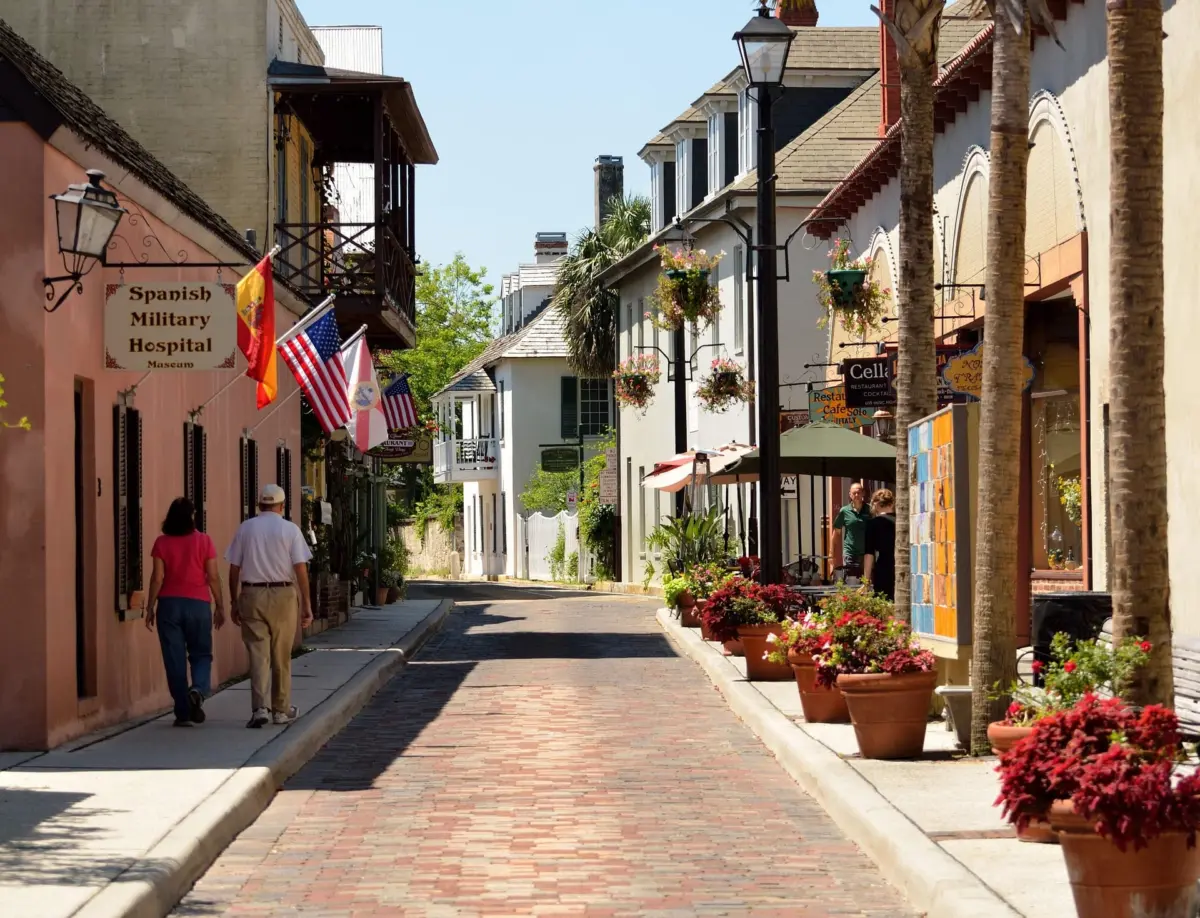
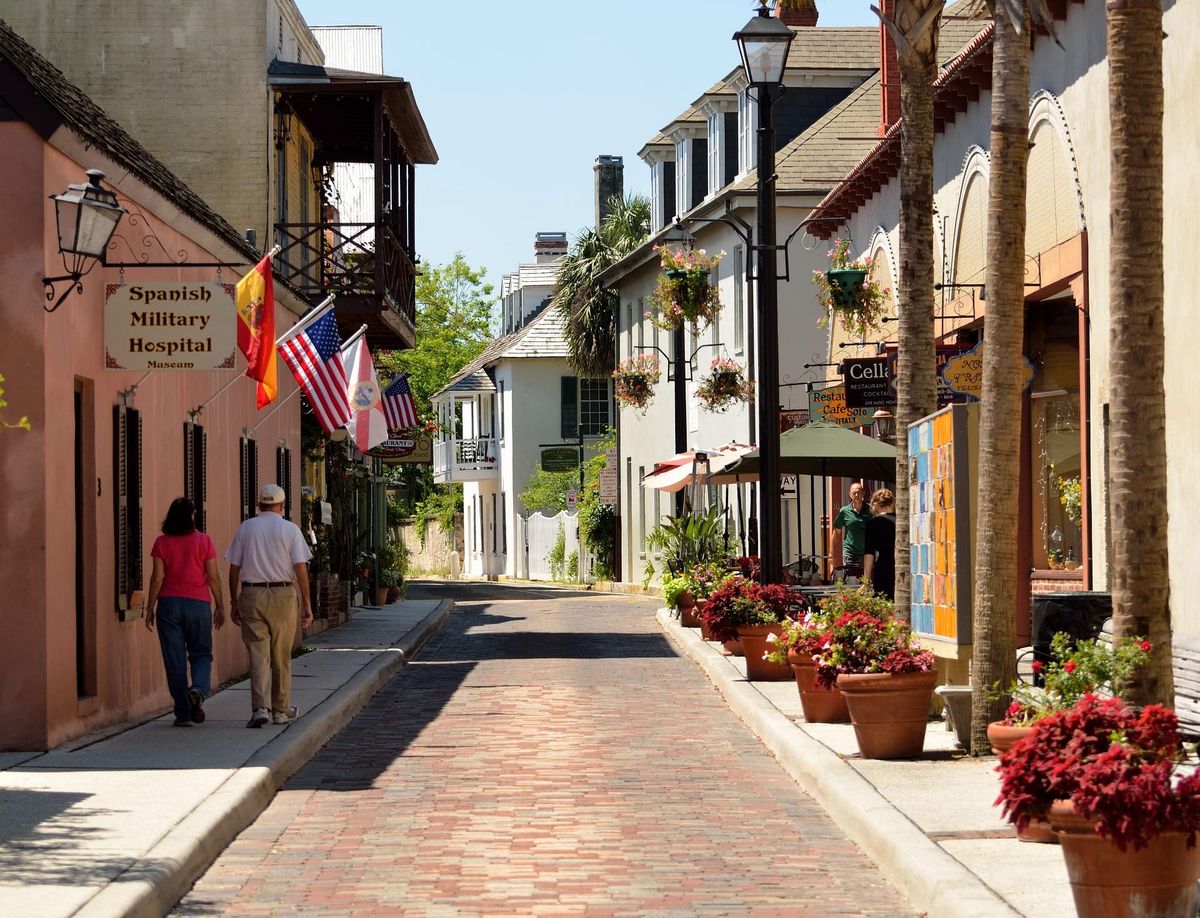
At the heart of St. Augustine’s physical legacy is Aviles Street, widely recognized as the oldest continuously documented public street in the United States. Flanked by overhanging balconies, lush tropical courtyards, and centuries-old structures constructed from native coquina—a unique sedimentary rock formed from compressed millions of tiny mollusk shells—Aviles Street encapsulates the aesthetic of the Spanish colonial era.
Towering over the Matanzas Bay is the Castillo de San Marcos, the oldest masonry fort in the continental United States. Constructed between 1672 and 1695 under the direction of the Spanish Crown, the fortress was designed to protect St. Augustine from British attacks, most notably during the sieges led by South Carolina Governor James Moore in 1702 and Georgia founder James Oglethorpe in 1740. Constructed entirely of coquina blocks, the fort’s walls possessed a remarkable engineering property: rather than shattering under cannon fire, the porous shell-stone absorbed the impact of enemy projectiles, rendering the fortress virtually indestructible during major sieges.
Economic Impact and Tourism Metrics
Today, St. Augustine’s deep historical lineage serves as the cornerstone of its modern economy. Tourism statistics compiled by local and state hospitality authorities indicate that the city draws approximately two million visitors annually.
- Economic Engine: Heritage tourism accounts for a substantial share of St. Johns County’s employment and tax revenue, supporting hundreds of locally owned bed-and-breakfasts, boutique hotels, restaurants, and guided tour operators.
- Demographic Growth: While historic preservation remains a fiercely guarded priority, St. Augustine and the surrounding St. Johns County have experienced explosive residential growth. Driven by retirees, remote professionals, and families seeking historic charm combined with coastal proximity, the region routinely ranks among the fastest-growing counties in Florida.
- Cultural Festivals: Annual events, such as the Grand Fiesta de Menorca, Spanish Night Watch, and the massive Nights of Lights display—which transforms the historic district with millions of glittering white lights—draw regional and national crowds, sustaining year-round economic vitality.
Official Statements and Heritage Stewardship
The preservation of America’s oldest city is a delicate, ongoing collaboration between federal agencies, municipal leaders, and historic preservation societies. Ensuring that 16th-century structures survive 21st-century environmental pressures requires rigorous administrative oversight and committed public advocacy.
Federal and Local Leadership Perspectives
Representatives from the National Park Service (NPS), which administers the Castillo de San Marcos National Monument and Fort Matanzas, emphasize the national significance of St. Augustine’s built environment.
"St. Augustine is not merely a local treasure or a Florida landmark; it is a foundational pillar of American history," notes park administration literature. "The stories told within these coquina walls span indigenous histories, Spanish colonial rule, British occupation, and the crucible of the American experience. Preserving these sites is an urgent national imperative."
Local municipal leaders in St. Augustine echo this sentiment, balancing the demands of a booming modern tourist economy with strict historic zoning ordinances. The St. Augustine Historic Architectural Review Commission (HARC) enforces rigorous guidelines governing exterior alterations, signage, and new construction within the historic district, ensuring that the 400-year-old streetscape remains untainted by discordant commercial developments.
Addressing Environmental and Climate Challenges
In recent years, city officials and historic preservationists have faced an increasingly formidable adversary: rising sea levels, severe coastal storms, and accelerated tidal flooding. Because St. Augustine sits at a low elevation along the Atlantic intracoastal waterway, historic properties face growing threats from climate-driven inundation.
In response, municipal authorities have partnered with state and federal agencies to draft comprehensive resilience strategies. These initiatives include raising sea walls, installing enhanced stormwater management systems, and utilizing cutting-edge 3D laser scanning to digitally archive historical structures before extreme weather events can compromise their structural integrity.
Future Outlook: Protecting the Past while Navigating Modernity
As St. Augustine looks toward its future, it faces the complex challenge familiar to many heritage-rich destinations worldwide: how to honor and protect historical integrity while accommodating modern growth, infrastructure demands, and environmental vulnerabilities.
Sustainable Tourism and Cultural Education
Moving forward, city planners are shifting emphasis toward sustainable tourism models. Rather than merely maximizing visitor volume, municipal strategies increasingly prioritize heritage education, encouraging tourists to venture beyond the bustling commercial corridors of St. George Street to explore lesser-known historical narratives—including the deep contributions of African, Menaman, and Indigenous populations who helped build and sustain the community across the centuries.
Infrastructure Modernization and Climate Resilience
The coming decades will test St. Augustine’s ability to adapt to a changing climate. Millions of dollars in capital improvement projects are currently slated for low-lying historic zones, focusing on subterranean drainage improvements and intelligent pumping stations designed to mitigate king tides and coastal storm surges. Maintaining the architectural authenticity of colonial-era roadways while embedding modern flood-mitigation infrastructure beneath cobblestone surfaces requires delicate, highly specialized engineering.
Conclusion
Long before the Mayflower dropped anchor or colonial settlers cleared the wilderness of Jamestown, Spanish flagships had already claimed the soil of northeastern Florida, writing the opening chapter of European civilization in what would become the United States. St. Augustine’s survival across nearly five centuries—withstanding hurricanes, pirate raids, imperial conquests, and the march of modern development—stands as a profound monument to human endurance. By fiercely guarding its architectural heritage while aggressively confronting contemporary environmental challenges, St. Augustine ensures that the turbulent, fascinating origins of America will remain vibrant, accessible, and illuminating for generations to come.

0 Comments