In an era defined by aggressive urban expansion, concrete infrastructure, and vanishing wilderness, the Naples Preserve stands as a remarkable testament to localized ecological conservation. Spanning just 9.5 acres—roughly the dimensions of a block long and a third of a block wide—this protected urban forest is a rare sanctuary nestled immediately north of downtown Naples, Florida. Owned and managed by the City of Naples, the preserve offers an increasingly rare window into the region’s native ecosystems, serving as a critical habitat corridor for threatened and endangered species, most notably the keystone gopher tortoise (Gopherus polyphemus).
Located at the prominent gateway of Fleischmann Boulevard—a thoroughfare leading directly to the internationally recognized Naples Zoo at Caribbean Gardens—the site carries deep historical roots. Longtime residents and local historians recall when this specific intersection was anchored by a towering, colorful toucan sign pointing the way toward the historical Caribbean Gardens. Today, however, the commercial nostalgia of yesteryear has given way to modern preservation imperatives.
The preserve features a meticulously constructed 0.4-mile elevated boardwalk system designed to minimize human footprint while maximizing public accessibility and environmental education. Complete with the distinctive Mid-Century Modern Hedges Family Eco-Center, native demonstration gardens, and an active wildlife monitoring program, the Naples Preserve bridges the gap between urban development and natural preservation. This report explores the ecological significance, trail layout, operational framework, and ongoing management challenges of one of Southwest Florida’s most precious micro-sanctuaries.
Detailed Chronology & Historical Context
To understand the modern landscape of the Naples Preserve, one must trace the evolution of Naples from an isolated coastal outpost to a thriving, densely populated municipality.
The Early Roots (Mid-20th Century): The vicinity surrounding Fleischmann Boulevard long served as a focal point for nature-based attractions in Collier County. Decades ago, the arrival at Caribbean Gardens—now the Naples Zoo—was heralded by iconic roadside advertising, including the legendary giant toucan marker. The surrounding land, characterized by native pine flatwoods, scrubby flatwoods, and oak hammocks, remained largely wild.
Transition to Urban Preservation: As residential and commercial development intensified along the Tamiami Trail (US 41) corridor through the late 20th century, fragmented parcels of native habitat disappeared at an alarming rate. Recognizing the ecological void left by rapid urbanization, local municipal leaders and conservationists championed the protection of the remaining 9.5-acre parcel. Acquired and managed by the City of Naples, the land was designated as a public preserve to protect dwindling gopher tortoise populations and showcase native Southwest Florida flora.
Architectural and Educational Milestones: The establishment of the Hedges Family Eco-Center introduced a striking piece of Mid-Century Modern architecture to the site, serving as an educational hub. Inside, exhibits connect visitors to county natural areas and local history, while outdoor additions—such as the Pollinator Garden and the interactive "Promise Globe"—cultivate environmental stewardship in younger generations.
The Wrath of Hurricane Irma (2017): Like much of Southwest Florida, the Naples Preserve has faced severe natural stress tests. In September 2017, Hurricane Irma struck the region with catastrophic force. Among the casualties within the preserve was a monumental specimen: the National Champion myrtle oak. Standing 41 feet tall with a magnificent crown spread of 38 feet, the champion tree was felled by the storm’s ferocious winds, marking a poignant ecological loss for the urban forest. Despite this, the canopy has shown remarkable resilience, continuing to shelter succeeding generations of native wildlife.
Supporting Context & Metrics: Navigating the Naples Preserve
For researchers, casual hikers, and families seeking an immersive environmental experience, the Naples Preserve offers an accessible, low-impact excursion. Below is a comprehensive breakdown of the site’s logistics, specifications, and layout.
Operational Metrics & Logistics
Location: Naples, Collier County, Florida
Total Acreage: 9.5 acres of protected urban forest
Trail Length: 0.4 miles (loop configuration utilizing an elevated boardwalk)
Land Manager: City of Naples Parks and Recreation Department
Contact Phone: 239-261-4290
Operational Hours: Boardwalk is open during daylight hours. The Hedges Family Eco-Center is open Monday through Friday, 9:00 AM to 5:00 PM (check official municipal listings for seasonal schedule variations and lecture series).
Amenities: Restrooms located at the Eco-Center; dedicated parking area immediately accessible via Fleischmann Boulevard.
The Trail Experience: A Step-by-Step Breakdown
The 0.4-mile journey through the Naples Preserve is designed to be completed in under an hour, making it ideal for visitors of all physical capability levels.
The Trailhead & Eco-Center Introduction:
Visitors begin their excursion at the Hedges Family Eco-Center. The building’s architectural profile blends seamlessly into the shaded canopy. Just outside the entrance, the Pollinator Garden attracts a flurry of native butterflies and hummingbirds. Families are encouraged to engage with the "Promise Globe," an interactive installation where children pledge ways to protect the Earth.
The Gardens & Board Walk Ascent:
Flanking the entrance are two distinct pathways: a limestone-outlined footpath leading left through the Dry Scrub Garden, and another leading right through the Flatwoods Garden, both terminating at shaded picnic tables. These paths converge at the base of the ramp leading to a traditional thatched-roof chickee equipped with benches. Here, a community whiteboard displays recent wildlife sightings, setting expectations for what lies ahead.
Deck 1 and the Oak Hammock:
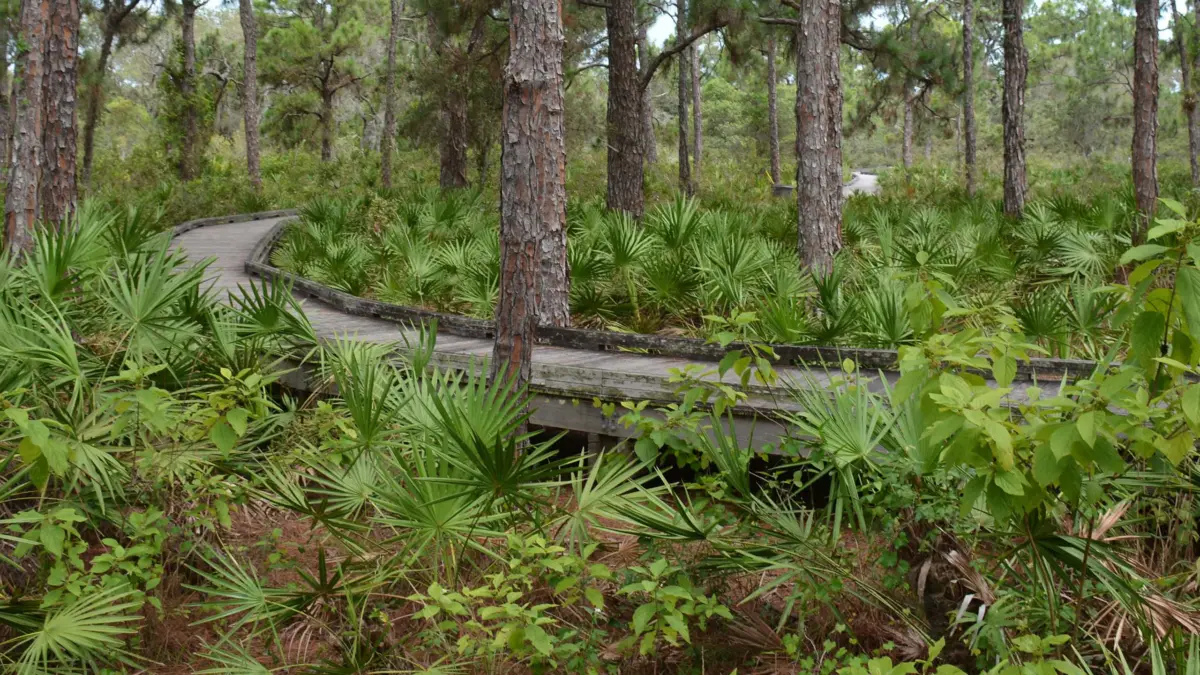
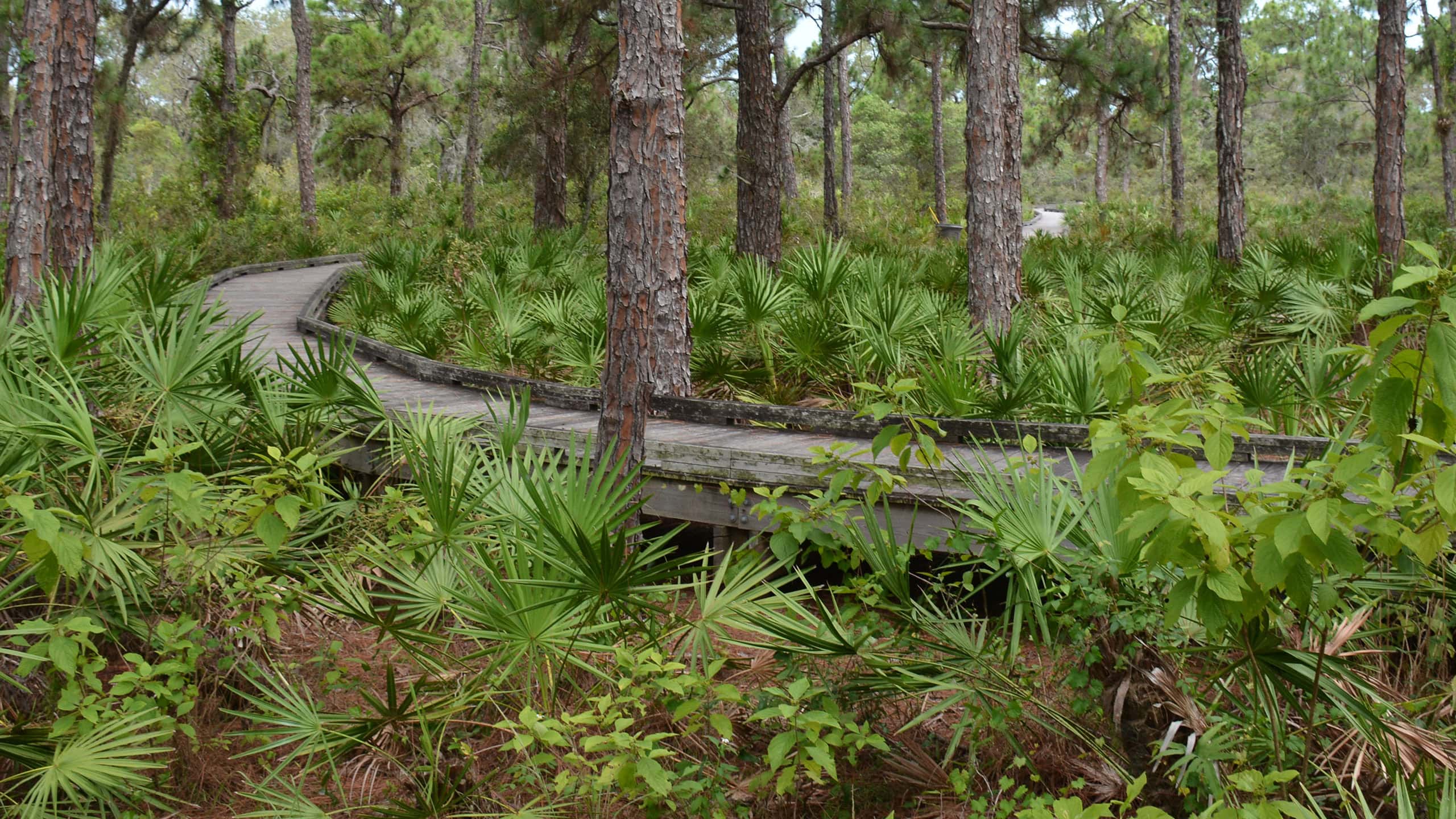
Ascending the gentle sweep of the boardwalk, hikers enter an oak hammock characterized by a dense, active understory of saw palmetto, American beautyberry, and thick grapevines. Deck 1 offers a quiet resting bench. Directly behind this deck lies the historical footprint of the fallen National Champion myrtle oak, serving as a reminder of nature’s dynamic and destructive forces.
Pine Flatwoods and Loop Junction:
At approximately 0.1 miles, the boardwalk enters the pine flatwoods, reaching a loop junction where hikers bear left past Deck 2. The elevated design of the boardwalk—hovering just inches above the forest floor—is intentional, allowing gopher tortoises and other small fauna to traverse their natural ranges without human-made obstruction. Observers should scan both the pine duff below for crawling life and the pine trunks above for woodpeckers and flickers.
Scrubby Flatwoods & Deck 3:
As the forest thins near the apex of the loop, wiregrass yields to open patches of white sand. At 0.2 miles, a short spur leads to Deck 3, the southernmost point of the loop. This scrubby flatwoods corner bursts into a vibrant display of native fall wildflowers, attracting specialized pollinators.
Return Journey:
Completing the loop at 0.3 miles, hikers turn left for the final stretch back toward the entrance. Visitors are encouraged to update the sighting whiteboard with their own wildlife encounters before descending back to the parking area at the 0.4-mile mark.
Official Statements & Ecological Stewardship
Municipal management of urban protected areas requires a delicate balance between public recreation and strict environmental preservation. The City of Naples enforces clear operational protocols to safeguard the preserve’s delicate ecology.
"The Naples Preserve serves a vital dual purpose: providing an accessible nature educational center for our community while offering an inviolable refuge for vulnerable local species trapped by rapid urban development," notes the City of Naples Parks and Recreation Department in municipal park literature. "Every square foot of this 9.5-acre parcel is actively managed to replicate natural conditions, ensuring that iconic Florida species like the gopher tortoise retain a viable urban foothold."
Because of the extreme fragility of the urban forest floor and the presence of protected wildlife, stringent regulations are enforced across the property:
No Pets: Dogs and other domestic pets are strictly prohibited to prevent the introduction of scent markers, predatory instincts, and potential harassment of ground-dwelling wildlife.
No Bicycles or Vehicles: Wheeled transport is excluded from the boardwalk and footpaths to maintain pedestrian safety and protect structural components.
Stay on the Boardwalk: Once visitors step onto the elevated boardwalk system, stepping off onto the soil or vegetation is prohibited to prevent soil compaction, damage to native root systems, and accidental disruption of tortoise burrows.
Zero Litter Policy: No food or beverages are permitted on the trail to deter invasive pests and protect native fauna from consuming harmful human refuse.
Future Outlook & Conservation Challenges
As Southwest Florida continues to experience high population growth and commercial real estate development, small-scale urban reserves face compounding pressures. The Naples Preserve, despite its robust municipal oversight, must navigate several long-term management challenges:
Habitat Fragmentation and Genetic Isolation: Being entirely surrounded by urban infrastructure, the preserve functions as an ecological island. Wildlife populations within its 9.5 acres lack natural corridors to interbreed with populations in larger regional preserves, raising long-term concerns regarding genetic diversity among resident gopher tortoises.
Climate Change and Extreme Weather: As demonstrated by Hurricane Irma, intense tropical weather events pose severe physical threats to the canopy structure, ancient specimen trees, and boardwalk infrastructure. Municipal arborists and park managers must continuously adapt mitigation strategies to protect visitors and preserve the ecological integrity of the forest.
Public Education and Invasive Species Control: Maintaining the balance between heavy public visitation—particularly families and school groups—and strict conservation requires ongoing educational outreach. Additionally, the constant threat of invasive non-native plant and animal species encroaching from surrounding urban landscaping demands rigorous, continuous monitoring by park staff.
Despite these challenges, the Naples Preserve remains a shining model of municipal conservation. By prioritizing the protection of gopher tortoises, native flatwoods, and public environmental education within the heart of a bustling city, Naples proves that urbanization and ecological stewardship can, through deliberate design, coexist.
Explore More: Nearby Adventures in Greater Naples
For travelers and nature enthusiasts looking to expand their exploration of Southwest Florida’s unique natural landscapes, the Naples region offers several world-class conservation areas and educational centers within a short driving distance:
Naples Zoo at Caribbean Gardens: Established in 1919 by pioneering botanist Henry Nehrling, this historic site has evolved over a century of expansion into a nationally accredited zoological park blending exotic wildlife with mature tropical botanical gardens.
Gordon River Greenway: Located just south of the Naples Preserve, this extensive greenway system allows visitors to hike, bike, or paddle through the city’s urban mangrove forest along the scenic Gordon River.
Fred W. Coyle Freedom Park: Situated in northeast Naples, this impressive park features an accessible network of paved pathways and boardwalks meandering across a complex mosaic of freshwater wetlands teeming with wading birds and alligators.
Conservancy of Southwest Florida Nature Center: Edging the mangrove-lined Gordon River immediately south of the Naples Zoo, this 21-acre environmental complex pairs interactive learning exhibits with nature trails and active wildlife rehabilitation facilities.







0 Comments