Nestled along the picturesque banks of the Intracoastal Waterway, Waterfront Park in Palm Coast, Florida, stands as a prime example of municipal recreational planning intersecting with sensitive coastal ecosystems. Managed by the City of Palm Coast, this linear park offers residents and visitors an accessible, multi-faceted outdoor experience that blends active recreation with quiet reflection. Featuring a 1.9-mile out-of-the-box paved trail network, the park serves as a vital anchor within the city’s broader pedestrian infrastructure, seamlessly connecting to major regional greenways such as the St. Joe Walkway and the Graham Swamp Trail system.
Designed for a wide array of outdoor enthusiasts—ranging from casual walkers and families to avid paddlers and cyclists—Waterfront Park bridges urban accessibility with natural preservation. From its vibrant recreational hub featuring a kayak launch, picnic pavilions, and a fishing pier, to the somber, reflective atmosphere of the Children’s Memorial Garden, the park provides an intimate window into Northeast Florida’s unique coastal environment. This report delivers an exhaustive look at the park’s layout, historical context, trail logistics, and its integration into the wider Palm Coast trail network.
Detailed Chronology: Navigating the Waterfront Park Trail
Trailhead to the Recreational Hub
A journey through Waterfront Park begins at the primary parking area, accessible via a scenic, winding 0.7-mile entrance road from Colbert Lane. Upon arrival, visitors are greeted by a large orientation sign detailing mileages and path networks across Palm Coast, flanked by an informative kiosk.
Setting off on the paved linear path, hikers are immediately enveloped by a coastal hammock corridor that provides dappled shade. Within moments, the trail opens into the park’s primary recreational zone. This bustling activity area features:
A kayak and paddleboard launch point complete with rental infrastructure.
Family-friendly picnic tables and shaded pavilions.
A fenced-in children’s playground.
Modern restroom facilities.
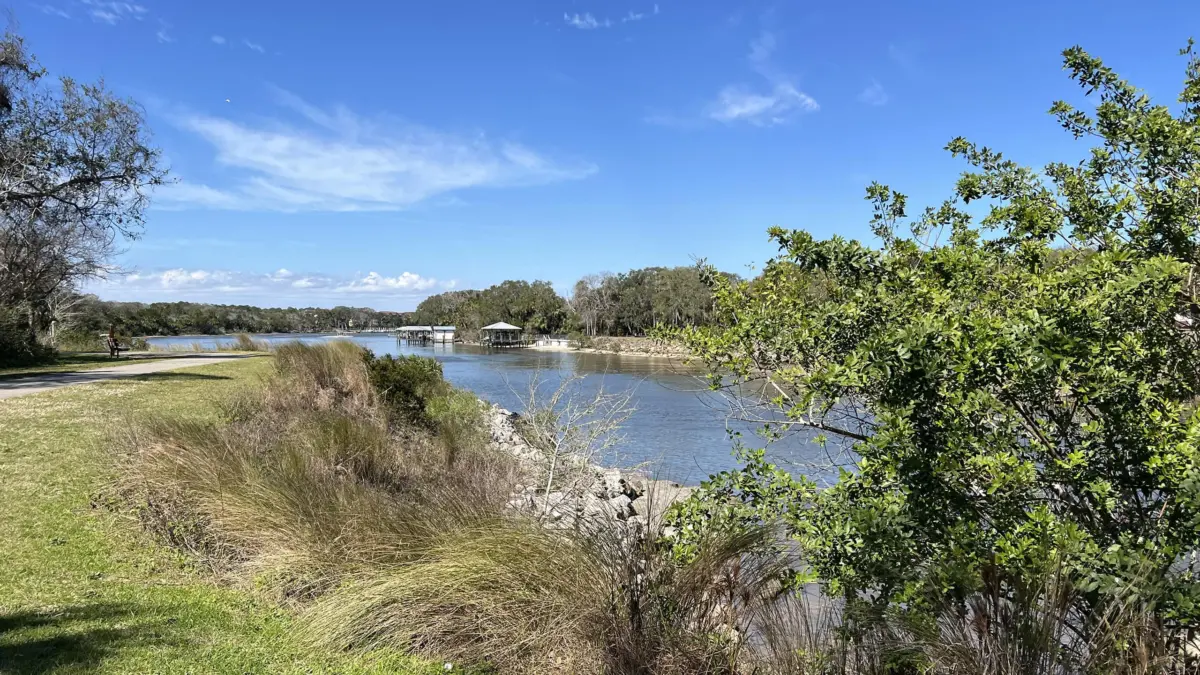
Passing these amenities, the path moves past a scenic bench overlooking a calm boat basin off the main waterway channel. Interpretive signage here educates visitors on local paddling routes and the historical evolution of the Intracoastal Waterway. Continuing forward, hikers cross a pedestrian bridge over a shallow, tea-colored tannic creek. This stream carries the natural outflow from Graham Swamp as it drains directly into the broader Intracoastal channel, creating a stunning visual contrast between the dark, organic-rich waters and the sunlit expanse of the main waterway.
North Along the Bluffs and the Children’s Memorial Garden
Beyond the creek crossing, the path navigates two sharp turns and transitions northward onto elevated bluffs overlooking the Intracoastal Waterway. Sand live oaks edge the grassy corridors bordering the paved path, offering sporadic benches set back in welcome shade, though the majority of this stretch remains exposed to full sun.
At approximately the 0.2-mile mark, trail users encounter a poignant detour: the Children’s Memorial Garden. Shaded heavily by a mature oak hammock, this tranquil sanctuary ripples with emotional resonance. Memorial benches, commemorative plaques, and delicate sculptures honor family members and children who have passed, providing a quiet space for contemplation away from the active trails.
Returning to the main path, the northbound route continues past open green spaces. Across the water, breaks in the tree line reveal tall, scraped limestone bluffs on the opposite bank—a vivid reminder that this major marine highway was historically dredged and cut through the natural topography by the U.S. Army Corps of Engineers. Gentle curves in the path mirror the contours of the shoreline, offering continuous vistas of passing boat traffic and coastal wildlife.
The St. Joe Walkway Junction and Turn-Around Options
As the path proceeds for another half mile, it gradually turns its back on the Intracoastal Waterway, curving inland into a lush hardwood hammock. A short distance later, the trail crosses a long bridge spanning an estuarine channel and the historic St. Joe Waterway canal.
At the 0.9-mile mark, visitors reach a critical decision point at the junction with the St. Joe Walkway:
Short Option (Staying Local): Visitors wishing to keep their journey strictly within the boundaries of Waterfront Park can use this bridge as their natural turn-around point, retracing their steps back along the bluffs and recreational zones for a total distance of 1.9 miles.
Extended Loop Option: For those seeking a longer trek, heading left connects to Linear Park, where the Magnolia Trail links to the Graham Swamp Trail. Paralleling Colbert Lane eastward, the Graham Swamp Trail intersects with the Waterfront Park crosswalk, completing a robust 3.7-mile paved loop. This extended route involves four road crossings, including a major crossing over Palm Coast Parkway.
Supporting Context & Metrics
Key Park Logistics and Resource Data
Location: Palm Coast, Florida
Physical Address: 150 Waterfront Park Rd, Palm Coast, FL 32137
Geographic Coordinates: 29.558801, -81.175885
Total Trail Length: 1.9 miles (standard out-and-back); expandable to a 3.7-mile loop.
Land Manager: City of Palm Coast
Operating Hours: Open daily from sunrise to sunset.
Admission Fees: Free to the public.
Amenities: Restrooms at the trailhead, picnic areas, playground, kayak launch, fishing/observation pier, and interpretive kiosks.
Pet Policy: Leashed dogs are welcome; visitors are strictly required to clean up after their pets.
Contact Number: City of Palm Coast Parks and Recreation: 386-986-2323
Ecological and Structural Highlights
The park’s infrastructure is carefully engineered to balance public access with environmental preservation. The paved pathways are designed to accommodate pedestrians, runners, and cyclists of all mobility levels while protecting the fragile root systems of the surrounding sand live oaks and coastal hammocks.
Waterfront Park also serves as a strategic wildlife viewing area. During the cooler winter months, observant visitors looking down from the park’s fishing and observation pier frequently spot West Indian manatees seeking refuge in the warmer, protected waters of the Intracoastal basin.
Official Statements & Community Impact
Local municipal officials and park planners have consistently emphasized the role of Waterfront Park as a cornerstone of Palm Coast’s non-motorized transit and recreation vision.
"Parks like Waterfront Park do more than just provide a place to exercise; they weave our community together," notes the City of Palm Coast Parks and Recreation Department. "By connecting neighborhood paths directly to regional greenways like the Graham Swamp Trail and St. Joe Walkway, we give residents safe, scenic alternatives to vehicular travel while celebrating our unique coastal heritage."
Community advocates and outdoor authors have similarly lauded the site’s versatility. Sandra Friend and John Keatley, noted authors of Florida Hikes, highlight the park’s unique ability to cater to diverse user groups:
"Whether you are looking to launch a kayak into the tea-colored creeks, pay respects in the serene Children’s Memorial Garden, or embark on a heart-pumping multi-mile neighborhood loop, Waterfront Park delivers an exceptionally well-maintained slice of Florida’s outdoors."
Future Outlook
As Palm Coast continues to experience steady residential growth and urban expansion, the preservation and enhancement of green spaces like Waterfront Park remain a top priority for city planners. Future municipal initiatives aim to further optimize non-motorized trail connectivity, improve pedestrian safety at major thoroughfare crossings—such as the Palm Coast Parkway intersection—and expand interpretive educational programming along the Intracoastal corridor.
Through ongoing maintenance, community stewardship, and thoughtful infrastructural integration, Waterfront Park is poised to remain a treasured sanctuary for recreation, ecological education, and quiet reflection for generations to come.






0 Comments