

Tucked away on the southern tip of Longboat Key, Florida, the Quick Point Nature Preserve stands as a masterclass in ecological diversity packed into a remarkably compact footprint. Spanning roughly a mile of round-trip pathways, this coastal sanctuary offers a multifaceted landscape where mangrove wetlands, tidal lagoons, upland vegetation, and sandy shorelines converge. Managed by the Town of Longboat Key, the preserve serves as an essential ecological buffer and a vital recreational asset, granting locals and travelers alike an intimate window into the fragile beauty of the Gulf Coast ecosystem.

For outdoor enthusiasts, conservationists, and casual visitors, navigating Quick Point is an exercise in sensory immersion. A carefully engineered network of paved walking paths, sandy trails, elevated boardwalks, and hidden viewing decks guides explorers past waters teeming with marine life and overhead canopies bustling with wading birds. Despite its urban proximity—flanked by bustling traffic arteries and scenic waterways—the preserve successfully shields its visitors in natural serenity. However, its coastal exposure, susceptibility to tidal fluctuations, and seasonal insect activity require mindful preparation. This report provides an authoritative, comprehensive examination of the preserve’s layout, logistical framework, ecological footprint, and recreational value.

Detailed Chronology of the Trail Experience
The journey through Quick Point Nature Preserve is a sequential unfolding of distinct coastal habitats, each marked by deliberate transitions in infrastructure and scenery.

The Gateway and Seawall Approach
The adventure begins at the southern edge of Overlook Park, situated immediately north of the New Pass Bridge. From downtown Sarasota, travelers follow John Ringling Boulevard (SR 789) west through St. Armands Circle, transitioning onto Gulf of Mexico Drive. Visitors are strongly encouraged to utilize Overlook Park for parking, though an alternative, highly limited four-vehicle parking area exists further north near the water treatment plant.

From Overlook Park, hikers make their way toward the water’s edge to encounter one of the preserve’s most defining architectural features: a sturdy wooden boardwalk designed to pass safely beneath John Ringling Parkway. This underpass shields pedestrians from highway traffic before delivering them directly onto a paved path that hugs a concrete seawall. Here, the urban environment abruptly gives way to expansive aquatic vistas. Peer into the clear, shallow waters along the seawall, and you are likely to spot darting marine life, while kayakers, paddleboarders, and larger watercraft glide across the open expanse of Sarasota Bay.

Into the Sands and the Information Kiosk
As the paved path sweeps to the right, a short wooden connector path introduces a classic three-sided wooden information kiosk, marking the formal threshold of the preserve. Beyond this point, modern paving yields to a rustic, well-worn sandy trail. This initial stretch hugs a pocket-sized sandy beach—a favored resting spot for visitors wishing to sunbathe or dip their toes in the shallows—while dense sea grapes and coastal shrubs frame the path.

Deeper into the interior, the sandy trail branches around a small vegetated island. While the wider left fork likely serves maintenance vehicles, the narrower right-hand path offers a more authentic hiking experience. Both tracks converge shortly thereafter, joined by intermittent social trails that afford sudden, unobstructed peepholes out toward the bay.

Lagoons and Avian Hotspots
As hikers push further along the coastal ribbon, a wooden boardwalk branches sharply to the right, curving directly over a striking, milky-blue lagoon. The opaque quality of the water obscures the depths, yet ripples and splashes frequently betray the bustling aquatic activity hidden below. The surrounding shorelines serve as prime staging grounds for herons, egrets, and other wading birds that stalk the shallows with calculated patience.

Rejoining the main sandy pathway, the route narrows as the native vegetation thickens. A subsequent boardwalk on the left leads visitors to an intimate pier overlooking the preserve’s natural lagoon. In stark contrast to the man-made lagoon, this natural water feature boasts darker, murkier water and a distinct biological character. Interpretive signage details the ecological function of the lagoon, while built-in wooden benches provide an ideal space for quiet contemplation.

Mangrove Tunnels and Bayside Overlooks
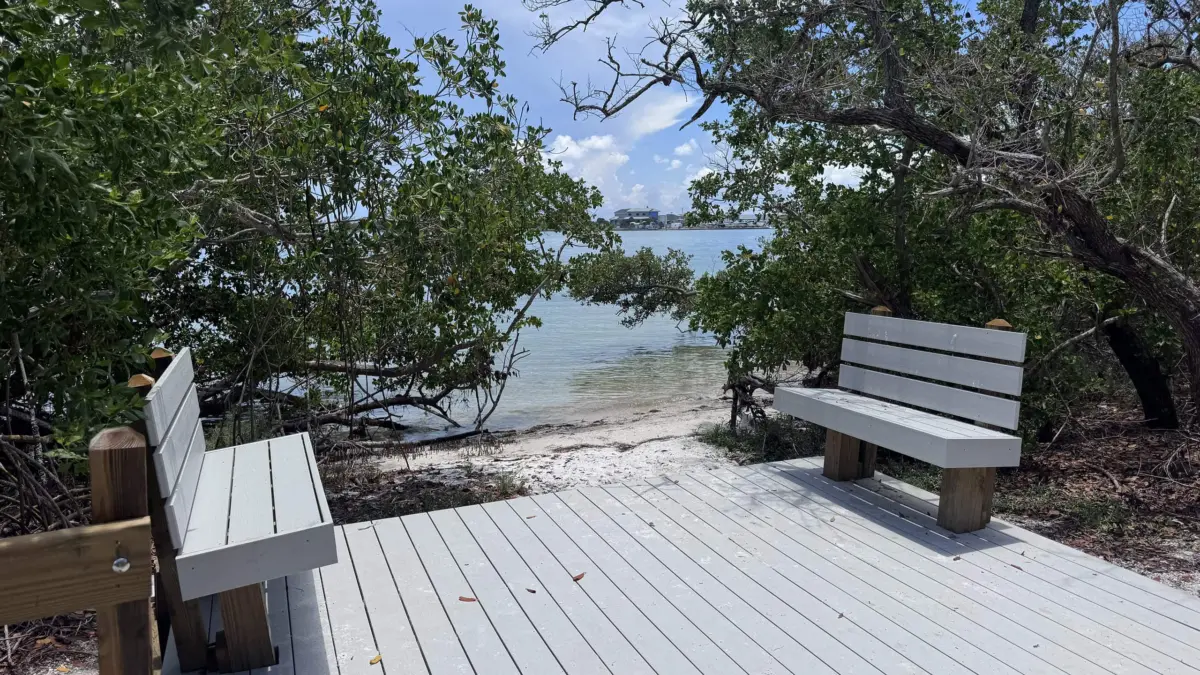
Continuing past the natural lagoon, the trail encounters a series of small wooden bridges designed to span tidal channels that may run completely dry during low tide. The route splits again near a shaded, mangrove-shaded cove, with one boardwalk looping left into a tranquil recess and another branching right toward a bayside overlook equipped with twin benches.

This extended boardwalk eventually stitches back into the sandy trail, flanked by interpretive signs explaining upland plant communities. The final leg of the trek culminates in a narrow, highly atmospheric boardwalk that tunnels straight through a dense canopy of red, black, and white mangroves. This arboreal corridor deposits hikers at the Sarasota Bay Overlook—the crown jewel of the preserve. From this vantage point, sweeping views of the bay unfold, often punctuated by large luxury vessels anchored in the distance. Having absorbed the coastal panorama, visitors retrace their steps in reverse to complete the roughly one-mile excursion.

Supporting Context & Metrics
Understanding the logistical parameters of Quick Point Nature Preserve ensures a safe, well-prepared excursion. Below is a comprehensive breakdown of the preserve’s operational metrics:

- Location: Longboat Key, Sarasota County, Florida.
- Total Trail Length: Approximately 1 mile round trip.
- Access Coordinates:
- Overlook Park Trailhead: 27.334139, -82.583111
- North Parking Area: 27.336333, -82.585250
- Physical Address: 100 Gulf of Mexico Dr, Longboat Key, FL 34228.
- Recommended Parking: Overlook Park (201 FL-789, Longboat Key). Free of charge.
- Operating Hours: Open daily from 5:00 AM to 11:00 PM.
- Admission Fees: Free to the public.
- Restroom Facilities: None available on-site.
- Pet Policy: Prohibited to protect local wildlife and nesting habitats.
- Environmental Caveats: The preserve is an exposed coastal environment offering minimal shade. It is highly susceptible to tidal fluctuations (which can submerge certain bridges or expose mudflats) and experiences heavy mosquito pressure during warmer months.
Official Statements & Management Framework
The preservation, maintenance, and public accessibility of Quick Point Nature Preserve are overseen by the Town of Longboat Key. Local municipal authorities emphasize a strict balance between public recreation and environmental stewardship.

In municipal planning documents and public land guidelines, representatives for the Town of Longboat Key stress that properties like Quick Point act as vital biological filters for Sarasota Bay. The strict prohibition of pets is a heavily enforced policy, designed to prevent domestic animals from disturbing ground-nesting shorebirds, fragile dune vegetation, and resident wildlife populations such as raccoons, rabbits, and wading birds. Furthermore, municipal maintenance crews routinely inspect the extensive boardwalk network, bridges, and informational kiosks to withstand the corrosive marine environment, ensuring safe transit for tens of thousands of annual visitors without compromising the delicate mangrove root systems below.

Future Outlook & Conservation Challenges
Looking ahead, Quick Point Nature Preserve faces a set of complex environmental and logistical challenges common to low-lying coastal sanctuaries in Southwest Florida. Chief among these is the ongoing threat of sea-level rise and increasing intensity of tropical storm systems. Because the preserve sits directly at sea level and features exposed sandy shorelines and tidal lagoons, storm surges and king tides periodically test the resilience of its wooden boardwalks and drainage structures.

Conservation advocates and local planners are increasingly focusing on climate adaptation strategies, ensuring that trail repairs incorporate more resilient, marine-grade materials capable of withstanding saltwater inundation. Additionally, educational initiatives led by regional naturalists aim to foster a deeper public appreciation for the protective functions of mangroves—nature’s frontline defense against storm erosion. As regional development continues to densify the surrounding coastal corridors of Sarasota and Longboat Key, sanctuaries like Quick Point will only grow in ecological value, serving as irreplaceable pockets of wilderness that demand vigilant protection, responsible public use, and forward-thinking municipal management.

0 Comments