

Executive Overview
The modern recreational boating landscape has undergone a profound physical and architectural transformation over the past decade. Center consoles, once topping out at modest lengths of 40 feet, have ballooned into colossal 50- and 60-foot floating powerhouses. Packed with multi-engine configurations, towering hardtops, onboard generators, gyro-stabilizers, and towering superstructures, these modern vessels offer unmatched offshore performance and luxury. However, this massive upscale in size, weight, and windage has introduced a major operational bottleneck: close-quarters handling in tight marinas.
Compounding this challenge is a shift in modern boating demographics. Today’s owners of high-end center consoles, large day boats, and precision wakesurfing vessels rarely operate with a professional crew. More often than not, the helm is manned by the owner, supported only by family members or friends who may have limited experience with line-handling, fenders, or emergency anchoring. When a skipper needs to thread a 50-foot hull into a narrow slip, pick up a downed rider, or secure an anchor line, they are traditionally anchored to the helm—unable to utilize their own eyes and hands where they are needed most on the deck.
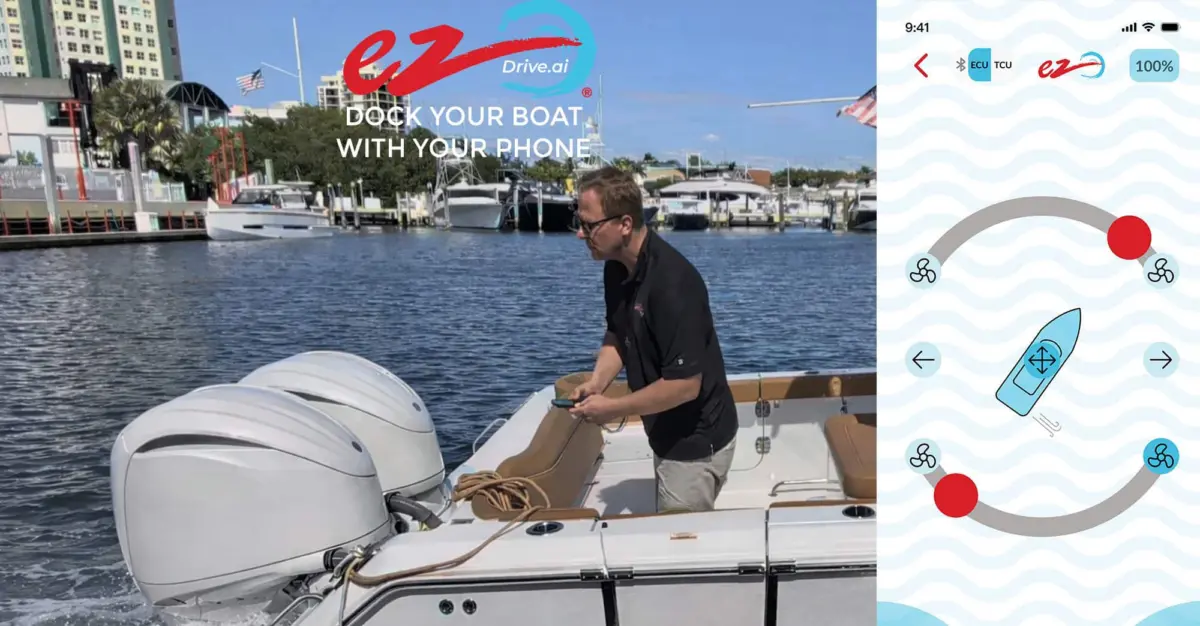
Enter ezDrive®️.ai, an innovative, wireless, app-driven ecosystem engineered to solve this exact problem. By converting an everyday smartphone into a full-fledged docking command center, ezDrive®️.ai grants skippers real-time, proportional control over their engines and thrusters from anywhere on deck. Combining advanced artificial intelligence, tactile haptic feedback, long-range Bluetooth connectivity, and a seamless plug-and-play architecture, this upcoming platform is set to redefine solo vessel handling, making marina maneuvering, trailering, and anchoring safer, smarter, and entirely stress-free.
Detailed Chronology: The Engineering Path to Smartphone-Controlled Marine Navigation
The conceptualization of ezDrive®️.ai did not happen overnight; it is the culmination of years of iterative marine electronic engineering aimed at bridging the gap between heavy, complex vessel systems and intuitive, consumer-grade user interfaces.
Phase 1: Identifying the Industry Gap
As center consoles and wake boats swelled in displacement and height, the traditional mechanical and digital tethering to the helm became a critical safety and usability liability. Marine engineers recognized that while joystick technology (such as those introduced by Yamaha, Mercury, and Suzuki) had revolutionized twin- and quad-outboard handling, the joystick itself remained physically bolted to the main helm station. If a skipper needed to step onto the gunwale to fend off a piling or manage a bow line, they had to abandon control of the engines entirely, relying on verbal cues shouted to an inexperienced deckhand.
Phase 2: Developing the Digital Architecture
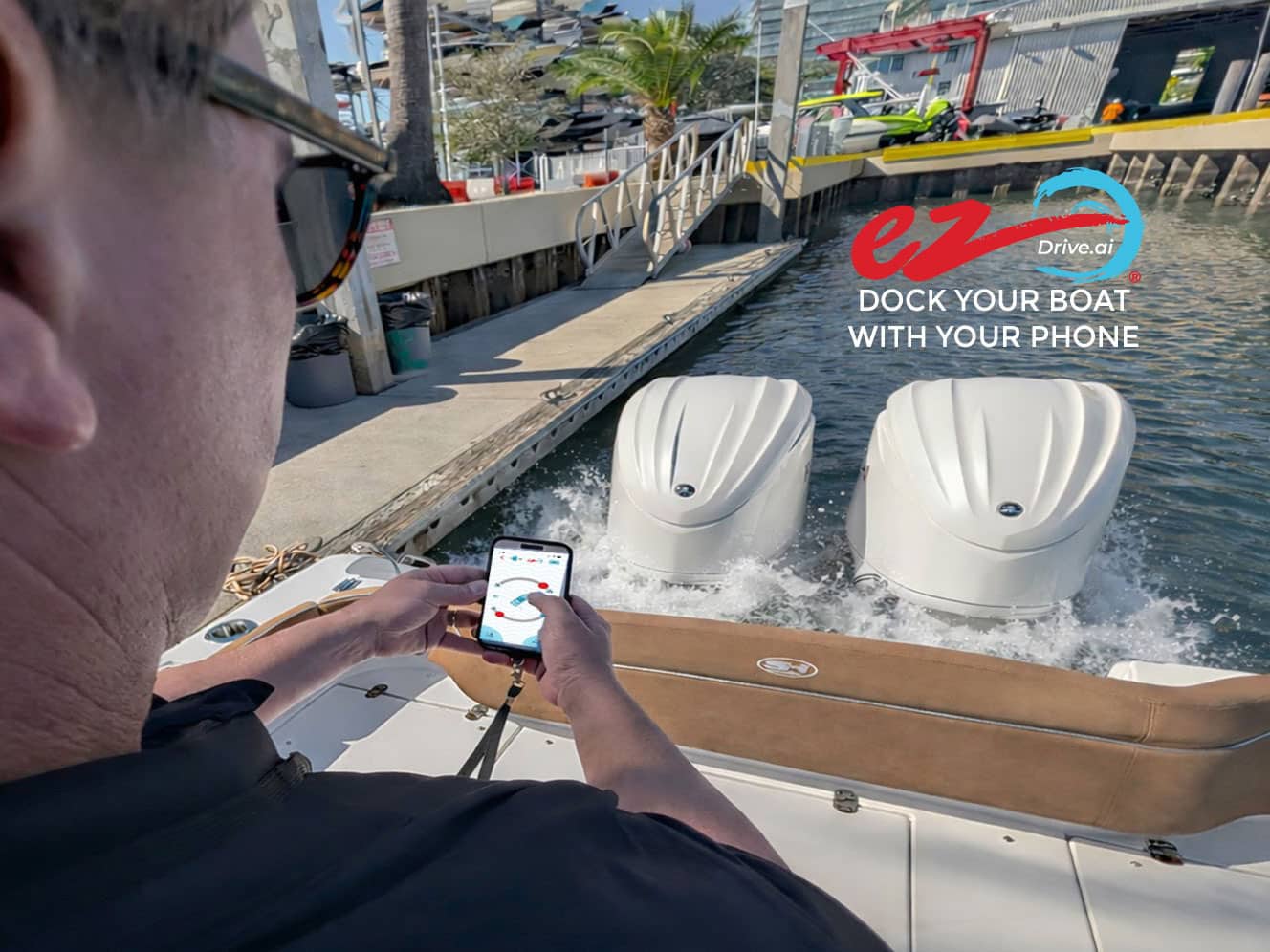
Rather than manufacturing expensive, single-purpose hardware key fobs or standalone remote-control units—which are often costly to purchase, easy to misplace, and limited in display capability—the development team behind ezDrive®️.ai looked to the most ubiquitous computing device already in the boater’s pocket: the smartphone.
The software architecture was built from the ground up to interface directly with major original equipment manufacturer (OEM) electronic control systems. Instead of bypassing vital safety protocols, engineers mapped the app’s digital inputs to mirror the exact operational parameters of factory joysticks and electronic throttles. This ensured that software commands would translate into smooth, proportional hydraulic or electric thruster and engine responses.
Phase 3: Refining Machine Learning and Adaptive AI
Recognizing that no two bodies of water—and no two boaters—are alike, the engineering team integrated a dynamic machine learning protocol. Dubbed "AI Mode," the system continuously aggregates anonymous usage and docking telemetry from registered users. This crowdsourced dataset allows the artificial intelligence algorithms to dynamically refine thrust vectors, wind-compensation profiles, and responsiveness curves over time, tailoring the app’s performance to the distinct hydrodynamic signatures of various hull configurations.
Phase 4: Commercialization and Fall Launch
Following rigorous open-water testing in diverse marine environments—ranging from choppy saltwater coastal inlets to tight freshwater slipways—ezDrive®️.ai is scheduled for an official market rollout this fall. The platform promises broad compatibility with leading outboard and stern-drive architectures, poised to disrupt the multi-thousand-dollar marine remote control aftermarket with a software-forward, highly scalable alternative.
Supporting Context & Metrics: The Physics and Practicalities of Modern Boating
To fully appreciate the utility of ezDrive®️.ai, one must examine the distinct physical realities and demographic metrics governing modern recreational vessel ownership.
The Rise of the Mega-Center Console
Over the last ten years, the average length-overall (LOA) of premium center consoles has increased by over 30%. A standard 2016 flagship vessel of 38 feet has been largely supplanted by 55-foot platforms featuring triple or quad 600-horsepower outboards. These configurations produce immense thrust potential, but they also introduce massive windage profiles due to elevated second-station towers and enclosed windshield enclosures. Crosswinds in a crowded marina can quickly turn a routine docking maneuver into a high-stakes emergency for an isolated helm operator.
The "Family Crew" Dynamic
Industry surveys indicate that upwards of 85% of center console and high-performance wake boat owners operate primarily on a recreational basis with friends and family rather than professional crew. Key metrics highlight this reality:
- Over 70% of passengers aboard recreational day boats report having little to no formal understanding of nautical knot-tying, spring lines, or fender placement.
- More than 60% of single-handed docking mishaps occur due to miscommunication between the driver locked at the helm and a helper stationed on the bow or stern.
- Trailering anxiety remains one of the most cited deterrents for new boat owners, particularly with heavy inboard wakesurf boats where backing down a slick boat ramp requires absolute precision.
Technical Specifications and Connectivity Metrics
To overcome the notoriously interference-heavy marine environment—where radar arrays, VHF radios, and fiberglass hulls disrupt standard consumer wireless signals—ezDrive®️.ai leverages extended-range Bluetooth protocols. Unlike standard consumer devices that drop connection past 30 feet, the system’s proprietary hardware receiver exploits advanced long-range Bluetooth architecture already present in modern smartphones. This establishes a robust, low-latency connection capable of maintaining absolute command integrity anywhere within a 50- to 100-foot radius of the vessel.
Official Statements and Industry Insights
The philosophy driving ezDrive®️.ai centers on empowering the skipper to be in multiple places at once without compromising safety or control.
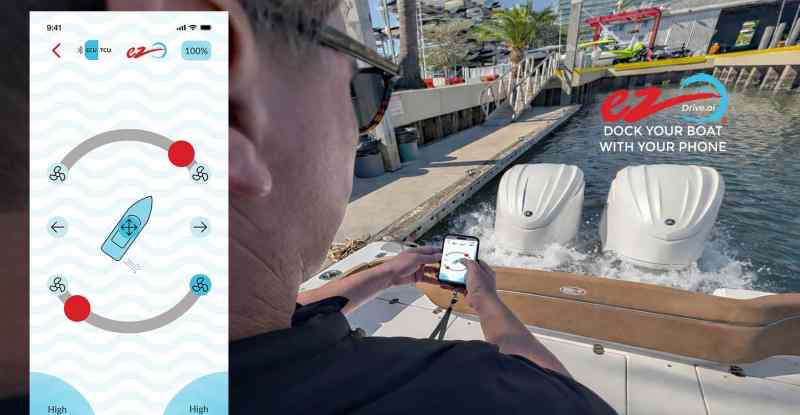
Chris Willits, Account Manager for ezDrive.ai, highlights the fundamental shift in operational dynamics that the application provides:
"Having control in the palm of your hands allows you to remain in control while you work on the bow line, drop anchor, get a line of sight on the dock, pick up a downed rider while wake surfing, and much more. If you’re in a 40- to 50-foot boat tied to the helm, it’s difficult to do certain tasks if you have an inexperienced person helping with lines. ezDrive.ai integrated into your phone has changed that dynamic. It lets you move wherever you need to and still have control while working on the trickier parts of an outing."
Willits also emphasizes the non-intrusive nature of the system’s integration, ensuring that boat owners do not have to sacrifice their vessel’s factory safeguards:
"We don’t want to disturb the user experience you’re already used to. We create an accurate model that mimics the mechanics of your OEM equipment, and we don’t bypass any features or safety protocols you use on your boat."
Addressing the economic and practical advantages over legacy hardware solutions, Willits adds:
"It’s super practical and easy to use. You don’t have to think about it. Our goal is to give center console and wakesurf boat owners a far more cost-effective solution than the traditional wireless remote-control systems typically offered in the yachting market."
Three Distinct Ways to Drive: Inside the App Interface
Recognizing that every boater has a unique preference for tactile interaction, ezDrive®️.ai avoids a rigid, single-layout menu structure, instead offering three specialized operational modes.
1. Auto Mode (True 3-Axis Joystick Simulation)
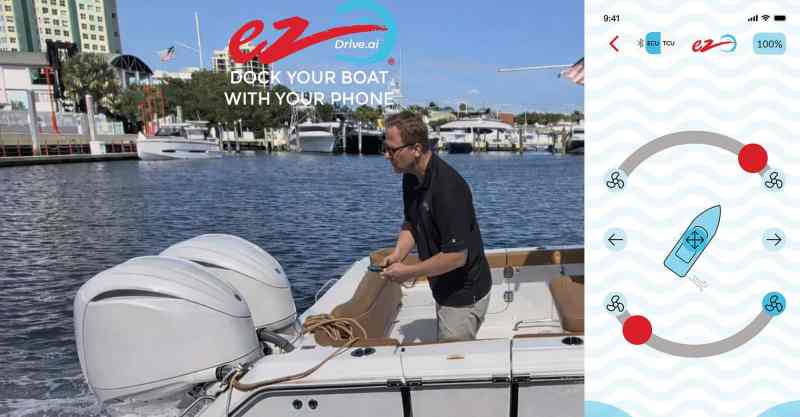
Designed for skippers accustomed to factory-installed physical joysticks, Auto Mode delivers a true 3-axis proportional control experience. It interfaces directly with digital outboards and thrusters from industry giants like Yamaha, Mercury, and Suzuki. As the user interacts with the app interface, the software delivers haptic feedback directly to the smartphone, generating subtle physical vibrations that mimic the resistance and feel of OEM hardware. This tactile confirmation ensures the operator knows precisely how much thrust is being applied without needing to glue their eyes to the screen.
2. AI Mode (Intuitive Directional Sliding)
For rapid, simplified close-quarters adjustments, AI Mode strips away complex multi-axis geometry. Instead of manipulating a virtual stick, the user simply slides their finger across the screen in the exact direction they want the hull to travel. The onboard artificial intelligence interprets the directional input and instantaneously fires the appropriate combination of bow thrusters, stern thrusters, and outboard steering angles to execute the vector smoothly.
3. Console Controller Mode (Familiar Gaming Dynamics)
Leveraging muscle memory familiar to generations of smartphone users, Console Controller Mode transforms the horizontal phone layout into a dual-thumb interface. One thumb commands a virtual joystick while the other manages directional slides. This mode is particularly favored by younger boaters and those transitioning from high-tech recreational backgrounds, providing instant familiarity.
Safety Engineered Into Every Layer
Entrusting vessel propulsion and steering to a software application running on a consumer mobile device naturally raises critical safety questions. The engineering team at ezDrive®️.ai anticipated these concerns, embedding multiple layers of hardware and software redundancy to guarantee fail-safe operation.
- Battery Threshold Protection: The app continuously monitors the host smartphone’s internal battery charge. If the battery drops below 20%, the system refuses to transfer helm control to the app, issuing early visual and audio warnings to the user well before reaching that critical threshold.
- Connection Integrity Monitoring: In the exceptionally rare event that the long-range Bluetooth connection is momentarily interrupted, the smartphone immediately initiates intense haptic pulsing and displays an unambiguous visual warning.
- Momentary Control Architecture: To prevent any possibility of a runaway vessel caused by a dropped phone or an accidental input, ezDrive.ai operates strictly on a momentary control basis. The engine and thrusters will only respond while the operator’s finger is actively engaging the screen controls. The moment contact is lost, command input ceases.
- Seamless Helm Handshake: Transferring command from the physical helm to the smartphone is handled via standard electronic handshakes identical to traditional multi-station yachts. Returning manual control to the primary helm is as effortless as gripping the physical throttles or moving the factory joystick.
Future Outlook: The Next Horizon in Marine Automation
As the marine industry continues its march toward comprehensive digitization, technologies like ezDrive®️.ai represent a crucial stepping stone between manual handling and fully autonomous docking. By utilizing the existing computational power of smartphones, the platform democratizes advanced vessel control, eliminating the need for expensive, dedicated proprietary remotes that often cost thousands of dollars to install and maintain.
The upcoming fall launch will introduce extensive integration support for a rapidly expanding roster of outboard and inboard propulsion systems. For the modern boater navigating crowded marinas, tight residential canals, and bustling fuel docks, ezDrive®️.ai transforms a potentially stressful group project into a streamlined, confident, one-person operation.
To learn more about compatibility, explore supported propulsion systems, and prepare for the upcoming fall release, visit the official platform portal at ezdrive.ai.

0 Comments