
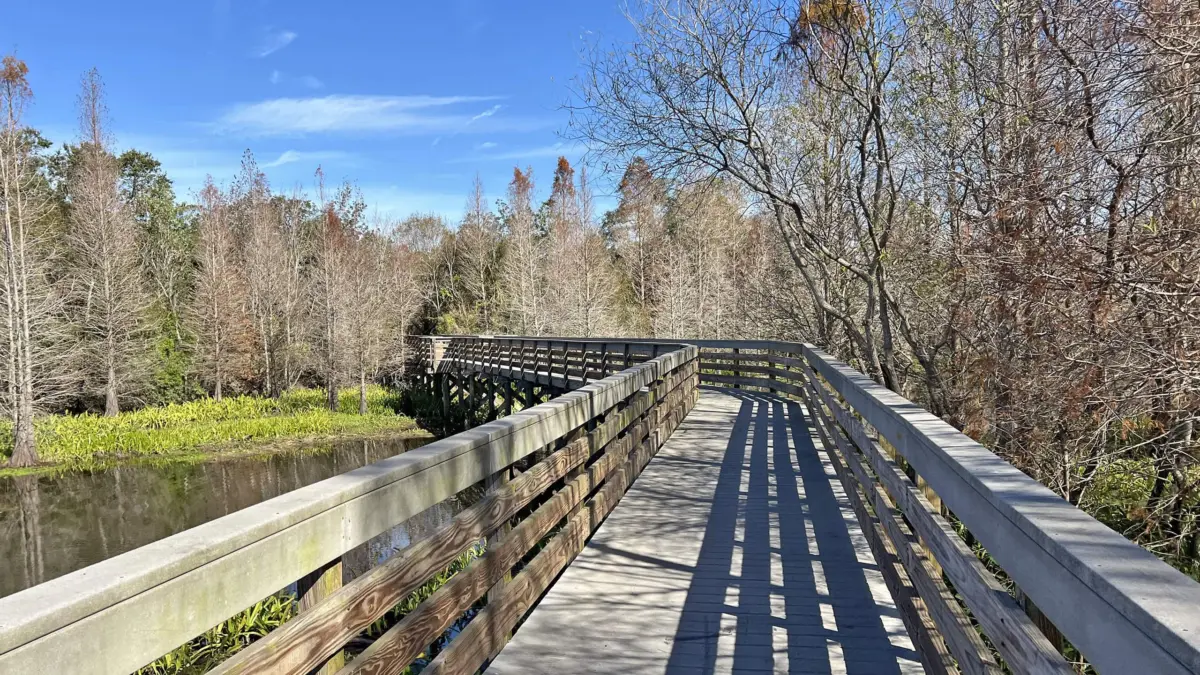

CLEARWATER, Fla. — Urban environmental restoration rarely unfolds with the seamless grace of a textbook, yet the Alligator Creek basin at Kapok Park stands as a compelling exception to the rule. For years, this vital waterway struggled against the pressures of high-density development, suffering the indignity of channelized banks, concrete stabilization, and the ecological degradation typical of Florida’s urban corridors.
Today, however, a quiet transformation has taken root. Through a multi-phase restoration spearheaded by the City of Clearwater, this 1.1-mile outdoor sanctuary has blossomed into a thriving wildlife haven. Where concrete and invasive species once dominated, native cypress sloughs now line the banks, wading birds forage quietly along marshy fringes, and an intricate network of accessible pathways invites the public to witness firsthand the resilience of a rewilded urban ecosystem.
Executive Overview
Kapok Park represents a masterclass in urban conservation, bridging the gap between municipal recreational infrastructure and sensitive habitat restoration. Centered along a vital stretch of the Alligator Creek basin, the park functions not only as an essential node on the regional Ream Wilson Trail network, but also as an environmental buffer that improves stormwater management and water quality.
Quick Facts & Site Metrics
- Location: Clearwater, Florida (Pinellas County)
- Trail Length: 1.1 miles (loop configuration)
- Designation & Land Manager: City of Clearwater Parks and Recreation Department
- Operating Hours: Sunrise to sunset daily
- Fees: Free admission to the public
- Amenities: Restrooms at the trailhead, paved multi-use paths, elevated boardwalks, observation decks, and bicycle connectivity via the Ream Wilson Trail.
- Pet Policy: Leashed dogs are welcome (municipal cleanup policies strictly enforced).
Detailed Chronology: Navigating the Kapok Park Loop
Exploring Kapok Park requires a gentle navigation of both manicured urban parklands and ruggedly restored wetlands. Because the site is seamlessly integrated into the broader regional trail grid, visitors have multiple access points from which to begin their journey.

Phase 1: The Approach via Cliff Stephens Park
Most outdoor enthusiasts begin their excursion from the adjoining Cliff Stephens Park, utilizing the disc golf parking area off Fairwood Avenue. Upon entering from this western flank, an informational trailhead map clearly outlines the route toward Kapok Park, orienting first-time visitors to the multi-use path system.
The journey starts on a broad, smooth asphalt pathway flanked by a manicured recreational green space. Here, the trail cuts beneath a magnificent canopy of ancient, moss-draped live oaks (Quercus virginiana). These centuries-old sentinels provide deep shade and set a tranquil tone for the walk.

As the path pushes eastward, the initial glimpses of Alligator Creek emerge through the roadside vegetation. At first glance, this upstream section reflects its historic human alterations: a wide, deep drainage ditch flanked by steep banks, with residential condominiums rising starkly on the opposite bluff. It is a visual reminder of the heavy engineering historically imposed on Florida’s urban waterways.
[Cliff Stephens Park Trailhead]
       │
       ▼ (Paved path under Live Oaks)
[Alligator Creek Urban Ditch Section]
       │
       ▼ (Right turn across pedestrian bridge)
[Boardwalk & Cypress Basin Restoration]
       │
       ▼ (Observation Deck - Wildlife Haven)
[Wetland Restoration Loop & Former Trailer Park Site]
       │
       ▼ (Return via Ream Wilson Connector)
[Completion at Cliff Stephens Park (1.1 Miles Total)]
Phase 2: Crossing the Creek and Entering the Wild
A pivotal moment on the trail occurs at the first major junction, where visitors make a right turn to cross a pedestrian bridge spanning Alligator Creek. Descending to this lower perspective immediately shifts the visitor’s perception of the basin. From the bridge, the waterway feels less like an artificial ditch and more like a recovering natural slough.

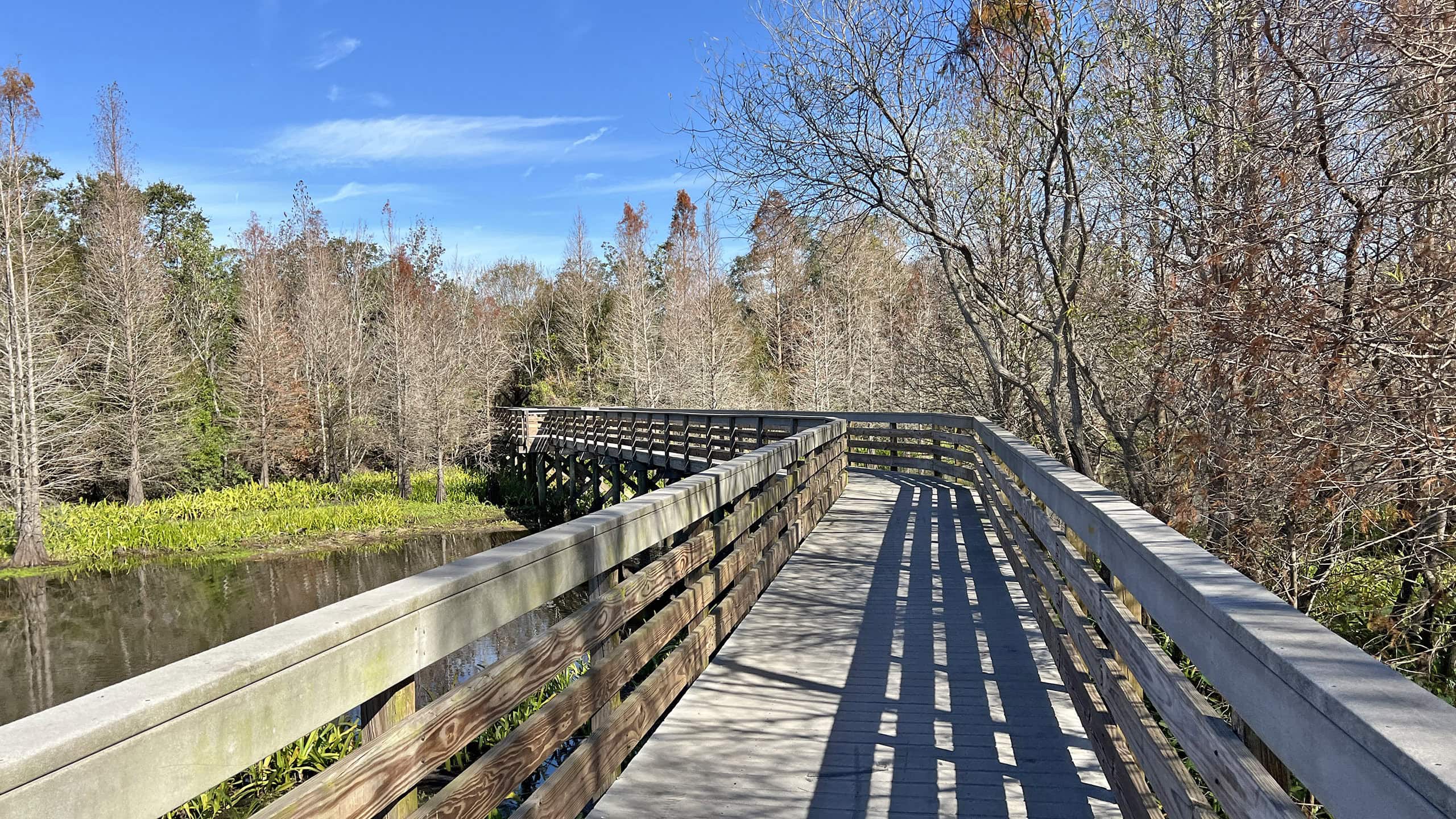
Paralleling the northern bank on a paved path, hikers soon encounter a crucial junction at the 0.4-mile mark. Here, the route diverges from the main artery of the Ream Wilson Trail, transitioning onto a dedicated wooden boardwalk that plunges deeper into the newly restored ecosystem.
Phase 3: The Observation Deck & Avian Abundance
A long spur boardwalk extends gracefully over the water, terminating at a spacious observation deck that overlooks a wide, curving bend of Alligator Creek. The ecological contrast between this protected basin and the upstream channelized sections is nothing short of striking.

Where concrete and mowed lawns once met the water, the shores are now lined with dense stands of planted bald cypress (Taxodium distichum). Their characteristic "knees" break the surface of the dark, tannic water, while floating rafts of native aquatic lilies drift lazily across the current. This micro-habitat has quickly become a magnet for coastal and wading birds. Visitors standing quietly on the observation deck are routinely treated to the sight of great blue herons (Ardea herodias), snowy egrets (Egretta thula), and tri-colored herons stalking prey along the marshy margins.
Phase 4: Traversing the Wetland & Historic Footprint
Returning to the primary boardwalk loop, the trail weaves through an increasingly diverse botanical community. Red maples (Acer rubrum), sweetgum trees (Liquidambar styraciflua), and wax myrtles (Myrica cerifera) create a rich multi-layered canopy that frames the watercourses.

The boardwalk eventually terminates at a wide grassy clearing canopied by massive live oaks. Local history buffs may find this open space particularly interesting: it marks the former location of a historic trailer park that once occupied the floodplain. Recognizing the ecological vulnerability of developing directly within a creek basin, municipal leaders prioritized the acquisition and clearing of the parcel, allowing the land to return to its natural function as a water-holding basin and wildlife corridor.
From this grassy clearing, a paved pathway resumes, carrying visitors across a secondary canal shaded by dense overhead boughs. Another short boardwalk segment leads hikers directly through a restored cypress dome—a classic Florida depression wetland where stunted cypress trees cluster around the deepest holding water.

Phase 5: Completing the Circuit
At approximately the 0.7-mile mark, the paved path reaches a minor "Y" junction. A right turn leads outward within 0.2 miles to the official Glen Oak Avenue trailhead, while bearing left completes the continuous loop through Kapok Park proper.
This final leg of the journey features strategically placed wooden benches overlooking quiet stretches of the creek, offering peaceful spots for quiet reflection or birdwatching. Merging back with the initial bridge junction near the condominiums, hikers retrace their steps through the live oak canopy, completing the 1.1-mile loop back at Cliff Stephens Park.

Supporting Context & Logistical Metrics
For those planning an excursion to Kapok Park, understanding the regional transit and geographical context is crucial for a smooth visit.
Alternative Trailheads & Parking Options
Because Kapok Park serves as a critical connective hub, parking congestion can occasionally occur at the primary Cliff Stephens Park disc golf lot, particularly on weekends. Fortunately, multiple access points accommodate visitors:

- Cliff Stephens Park (Primary Access): Located off Fairwood Ave (Address: 919 Fairwood Ave, Clearwater). Features restrooms at the trailhead and immediate access to the Ream Wilson Trail system.
- Official Kapok Park Trailhead: Situated at 2950 Glen Oak Ave N, Clearwater, nestled quietly within a residential subdivision west of the busy McMullen-Booth Road corridor.
- Eddie C. Moore Park Complex: Located further south off Drew Street (Complexes 5-7). Visitors can park here and walk northward along the paved Ream Wilson Trail connector, adding a pleasant linear extension to their hike.
Navigational Directions
- From State Road 60 (Courtney Campbell Causeway): Head north on McMullen-Booth Road for approximately half a mile. Take a left from the leftmost lane at Drew Street, travel one mile to Fairwood Avenue, drive 0.6 miles, and turn into the parking area on the right immediately before the railroad tracks.
- Alternative Glen Oak Approach: From McMullen-Booth Road, travel north past Drew Street to Terrace View Lane (0.4 miles north of the light), turn west, and proceed to the dead end at Glen Oak Avenue North.
Official Statements & Environmental Significance
While municipal parks in dense pinellas county are frequently designed purely for active recreation—such as ballfields, tennis courts, and playgrounds—Kapok Park represents a philosophical shift toward passive conservation and ecological restoration.
City officials and landscape architects point to the Alligator Creek restoration as a vital component of Tampa Bay’s broader watershed recovery efforts. By removing impervious surfaces, stabilizing banks with native vegetation, and constructing expansive wetland boardwalks, the City of Clearwater has successfully re-established natural hydrological functions.

"When you stand on the observation deck and look at the cypress-lined shores, it’s hard to believe this was once a heavily altered, degraded drainage ditch," noted environmental field researchers Sandra Friend and John Keatley during recent explorations of the site. "The speed with which native wading birds and aquatic flora have reclaimed this basin demonstrates that if you give nature the room to heal, it will return with remarkable force."
Furthermore, the integration of Kapok Park into the Ream Wilson Clearwater Trail—a paved multi-use trail stretching nearly 15 miles from Howard Park on the Gulf coast to the Courtney Campbell Causeway on Tampa Bay—highlights the importance of combining alternative transportation corridors with ecological preserves. Commuters and recreational cyclists now share space with birdwatchers and families, fostering a widespread community appreciation for local conservation initiatives.

Future Outlook and Regional Impact
As urban density continues to surge across Pinellas County, the preservation and active restoration of green spaces like Kapok Park transition from being mere aesthetic amenities to essential urban infrastructure.
Future municipal planning along the Alligator Creek watershed focuses heavily on expanding these restoration successes further upstream and downstream. By improving stormwater retention, mitigating urban heat island effects, and expanding continuous wildlife corridors, Clearwater is setting a benchmark for sustainable coastal city planning.

For visitors, Kapok Park offers a rare window into old Florida beauty without requiring a trek deep into the rural interior. It stands as a testament to what can be achieved when urban planning, ecological science, and public accessibility intersect in harmony.
Recommended Resources & Further Exploration
To dive deeper into Florida’s diverse natural landscapes, consider exploring these essential regional guides:

- The Hikers Guide to the Sunshine State by Sandra Friend and John Keatley
- 50 Hikes in Central Florida
- Paddlers Guide to Florida
Nearby Adventures Worth Visiting
- Moccasin Lake Nature Park: A protected sanctuary featuring native habitats, educational centers, and shady forest trails in the heart of Clearwater.
- Safety Harbor Waterfront Park: Offers a coastal boardwalk through a thriving mangrove forest along the eastern terminus of the Ream Wilson Trail on Tampa Bay.
- Fred Marquis Pinellas Trail: A world-class 38-mile paved greenway stretching from St. Petersburg to Tarpon Springs.
- Gladys E. Douglas Preserve: Home to rare scrub communities and the last known rosemary bald habitat in Pinellas County.
For more information on park amenities, rules, and community events, visit the City of Clearwater Parks and Recreation Official Website.

0 Comments